How to dry flowers comes down to this: cut them just before they are fully open, strip the leaves, tie small bunches and hang them upside down in a warm, dark, dry, ventilated place. Missouri and Iowa State extension both say that takes 2 to 3 weeks, and Nebraska says 3 to 5. Full blooms like roses and zinnias dry better in silica gel, and flat ones like pansies press well. If you grow your own, succession planting keeps cut flowers coming all season.
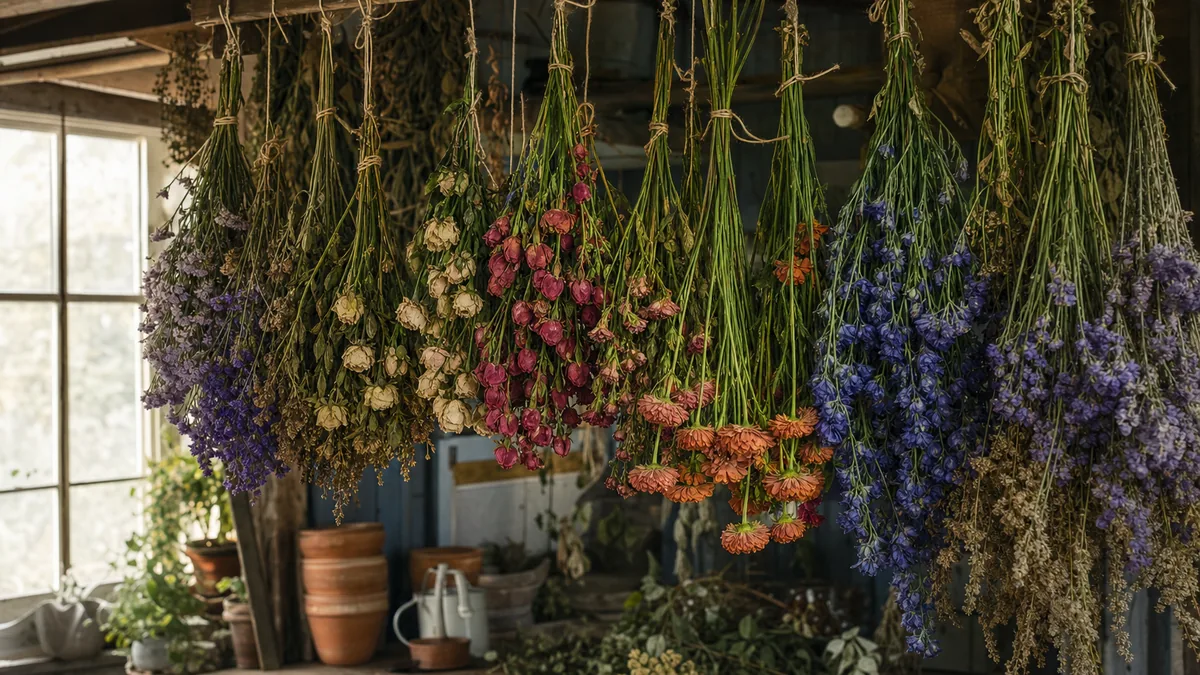
How to Dry Flowers: Quick Facts
Extension guides agree on the basics and differ on times, so the table gives ranges and names the source for each.
| What | Answer | Source |
|---|---|---|
| Where to hang | Warm, dark, dry, well ventilated, out of direct sun | Missouri, Clemson, Nebraska |
| Air drying time | 2 to 3 weeks in most guides, 3 to 5 weeks in Nebraska, up to 2 months or more when cool and humid | Missouri, Iowa State, Nebraska, Delaware State |
| Silica gel | About 1 to 8 days, depending on how thick the flower is | Missouri, Iowa State |
| Borax and cornmeal | About 10 days to 3 weeks | Clemson, Iowa State, Missouri, Nebraska |
| Microwave with silica gel | About 1 to 3 minutes, then 12 to 24 hours resting in the gel | Missouri |
| Pressing | Between paper, weighted. No guide gives one total time, so check after a day and again after a week | Delaware State, Missouri |
| Poor candidates | Poppies and other petal-shedders | Missouri |
How to Dry Fresh Flowers: When and How to Pick
Good drying starts in the garden. Missouri Extension says to pick flowers in prime condition or slightly immature, because they keep opening as they dry, and to avoid stems wet with dew or rain. Iowa State adds that a flower is a good candidate if it is not fleshy and does not start wilting right after it is picked. Cut more than you think you need, since Missouri and Nebraska both warn that some blooms get damaged along the way, and put the stems in water while you gather.
The right stage depends on the flower. Iowa State Extension’s guide to everlasting flowers gives these:
- Larkspur: when half of the flowers on the spike are open.
- German statice: when all the tiny lavender flowers are open. The petals drop as it dries, leaving the white calyces.
- Annual statice: when all the cup-like calyces are open. The petals wither and the calyces stay.
- Strawflower: when the outer bracts are open but the center is still closed.
- Yarrow and cockscomb: at peak color, with yarrow heads firm.
- Bells-of-Ireland: when the green cups are fully open. Iowa State says they fade to cream or tan.
Delaware State’s extension fact sheet gives the general rule: cut before full maturity, while color is at its peak and before it starts to fade, on a sunny day after the dew has dried.
How to Air Dry Flowers by Hanging Them
Hanging is the simplest way to dry out flowers, and it costs nothing. It suits everlasting types, the ones that hold their shape as they lose water. Missouri Extension lists acroclinium, baby’s breath, bachelor’s button, bells of Ireland, cockscomb, globe amaranth, larkspur, sea lavender, statice and yarrow. Nebraska Extension adds hydrangea, astilbe, bee balm and lavender, and Clemson adds celosia and goldenrod.
- Strip the foliage. Iowa State and Missouri both say to remove the leaves.
- Make small bunches. Tie stems with a rubber band. Missouri uses a rubber band and notes that the bunch tightens as the stems shrink.
- Hang upside down. Iowa State says hanging keeps the stems straight. Nebraska wraps the rubber band around the stem ends and loops the last turn over a hanger.
- Pick a warm, dark, dry spot. Missouri suggests an attic, closet or furnace room, and Iowa State an attic or shed. Avoid damp rooms and direct sun, and keep air moving.
- Test for dryness. Delaware State says the material is ready when it is stiff and the stems snap easily.
Two exceptions are worth knowing. Missouri says to hang large blooms such as peony and hydrangea individually, not in bunches. Strawflowers are wired on 22-gauge wire before drying, according to Iowa State, or dried as heads alone on a screen or in an open box, according to Nebraska.
How to dry statice
Statice is one of the easiest flowers to dry, and every source we read lists it. Clemson, Missouri, Nebraska and Iowa State all include statice among the flowers for hanging. Cut it at the stage in the list above, strip the leaves, tie small bunches and hang them. Iowa State says to expect 2 to 3 weeks. Missouri also lists statice among plants that can be glycerinized, a method covered later.
How Long Does It Take for Flowers to Dry?
It depends on the method, the flower and your room. The ranges below come straight from the guides, and where they disagree the table shows both.
| Method | Time | Source |
|---|---|---|
| Hanging | 2 to 3 weeks | Missouri, Iowa State |
| Hanging, Nebraska | 3 to 5 weeks | Nebraska Extension |
| Hanging, by climate | Check after 2 weeks if hot and dry. Cool and humid can take 2 months or more | Delaware State |
| Borax and cornmeal | About 10 days (2 parts borax to 1 cornmeal), 1 to 2 weeks, 2 to 3 weeks, or 1 to 3 weeks | Clemson, Iowa State, Missouri, Nebraska |
| Silica gel | 3 to 8 days typical, 1 to 5 days for the flowers in Missouri’s table | Iowa State, Missouri |
| Microwave and silica gel | 1 to 3 minutes (Missouri), 1 to 6 or 7 minutes (Nebraska), plus resting time | Missouri, Nebraska |
The practical answer to how long it takes for flowers to dry is to go by feel, not the calendar. Humid weather slows hanging, and Delaware State is the only source to say how much.
How to Dry Flowers in Silica Gel or Borax
Missouri Extension says desiccants are best for flowers that are high in moisture, or flat and open ones that can get misshapen when hung. They keep color and shape better than air drying. Silica gel is the one all the sources recommend: Missouri calls it the most satisfactory for home use, and Iowa State calls it probably the best, though rather expensive. It costs more upfront but is reusable for years and dries faster.
Which mix? The cheap alternative is borax with white cornmeal, and the sources do not agree on the ratio. Clemson uses 2 parts borax to 1 part cornmeal, Iowa State and Missouri use equal parts, and Nebraska uses 1 part borax to 3 parts cornmeal. Missouri says ratios from 1:1 to 1:6 have given similar results. Borax with fine sand also works, but Missouri warns that sand is heavy and can flatten flowers.
- Prepare the flowers. Pick them dry and undamaged. Nebraska cuts stems to about 1 inch and replaces them with florist’s wire afterward. Missouri uses 20 to 24 gauge wire, with a hooked wire for soft-centered flowers such as daisies, marigolds and zinnias.
- Layer the desiccant. Put 1 to 2 inches in the bottom of a container (Missouri) and set flowers face up. Iowa State says to use one kind of flower per box.
- Cover gently. Sift the desiccant between the petals and tap the container to settle it. Clemson finishes with about 1 inch over the top of the flower, and Iowa State warns that more than an inch may distort the shape.
- Seal or leave open as the mix requires. Silica gel needs a shallow airtight container, since moisture slows drying. Borax and cornmeal go in an open box, because Iowa State says air is needed.
- Check and remove. Flowers are done when dry but not brittle. Missouri says removing them too early causes drooping and too late causes brittleness. Pour off the desiccant and brush the dust away with a soft brush.
Missouri Extension lists silica gel times for named flowers, which is the most useful table we found: yarrow 1 day, daylily 1 day, daisy 2 days, Queen Anne’s lace 2 days, sunflower 2 days, tulip 2 days, rose 2 to 3 days, zinnia 2 to 3 days, marigold 3 to 4 days and hyacinth 4 to 5 days. Missouri also says dark reds, purples and blues may look nearly black, and whites turn cream or tan.
To reuse silica gel, blue crystals are dry and pink ones need re-drying. The guides give different oven settings: 250°F for about 1 hour (Missouri), 250°F for 1 to 2 hours (Delaware State), 250 to 300°F for about an hour (Iowa State) and 225°F for several hours (Nebraska). Marigolds and zinnias, which suit this method, are easy to grow from seed, as in our guide on planting marigold seeds.
How to Dry Tulips, Daffodils and Lilies
Bulb flowers are the ones people ask about most, and the extension sources are thinner than you might expect. Here is what they do and do not say.
- Tulips: none of the guides lists tulips for hanging. Missouri lists tulip in its silica gel table at 2 days, and Clemson lists tulip among the flowers it dried in the microwave. So the supported route is a desiccant, not air drying.
- Daffodils: Iowa State’s 1996 article lists daffodil as suitable for drying, Missouri gives 2 to 3 days in silica gel, Clemson lists daffodil for microwave drying, and Missouri includes daffodil in its pressing list.
- Lilies: we found no extension guide that dries a fresh lily bloom. Missouri lists lily only among seed heads suitable for air drying, meaning the pods after the flower is gone. Missouri’s silica gel table and Iowa State’s 1996 article both list lily-of-the-valley, which is a different plant. If you want to try a lily flower, treat it as an experiment.
Thick petals are the problem. Clemson says thick-petaled flowers such as magnolia and hyacinth do not dry well in a microwave, though Missouri’s table does give hyacinth 4 to 5 days in silica gel, and that is the longest time on its list, which fits the idea that thick blooms take longer. Iowa State’s rule that a good candidate is not fleshy and does not wilt right after picking may also be why tulips are missing from the hanging lists.
How to Dry Flowers Flat by Pressing
Pressing suits flat, thin-petaled flowers. Missouri says pansies press best, and advises avoiding fleshy stems and leaves, very thin petals and wilted material. Clemson lists violets, pansies, larkspur and ferns. Missouri’s list of 38 pressable flowers includes daisy, cosmos, marigold, zinnia, rose, daffodil, verbena and sweet pea.
- Layer. Sandwich flowers between plain, nonglossy paper such as newspaper or old phone books, with facial tissues to pull out moisture. Delaware State warns against colored or shiny catalog pages.
- Stack and weight. Stack several layers with boards top and bottom and weigh the pile down in a warm, dry place. Delaware State says a brick works.
- Check early. Delaware State says to look at the material after one day.
- Change the paper. After the first week, Missouri says to replace the tissues and paper with fresh, dry ones.
- Date the stack. Missouri suggests writing the date on each stack to track drying time.
Missouri also says faster drying preserves color but too much heat causes browning. No guide gives a single total time, which is why checking is the method.
How to Dry Flowers in the Microwave
The microwave is the quick option, and it needs silica gel. Missouri Extension says to bury flowers in silica gel in an uncovered, heat-tolerant glass or microwave container, with a cup of water in the oven. Allow about 1 minute for small or thin-petaled flowers and up to about 3 minutes for dense ones, checking often, since ovens and flowers vary. Nebraska allows 1 to 6 or 7 minutes, so start low.
Afterward, leave the flowers in the gel to finish. Missouri says 12 to 24 hours, Nebraska says 10 to 36 hours and Clemson says about 24 hours with a slightly cracked lid. Clemson lists these as microwave-dried successfully: gerbera, chrysanthemum, cosmos, daffodil, delphinium, larkspur, rose, tulip and zinnia. Missouri adds that microwave drying does not work well for thick petals, and suggests a spray of hair spray or lacquer before storing in an airtight container.
How to Dry Wildflowers, Daisies and Queen Anne’s Lace
Wildflowers are a good place to experiment, since you can cut more than you need. Nebraska Extension lists milkweed, thistle, Queen Anne’s lace, teasel, dock, goldenrod, Indian grass and cattails for air drying. Missouri puts Queen Anne’s lace, milkweed, mullein, teasel and dock under seed heads, which dry well on the stem. For desiccant drying Nebraska names blanket flower, Maximilian sunflower and black-eyed Susan.
- Queen Anne’s lace: hang it (Nebraska, Missouri), or use silica gel at 2 days (Missouri), or press it (Missouri).
- Daisies: Missouri gives 2 days in silica gel, with a hooked wire for soft-centered flowers like daisies. Nebraska lists painted daisy for desiccants, and Missouri’s pressing list includes daisy.
- Goldenrod: hang it, per Clemson and Nebraska.
- Black-eyed Susan: silica gel, 2 days (Missouri).
Only pick wildflowers where it is allowed, and leave plenty to set seed. Missouri warns that petal-shedders such as poppies are unsuitable.
How to Dry Pussy Willow, Cherry Blossom Branches and Mimosa
Pussy willow. Clemson HGIC lists pussy willow among the plants for air drying, which is the only extension mention we found. Hang the stems as you would any bunch, in a dry place with good air.
Cherry blossom branches and mimosa. We could not find extension or government guidance for drying either, so we will not invent steps. What the sources do cover is glycerin, which preserves foliage and branches. Clemson uses 1 part glycerin to 2 parts water, kept warm, in a solution about 6 inches deep, with branches no longer than 18 inches and the stem ends crushed. Missouri uses the same 1 to 2 ratio, 4 to 5 inches deep, and says 1 to 3 weeks for most branches. Clemson says leaves turn golden brown over 2 to 3 weeks. Missouri lists crabapple, flowering quince, spirea and statice among plants to glycerinize, but no source we read mentions cherry or mimosa, so expect to experiment.
Grow a Cutting Garden for Drying
Dried flowers are cheapest when you grow them. Statice, larkspur, zinnias, marigolds and strawflowers all appear above, and most are annuals you sow each year. The same Missouri advice to cut more than you need means planting a bit extra. Use succession planting to spread the harvest, and check our companion planting chart before you mix flowers in with vegetables.
Timing comes from your frost dates, and our soil temperature guide covers when each seed can go in. Use the frost date pages and the planting calendar to find your window. For the layout, the plant spacing pages show how much room each flower needs, and our spacing and planting hub collects the rest of the series.
Storing dried flowers
Missouri Extension says tightly sealed containers prevent insect damage from museum beetles, silverfish and roaches, and to check boxes now and then and destroy infested material. It also says dried flowers fade over time, so replace them yearly if you can.
Free book · 23 pages, PDF
How to Dry Flowers FAQ
How long does it take for flowers to dry?
Hanging takes 2 to 3 weeks according to Missouri and Iowa State Extension, and 3 to 5 weeks according to Nebraska. Delaware State says cool, humid rooms can take 2 months or more. Silica gel takes about 1 to 8 days depending on the flower, and borax with cornmeal takes roughly 10 days to 3 weeks.
How do you air dry flowers?
Strip the leaves, tie small bunches with a rubber band and hang them upside down in a warm, dark, dry, ventilated place. Missouri Extension recommends an attic, closet or furnace room, and says to avoid damp rooms and direct sun. Delaware State says they are done when the stems snap easily.
How do you dry tulips?
Use a desiccant. Missouri Extension lists tulip at 2 days in silica gel, and Clemson HGIC lists tulip among flowers it dried in the microwave. None of the extension guides we read lists tulips for hanging, and thick, fleshy petals are the usual problem.
Can you dry a lily or daffodils?
Daffodils, yes. Missouri Extension gives 2 to 3 days in silica gel and lists daffodil for pressing, and Clemson lists it for the microwave. We found no extension guide for drying a fresh lily bloom. Missouri lists lily only among seed heads for air drying.
What is the easiest flower to dry?
Everlasting types that hold their shape. Missouri Extension lists statice, baby's breath, larkspur, globe amaranth, yarrow and cockscomb for air drying, and Iowa State says to expect 2 to 3 weeks.
How do you dry flowers flat?
Press them between nonglossy paper, such as newspaper or old phone books, with weight on top. Missouri Extension says pansies press best and to replace the paper after the first week. Delaware State says to check after one day.
What is the best mix for drying flowers in a box?
Silica gel, according to Missouri, Iowa State and Nebraska Extension. It is reusable and dries faster. Borax with white cornmeal is the cheaper option, with ratios from 1:1 to 1:6 giving similar results according to Missouri.
Sources & further reading
Harvest stage, hanging times, desiccant ratios and drying times come from University of Missouri Extension’s guide G6540 on drying flowers and its note on drying garden flowers, Clemson HGIC’s drying flowers fact sheet, University of Nebraska-Lincoln Extension in Lancaster County and its drying flowers fact sheet, and Delaware State University’s fact sheet on drying flowers and other plant materials. Flower-by-flower harvest stages come from Iowa State University Extension on everlasting flowers, with more on drying flowers and preserving fresh flowers from the same program. The Iowa State 1996 article is older, so treat it as a secondary source. For how we source the facts on this site, see our methodology page.
Free book · 23 pages, PDF
The Spacing & Planting Cheat Sheet
Sent