How long do tomatoes take to grow? From seed to the first ripe fruit, plan on roughly 3 to 5 months. Oregon State University Extension says it takes 5 to 8 weeks to raise a good transplant from seed, and NC State Extension says tomatoes ripen 50 to more than 80 days after transplanting, depending on type. Cool weather adds time, and the exact numbers below show where the sources agree and where they do not. For the sowing details, see our tomato seed-starting guide.
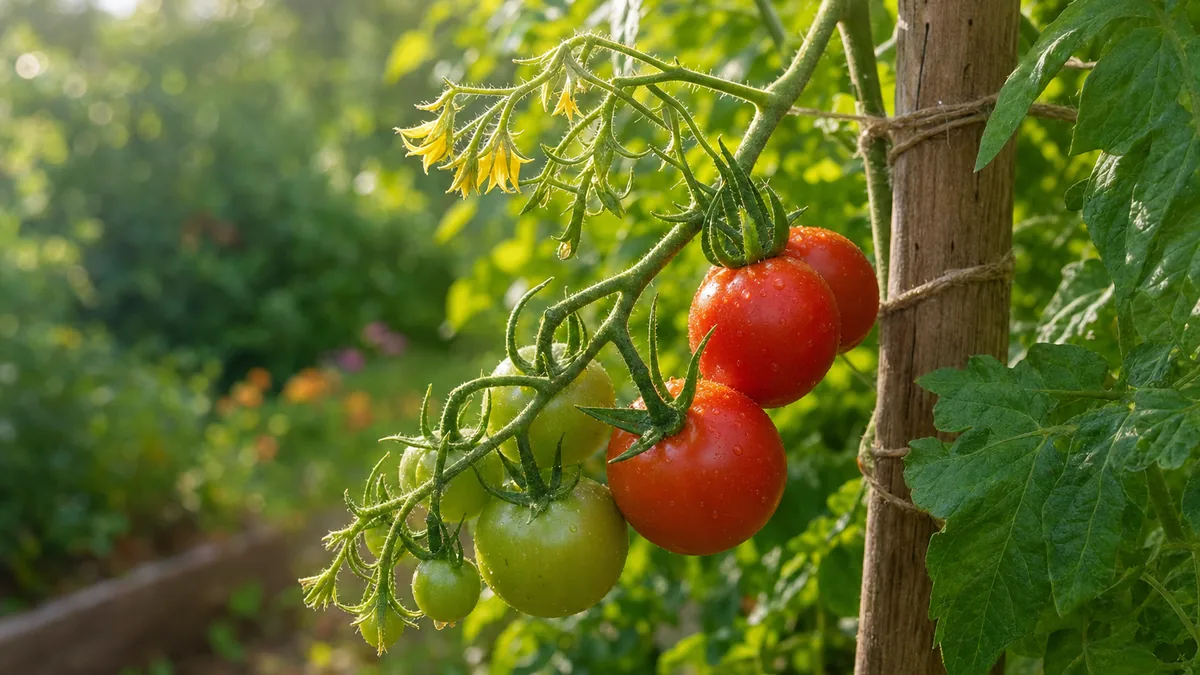
Tomato Timeline Quick Facts
| Stage | How long | Source |
|---|---|---|
| Seed to sprout | 6 to 8 days at 68 to 86°F, 14 days at 59°F, 43 days at 50°F | Oregon State |
| Seed to transplant | 5 to 8 weeks | Oregon State, Utah State, South Dakota State, Minnesota |
| Transplant to ripe fruit | 50 to 65 days (early), 66 to 80 (mid), over 80 (late) | NC State Extension |
| Flower to ripe fruit | About 4 to 8 weeks, depending on what the source counts | Utah State, Iowa State, Cornell |
| Seed to first harvest | 2 to 3 months, or 4 to 5 months for slower types | NC State Plant Toolbox |
| Harvest window, bush types | 4 to 6 weeks | University of Minnesota |
| Harvest window, vining types | Until frost or disease ends the plant | NC State, Utah State, Maryland |
| Ripening slows or stops | Above about 85 to 90°F | Cornell, Purdue, South Dakota State |
Sources are linked at the end of this guide. Where two extension pages disagree, the sections below give both numbers.
How Long Do Tomato Seeds Take to Germinate?
Tomato seeds sprout in about a week when the soil is warm, and much more slowly when it is cold. Oregon State University Extension, using data from the University of California, Davis, lists the days to seedling emergence for seed planted 1/2 inch deep: 43 days at 50°F, 14 days at 59°F, 8 days at 68°F, 6 days at 77°F and at 86°F, and 9 days at 95°F. It gives 50°F as the minimum, 60 to 85°F as the optimum range and 95°F as the maximum. The University of Minnesota Extension keeps seed flats at 75 to 85°F until seedlings emerge.
So when someone asks how long it takes for tomato seeds to sprout, the honest answer is 6 to 14 days at normal indoor and garden temperatures, and over a month if the soil sits near 50°F. That is the main reason seed sown straight into cold spring ground loses weeks. Our guide to soil temperature for planting covers how to check your own soil before you sow.
How Long to Grow Tomatoes From Seed vs From Transplants
Extension guides give a range for raising your own transplants rather than one number. Oregon State says it takes 5 to 8 weeks to produce good plants from seed, depending on temperature. Utah State University Extension says to allow 6 to 8 weeks, South Dakota State University Extension wants transplants five to six weeks old when they go out, and the University of Minnesota says to start seeds indoors five to six weeks before planting outside. NC State Extension is the outlier at the long end, advising seeds be sown six to ten weeks before the last frost. The University of Missouri sits at the short end, saying a stocky transplant 8 to 10 inches tall takes three to five weeks. Most of the difference comes from how big a plant each source wants, and from how warm and bright the growing spot is.
Size is a better test than age. Utah State says transplants should have 5 to 7 leaves and a well-developed root system, and University of Maryland Extension says to choose stocky plants about 6 to 10 inches tall. South Dakota State says transplants should at most just be beginning to flower when they go out. A seedling that stretches and flops on a dim windowsill is not ready no matter how many weeks it has had, and our leggy seedlings guide explains why.
| Route | Time before the first ripe fruit | Note |
|---|---|---|
| Your own transplants | 5 to 8 weeks indoors, plus the days to maturity below | Oregon State. Our arithmetic: about 85 to 140 days in all for a 50 to 85 day type. |
| Store-bought transplants | The days to maturity on the tag, counted from planting out | NC State and Oregon State count maturity from transplanting. |
| Seed sown in the garden | About 25 days longer than transplants | Oregon State. Needs a long, warm season. |
How Long From Transplant to First Ripe Tomato?
This is the number most seed packets mean by days to maturity. NC State Extension splits it three ways: early-season tomatoes ripen in 50 to 65 days after transplanting, mid-season in 66 to 80 days, and late-season types need more than 80 days. It adds that those times assume continuous temperatures above 65°F. University of Maryland Extension gives a single range, 65 to 90 days from transplant, with early cultivars ripening 55 to 65 days after transplanting. Oregon State runs from 50 days for early cherry types and 60 days for early full-size fruit, through 75 days for mid-season cultivars, up to 85 days for later, full-season cultivars from transplants.
Cool weather moves the date. Oregon State says that in cold climates you should add a minimum of 10 days to 2 weeks to the number of days to maturity on the seed packet. Purdue Extension notes that early-maturing cultivars produce fruit 2 to 3 weeks earlier than mid- or late-season ones, which fits the NC State bands. Those counts start at planting out, so a plant set into the garden early does not necessarily finish early. Our raised bed tomato guide covers setting plants out into beds.
The ripe-fruit date also depends on your frost dates, because a late variety started late may not finish before fall. Look up your own average dates on our frost dates by city pages and count forward from there.
How Long From Flower to Ripe Tomato?
Once a flower is pollinated and the fruit sets, the clock for that single tomato runs for several more weeks. The extension sources disagree on the number, and the reason seems to be what each one counts as done.
- About 30 days to full size: South Dakota State University Extension says it takes about 30 days from bloom until the fruit is full-sized and begins to ripen. Utah State says tomato fruits require 25 to 35 days to mature from flowering, depending on temperature and variety.
- 45 to 55 days to fully ripe: Iowa State University Extension says that once fruit set has occurred, it normally takes 45 to 55 days for tomato fruit to fully develop and ripen.
- 6 to 8 weeks to full maturity: Cornell Cooperative Extension says it takes six to eight weeks from pollination until tomato fruit reach full maturity.
- Up to 60 days: a second South Dakota State page says it can take up to 60 days after flowering for a tomato to grow and ripen.
The short numbers appear to measure the time until the fruit reaches full size and starts to change, and the long ones the time until it is red. For planning, think of it as roughly 4 weeks to a full-size green fruit and 6 to 8 weeks to a ripe one. South Dakota State adds that fruit typically begins coloring 2 to 3 days after reaching the mature green stage. The same page notes that in greenhouse tomatoes, raising temperatures from 72 to 79°F shortened flowering to ripening by only 4 days (46 versus 42), so warmth speeds things up less than people expect.
As for how soon after flowering a tiny green tomato appears, we did not find an extension figure, so we leave one out. If the flowers fall instead, the cause is usually heat, cold nights, dry soil or poor pollination, and our tomato blossom drop guide lists the temperature limits.
We also did not find an extension number for how many days a garden transplant takes to open its first flower. The closest figures are for greenhouses. The University of Connecticut IPM program says seedlings are generally transplanted into production greenhouses two to three weeks before flowering, and that under ideal conditions it takes about eight weeks from seeding until the first flowers open, and another eight weeks from flowering until first harvest. Those are greenhouse numbers, so treat them as a guide, not a promise for the backyard. Steady moisture matters while the first trusses set, and our guide on how often to water tomatoes has the amounts.
Days to Maturity: Cherry, Roma, Beefsteak and Heirloom
Smaller fruit generally ripens sooner, and big slicers and heirlooms take the longest. Oregon State puts early cherry types at 50 days and early full-size fruit at 60. The named varieties in the university lists below fill in the rest. Treat each figure as a guide for that variety, since the Texas A&M and Kansas State pages do not say whether days are counted from seeding or transplanting, and the University of Missouri does not either. Oregon State and NC State count from transplanting.
| Type | Days to maturity listed | Source |
|---|---|---|
| Cherry and grape | 50 for early cherry types. Sun Gold 57, Juliet 60, Super Sweet 100 60 to 65, Sweet Million 65 to 75 | Oregon State, Texas A&M, Kansas State, Missouri |
| Roma and paste | 67 to 75: Golden Rave 67, Margherita 72, Super Italian Paste 73, Italian Gold and Martino’s Roma 75 | Kansas State |
| Slicers | Early Girl 52, Celebrity 70, Better Boy 75 | Missouri, Texas A&M |
| Beefsteak and large | Big Beef 70 to 73, Beefy Boy 75, Beefmaster 80, a plain Beefsteak 95 | Kansas State, Missouri, Texas A&M |
| Heirloom | Black Krim 80, Aussie 85, Cherokee Purple 72 to 90 (the two lists differ) | Kansas State, Texas A&M |
Sources: Texas A&M AgriLife Extension recommended tomato varieties list, Kansas State University Sedgwick County variety recommendations, University of Missouri Extension guide G6461 and Oregon State University Extension EC 1333. Cherokee Purple is 72 to 80 days on the Kansas State list and 80 to 90 on the Texas A&M list, a reminder that local heat changes the count.
So for roma tomatoes, expect roughly the middle of the range, and for heirloom tomatoes expect the slow end. Determinate and indeterminate habit matters as well: Utah State recommends determinate or semi-determinate types for its short growing season because they have a more concentrated fruit set and maturity.
What Slows Tomato Ripening: Heat, Cold Nights and Cool Summers
Tomatoes ripen best in a middle band of temperature. Cornell Cooperative Extension gives 70 to 75°F as the optimum for ripening and says that when temperatures exceed 85 to 90°F, the ripening process slows significantly or even stops, because the fruit cannot produce lycopene and carotene, the pigments that make it red. Purdue Extension says the red color typical of most cultivars does not form when temperatures are above 86°F, and South Dakota State agrees that temperatures above 86°F significantly reduce lycopene and carotenoid, which can leave yellow shoulders. Missouri says color and flavor are best when average daily temperatures are about 75°F, and that temperatures above 92°F during ripening reduce flavor, texture and color. Utah State puts the line higher: at temperatures above 95°F fruit does not increase in size and will not color properly.
The cold side matters just as much. South Dakota State says temperatures between 60 and 75°F are ideal for ripening and that nights below 54°F will slow it. Iowa State says cool temperatures during fruit development slow maturity, and that when daytime highs stay in the 60s and 70s it can take an additional 7 to 10 days to mature. Purdue says fruit sets only when night temperatures fall within 55 to 75°F, which ties ripening time to how early the flowers set in the first place.
- Heat wave in midsummer: Cornell says fruit can stay in the mature green phase for quite some time, much like the slow ripening of autumn.
- Cool, cloudy summer: add about a week and a half, per Iowa State.
- Cold nights in fall: below 54°F at night slows ripening (South Dakota State). Pick mature green fruit before frost and finish it indoors, as our guide to ripening green tomatoes explains.
One myth to skip: South Dakota State says it is a myth that tomatoes need temperatures in the upper 80s and 90s to ripen. More heat does not make them redder or faster.
How Long Do Tomato Plants Live and Keep Producing?
In most of the country a tomato plant lives one season. NC State Extension’s Plant Toolbox says tomatoes are usually grown as an annual, but in frost-free climates they are perennials, and University of Maryland Extension says a tomato is a perennial that is usually grown outdoors in temperate climates as an annual. Neither page gives a lifespan in years, so we do not offer one. In practice the first frost ends the plant, and our guide to what temperature frost forms at covers when frost actually forms.
How long a plant keeps producing depends on its growth habit.
- Determinate (bush) types: the University of Minnesota says bush-type plants ripen their crop within a four- to six-week period. NC State says the main harvest occurs over a few weeks, and then the plants die. University of Maryland Extension is gentler, saying determinate varieties typically produce tomatoes throughout the summer, so the length depends on variety and weather.
- Indeterminate (vining) types: NC State says they continue producing fruit until frost, and Utah State says they keep growing and producing until frost. Maryland adds that the vines continue to grow until frost or disease kills them.
As for how fast tomatoes grow, NC State lists the growth rate as rapid, with plants reaching 1 to 10 feet tall and 1 to 4 feet wide depending on type. Its Plant Toolbox says harvest may begin 2 to 3 months after planting the seeds, or up to 4 to 5 months depending on the variety.
Plan Your Tomato Season Backwards
Because the stages add up, the easiest way to use these numbers is to count back from the date you want ripe fruit, or forward from the date you can plant out.
- Find your frost dates. Your last spring frost sets the earliest planting date and your first fall frost is the deadline. Our comparison of Farmers’ Almanac and NOAA frost dates shows why two sources can differ.
- Pick a type for your season. Early cherry and slicer types are the safe choice for short summers, since sources list them at 50 to 65 days from transplant.
- Add cold-climate time. Oregon State says to add a minimum of 10 days to 2 weeks to the packet number in cold climates.
- Add seedling time. Count back 5 to 8 weeks (Oregon State) from your planting-out date for your own transplants.
- Check the total. Our arithmetic for a 75-day mid-season type in a cold climate: 75 plus 10 to 14 is 85 to 89 days from transplanting, and 5 to 8 weeks (35 to 56 days) of seedlings brings seed to first ripe fruit to about 120 to 145 days, or 4 to 5 months.
For month-by-month sowing and planting dates in your state, use our planting calendar by state.
Free book · 23 pages, PDF
How Long Do Tomatoes Take to Grow FAQ
How long do tomato plants take to grow from seed to harvest?
NC State Extension's Plant Toolbox says harvest may begin 2 to 3 months after planting seeds, or up to 4 to 5 months depending on the variety. That fits Oregon State, which allows 5 to 8 weeks to raise a transplant, plus 50 to 85 days from transplanting to ripe fruit.
How long does it take for tomato seeds to germinate?
Oregon State University Extension lists 6 days at 77 and 86°F, 8 days at 68°F, 14 days at 59°F and 43 days at 50°F for seed planted 1/2 inch deep. Keep the flat warm and expect sprouts in about a week.
How long after flowering do tomatoes ripen?
It depends on what is counted. South Dakota State says about 30 days from bloom to full size, Iowa State says 45 to 55 days from fruit set to fully ripe, and Cornell says six to eight weeks from pollination to full maturity. Plan on roughly 4 to 8 weeks.
How long do cherry tomatoes take to grow?
They are the fastest type. Oregon State says early cherry types mature in about 50 days, and Texas A&M lists Sun Gold at 57 days and Super Sweet 100 at 65. Kansas State lists Super Sweet 100 at 60 days, so allow roughly 50 to 65 days, plus the seedling stage.
How long do tomato plants live?
In temperate climates, one season, ended by frost. NC State Extension says tomatoes are usually grown as an annual but are perennials in frost-free climates, and Maryland Extension says the same. Neither source gives a lifespan in years.
Why are my tomatoes taking so long to ripen?
Temperature is the usual cause. Cornell says ripening slows or stops above 85 to 90°F and is best at 70 to 75°F, while Iowa State says cool days in the 60s and 70s can add 7 to 10 days. Heat or cold both stretch the timeline.
Sources & further reading
Germination, seedling and transplant timing come from Oregon State University Extension’s guide to growing tomatoes (EC 1333), its soil temperature and seed germination table, Utah State University Extension, South Dakota State University Extension and University of Minnesota Extension. Days to maturity come from NC State Extension, University of Maryland Extension, University of Missouri Extension (G6461), Texas A&M AgriLife Extension’s recommended varieties and Kansas State University’s Sedgwick County variety recommendations. Flower-to-fruit timing and ripening temperatures come from Iowa State University Extension, Cornell Cooperative Extension, South Dakota State University Extension on heat and ripening and Purdue Extension (HO-26). Plant life cycle and growth rate come from the NC State Extension Plant Toolbox, and greenhouse schedules from the University of Connecticut IPM program. For how we source the facts on this site, see our methodology page, and for more on timing and spacing across the garden, see our complete guide to spacing and planting.
Free book · 23 pages, PDF
The Spacing & Planting Cheat Sheet
Sent