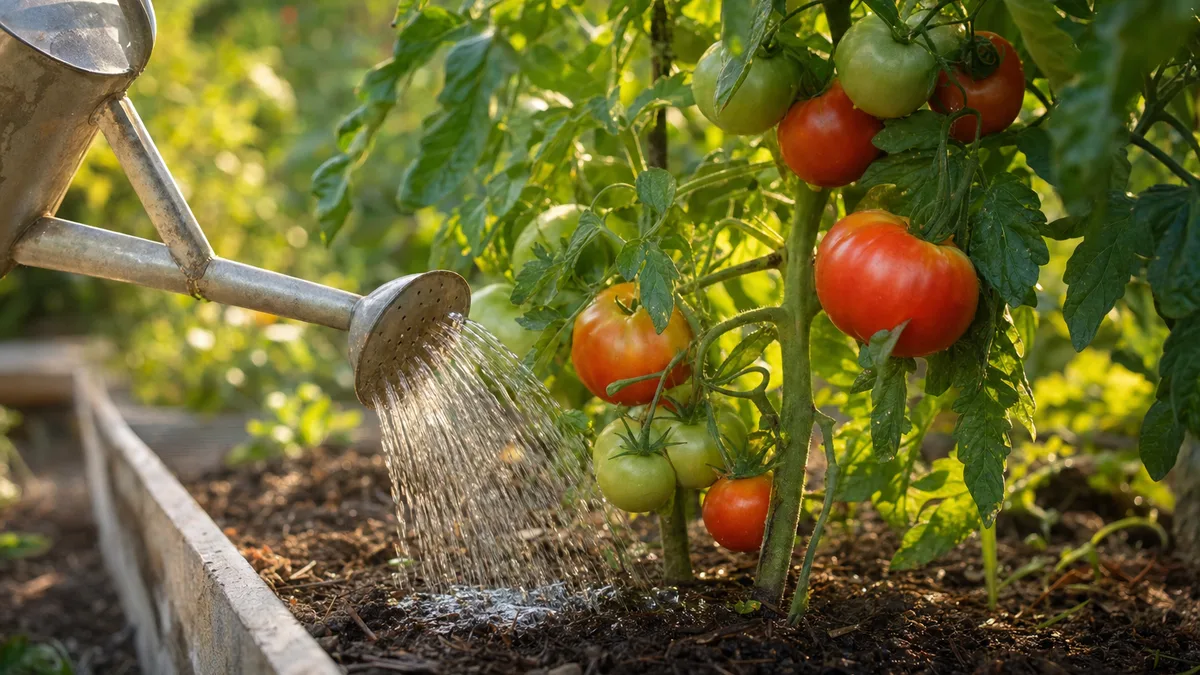
Water tomato plants deeply about once a week, giving 1 to 1 1/2 inches including rain, which is roughly 20 to 30 gallons for a 4 by 8 foot bed. Water more often in hot summers, raised beds and pots: mature plants may need water two to three times a week in summer, and pots often need it daily. Water in the morning, at the base of the plant.
Tomato Watering Quick Facts
| What | Answer | Source |
|---|---|---|
| Amount per week | 1 to 1 1/2 inches (Utah State says 1 to 2) | Iowa State, Penn State, Ohio State, Utah State |
| Style | Deep and infrequent, not light and daily | Utah State, Minnesota, Missouri |
| In the ground | A thorough soak every 7 days when rain is lacking | Iowa State, Maryland |
| Big plants in summer | Two to three times a week | Ohio State |
| Time of day | Morning, at the soil, not on the leaves | Penn State, Ohio State, Missouri |
| Mulch | 2 to 3 inches of straw or bark chips | Penn State, Ohio State |
| In pots | Check daily, and in summer possibly twice a day | UW-Extension, Illinois, Iowa State |
| Quick test | If the soil is dry 2 inches down, water | Penn State |
How Much Water Do Tomato Plants Need?
Most extension guides land on about 1 to 1 1/2 inches of water a week during the growing season. Iowa State University Extension says tomato plants require about 1 to 1 1/2 inches a week, Penn State Extension says to provide 1 to 1 1/2 inches, and Ohio State University Extension says tomato plants need about 1 to 1 1/2 inches. Utah State University Extension, which writes for a dry climate, says to water tomatoes deeply and infrequently, applying 1 to 2 inches per week. University of Minnesota Extension calls 1 inch of rainfall or irrigation per week ideal. The inches include rain, so subtract what the sky gave you.
Inches to gallons: the math
Inches are hard to measure with a hose, so convert them to gallons. One inch of water over 1 square foot is 144 cubic inches, and a US gallon holds 231 cubic inches, so 144 ÷ 231 = 0.623 gallons. That matches the factor in Utah State Extension’s irrigation guide, which gives 1.604 inches of water for each gallon spread over a square foot (1 ÷ 1.604 = 0.623).
For a 4 by 8 foot bed, the area is 32 square feet. So 32 × 0.623 = about 20 gallons per inch. That makes 1 inch about 20 gallons, 1 1/2 inches about 30 gallons, and 2 inches about 40 gallons. If a rain gauge shows 1/2 inch of rain, you only need to add 10 to 20 gallons to reach the 1 to 1 1/2 inch target.
One figure comes in a different unit. University of Maryland Extension says a mature tomato plant may require 2 to 3 gallons of water weekly. That is a per-plant number, while the inches above cover the whole bed, and the two will not match exactly, because soil, mulch, weather and plant spacing change how much each plant actually uses. Treat both as a starting point and let the soil test below make the final call.
How Often to Water Tomato Plants
The honest answer is that it depends on where the tomato is growing. A schedule is a starting point, and the soil tells you whether to adjust. Here is how extension sources break it down.
| Where | How often | Source |
|---|---|---|
| In the ground, normal weather | One deep soak a week when rain is lacking | Iowa State says a thorough soaking every seven days is adequate for most plants. Maryland says to water deeply at least once a week if rainfall is lacking. |
| In the ground, hot summer | Two to three times a week for large plants | Ohio State. |
| Sandy soil | More often than loam or clay | Minnesota says very sandy soils may require watering more often. |
| Raised beds | More often than in-ground beds | Minnesota and Clemson say raised beds dry out faster. |
| Pots | Daily, sometimes twice a day in summer | UW-Extension and Illinois Extension. |
| Greenhouse or high tunnel | By soil moisture, not by the calendar | Utah State Extension. |
How often to water tomatoes in raised beds
University of Minnesota Extension says raised beds dry out more quickly than in-ground gardens and need to be watered more frequently, and that the taller the raised bed, the more frequently you need to water. Clemson Extension agrees that raised beds dry out more quickly than in-ground beds and recommends drip hoses on timers. None of the guides we checked set a fixed number of days, so start from the weekly soak and check the soil between waterings. Our guide to growing tomatoes in raised beds covers the setup.
How often to water tomatoes in hot weather
Heat raises demand, and uneven moisture in heat is where problems start. Utah State Extension says to maintain uniform soil moisture during hot weather, particularly when plants are flowering. Ohio State says it may be necessary to water larger, mature plants two to three times a week during the summer months, and Missouri Extension notes that blossom-end rot is often intensified by high temperatures and low moisture. In a heat wave, check the soil more often rather than switching to light daily sprinkles. Flowers can drop when moisture swings in heat, which our guide to tomato blossom drop covers.
How often to water tomatoes in a greenhouse or polytunnel
A cover changes the water budget. Utah State Extension’s high tunnel guide says it is easy to over- or under-irrigate without soil moisture monitoring, and that conditions in a tunnel in summer are often much hotter than outside because of the restricted airflow, which increases irrigation needs. It gives no fixed number of days: schedules come from soil moisture readings, with frequent watering in summer and far less in midwinter. Venting, row covers and plastic mulch all change how much the plants use. For a home greenhouse, check soil moisture before each watering instead of watering on autopilot. For early high tunnel tomatoes, Utah State places sensors about 6 inches from the plant, at 6 inches deep and at 18 to 24 inches deep.
5 Signs Your Tomatoes Need Water
Check the soil before you pick up the hose. These five checks and warning signs come straight from extension guidance.
- The soil is dry 2 inches down. Penn State Extension says if it is dry at 2 inches deep, provide water, and to check with your finger first.
- The top inch of potting mix is dry. Illinois Extension says that if the top 1 inch of the mix feels dry, water the container. UW-Extension says to wait until your finger does not feel moist in the soil before watering again.
- A screwdriver will not slide in. Missouri Extension says if the screwdriver tip easily penetrates 6 inches or so into the soil, it has been watered enough. If it stops short, the bed needs a deeper soak.
- Flowers and fruit drop. Iowa State Extension says that letting a pot dry out completely between waterings can make plants drop fruits and flowers, and that deep weekly watering in dry weather reduces poor fruit set and blossom drop.
- Dark, leathery spots on the fruit bottoms. Utah State Extension says irregular watering, over or under, can cause blossom-end rot, a dark leathery spot on the bottom of the fruit.
The last two are late signs. By the time the fruit shows damage, the moisture swing already happened, so rely on the first three checks to stay ahead.
Deep Watering, Morning Watering and Mulch
Why deep and infrequent beats light and often
Utah State Extension says to irrigate so that water goes deeply into the soil. Missouri Extension explains the payoff: watering less often but for longer keeps the soil moist 6 to 8 inches down, which encourages deeper roots, while frequent light watering leads to shallow roots. University of Minnesota Extension adds that an inch of water will wet a sandy soil to a depth of ten inches and a heavy clay soil to six inches, and that light watering can cause shallow root development. Use a trowel to check: if the wet layer is only an inch or two, keep the water running.
Should you water tomatoes in the morning?
Yes. Penn State Extension says to water the plants in the morning so that the leaves dry quickly, and to water the soil, not the leaves. Ohio State says watering in the evening keeps roots and leaves wet longer, which encourages disease, and Missouri Extension says morning watering allows leaves to dry if they get wet, while evening watering leaves foliage wet longer and favors disease.
Mulch to hold the moisture
Mulch slows evaporation, so the soil stays evenly moist between waterings. Penn State and Ohio State both recommend 2 to 3 inches of straw or bark chips, and Minnesota gives 3 to 4 inches. Timing matters: Ohio State says mulching too early keeps the soil cool and slows root growth, so wait until the soil has warmed, typically around early June in Ohio, and Utah State advises waiting until soils reach 75°F before applying organic mulch. Keep it off the stem, and see our guide to common mulch mistakes.
Drip Irrigation for Tomatoes: How Long to Run It
Drip puts the water at the roots and keeps the leaves dry. Ohio State Extension calls soaker hoses and drip irrigation great ways to deliver water directly to plant roots, and Utah State says to use drip irrigation if possible and notes that drip can reduce water use by up to about 50%.
Run time depends on your emitters. Utah State Extension’s table gives the time to apply 1/2 inch of water on a 100-foot row with rows 2 feet apart. Double it for a full inch.
| Emitter flow and spacing | Time for 1/2 inch (Utah State) | Time for 1 inch (doubled) |
|---|---|---|
| 0.5 gph, 12 inches apart | 74 minutes | 148 minutes (2 hours 28 minutes) |
| 0.9 gph, 12 inches apart | 42 minutes | 84 minutes |
| 1.0 gph, 12 inches apart | 38 minutes | 76 minutes |
| 1.0 gph, 6 inches apart | 19 minutes | 38 minutes |
The same page gives the formula behind it: inches per hour = emitter flow in gph × 231 ÷ (emitter spacing in inches × spacing between lines in inches). For 1.0 gph emitters 12 inches apart on lines 24 inches apart, that is 231 ÷ 288 = 0.80 inches per hour, so 1/2 inch takes about 37 minutes and 1 inch about 75. Your own system will differ, so catch the output in a container once to confirm.
How to Water Tomatoes in Pots and Containers
Containers dry out fast, so they are the one place where daily checks are normal. Iowa State University Extension says containers require frequent watering because they dry out quickly from sun and wind, and that some plants may require daily watering. UW-Extension says in summer it may be twice a day, particularly with smaller containers, and Illinois Extension says that in warm, dry weather containers may need watering more than once a day.
- Drainage holes: required. Iowa State says any container works as long as it has drainage holes in the bottom, and UW-Extension says it must have them.
- How much: water until it runs out of the bottom. Iowa State says to water until moisture reaches the bottom of the pot and runs out of the holes.
- Do not let it dry out completely: Iowa State says this can cause plants to drop fruits and flowers.
- Do not overdo it either: Iowa State says overwatering is harmful because roots can suffer from lack of oxygen. Our guide to root rot shows what soggy roots look like.
- Leave headspace: UW-Extension says there should be 1 inch of space at the top of the container after the first watering.
- Add a reservoir if you cannot water daily: UW-Extension says if you cannot water the plant daily, or sometimes twice a day, use a container with a water reservoir.
Pot size drives how often you water, and the extension guides give different minimums. Iowa State says cherry tomatoes need at least 2 gallons (about 10 inches across) and standard tomatoes at least 4 gallons (about 12 to 14 inches). UW-Extension says the container for a plant that keeps growing should be bigger than a 5 gallon bucket, and Illinois Extension lists tomatoes at a container at least 20 inches across. The bigger the pot, the more water it holds and the less often you need to water. Our guide to plant pot sizes explained decodes the gallon and inch labels.
What Inconsistent Watering Does to Tomatoes
Extension sources agree that swings between dry and wet cause most watering problems.
- Blossom-end rot: Iowa State Extension says wide fluctuations in soil moisture impair calcium uptake by the roots, and Maryland Extension lists inconsistent watering, shallow watering or droughty conditions as factors that encourage it. Maryland adds that regular, deep watering will alleviate the problem if calcium levels in the soil are adequate.
- Cracking and splitting: Iowa State says heavy rain or deep watering after a long dry period results in rapid water uptake by the plant, and Penn State links split tomatoes to sudden increases in moisture. Utah State advises keeping soil moisture uniform as the tomatoes develop.
- Poor fruit set: Iowa State says watering deeply once a week during dry weather reduces poor fruit set and blossom drop.
The fix is steadiness, not more water. Penn State puts it simply: consistent watering in the right amounts is key to preventing both blossom-end rot and splitting. Our blossom end rot guide goes deeper on causes and fixes, and if the leaves are the problem, see why tomato leaves turn yellow.
Watering Tomatoes With Rain Barrels
Rain barrels turn roof runoff into free tomato water. The math is the same 0.623 gallons per square foot per inch as above. A 50-gallon barrel holds enough for 50 ÷ 20 = 2.5 one-inch waterings of a 4 by 8 foot bed, so a single barrel covers about two and a half weeks of the weekly target, but it needs to be refilled by rain between waterings. A bigger roof area or more barrels gives you a buffer for dry spells. For the gutters, overflow and filtering, see our guide to a rainwater collection system.
Free book · 23 pages, PDF
How Often to Water Tomatoes FAQ
How often should you water tomato plants?
In the ground, give a deep soak about once a week when rain is lacking. Iowa State Extension says a thorough soaking every seven days is adequate for most tomato plants, and Ohio State says large plants may need water two to three times a week in summer. Pots often need water daily.
How much water does a tomato plant need per week?
About 1 to 1 1/2 inches a week, including rain, according to Iowa State, Penn State and Ohio State Extension. Utah State says 1 to 2 inches. Since 1 inch over 1 square foot is 0.623 gallons, a 4 by 8 foot bed needs about 20 gallons per inch.
Is it better to water tomatoes in the morning or evening?
Morning. Penn State Extension says to water in the morning so the leaves dry quickly, and Ohio State says evening watering keeps roots and leaves wet longer, which encourages disease. Water the soil, not the leaves.
Do tomatoes need to be watered every day?
Not in the ground. Utah State Extension says to water deeply and infrequently, and Missouri Extension says frequent light watering leads to shallow roots. Pots are the exception: UW-Extension says that in summer they may need water twice a day.
How do I know if my tomatoes need water?
Check the soil. Penn State Extension says if it is dry 2 inches down, water. In pots, Illinois Extension says to water when the top inch of mix feels dry. Do not wait for dark spots on the fruit, because blossom-end rot means the moisture swing already happened.
Can you overwater tomatoes in pots?
Yes. Iowa State Extension says overwatering is harmful because roots can suffer from lack of oxygen. Use a pot with drainage holes, water until it runs out of the bottom, then let the top inch dry before watering again.
How long should I run drip irrigation on tomatoes?
It depends on your emitters. Utah State Extension says 1.0 gph emitters spaced 12 inches apart take about 38 minutes to apply 1/2 inch on a 100 foot row, so about 76 minutes for 1 inch. Check the real output of your system by catching it in a container.
Sources & further reading
Watering amounts, frequency and timing come from Utah State University Extension, Penn State Extension, Ohio State University Extension, University of Minnesota Extension, Iowa State University Extension, University of Maryland Extension on blossom end rot, University of Missouri Extension and its home garden tomato guide. The inches-to-gallons factor and drip run times come from Utah State Extension’s water recommendations for vegetables, and greenhouse advice from its high tunnel irrigation guide. Container advice comes from Iowa State Extension, UW-Extension and the Illinois Extension container gardening guide. Raised-bed watering comes from University of Minnesota Extension and Clemson Home and Garden Information Center. For how we source the facts on this site, see our methodology page. Starting tomatoes from seed? See how to grow tomatoes from seed, and for beds, growing tomatoes in raised beds.
Free book · 23 pages, PDF
The Watering & Irrigation Cheat Sheet
Sent