If you’re asking why are my tomato leaves turning yellow, the honest answer is that it isn’t one problem with one fix. Where the yellowing shows up on the plant, and what else is happening alongside it, points to genuinely different causes: a few spent leaves at the bottom of a healthy plant mean something completely different from yellow leaves covered in dark rings. This guide is the third piece in our tomato series: the seed-starting guide covers germination, the raised bed guide covers bed setup and blossom end rot, and this one covers diagnosing what’s going on with the leaves themselves. If your plant isn’t a tomato, or you want the full breakdown across every nutrient and cause, see our general yellow leaves diagnostic guide.
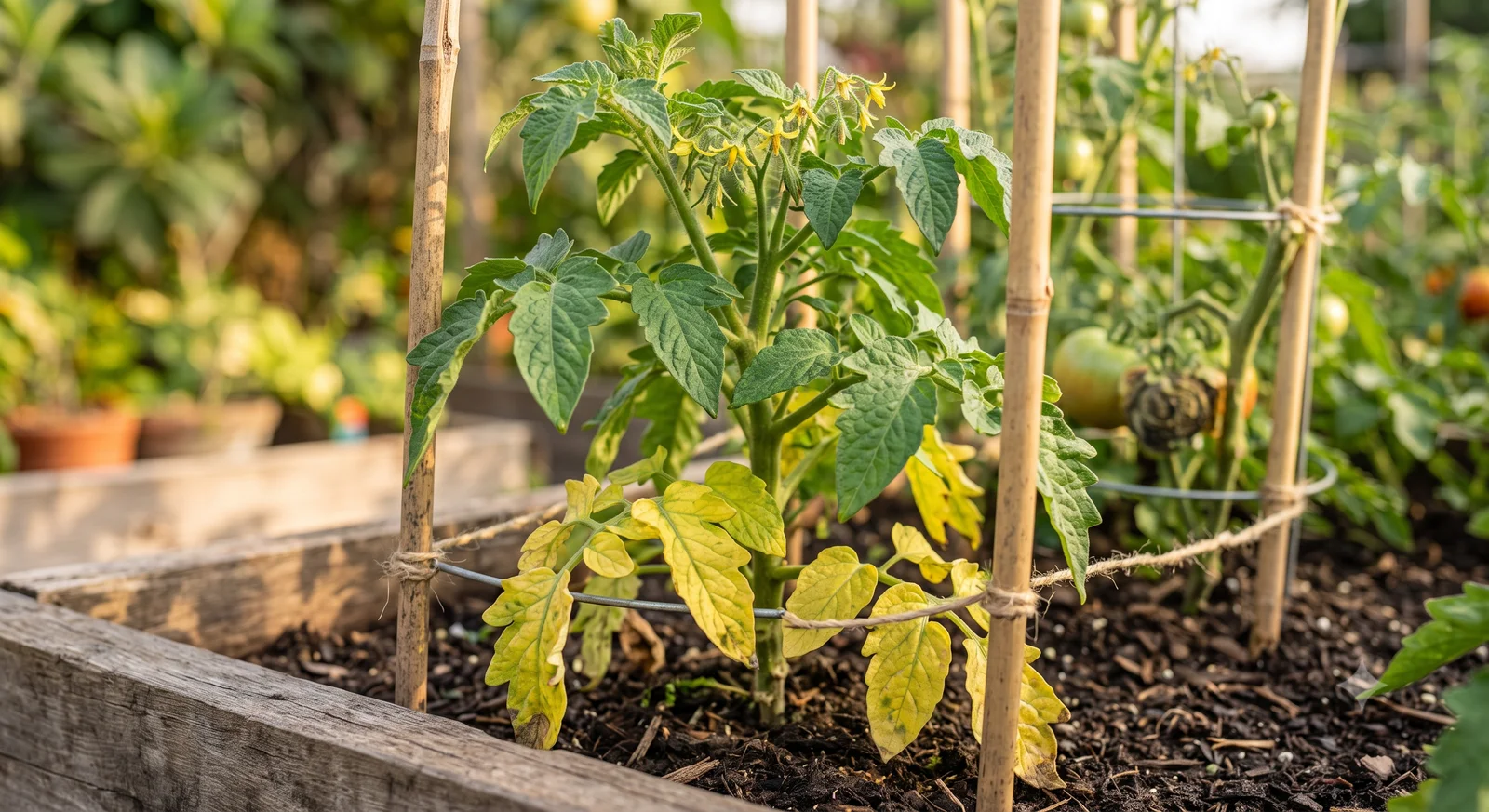
Start Here: What Does the Yellowing Look Like?
Yellowing shows up on tomato (Solanum lycopersicum) plants for a lot of different reasons, and the fastest way to narrow it down is to look at exactly where it’s happening and what else is going on: spots, curling, or nothing else at all. Match what you’re seeing against the table below and jump to the section that covers it.
| Symptom pattern | Most likely cause |
|---|---|
| Lowest, oldest leaves only turn uniform yellow, no spots | Normal aging (senescence) or nitrogen deficiency |
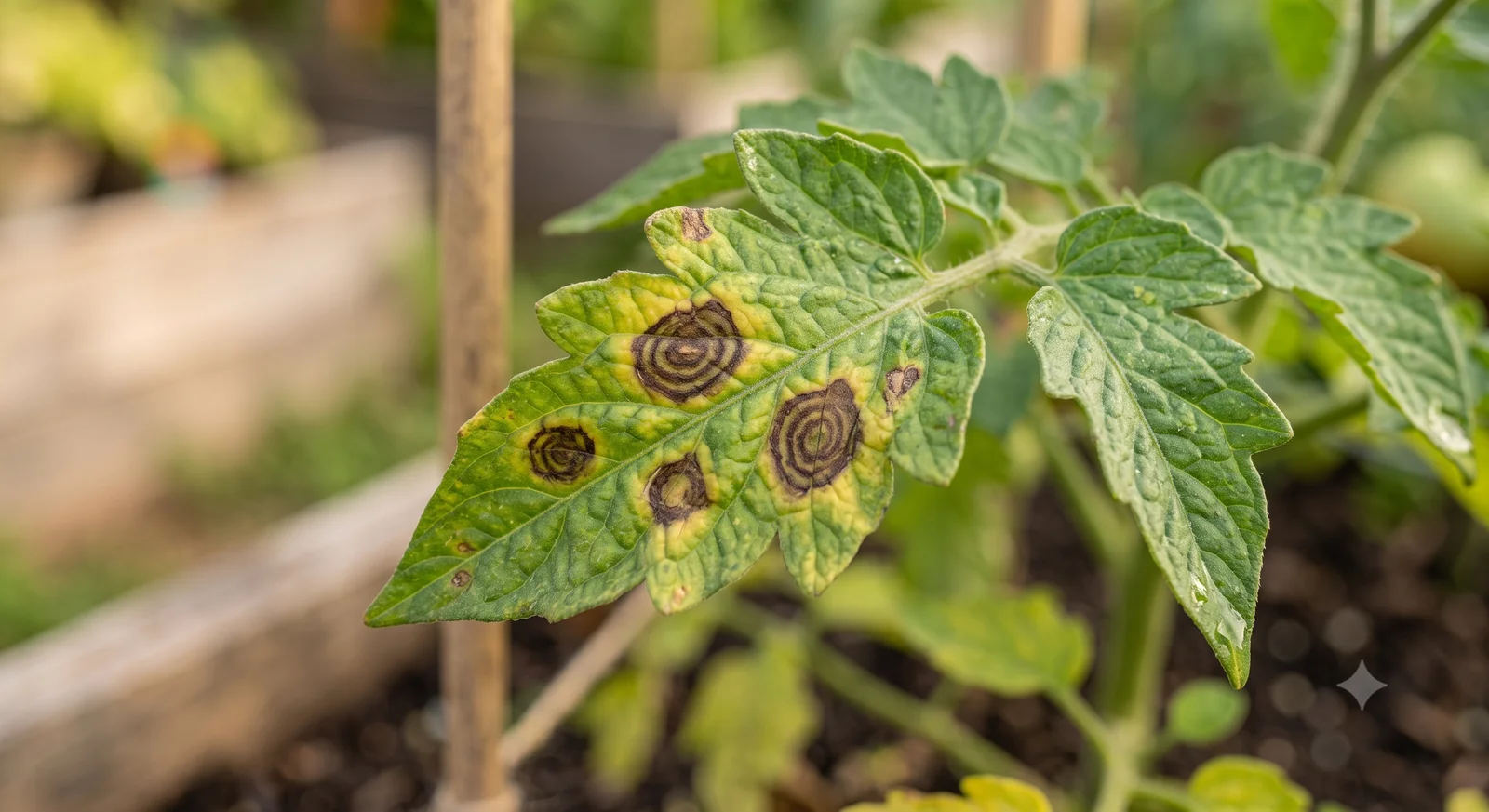
| Yellow with brown spots showing concentric rings, a “bullseye” pattern | Early blight |
| Yellow with small gray-centered spots and tiny black dots inside them | Septoria leaf spot |
| Yellow between the leaf veins, the veins themselves stay green | Magnesium or another micronutrient issue |
| Yellowing plus curling leaves | Environmental stress, herbicide drift, or a virus |
| Whole young plant yellows shortly after transplant | Transplant shock |
Tomato Plants Turning Yellow at the Bottom
Tomato plants turning yellow at the bottom is the single most common version of this question, and it’s often not a problem at all. A tomato’s oldest, lowest leaves naturally yellow and die off as the plant matures: it’s redirecting energy toward new growth and developing fruit rather than maintaining leaves that have already done their job. If the yellowing is limited to the lowest leaves, there are no spots, and the rest of the plant looks green and vigorous, this is normal aging, not a disease or deficiency.
Nitrogen deficiency produces a similar-looking pattern (uniform yellowing starting on the oldest leaves first), but per the University of Maryland Extension, it isn’t limited to a leaf or two at the very bottom. As it progresses, it moves up the plant and affects a larger share of the foliage, and the plant overall looks pale and slow rather than just shedding a few spent leaves. If more than the lowest one or two leaves are involved, our NPK Calculator can help you dose nitrogen more precisely instead of guessing.
Early Blight vs. Septoria Leaf Spot: How to Tell Them Apart
Early blight and septoria leaf spot are the two fungal diseases behind most spotted, yellowing tomato leaves. Per the University of Maryland Extension, they often show up on the same plant at the same time, and they look similar enough at a glance to get confused, but one detail in the spot itself tells them apart reliably.
| Early Blight | Septoria Leaf Spot | |
|---|---|---|
| Spot size | Up to ½ inch, spots enlarge and coalesce | Small, ⅛–¼ inch |
| Pattern | Dark concentric rings forming a bullseye, yellow halo around the spot | Gray to tan center with a dark border, no rings |
| Inside the spot | No distinctive marking | Tiny black dots (pycnidia, the fungus’s fruiting bodies), visible without magnification once the spot ages |
| Where it starts | Lower, older leaves first | Lower, older leaves first |
| Fruit | Can also infect fruit: dark, leathery spots near the stem end | Rarely infects fruit |
| Favored conditions | Warm weather, favored above roughly 80°F | Cooler and wet, favored around 68–77°F |
The single most reliable rule: concentric rings in a bullseye pattern mean early blight, and tiny black dots inside gray-centered spots mean septoria leaf spot. It’s common for a plant to have both at once, and because septoria favors cooler, wetter conditions while early blight favors warmer weather, septoria tends to show up earlier in the season with early blight becoming more likely as the weather heats up.
Other Common Causes of Yellowing
Overwatering and poor drainage are common culprits beyond disease: waterlogged soil pushes oxygen away from the roots, and roots that can’t get oxygen struggle to take up nutrients even when the soil has plenty. Heavy clay makes this worse, since it drains slowly and stays saturated longer after watering or rain; our Soil Type Calculator can help you confirm what you’re working with. Inconsistent watering (swinging between soggy and bone-dry) stresses roots in a similar way and can trigger yellowing on its own, separate from any disease.
For nutrient causes generally, the pattern of the yellowing is the clue. Per the University of Maryland Extension, interveinal yellowing (where the tissue between the leaf veins yellows but the veins themselves stay green) points to a micronutrient issue such as magnesium, iron, potassium, or manganese, while uniform yellowing that starts on the oldest leaves and works upward points to nitrogen. Guessing which one and dosing blind rarely works well; a soil test is the honest way to know. Our Soil Test Results article walks through reading one, and the NPK Calculator turns the result into an actual fertilizing plan.
Young Tomato Plant Leaves Turning Yellow
Young tomato plant leaves turning yellow (at the seedling stage or right after transplanting) is usually transplant shock or cold soil rather than disease. Moving a plant from a controlled indoor setup into outdoor sun, wind, and temperature swings is stressful even when it’s handled well, and cold soil slows root function enough to show up as yellowing on its own. In both cases, plants often recover on their own within a week or two once they settle in, with no treatment needed beyond time and consistent watering.
If you’re seeing this shortly after transplant, it’s worth checking that hardening off was done properly and that the soil had actually warmed before planting, both covered in our tomato seed-starting guide. If you’re not sure your soil is warm enough yet, our Frost Date Calculator estimates your last frost date and the general timing for safe transplanting.
Treatment for Yellow Tomato Leaves
Treatment for yellow tomato leaves depends on the cause, but a few practices help across the board, especially for the two fungal diseases.
For early blight and septoria specifically: remove affected lower leaves as soon as you spot them, and don’t compost them. Per Iowa State University Extension, both fungi overwinter on infected plant debris, so tossing infected leaves in a home compost pile just gives the disease somewhere to survive until next season. At the end of the season, clean up fallen leaves and old plant material thoroughly rather than tilling it back in.
Prevention does more than any treatment applied after the fact:
Adequate spacing for airflow. Crowded plants stay damp longer after rain or watering, which favors both diseases. Our Plant Spacing Calculator works out proper spacing for your bed and variety.
Mulch to stop soil splash. Both fungi spread when rain or overhead watering splashes spores from soil and infected debris onto lower leaves. A mulch layer breaks that path. Our Mulch Calculator works out how much you’ll need.
Water at the base, not overhead. Keeping foliage dry removes the moisture both fungi need to infect and spread. Our Drip Irrigation Calculator works out run time and delivery for your setup.
Prune the lowest branches. Once plants are established and fruiting, removing the lowest 3–4 leaf branches improves airflow near the soil line and removes the leaves most likely to be splashed.
Rotate where space allows. Since both fungi overwinter in soil debris, avoiding the same spot for tomatoes (and potatoes, Solanum tuberosum, which share these diseases) for a few years helps break the cycle.
Choose disease-resistant varieties. This is the single best preventive measure available, and it works regardless of how carefully you manage everything else.
One honest note: neither early blight nor septoria leaf spot is curable once a plant is infected. Management (removing affected leaves, keeping foliage dry, good airflow) slows the disease enough to still get a real harvest, but it doesn’t reverse it. Resistant varieties are the closest thing to a real fix, since they often outgrow the disease enough that it never becomes a serious problem in the first place.
Free book · 23 pages, PDF
Yellow Tomato Leaves FAQ
Is it normal for the bottom tomato leaves to turn yellow?
Yes, in most cases. A tomato plant's oldest, lowest leaves naturally yellow and die as the plant matures and redirects energy upward. If it's limited to a leaf or two at the very bottom with no spots and the rest of the plant looks healthy, it's normal aging, not a problem. If the yellowing spreads to more of the plant, nitrogen deficiency is the more likely cause.
Should I remove yellow leaves from my tomato plant?
For disease-related yellowing with spots, yes. Remove affected leaves as soon as you spot them and don't compost them, since fungal spores can survive in a home compost pile. For plain age-related yellowing with no spots, removing the leaves is optional, since the plant has already pulled most of the useful resources out of them, though it can help airflow near the soil line.
Why are my tomato seedlings turning yellow?
Usually transplant shock or cold soil rather than disease. Moving a seedling outdoors is genuinely stressful, and cold soil slows root function enough to show up as yellowing on its own. Most seedlings recover within a week or two without treatment. See our tomato seed-starting guide for proper hardening off and transplant timing.
Can tomato plants recover from yellow leaves?
Individual yellow leaves don't turn green again, but the plant as a whole can recover if the underlying cause is fixed: correcting inconsistent watering, addressing a real nutrient deficiency, or simply waiting out transplant shock. New growth comes in healthy once the cause is resolved; existing yellow leaves are usually best removed rather than left in place.
Do Epsom salts fix yellow tomato leaves?
Only sometimes, and only for one specific cause. Epsom salt supplies magnesium, which helps only if magnesium is genuinely deficient, something a soil test confirms rather than a guess. It does nothing for fungal disease, nitrogen deficiency, or overwatering, which are all far more common causes of yellowing than a magnesium shortage.
Sources & further reading
For the full range of tomato leaf symptoms and their causes, see the University of Maryland Extension’s Key to Common Problems of Tomatoes. For septoria leaf spot specifically, including its disease cycle and management, see Iowa State University Extension’s Septoria Leaf Spot guide. For more on how we source and review the facts behind every calculator and guide on this site, see our methodology page. And for more on spacing, timing, and companion planting across the whole garden, see our complete guide to spacing and planting.