Can tomato plants survive winter? Not outdoors where frost occurs. Colorado State Extension says tomatoes are readily killed by a light frost, and Nebraska Extension lists frost injury at 28 to 32°F. NC State Extension says they live on as perennials only in frost-free climates. Elsewhere, bring a pot inside, root cuttings, or ripen the last green fruit before your first fall frost date.
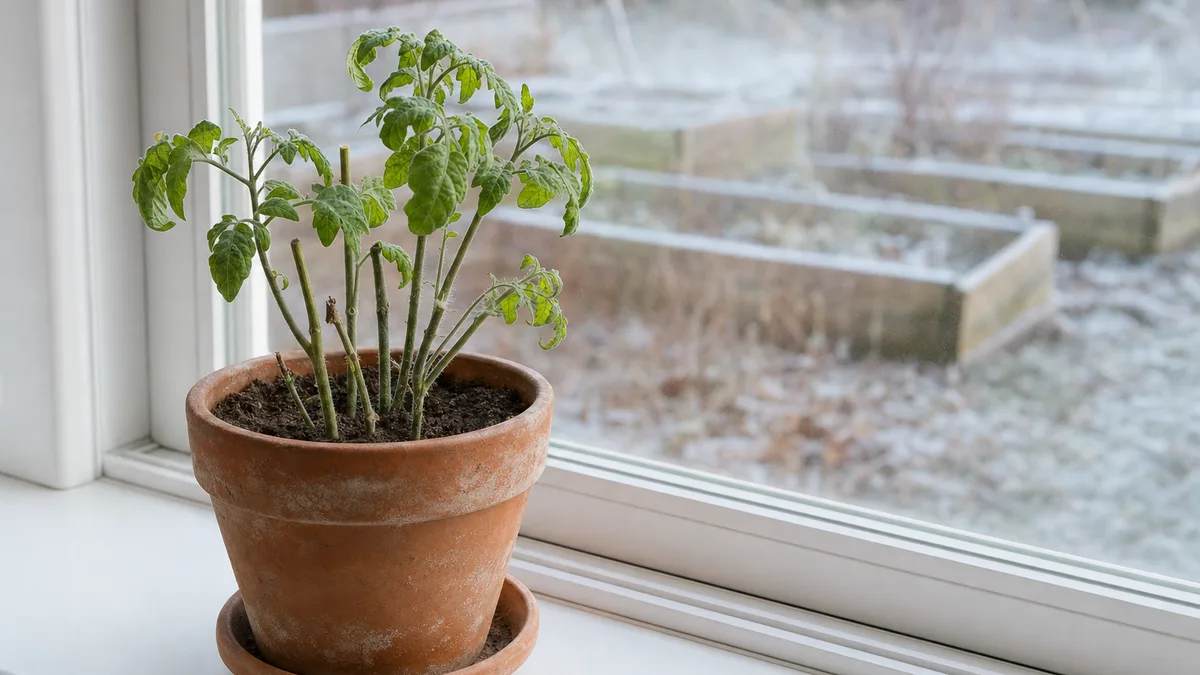
Tomato Plants in Winter: Quick Reference
| Situation | Limit or number | What to do | Source |
|---|---|---|---|
| Plant left in the garden | Frost injury at 28 to 32°F | Do not count on it surviving; protect only to extend the season | Nebraska, Colorado State |
| Frost-free climate | Behaves as a perennial | Plant can keep growing year after year | NC State, Maryland |
| Potted plant brought inside | Keep above 50°F; bright window or lamp | Inspect for pests, isolate, give light | Utah State, Illinois, Minnesota |
| Fruit set indoors | Nights below 55°F stop pollen developing | Keep warm; shake flowers to move pollen | Colorado State, UF/IFAS |
| Cuttings from suckers | Suckers 3 to 4 inches long | Root in water or soil, then pot up | UGA, Clemson |
| Green fruit before frost | Ripens in about 2 weeks at 65 to 70°F | Pick mature fruit and ripen indoors | Colorado State, Nebraska |
Can Tomato Plants Survive Winter Outside?
Not through a freeze. University of Maryland Extension calls tomatoes very tender, warm-season plants and says frost will injure the top growth. Nebraska Extension lists tomatoes among the tender vegetables injured or killed by frost at 28 to 32°F, while Colorado State Extension says to cover plants when a light frost of 28 to 32°F is forecast and to harvest the fruit ahead of a heavy frost below 28°F. NDSU Extension puts hard frost at 28°F or below and says nothing will save sensitive plants at that point. Extension sources agree on the range, but none gives one exact kill temperature.
Frost can form when the thermometer still reads above freezing, a point our guide to what temperature frost forms explains. Covers can buy a little time. Nebraska Extension says caged tomatoes can be covered with paper grocery sacks or plastic trash bags, removed the next morning because plastic can overheat plants in sun. NDSU says blankets or burlap give a few degrees of warmth and may buy about an extra week of gardening. For covers and mulch, see our guide to protecting plants in winter.
Will Tomato Plants Grow Back After Winter?
Only where winters have no frost. NC State Extension’s Plant Toolbox describes the tomato as an annual or herbaceous perennial, usually grown as an annual but a perennial in frost-free climates. University of Maryland Extension agrees that tomatoes are perennial but are usually grown as annuals in temperate climates. I did not find an extension source that names a hardiness zone for tomatoes, so I am not giving one. Check how often your own area drops below freezing with our growing zones guide or the frost dates pages.
In a cold climate, a plant that froze is finished, and new tomatoes in spring come from other plants. One useful side effect of the cold: University of Massachusetts Extension says tomatoes will not carry late blight over the winter, because freezing kills the whole plant. The same fact sheet says to dig or rototill vines and leaves into the soil or compost them in a well-managed pile to speed their breakdown. For the rest of the cleanup, use our winterize garden checklist. Perennials that do survive are covered in what is overwintering, which sorts plants by method.
What to Do With Tomato Plants in Winter
You have four realistic choices, and the right one depends on your climate and your patience.
- Harvest and clear. Pick the fruit, pull the plant and compost it or bin it if it was diseased. SDSU Extension says plants with any sign of virus should be removed with their roots, bagged and thrown away, and that healthy ones can be composted.
- Bring a potted plant inside. Works best for a healthy, container-grown plant and a bright spot. Details in the next section.
- Root cuttings. A few small sucker cuttings take far less room than a whole plant.
- Ripen the green fruit. The cheapest way to get something from a plant that is about to freeze.
Our guide to overwintering pepper plants covers a close relative in the same family, and the pest checks and light advice carry over. The cold limits below are narrower for tomatoes, which Utah State Extension says can be harmed below 50°F.
Can You Bring Tomato Plants Inside for Winter?
Yes, but expect a survival project and not a harvest. I found no extension publication written specifically on overwintering a garden tomato indoors, so the steps below combine the extension guidance on tomatoes indoors with the guidance on moving plants inside generally. Where something is my own judgment, I say so. The timing and pest checks for moving any pot are in when to bring plants inside for winter.
- Move before the cold nights. University of Illinois Extension says to bring plants indoors when temperatures fall below 55°F consistently. Utah State Extension says temperatures below 50°F can harm them.
- Check and wash. Inspect leaves and soil. Illinois Extension suggests hosing plants off first.
- Isolate. Illinois Extension says to keep newly moved plants apart for 3 to 4 weeks. University of Minnesota Extension says one to two weeks for newly acquired plants and to isolate any plant with pests.
- Pick the brightest spot. Illinois Extension says a south- or west-facing window is brightest and to add lighting if the plant does not get enough.
- Water by feel. Utah State says to let the soil dry moderately between waterings.
- Hand-pollinate or just keep it alive. See the next subsection.
Pests on a tomato brought indoors
Minnesota Extension names whiteflies, aphids, spider mites and fungus gnats as common indoor plant pests. Whiteflies feed on leaf undersides and aphids cluster on stems and new growth. Spider mites cause speckled leaves and thrive in warm, dry conditions. The usual first step is washing the plant, and yellow sticky cards catch adult whiteflies. Inspect the plant weekly for the first month, which is my own suggestion. If yellowing starts, our guide to tomato leaves turning yellow helps tell pests from watering or light problems.
Light, temperature and pollination
Utah State Extension recommends a bright south- or west-facing window away from drafts, with cool-white fluorescent lighting added and the plant tops kept within 3 to 6 inches of the bulbs. It says specialized grow lights are not necessary, and our comparison of LED and fluorescent grow lights helps you choose a lamp. A winter windowsill alone gives little light, so a lamp is the safer bet for a plant you hope to fruit.
Fruit is the hard part. Colorado State Extension says that when nights drop below 55°F, pollen fails to develop and the next morning’s flowers will not set fruit. UF/IFAS Extension says nights below 55°F or above 75°F can damage pollen, and Utah State warns that temperatures above 90°F may prevent fruit from setting. UF/IFAS says tomato flowers are complete and self-pollinating, and that gently shaking the plant can help distribute pollen when wind and insects are scarce. That matches the indoor situation, so tapping the flower trusses is a reasonable step. Dropped blossoms are common at wrong temperatures; our guide to blossom drop has the causes.
The Houseplant Care App (see the app) lists what each potted plant needs today, which helps when a tomato is one of several plants on a winter windowsill.
How to Cut Back Tomato Plants for Winter
Trim to fit the window, but I could not find an extension source that gives a percentage or height for tomatoes, so I am not inventing one. My own judgment: pick off fruit and flowers, remove yellow or diseased leaves, and shorten long stems to a size the pot and the light can support, leaving some healthy leaves on each stem. Make cuts above a leaf joint. Do not prune a plant that is stressed, wilting or heavily infested; throw that one away instead.
If the plant is in the ground, it is worth asking whether a pot is practical. Utah State Extension recommends a 1 gallon pot for the smallest tomato varieties and 2 or 3 gallons for larger ones, a drainage hole, and a peat-based potting mix, never yard soil. Those numbers are for indoor tomatoes grown from seed, so treat them as a floor for a cut-back transplant. Our plant pot sizes chart shows what each size holds. A tomato dug from a bed loses roots, so expect it to sulk. Soggy mix is the main risk, and our guide to root rot shows what it looks like.
Can You Overwinter Tomatoes From Cuttings?
Yes, and it is the lighter option. Frank Watson of University of Georgia Extension describes rooting suckers: choose healthy ones 3 to 4 inches long, stand several in a jar with water covering the ends by 1 to 2 inches, and keep the jar in a cool, well-lit place until roots form. A rooting hormone is optional, he says, though it would probably speed things up. Clemson Extension roots suckers in soil instead: strip some foliage and any flower cluster, push the cutting deep so it roots along the stem, and look for new growth as the sign it has taken. Neither source gives a number of days to root.
Both sources describe the method for the growing season, a late summer or mid-season replacement plant, not for winter. Taking suckers in early fall and growing them on a bright sill is my own extension of the method. A rooted cutting can then be potted up and kept in a bright spot until spring. Take cuttings before frost reaches the parent plant, and skip any sucker that shows disease or pests (my own judgment).
What to Do With Green Tomatoes Before Frost
Pick them. Iowa State Extension says that when frost is imminent, mature green tomatoes can be harvested and ripened indoors. Nebraska Extension adds that green tomatoes picked before frost can ripen over several weeks, while those picked after frost will not ripen or keep well. The sources differ a little on conditions, so here is the range.
| Source | Fruit to pick | Storage temperature |
|---|---|---|
| Colorado State | Glossy green, about three-fourths of full size | 65 to 70°F ripens in about 2 weeks; 55°F takes 3 to 4 weeks |
| Nebraska | Picked before frost | 50 to 55°F, ripens over several weeks |
| Iowa State | Mature, firm, no defects, wrapped in newspaper | 60 to 65°F in a cool, dark place |
| Maryland | Picked before the first killing frost | 50 to 70°F for 1 to 3 weeks |
Colorado State also warns that storage below 50°F gives fruit a bland, off flavor. Our guide to ripening green tomatoes goes through the methods in more detail. If you are still deciding how long the season has left, our guide to how long tomatoes take to grow shows why late fruit rarely finishes outside.
Is Overwintering Tomatoes Worth It?
Usually a fresh start wins, though a favorite plant may be worth saving, and one kept going needs its watering matched to indoor light, as how often to water tomatoes explains. NC State Extension says tomatoes are usually grown as annuals, and no source I found promises a better harvest from an old plant. Utah State Extension says smaller indoor varieties yield only enough fruit for an occasional salad or sandwich, which is a fair benchmark for a window-grown plant too. My own judgment: overwinter if you have a bright, warm spot and want to keep a particular variety, and sow new seed if all you have is a dim windowsill.
New plants from seed are the other route. The University of Maryland says days to maturity run 65 to 90 days from transplant, so count back from your last frost, or try our tomato seed guide for the steps. Start them under lights from the beginning, because a seedling stretching toward a window is the problem our leggy seedlings guide explains.
Tomatoes also have tidy companions for next season; our guide to what to plant with tomatoes is a good thing to read while the beds rest. Browse more in our spacing and planting guides.
Free book · 25 pages, PDF
Can Tomato Plants Survive Winter FAQ
Can tomato plants survive winter outside?
No, not where frost occurs. Colorado State Extension says tomatoes are readily killed by a light frost, and Nebraska Extension lists frost injury at 28 to 32 degrees F. NC State Extension says tomatoes are perennials only in frost-free climates.
Can you overwinter tomato plants?
Yes, indoors in a pot or as rooted cuttings. Keep plants above 50 degrees F, as Utah State Extension advises, give them a south- or west-facing window or a lamp, and check for pests. Expect little fruit in winter.
Will tomato plants grow back after winter?
Only in frost-free climates. NC State Extension describes the tomato as a perennial there but usually grown as an annual, and University of Maryland Extension says the same for temperate climates. A plant killed by frost does not regrow.
Can you bring tomato plants inside for winter?
Yes. University of Illinois Extension says to bring plants indoors when temperatures fall below 55 degrees F consistently, wash them, and keep them apart from other plants for 3 to 4 weeks. Use the brightest window or a lamp.
How do you cut back tomato plants for winter?
Remove fruit, flowers and diseased leaves, then shorten stems to fit the pot and window. I found no extension source that gives a percentage for tomatoes, so this is a judgment call. SDSU Extension says to throw away plants with virus signs.
What should I do with tomato plants in winter?
Pick mature green fruit before frost, then pull the plant, bring a pot indoors or root suckers. Iowa State Extension says mature green tomatoes picked ahead of frost can ripen indoors, and Nebraska Extension says those picked after frost will not.
Will indoor tomato plants set fruit in winter?
Sometimes, with warmth and light. Colorado State Extension says pollen fails to develop below 55 degrees F at night, and UF/IFAS Extension says gently shaking the plant can help move pollen. Utah State Extension notes small varieties give a modest crop.
Sources & further reading
Frost, perennial status and growing basics come from Colorado State Extension’s tomato guide, Nebraska Extension’s frost article, NDSU Extension’s frost article, University of Maryland Extension’s tomato guide and NC State Extension Plant Toolbox entry for tomato.
Indoor growing, pollination and cuttings are from Utah State Extension’s winter tomatoes article, UF/IFAS Extension’s hand pollination publication (HS1248), University of Georgia Extension on rooting tomato suckers and Clemson Extension on desuckering and rooting tomatoes.
Moving plants inside, pests, green fruit and cleanup are from University of Illinois Extension on moving houseplants indoors, University of Minnesota Extension on insects on indoor plants, Iowa State Extension on late season harvest, SDSU Extension’s fall cleanup article and University of Massachusetts Extension on late blight management.
Free book · 25 pages, PDF
The Indoor Plants Repotting Cheat Sheet
Sent