How to overwinter pepper plants: bring them indoors before frost. Oklahoma State Extension calls peppers very sensitive to light frost, and NC State Extension says to move hot peppers inside when temperatures are forecast below 28°F. Then cut back, check for pests and keep them bright, cool and barely watered. Prefer a fresh start? See our pepper seed guide.
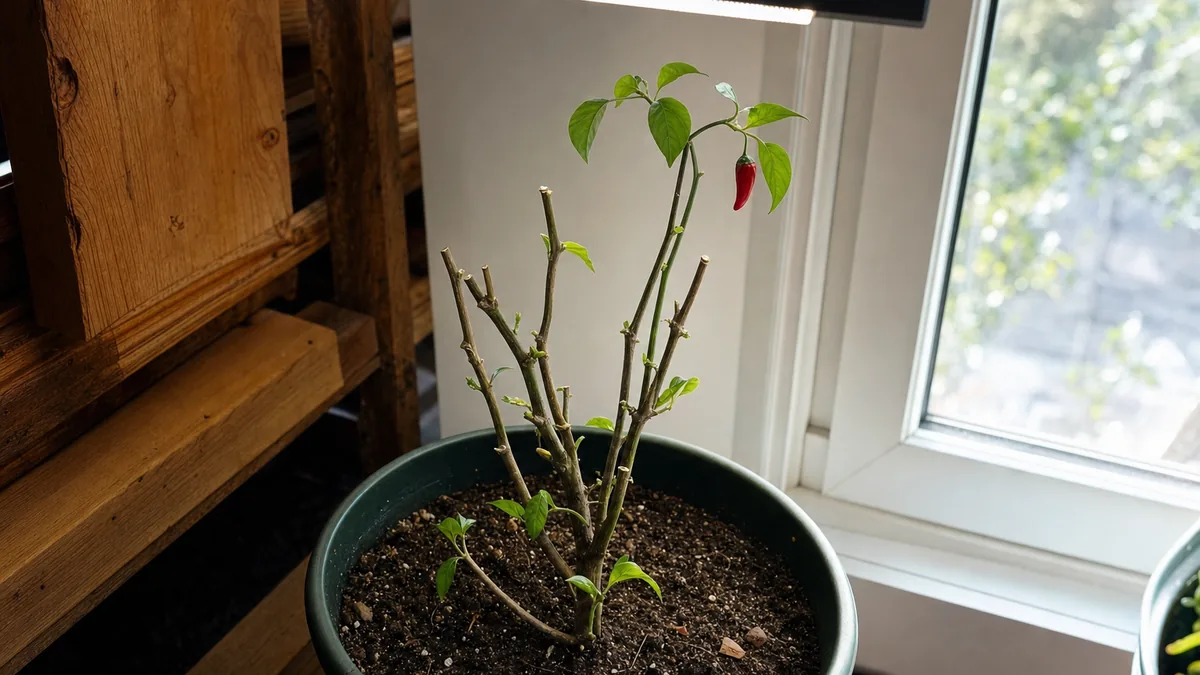
Overwintering Peppers: Quick Reference
| Step or situation | What to do | Source |
|---|---|---|
| Living outdoors all year | Perennial in zones 9b to 11b; elsewhere it dies back at frost | UF/IFAS, NC State |
| Frost forecast | Harvest or protect; NC State says move hot peppers in below 28°F | Purdue, NC State |
| Cool nights | Start moving pots in when nights approach 50°F | Kansas State, Minnesota |
| Pruning | Container plants can be cut back before moving; remove broken or dead branches | Oregon State, Kansas State |
| Pests | Inspect, rinse and isolate for one to two weeks | Minnesota, Kansas State |
| Winter conditions | Keep alive, not growing: 40 to 55°F, a grow light, very little water | Oregon State |
| Back outside | After nights stay above 50°F and the last frost; acclimate over 2 to 3 weeks | Penn State, Iowa State |
Will Pepper Plants Come Back After Winter?
Yes, where winters are frost-free, and sometimes indoors. Peppers are tender perennials that most of us grow as annuals. UF/IFAS Extension calls the ornamental pepper a tender perennial that is perennial in USDA zones 9b through 11b and usually replaced at the end of the season elsewhere. NC State Extension lists the hot pepper (Capsicum frutescens) for zones 9a to 11b, and Maryland Extension calls peppers very tender perennials that its gardeners grow as annuals.
The sources are not tidy on this. NC State’s page for common Capsicum annuum calls it a frost-tender perennial in one place and an annual in another. Treat zone 9b as the line for leaving a plant outdoors, and find yours with our growing zones guide.
Can Pepper Plants Survive Winter Outside?
Only in the warm zones above, and not through a freeze. Purdue Extension’s cold tolerance chart lists peppers as tender and “damaged by light frost,” and says to harvest or protect when the first frost is forecast. Oklahoma State Extension says peppers are very sensitive to light frost, and the University of Georgia says peppers do not tolerate frost. The numbers vary: NC State Extension tells growers of the hot pepper to bring plants indoors when temperatures are predicted to fall below 28°F, and says plants in containers can live in zones 7 and 8 if they come in for winter. Our guide to what temperature frost forms explains why frost can appear when the air reads above 32°F, so do not wait for a freezing forecast. The general timing for any potted plant is in when to bring plants inside for winter.
UF/IFAS says the ornamental pepper dies back after the first frost, so in colder zones a plant you want to keep has to come inside. For setting peppers in a bed, see our spacing and planting guides. Plants that stay out are a different job, and our guide to protecting plants in winter covers covers and mulch.
When to Bring Pepper Plants Inside
Before the first frost, and ideally when nights approach 50°F. Kansas State Extension says to keep tropical plants at or above 50°F at night and to start moving plants a few weeks before cold weather. University of Minnesota Extension says to bring houseplants in once it is below 50°F, and Penn State Extension says to move tropicals indoors before the first frost, noting that many struggle as nights near the low 40s°F. Peppers slow down well before that: University of Illinois Extension says plants grow slowly, leaves may yellow and flowers may drop when nights fall below 50 to 55°F.
My own reading of those figures: bring pots in when nights near 50°F, and treat the first frost forecast as the latest possible day. Look up your first fall frost on our frost dates by city page, or enter your ZIP code in the planting calendar by ZIP code, then count back a few weeks. Green fruit left at that point is the same problem as green tomatoes, another nightshade; our guide to ripening green tomatoes covers tomatoes only, and I found no extension source for peppers. Tomatoes face the same keep-or-replace choice, which can tomato plants survive winter compares.
How to Winter Pepper Plants, Step by Step
The sequence in short, with details in the sections that follow.
- Start two to three weeks ahead. Kansas State says to acclimate plants over a few weeks, starting in a shadier outdoor spot.
- Cut back. Oregon State says container plants can be cut back before moving them.
- Check and clean. Look for aphids, mites and whiteflies, rinse the foliage and scrub the pot.
- Repot if needed. Use fresh mix in a clean pot with drainage holes.
- Pick the spot. A bright window or grow light, at 40 to 55°F per Oregon State.
- Water sparingly. Oregon State says to cut watering back severely, and soggy winter pots invite root rot.
- Wait. Expect leaf drop and almost no growth until spring.
- Move out in spring. After nights stay above 50°F, harden off.
How to Prune Pepper Plants for Winter
Cut back, but I could not find an extension source that gives a percentage for peppers, so I am not giving one. Oregon State Extension says container-grown plants can be cut back before moving them, and Kansas State Extension says to remove only broken or dead branches, since pruning encourages new growth. Iowa State says tender perennials can be pruned just before or after a killing frost. UF/IFAS adds that pinching new growth on an ornamental pepper encourages side branching,.
A sensible cut, as my own judgment and not a sourced rule: strip the fruit and flowers, take out dead and crossing branches, and shorten the rest so the plant fits its window. Make cuts just above a leaf or a branch so growth can restart there.
Potting and Soil for Overwintered Peppers
Keep plants in pots through winter, and give them a clean, well-draining home. Oregon State describes container-grown plants as the ones to overwinter, so a plant growing in the ground is best dug with as much root as you can keep and potted up (my own judgment; no pepper pot size is given). Maryland Extension says a pepper grown in a container all season wants at least a 5 gallon pot, but a cut-back plant needs less. My own estimate: a pot just big enough for the trimmed root ball is safer than a big one, because extra damp mix stays wet around a resting plant. Our plant pot sizes chart shows what each gallon size measures.
Use fresh potting mix, not garden soil, and a pot with drainage holes. Minnesota Extension suggests fresh soil and a clean pot for hard-to-control pests, and Kansas State says a plant with many roots circling the pot edge is rootbound. Wet, heavy mix is the main winter risk.
Pests to Check Before Peppers Come Indoors
Check every pot before it crosses the door. Minnesota Extension names fungus gnats, aphids and spider mites as common hitchhikers and advises isolating returning plants, and NC State Extension’s pepper page lists aphids and whiteflies as pepper pests. Minnesota’s guide to insects on indoor plants covers the four below, and our guide to holes in plant leaves helps when the damage is chewing and not sucking.
- Aphids. Minnesota Extension says they are about 1/16 to 1/8 inch long, usually green, and leave sticky honeydew. Wash them off, dab with an alcohol-dipped cotton swab or use a forceful water spray.
- Spider mites. Minnesota says they cause speckled, bleached-looking leaves and fine webbing, and thrive in dry, warm conditions. Tap a leaf over white paper to see them. Wash plants and use insecticidal soap or plant oil extracts.
- Whiteflies. Minnesota says adults flutter up when you handle the plant and young stages sit on the leaf undersides. Wash plants and use yellow sticky cards.
- Fungus gnats. Minnesota says they rarely damage plants and are mostly a nuisance. Let the surface soil dry between waterings and use yellow sticky cards.
Kansas State Extension adds a pre-move routine: spray foliage with a jet of water, then soak the pot in warm water up to the lip for 15 minutes and let it drain. Minnesota says to quarantine for one to two weeks, check weekly and follow the pesticide label.
How to Keep Pepper Plants Over Winter: Light and Water
Give light, hold the temperature low and water sparingly. Oregon State Extension says to keep overwintered plants in stasis, alive and not growing, at 40 to 55°F, because above 55°F winter days are too short for fruit to ripen and there are no pollinators indoors. It says a greenhouse is not needed and that a garage under a grow light works, and it advises cutting watering back severely and waiting until spring to fertilize. Iowa State Extension says live indoor plants go in a sunny spot and should be checked regularly for pests. Keeping a pepper in stasis is one form of overwintering, and what is overwintering sets it beside mulching, cuttings and cold storage.
Window light alone can be thin in winter. If the plant stretches, a lamp helps, and our comparison of LED and fluorescent grow lights covers which fits a shelf. Stretching from too little light is the same problem our guide to leggy seedlings explains for young plants. Another plant that spends winter indoors is covered in our guide to overwintering rosemary.
On water, University of Minnesota Extension says to avoid overwatering and let the soil dry between waterings. Iowa State says to water live indoor plants when the soil is dry. No source gives a fixed schedule for peppers, so check the mix with a finger and water only when it is dry. Each potted plant dries at its own pace, and the Houseplant Care App (see the app) gives each potted plant its own watering, feeding and repotting rhythm.
What to Do With Pepper Plants in Winter
Mostly nothing. Expect a slow winter. Minnesota Extension says yellowing and leaf drop are common after plants move indoors and that plants usually recover with proper care, so a bare-looking pepper is not necessarily a dead one. Give it time. If leaves keep yellowing, use our yellow leaves diagnosis, and if the plant droops, check the roots and moisture with our guide to why plants wilt.
Check weekly for pests and wet soil, and pick off dropped leaves. Iowa State says to fertilize live indoor plants every 2 to 4 weeks in late winter and early spring, so wait until then. If you want something actually growing through the cold months, our what to plant in winter post lists crops that suit the season.
Moving Overwintered Peppers Back Outside
Wait for warm nights and the last frost. Penn State Extension says tropicals can go back out once nighttime temperatures stay above 50°F, and compares them to tomatoes and peppers. Iowa State says to move plants outside after the last frost and to acclimate them to outdoor light gradually over 2 to 3 weeks. Ohio State Extension describes hardening off for pepper seedlings as a few hours outdoors in sun, increased over one to two weeks, with plants brought in before sunset.
In practice, move out about when you would set out store-bought transplants. Look up the last frost for your area, for example on our zone 6b frost dates page, or the page for your own zone. Start in shade, then increase sun, and pot up or plant out once new growth appears.
Overwinter Peppers or Start New Plants?
Here is what the sources support. Oregon State says the goal is just keeping plants alive, with no ripening in winter. NC State says the hot pepper is a perennial that generally lasts only 2 years, with most fruit in the first year. So an old plant is not a guaranteed bigger harvest. My own judgment: save a plant with traits you cannot replace if you have a bright, cool spot, and sow new seed if you have only a warm living room.
New seed needs lead time. NC State says to start pepper seed indoors 6 to 8 weeks before the last frost, Ohio State says 8 to 10 weeks, and Maryland Extension says 8 to 10 weeks and up to 12 for some types. That puts sowing in late winter. Our pepper seed guide has the steps, and our guide to damping off covers the main risk for young seedlings. I did not find an extension source for rooting pepper cuttings, so I do not give a method here.
Free book · 25 pages, PDF
How to Overwinter Pepper Plants FAQ
Will pepper plants come back after winter?
Yes, in frost-free climates. UF/IFAS Extension says the ornamental pepper is perennial in zones 9b through 11b and is replaced at the end of the season elsewhere. NC State Extension lists the hot pepper for zones 9a to 11b. In colder zones, a plant brought indoors can return to the garden in spring.
Can pepper plants survive winter outside?
Only in warm zones. Purdue Extension lists peppers as tender and damaged by light frost, and NC State Extension says to bring hot peppers indoors when temperatures are forecast below 28 degrees F. UF/IFAS says the plant dies back after the first frost.
Can you overwinter pepper plants indoors?
Yes. Oregon State Extension describes keeping overwintered plants alive at 40 to 55 degrees F, cutting back container plants before the move and cutting watering severely. A bright window or a grow light supplies the light.
When should I bring pepper plants inside?
Before the first frost, ideally when nights approach 50 degrees F. Kansas State Extension says to keep tropical plants at 50 degrees F or above at night, and Minnesota Extension says to bring plants in once it is below 50.
How do you prune pepper plants for winter?
Oregon State Extension says container plants can be cut back before moving them, and Kansas State Extension says to remove broken or dead branches. No extension source gives a percentage for peppers, so cut only what you need to remove dead growth and fit the plant to its spot.
What pests should I check for before bringing peppers in?
Aphids, spider mites, whiteflies and fungus gnats. Minnesota Extension names them as common hitchhikers, advises washing plants and isolating them for one to two weeks. Kansas State Extension adds a jet of water and a 15 minute soak of the pot in warm water.
When can overwintered peppers go back outside?
After the last frost and once nights stay above 50 degrees F, according to Iowa State and Penn State Extension. Iowa State says to acclimate plants to outdoor light over 2 to 3 weeks, and Ohio State Extension describes hardening off as a few hours a day over one to two weeks.
Sources & further reading
Perennial status, zones, frost and cold nights come from UF/IFAS Extension’s ornamental pepper publication, NC State Extension Plant Toolbox entry for hot pepper, NC State Extension’s Capsicum annuum entry, University of Maryland Extension’s pepper guide, Ohio State Extension’s pepper factsheet, Purdue Extension’s cold tolerance chart, Oklahoma State Extension’s pepper production fact sheet, University of Georgia Extension’s home garden peppers publication and University of Illinois Extension’s pepper Hort Answers page.
Overwintering, timing, pruning and moving outdoors are from Oregon State Extension’s overwintering article, University of Minnesota Extension’s guide to bringing houseplants in for winter, Kansas State Research and Extension’s houseplant guide, Penn State Extension’s tropical plants to overwinter, Iowa State Extension’s guide to overwintering plants and Washington State University Extension’s container overwintering guide.
Pest identification and control are from University of Minnesota Extension’s guide to insects on indoor plants.
Free book · 25 pages, PDF
The Indoor Plants Repotting Cheat Sheet
Sent