The best time to plant vegetables by moon phase, in the tradition, is above-ground crops while the moon waxes and root crops while it wanes. University of Illinois Extension reports that a review of over 120 references found no consistent lunar influence on plants, so let your frost dates and soil temperature set the window, and use the moon only to choose between two workable days.
Planting by Moon Phase Quick Reference
| Crop type | Moon tradition says | What decides the date | Source |
|---|---|---|---|
| Lettuce and other leafy crops (above ground) | Plant while the moon waxes, new to full | Soil can be worked; germination minimum 35°F for lettuce | Old Farmer’s Almanac, Farmers’ Almanac, Alabama Extension |
| Tomatoes, squash, corn (above ground, warm season) | Plant while the moon waxes | Frost-free dates and warm soil; tomato germination minimum 50°F, best 70 to 95°F | Old Farmer’s Almanac, Alabama Extension |
| Beans (above ground) | Plant while the moon waxes | Soil above 60°F | Farmers’ Almanac, Utah State Extension |
| Carrots, onions, potatoes (below ground) | Plant while the moon wanes, full to new | Cool soil, weeks before the last frost; carrot germination minimum 40°F, onion 35°F | Old Farmer’s Almanac, Alabama Extension |
| Any crop, any day | The Old Farmer’s Almanac calls it a judgment call and says seeds grow well any time of the month | Frost, soil temperature, crop type | Old Farmer’s Almanac, Illinois Extension, WSU Extension |
What Does Planting by the Moon Mean?
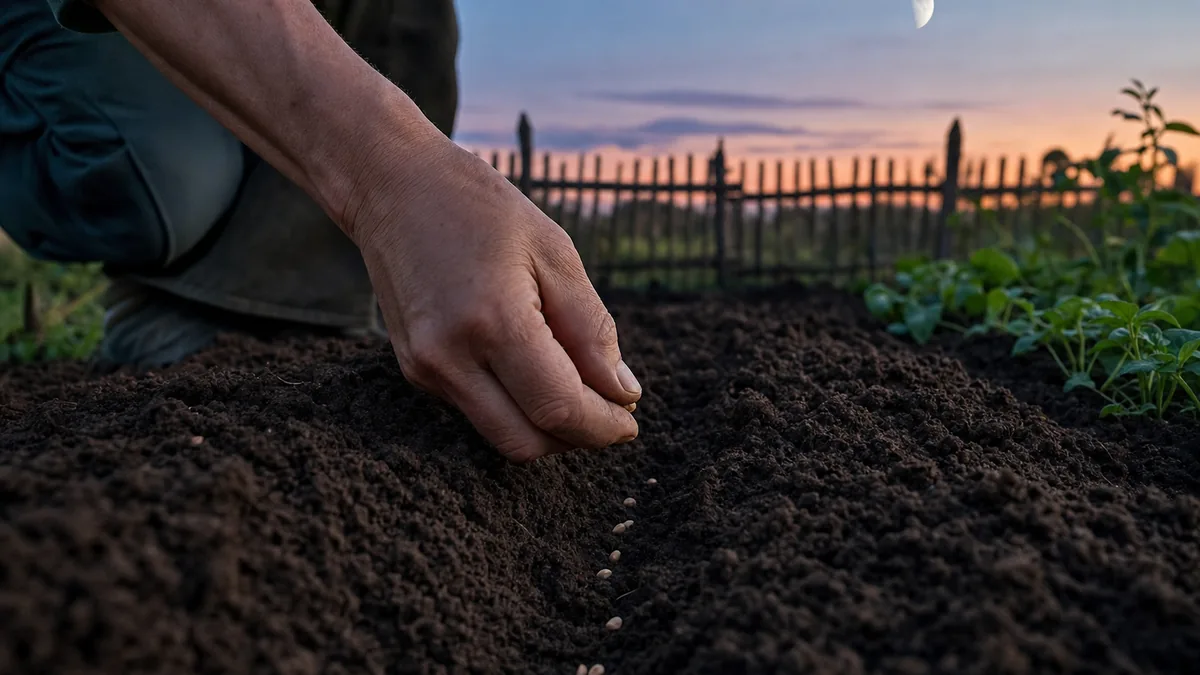
Planting by the moon is an old rule of thumb that ties the sowing date to the moon’s phase. According to NASA, the moon’s phases repeat about every 29.5 days, and the tradition splits that cycle in two. While the moon is waxing, meaning the lit part grows from new moon toward full moon, you sow crops that bear their harvest above ground, such as lettuce, beans, tomatoes, squash and corn. While it is waning, from full moon back to new, you sow crops that bear below ground, such as carrots, potatoes, onions and beets.
The usual explanation is moisture. Washington State University Extension’s Yakima County master gardener column describes the belief that the moon pulls on soil moisture and sap the way it pulls on tides, and that seeds absorb the most water around the new and full moon. The same column traces the practice back to Mesopotamia, Egypt and Rome, so this is not a modern fad. Gardeners who plant this way are following a long line of farmers, and that is worth respecting even where the evidence is thin.
For the sowing depth, spacing and timing of each crop, see the rest of our spacing and planting guides.
What Does the Farmers Almanac Say About Planting by the Moon?
There are two separate publications, and they word it differently. Neither claims the moon beats the weather.
The Old Farmer’s Almanac
The Old Farmer’s Almanac (almanac.com) gives the same two-part rule. On its planting by the moon page it says to plant annual flowers and fruit and vegetables that bear above ground from the day the moon is new to the day it is full, and to plant flowering bulbs, biennial and perennial flowers and vegetables that bear below ground from the day after it is full to the day before it is new again. It names corn, tomatoes, watermelon and zucchini as above-ground examples, and carrots, onions and potatoes as below-ground ones.
The same page is candid about the evidence. It says there is some evidence that the moon phases might have a small impact on plant growth, notes that other studies call the practice folklore, and says soil quality, sunlight and water matter more. It calls timing by the moon a judgment call and says seeds will certainly grow perfectly well any time of the month they are planted, given proper care. It also separates the two methods it publishes: planting by the moon is astronomical, depending on the phase, while what folks call the Best Days by the Moon is astrological, based on the zodiac.
On the date side, the page says its Gardening Calendar customizes planting dates by the last spring frost and lunar cycles for your ZIP or postal code. The calendar page describes a toggle that shows dates aligned with the moon’s phases for gardeners who plant by lunar tradition, and that can be switched off. The almanac does not publish its calculation steps on those pages, so treat its dates as its own guidance and not as a universal rule.
The Farmers’ Almanac
The Farmers’ Almanac (farmersalmanac.com) calls gardening by the moon an ancient concept and a fundamental part of its philosophy. Its gardening calendar page says moisture rises from the new moon toward the first quarter, calling that the best time for above-ground crops like lettuce, tomatoes, beans and squash. It describes the days after the full moon as traditionally favored for root crops, pruning, harvesting and soil work, and it attributes the effect to lunar gravity acting on groundwater and sap flow.
That page also contains the caveats. It says modern science has not definitively proven lunar gardening effects in controlled studies, that moon gardening does not replace good soil, proper timing or climate awareness, and that its dates are the same across all growing zones, so readers should consider regional weather and climate before following them. The Old Farmer’s Almanac customizes by frost date, while the Farmers’ Almanac page says its dates do not vary by zone. Both ask you to use the weather where you live. For the frost-date numbers behind the almanacs, our comparison of almanac frost dates and NOAA data shows where they come from.
What Are the Best Days to Plant Above Ground Crops?
By the tradition, the best days to plant above ground crops are the days between a new moon and the following full moon, which is about two weeks of every month. The Farmers’ Almanac narrows it further to the stretch from new moon to first quarter for leafy and stem growth, and calls the full moon itself a strong window for planting and transplanting. The Old Farmer’s Almanac keeps it simpler: any day from new to full.
Specific dates are where readers get stuck. A page that lists the best planting days for a given month is only good for that month: twelve cycles of 29.5 days add up to 354 days, so every phase lands about 11 days earlier on the calendar each year, and the almanacs recalculate every edition. The Old Farmer’s Almanac says its Gardening Calendar is updated yearly. So if you see a list of lucky dates for a past year, ignore it, and check the current edition or its online calendar, entering your own ZIP code. This article does not reprint any year’s dates, because they would be out of date within a season.
Notice also that the tradition only works if the day is plantable at all. A waxing-moon day in late March does not make it safe to set out tomatoes. Beans are a good test case: Utah State University Extension says they need soil and air temperatures above 60°F for best germination and plant growth, and that seedlings emerge in 7 to 10 days from soil that has warmed to 65 to 85°F. The moon does not warm the soil. Our guide to growing beans from seed starts from the temperature, not the lunar phase.
Does Planting by the Moon Work? What Extension Research Says
Extension sources that look at the question do not find reliable evidence for it, and several say so in plain terms.
- University of Illinois Extension (Ryan Pankau, April 2022) summarizes a review in the journal Agronomy of over 120 references. It reports that the moon’s gravitational effect on Earth is about 300,000 times weaker than Earth’s own gravity, and that against the force needed to move sap up a stem the moon’s pull is completely imperceptible. A full moon’s light is about 128,000 times less than sunlight, and it was not found to matter for photosynthesis. The conclusion, in its words: no consistent relationship was identified that supports a lunar influence on plant life.
- Washington State University Extension (Yakima County, master gardener Carol Barany) cites the same review and the Illinois article, and quotes it as finding no reliable science-based evidence for any relationship between lunar phases and plant physiology. It adds that local soil temperature and frost dates matter more than the calendar, and points readers to their local extension office.
- NC State Extension (Henderson County) calls planting by the signs a practice with little basis in fact, citing the same research, but ends with a shrug: if it works for you, do it, since people who plant by the moon may also pay closer attention to their plants.
- University of Washington Botanic Gardens (Plant Answer Line) reports that an astronomer could not find extensive scientific studies testing the proposed benefits of lunar gardening, and that more studies are needed. It also notes that the extra care lunar gardeners give their plants may help whether or not the moon is involved.
- University of Arkansas Cooperative Extension describes the waxing and waning rule as relatively straightforward, with potatoes, onions and carrots in the waning phase, and says a subtle effect on plants is easy to speculate about but hard to prove.
The pattern is consistent. None of these sources says the tradition is proven, none says gardeners who follow it are doing harm, and the one finding that came close to a moon effect was narrow: Illinois Extension notes a Middle Eastern shrub that produced more pollen under a full moon, which may have helped pollination. That is a long way from a rule for sowing carrots. The fair summary is that the moon makes a fine calendar convention and a poor predictor of germination or yield.
This does not make the practice worthless. A gardener who plants by the moon usually also keeps notes, checks the beds on a schedule and sows in small batches, and those habits are what the University of Washington and NC State pages credit. Sowing a short row of carrots every two weeks is how succession planting works anyway, and the moon makes a handy reminder for it.
What Actually Decides the Best Planting Days?
Three things, in this order: the last spring frost for your location, the temperature of the soil, and the crop. The moon sits well behind these.
Frost dates
Frost kills tender seedlings and transplants, and cool-season crops are timed backward from the last frost, warm-season crops forward. Our zone data show how much that varies. The median last spring frost for zone 6b is Apr 23, and for zone 7a frost dates it is Apr 16. That is a week’s difference in a single zone step. Your own ZIP code will differ from either figure, so a zone page such as the one for zone 6b frost dates is only a starting point.
Soil temperature
Alabama Extension’s publication ANR-1061 lists minimum soil temperatures for seed germination: 35°F for lettuce, 40°F for carrot, 35°F for onion, 50°F for tomato and 60°F for snap bean. Its optimal ranges are higher, for example 70 to 95°F for tomato and 65 to 85°F for snap bean. A seed planted on the best moon day into soil below its minimum is a poor bet, and a seed planted on a so-called wrong day into good soil is not. Measure the bed first, using the readings and probe depth in our guide to soil temperature for planting.
Crop type
Cool-season crops such as lettuce, carrots and onions go in before the last frost; tender crops such as tomatoes, beans and squash wait until after it. The crop is the biggest lever, which is why the moon only makes sense as a tie-breaker inside a window that frost and soil have already approved.
Worked Example: Zone 6b Dates With the Moon as Tie-Breaker
Here is the calculation using our planting calendar data. We use the zone 6b median last spring frost from our frost data, Apr 23, and apply the planting calendar’s offsets in weeks. Zone 6b includes Chicago and Columbus in our state data, so readers in Illinois and Ohio can compare this with their own state’s full table, which also covers more crops. The offsets are the calendar’s own rules of thumb, each listing an extension source on the planting calendar pages. They are ranges, not guarantees.
| Crop | Moon group | Calendar offset from Apr 23 | Calculated window |
|---|---|---|---|
| Lettuce (direct sow) | Above ground, waxing | 2 to 4 weeks before | Mar 26 to Apr 9 |
| Carrots (direct sow) | Below ground, waning | 2 to 5 weeks before | Mar 19 to Apr 9 |
| Onion sets or transplants | Below ground, waning | 2 to 4 weeks before | Mar 26 to Apr 9 |
| Beans (direct sow) | Above ground, waxing | 0 to 1 weeks after | Apr 23 to Apr 30 |
| Tomatoes (start indoors, then transplant) | Above ground, waxing | 6 to 8 weeks before; transplant 1 to 2 weeks after | Start Feb 26 to Mar 12; transplant Apr 30 to May 7 |
The arithmetic is plain: 4 weeks before Apr 23 is 28 days earlier, Mar 26; 2 weeks before is Apr 9; 5 weeks before is 35 days earlier, Mar 19. Six weeks before is Mar 12 and 8 weeks before is Feb 26. One week after is Apr 30 and two weeks after is May 7. Notice what the table shows. The carrot window is three weeks long, and the waxing half of a lunar cycle is only about 14.75 days (half of NASA’s 29.5), so a three-week window always contains some waning days. The lettuce window is two weeks, so it may fall wholly inside one phase. Either way, the moon never moves a date outside the window.
The dates also cannot show the soil. Utah State University Extension says beans want soil above 60°F, and tomatoes, with a best germination range of 70 to 95°F per Alabama Extension, are the same story: the offsets are a starting estimate, and a thermometer has the last word. For the rest of your crops, enter your ZIP code and get this month’s list, which uses your own frost dates instead of a zone median.
How to Use the Moon as a Tie-Breaker
If you garden by the moon and want to keep doing it, here is a way that does not cost you a crop. The moon only decides between days that the frost date and the soil have already approved.
- Find your window. Get your last frost date and apply the crop’s offset, as in the table above.
- Check the soil. Take the bed’s temperature on three mornings and compare it with the crop’s minimum. If it is below, wait, whatever the phase.
- Look up the phase. Use the current edition of an almanac, or any lunar calendar, and mark the waxing and waning days inside your window.
- Match crop to phase. Above-ground crops on waxing days, below-ground crops on waning days, as the Old Farmer’s Almanac describes.
- Do not wait for the perfect day. If the weather is right and the moon is not, plant anyway. The Old Farmer’s Almanac itself says seeds will grow well any time of the month.
- Keep a note. Write down the sowing date, the phase and the result. Several extension pages credit careful tending, not the moon, so your own notes are the best evidence you will get.
Root crops are where the waning rule bites in the spring, because they go in early. Onions, for example, are laid out step by step in how to plant onion sets. If you would rather not do the date math for every crop, the Season Planner puts every date for your own ZIP code into one plan.
Free book · 23 pages, PDF
Planting by Moon Phase FAQ
What is the best time to plant vegetables by moon phase?
By tradition, plant above-ground crops while the moon waxes (new to full) and root crops while it wanes (full to new). The Old Farmer's Almanac describes it this way, but it also says seeds grow well any time of the month, so use the moon only to choose between days that suit your frost date and soil.
What does the Farmers Almanac say about planting by the moon?
The Old Farmer's Almanac says to plant above-ground crops from new moon to full moon and below-ground crops from the day after full to the day before new. The Farmers' Almanac says moisture rises from new moon toward first quarter, favoring crops like lettuce, tomatoes, beans and squash, and also says science has not definitively proven lunar gardening effects in controlled studies.
Does planting by the moon actually work?
Extension sources find no reliable evidence that it does. University of Illinois Extension summarizes a review of over 120 references that found no consistent relationship supporting a lunar influence on plant life, and WSU Extension quotes the review's finding of no reliable science-based evidence. Planting by the moon is harmless, though, and may encourage careful tending.
What are the best days to plant above ground crops?
In the tradition, any day between a new moon and the next full moon, about two weeks a month. The exact dates change every year, so check the current edition of the almanac or its online calendar for your ZIP code. The Old Farmer's Almanac says its Gardening Calendar is updated yearly and customized by your last spring frost.
Should I follow the almanac's best planting days over my frost date?
No. Frost and soil temperature come first. Utah State University Extension says beans need soil and air above 60°F, and Alabama Extension lists 50°F as the germination minimum for tomato. A favorable moon day cannot warm cold soil. Washington State University Extension says local soil temperature and frost dates matter more than the calendar.
Is the Farmers Almanac planting calendar the same every year?
No. The phases fall about 11 days earlier each year, and the Old Farmer's Almanac says it updates its Gardening Calendar yearly, so dates from a past edition do not carry over. Twelve cycles of NASA's 29.5 days fall about 11 days short of a year. Always use the current year's calendar for your ZIP code.
Sources & further reading
The moon tradition and the almanacs: The Old Farmer’s Almanac, Planting by the Moon Phase, The Old Farmer’s Almanac, Gardening Calendar and The Farmers’ Almanac, gardening calendar. Phase cycle: NASA Science, Moon Phases.
Research and extension: University of Illinois Extension, Lunar Influence on Gardening, WSU Extension, Yakima County, Gardening by the Moon, NC State Extension, Henderson County, University of Washington Botanic Gardens, Lunar gardening and University of Arkansas Cooperative Extension, Planting by the signs.
Frost, soil and crop timing: Alabama Extension, Soil Temperature Conditions for Vegetable Seed Germination and Utah State University Extension, Beans in the Garden. The planting calendar offsets and zone medians in the worked example come from the site’s own planting calendar and frost data, which list an extension source for each crop.
Free book · 23 pages, PDF
The Spacing & Planting Cheat Sheet
Sent