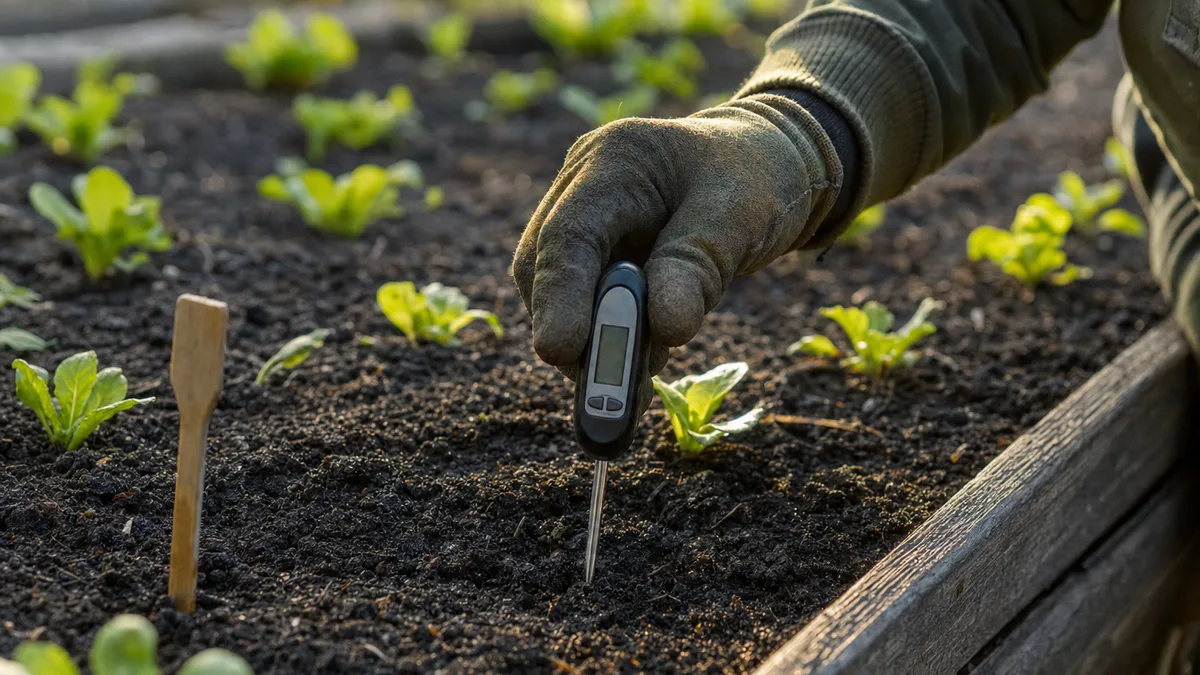
Soil temperature for planting matters because every vegetable has a minimum below which its seed is a poor bet. Alabama Extension lists 35°F for lettuce and spinach, 50°F for tomato and corn, and 60°F for cucumber, squash and snap bean. Push a thermometer 2 to 4 inches into the bed, take the reading at the same time for three mornings in a row, and compare it with the table below. Each crop’s own sowing advice is in our guides to growing cucumbers, beans and peppers from seed.
Soil Temperature Quick Facts
| What | Answer | Source |
|---|---|---|
| Probe depth | 2 inches for seeds, 4 to 6 inches for transplants; Colorado State says about 4 inches | UW-Madison Extension, Colorado State Extension |
| When to measure | Early morning when the soil is coolest, or at the same time each day | Colorado State Extension, UW-Madison Extension |
| How many readings | Three consecutive days, from several spots in the garden | UW-Madison Extension, Colorado State Extension |
| Lowest germination minimum of the 15 crops | 35°F for lettuce, spinach and onion | Alabama Extension (ANR-1061) |
| Highest germination minimum of the 15 crops | 60°F for pepper, cucumber, squash, snap bean and cantaloupe | Alabama Extension (ANR-1061) |
| Tomato transplants | Prefer 60 to 65°F soil | Colorado State Extension |
What Soil Temperature Means for Planting
The frost date tells you when the air is likely to stop freezing. The soil is a separate question, and the extension tables are written in it. Alabama Extension’s publication ANR-1061, revised in January 2023, gives for every crop a minimum, an optimum range and a maximum soil temperature for seed germination. Its table covers 27 vegetables, from asparagus to watermelon, and the numbers vary a lot: a pea seed has a 40°F minimum, while a pepper seed has a 60°F minimum.
The same publication notes that in the field, optimum germination temperatures can be reached by choosing the proper planting date. Our planting calendar pages give a starting date by city to check against. That is the whole idea of planting by soil temperature. You are not guessing at a calendar date; you are checking whether the bed has reached the number your crop needs.
Two different kinds of table are in use, and it helps to know which one you are reading. Alabama’s is a germination table: the lowest temperature at which seed of that crop germinates, and the range where it does best. The University of Wisconsin-Madison Extension, in an article by horticulture educator Lisa Johnson (revised January 2025), gives a minimum soil temperature to plant for each crop. Those numbers run higher than Alabama’s for every crop in the table below, for example 70°F for tomato against Alabama’s 50°F germination minimum. Neither is wrong; they answer different questions, so the table below shows both.
Minimum Soil Temperatures for 15 Vegetables
The first two columns come from Alabama Extension’s germination table, the last from UW-Madison Extension’s planting table. Alabama lists the crop as “corn” and “Bean, Snap”; Wisconsin lists “Corn” and “Beans”, so those rows are the closest match. Neither publication includes potatoes, so they are not in the table. Our guides to growing potatoes and peanuts cover the soil temperatures those crops want.
| Vegetable | Germination minimum (Alabama) | Best germination range (Alabama) | Minimum to plant (Wisconsin) |
|---|---|---|---|
| Lettuce | 35°F | 40 to 80°F | 45°F |
| Spinach | 35°F | 45 to 75°F | 45°F |
| Pea (English) | 40°F | 40 to 75°F | 50°F |
| Radish | 40°F | 45 to 90°F | 45°F |
| Carrot | 40°F | 45 to 85°F | 45°F |
| Beet | 40°F | 50 to 85°F | 45°F |
| Onion | 35°F | 50 to 95°F | 60°F |
| Cabbage | 40°F | 45 to 95°F | 55°F |
| Corn | 50°F | 60 to 95°F | 55°F |
| Tomato | 50°F | 70 to 95°F | 70°F |
| Pepper | 60°F | 65 to 95°F | 65°F |
| Cucumber | 60°F | 60 to 95°F | 65°F |
| Squash | 60°F | 70 to 95°F | 70°F |
| Snap bean | 60°F | 65 to 85°F | 72°F |
| Cantaloupe | 60°F | 75 to 95°F | 68°F |
Read the table as two floors. If the soil is below the Alabama number, seed of that crop is below its germination minimum. If it is below the Wisconsin number, you are under the temperature that university advises for planting. The Wisconsin number is the higher one for all 15 crops. It is 5 degrees higher for radish, carrot, beet, corn, pepper and cucumber, and the widest gaps are onion (25 degrees), tomato (20) and cabbage (15). If you want to be cautious, use the higher number.
Transplants are a separate case. Colorado State Extension says tomato transplants prefer soil between 60 and 65°F, and UW-Madison Extension tells you to measure at 4 to 6 inches for transplants instead of the 2 inches it uses for seeds.
How to Test Soil Temperature
All you need is a thermometer that can go into the ground. The extension guides we checked use a probe or a standard thermometer, and what matters more than the type is that you take every reading the same way. The steps below follow UW-Madison Extension and Colorado State Extension.
- Pick your spots. Colorado State suggests taking measurements from several locations in the garden, because one corner can run warmer or cooler than another.
- Push the thermometer to the right depth. UW-Madison says 2 inches for seeds and 4 to 6 inches for transplants. Colorado State says about 4 inches. If you plan to sow seed, use 2 inches; for transplants, use 4.
- Take the reading at the same time each day. Colorado State says to measure early in the morning, when the soil is coolest. UW-Madison says to take readings on three consecutive mornings at the same time, and names a window of 10 a.m. to noon. The two sources differ on the clock time, so choose one and stay with it.
- Repeat for three days in a row. A single reading can mislead after one warm or cold night. UW-Madison’s rule is three consecutive days.
- Compare each reading with your crop’s number. Use the table above. If all three readings clear the minimum, you have a reason to plant. If they are close, wait a few days and measure again. Sowing into cold, wet soil is also a classic setup for damping off.
Here is how that plays out. Suppose three mornings at 4 inches read 48°F, 52°F and 55°F, and you want to sow corn. Alabama’s germination minimum for corn is 50°F, so the first morning was just under it. Wisconsin’s planting minimum for corn is 55°F, which only the third reading reached. A cautious gardener would wait until all three days clear 55°F. This is an illustration with made-up readings, not a recommendation from either university.
Soil Temp Map: Where to Find Local Readings
No single national map gives a soil temperature for your street. What exists are networks of monitoring stations, run by federal agencies and by state universities, and each station publishes its own readings. The table lists the ones we could confirm and what each one shows. We link to them and do not copy their maps or data, because they update on their own schedules.
| Source | What it shows | Coverage and update |
|---|---|---|
| NOAA Climate Prediction Center, daily soil temperature | Daily mean soil temperature at 4 inches below the ground | About 50 stations across the southern and midwestern US, posted within 12 hours, from NWS cooperative observers. NOAA states that no quality control is applied. |
| USDA NRCS Soil Climate Analysis Network (SCAN) | Soil temperature and soil moisture at 2, 4, 8, 20 and 40 inches | Over 200 stations nationwide, with hourly reports for the last 24 hours and daily reports |
| Oklahoma Mesonet | 24-hour average soil temperature at 4 inches | Oklahoma stations, updated each day between 7 and 8 a.m. |
| TexMesonet (Texas Water Development Board) | Soil temperature in °F at 5, 10, 20 and 50 cm | Texas stations, logged every 5 minutes |
| NWS North Central River Forecast Center | Soil temperature maps by depth, plus a downloadable CSV of the past three days | Published by the NWS office in Chanhassen, Minnesota; the page does not state its coverage area |
| US soil moisture map (drought.gov portal) | Soil moisture, not temperature, at 5, 20 and 50 cm | United States including Alaska, Hawaii and Puerto Rico, updated daily; run with NOAA, NIDIS, USGS and USDA |
The NOAA and NRCS sources are national, but their stations are not evenly spread, so the nearest one may be a long way off. The state networks are denser inside their own states. If your state is not in the table, search for your state’s extension service or mesonet; many land-grant universities publish their own readings, and we only list the pages we could open and read.
Station readings are a guide, not your garden’s temperature. A station sits in one open spot with one kind of cover, and Oklahoma’s page says its reading is taken under the existing vegetative cover. A bed in afternoon shade, or a raised bed in full sun, can differ. That is why the extension guides still tell you to take your own reading.
Putting Soil Temperature and Frost Dates Together
Soil temperature and frost dates work as a pair. A frost date is a calendar estimate built from decades of weather records; a soil reading is today’s fact. Use the frost date to pick a window, then use the thermometer to choose the day. Our guide to frost dates from NOAA and the Almanacs explains where those dates come from, and what temperature frost forms at explains why the air can freeze a tender seedling even when the soil has warmed.
Cool-season crops sit at the low end of the table, so they can go in early. Warm-season crops need the soil to catch up with the air, which is why a tomato bed can look ready and still sit below the Wisconsin 70°F figure. For the bigger picture of how zones and dates fit together, see USDA hardiness zones explained.
Lawns follow the same logic with their own numbers. Our guide to when to overseed a lawn lists the soil temperature cues for cool-season and warm-season grass.
For every topic in this cluster, from sowing to spacing, see our complete guide to spacing and planting.
Common Soil Temperature Mistakes
- Trusting one reading. UW-Madison Extension asks for three consecutive days. One mild afternoon says little about the next cold night.
- Measuring in one spot. Colorado State Extension says to take measurements from several locations. Sun, shade and a sheltered wall change what a thermometer shows.
- Using the wrong depth. Seeds sit near the surface and transplant roots sit deeper, which is why UW-Madison uses 2 inches for one and 4 to 6 inches for the other.
- Mixing up the two kinds of minimum. A germination minimum is not a planting recommendation. Alabama’s 50°F for tomato seed and Wisconsin’s 70°F to plant are different questions, as the table shows.
- Treating a station reading as your own. Use it to see the trend, then confirm with a probe in your bed.
Free book · 23 pages, PDF
Soil Temperature FAQ
How do I find the soil temperature near me?
Look for the closest station that publishes soil temperature, because the networks report by station, not by address. The NOAA Climate Prediction Center posts a daily 4-inch reading for about 50 stations in the southern and midwestern states, NRCS SCAN covers over 200 stations at depths from 2 to 40 inches, and state networks such as the Oklahoma Mesonet and TexMesonet publish their own. If none is close to you, take your own reading with a thermometer.
Is air temperature enough, or do I need soil temps near me?
Soil temperature is the number the extension tables use. Alabama Extension lists germination minimums as soil temperatures, and UW-Madison Extension gives a minimum soil temperature to plant for each crop. A frost date is a good way to pick a planting window, and a soil reading then tells you whether the bed has caught up.
Is there a soil temperature by zip code map?
We did not find one from NOAA, NRCS or an extension service. The networks publish by station. What you can look up by ZIP code is your average last spring frost, which helps you choose a planting window. Then check the nearest station or your own thermometer for the soil.
How to know soil temperature if you do not have a thermometer?
The extension guides we read all use a thermometer: UW-Madison Extension uses a probe, and Colorado State says to insert a thermometer about 4 inches into the soil. Without one, the closest substitute is a nearby station reading from the networks above. We found no extension source that gives a reliable test by feel, so we do not offer one.
What soil temperature is too cold to plant tomatoes?
Sources differ because they answer different questions. Alabama Extension lists 50°F as the germination minimum for tomato seed, with 70 to 95°F as the best range. UW-Madison Extension gives 70°F as the minimum soil temperature to plant, and Colorado State Extension says tomato transplants prefer 60 to 65°F. A reading under 50°F is below all three numbers.
How deep do you put a soil thermometer?
UW-Madison Extension says 2 inches for seeds and 4 to 6 inches for transplants. Colorado State Extension says to insert the thermometer about 4 inches into the soil. Pick the depth that matches what you are planting, and use the same one every day.
Sources & further reading
Germination minimums, best ranges and the 27-crop table come from Alabama Cooperative Extension System’s Soil Temperature Conditions for Vegetable Seed Germination (ANR-1061). Minimum soil temperatures to plant, the probe depths and the three-day rule come from University of Wisconsin-Madison Extension’s When is the right time to plant vegetable seeds? Check soil temperature. The early-morning reading, the 4-inch depth, the several-locations advice and the tomato transplant range come from Colorado State University Extension’s Soil Temperatures, Frosts and Planting Dates.
Station networks: NOAA Climate Prediction Center, USDA NRCS SCAN, Oklahoma Mesonet, TexMesonet, NWS North Central River Forecast Center and the drought.gov US Soil Moisture Networks Portal. All page descriptions were read in October 2026. For how we source the facts behind every guide on this site, see our methodology page.
Free book · 23 pages, PDF
The Spacing & Planting Cheat Sheet
Sent