Learning how to grow cucumbers from seed is the easy part: the seeds germinate readily in warm soil, and most gardeners have seedlings up within a week or two without much trouble. The real problem shows up later: the plant flowers heavily, sometimes for weeks, and never sets a single cucumber. That’s almost always a pollination issue, not a growing mistake, and it’s the problem this guide is built around.
Direct Sow or Start Indoors?
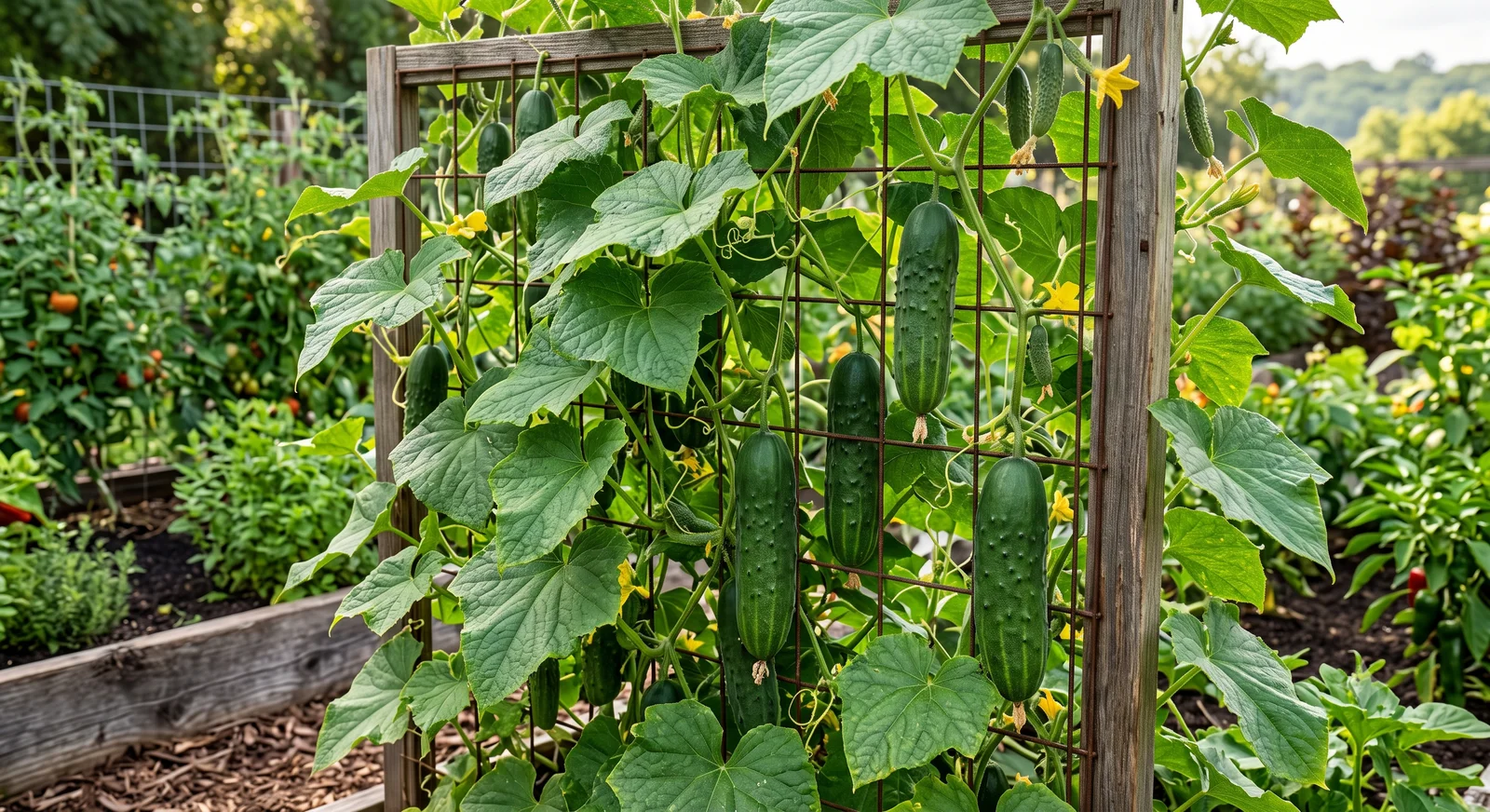
Cucumbers are the fifth pattern in this seed-starting series, and one of two crops in it that genuinely work both ways. Tomatoes and peppers need an indoor head start in most climates. Carrots can’t be transplanted at all. Lettuce is the other flexible crop in the series, though it leans direct-sown for different reasons: a cool-season crop avoiding heat, not a warm-season one waiting on it. Cucumbers sit in between the two extremes: direct sowing is the standard, most reliable approach, but starting indoors for a few weeks’ head start is a legitimate option too, as long as you handle the transplant carefully. Beans are the sixth pattern, and they land on the strict end with carrots: direct-sow only, no indoor start.
HarvestMath’s own Seed Starting Calculator lists cucumbers as a direct-sow crop, timed 1–2 weeks after your last frost date, once the soil has actually warmed, not just the calendar. If you’d rather start indoors, sow seeds in individual pots (not a shared flat) 3–4 weeks before you plan to transplant, and time that transplant for around the same window, 1–2 weeks after last frost. Use larger cells or pots than you would for tomatoes or peppers: cucumbers dislike root disturbance, and a cramped, root-bound start works against you at transplant time.
Whichever way you start, handle the roots gently at transplant. A cucumber grown in a cell tray and yanked out bare-root rarely recovers well: the plant either transplant-shocks and stalls for a week or two, or fails outright. Starting seeds in biodegradable peat pots that go into the ground intact sidesteps the problem, since the roots are never directly disturbed.
Direct sowing avoids all of this by skipping the transplant step entirely, which is part of why it’s the more commonly recommended method. If you don’t yet know your last frost date, our Frost Date Calculator estimates it by ZIP code.
How to Germinate Cucumber Seeds in a Paper Towel
If you want to know how to germinate cucumber seeds in a paper towel before committing them to soil, the method is straightforward and doubles as a seed-viability test. Dampen a paper towel (wet, not dripping), fold your cucumber seeds inside it, and seal the whole thing in a plastic bag or container. Keep it somewhere consistently warm, around 70–75°F: on top of the refrigerator or near a heat mat both work.
Check daily. You should see the first roots emerge within 2–5 days at that temperature. Once a seed has a visible root, plant it about ½ inch deep in soil or seed-starting mix, root-side down, handling it carefully so you don’t snap the fragile new root.
Beyond speed, this method tells you something direct sowing can’t: whether your seed is viable at all. If a meaningful share of seeds fail to sprout in a damp paper towel at ideal temperature, the problem is the seed, not your soil, watering, or timing, useful information before you’ve committed a whole row to seed that was never going to come up.
Soil Temperature and Timing
Cucumbers are genuinely warm-season, more so than most of the other crops in this series, and cold soil is the single biggest reason cucumber seed fails to come up. University of Minnesota Extension recommends waiting until soil hits at least 70°F at a one-inch depth before direct sowing; Oregon State University Extension puts the workable minimum a bit lower, around 65°F. Either way, warmer is better: germination is faster and more reliable the closer you get to 70°F and above.
Cold, wet soil doesn’t just slow cucumber seed down the way it does with some crops: it tends to rot the seed outright before it ever germinates. If your soil is still cool when you’d otherwise be planting, black plastic mulch warms it several degrees faster than bare soil, and both UMN and OSU Extension specifically recommend it as a way to plant a bit earlier without losing seed to cold, wet ground.
Types of Cucumbers: Slicing, Pickling, and Specialty
Nearly every cucumber variety you’ll come across falls into one of a few categories, and the differences matter more for how you use the harvest than how you grow the plant.
Slicing cucumbers are the standard garden cucumber: what most people picture when they think “cucumber.” They’re grown to a larger size, typically harvested at 6–10 inches long, and eaten fresh in salads and sandwiches.
Pickling cucumbers are bred specifically for brining: shorter, bumpier-skinned, and picked much smaller, usually 2–6 inches long, with thinner skin that takes up brine well. They’re also genuinely good eaten fresh, not just pickled.
English (or greenhouse) cucumbers are the long, thin-skinned, nearly seedless type often sold shrink-wrapped in grocery stores. Most English varieties are parthenocarpic, meaning they set fruit without needing pollination at all. More on why that matters below.
Specialty types round out the long tail: Persian cucumbers (small, thin-skinned, similar to English types but shorter), Armenian cucumbers (technically a melon, but grown and eaten like a ribbed, pale-green cucumber), and lemon cucumbers (round, yellow, and mild, named for their shape and color rather than their flavor).
Why Your Cucumbers Flower But Don’t Fruit
This is the question that brings most people to a cucumber-growing guide in the first place, and it comes down to one fact that surprises a lot of gardeners: cucumber plants produce separate male and female flowers on the same plant, and only the female flowers can become cucumbers.
You can tell them apart before they even open. Male flowers are attached to the vine by a slender, plain stem, with no swelling behind the petals, and they often appear in small clusters. Female flowers have a tiny, immature cucumber already visible at the base, right where the flower meets the vine: that swelling is the unfertilized ovary, and it’s there before the flower ever opens.
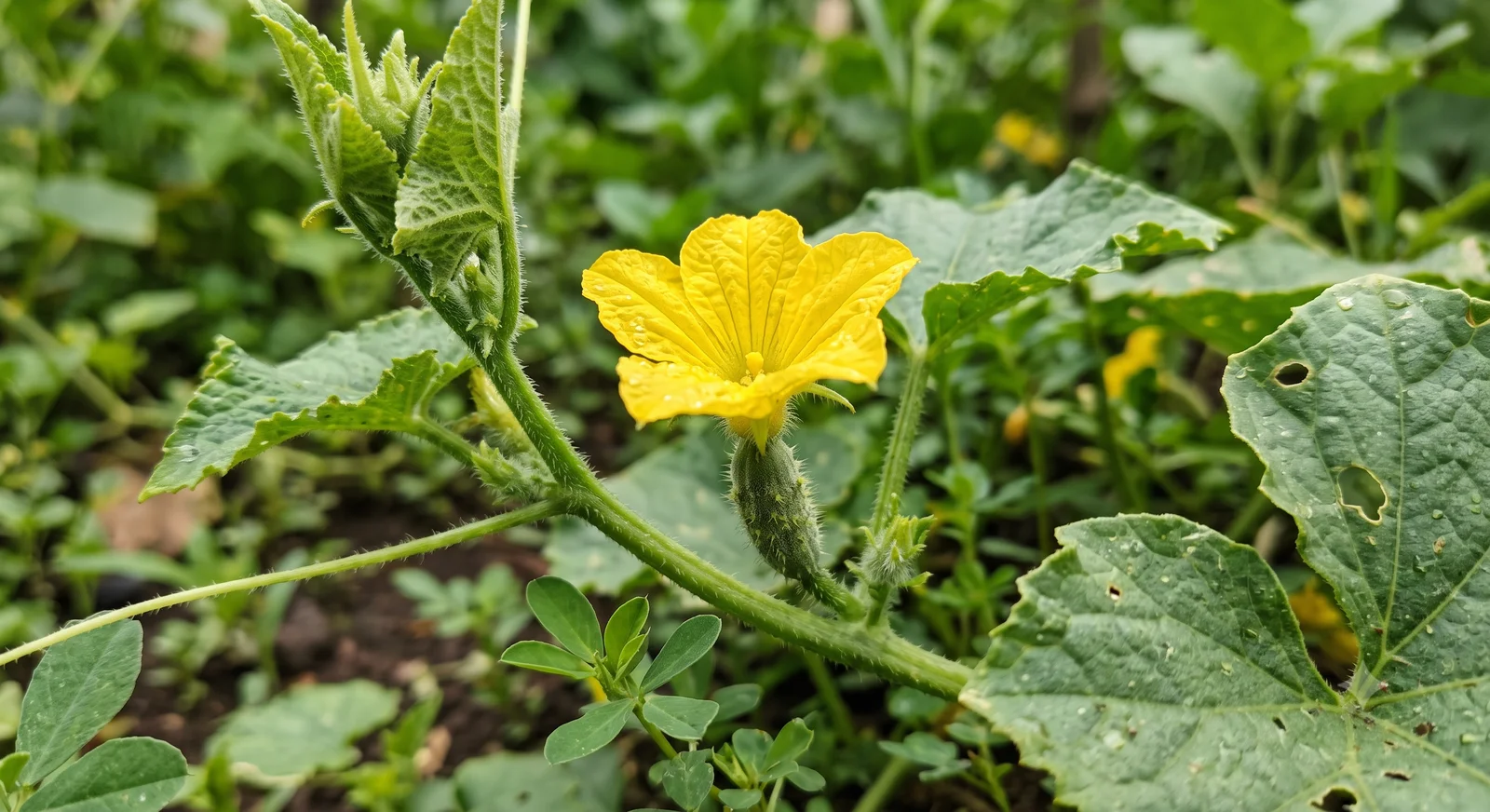
Here’s the detail that resolves most “why won’t my cucumbers fruit” panic: male flowers appear first, typically one to two weeks before the first female flowers show up. If all you’re seeing so far is flowers with no swelling behind them, that’s completely normal and not a sign anything is wrong: the plant hasn’t started producing female flowers yet. Give it another week or two before assuming there’s a problem.
Once female flowers do appear, there’s a second timing constraint: each flower, male or female, opens for a single day only, typically for just a few hours in the morning. That’s a tight window for pollination to happen at all. Cucumber pollen is also heavy and sticky, unlike wind-pollinated crops like corn, so it depends entirely on insects, mainly bees, to move it from male flowers to female ones. If a female flower doesn’t get pollinated during its one open day, the tiny cucumber at its base won’t develop; it shrivels and drops instead.
How to Hand Pollinate Cucumbers
If pollinator activity in your garden is inconsistent (a run of cold or rainy days, an early-season shortage of bees, or a female flower that opened before any male flowers were around), you can pollinate cucumbers by hand, and it takes only a minute or two per flower.
In the morning, while flowers are open, pick a male flower and peel back its petals to expose the pollen-covered center. Touch it directly to the center of an open female flower, transferring the pollen. A small paintbrush or cotton swab works the same way if you’d rather not pick the male flower. Dab it against the male flower’s center, then transfer that pollen to the female. One male flower carries enough pollen to hand-pollinate several female flowers in the same session.
You’ll know it worked within a few days: a pollinated female flower’s base keeps swelling into a normal cucumber, while an unpollinated one shrivels and drops within about a week.
Other Reasons Cucumbers Won’t Set Fruit
Pollination is the most common explanation, but a few other factors can suppress fruiting even when bees are doing their job.
Excess nitrogen pushes the plant toward vigorous leaf and vine growth at the expense of flowering, and specifically suppresses female flower production: a plant that looks lush and healthy but produces mostly male flowers is a classic sign of overfeeding. If you’re fertilizing on a schedule rather than by soil test, our NPK Calculator can help you dose more precisely instead of guessing.
Heat above about 90°F stresses the plant and reduces female flower production, on top of making existing flowers less likely to be visited by bees during the hottest part of the day. The ideal range for both flowering and fruit development is closer to 75–85°F.
Too few pollinators in the garden generally is a real constraint in some yards, especially early in the season before many flowering plants are blooming nearby. Planting bee-attracting flowers near your cucumbers can help, alongside avoiding insecticide use while cucumbers are flowering.
If pollination is a recurring problem in your specific garden rather than a one-time bad stretch of weather, parthenocarpic varieties are the structural fix rather than a workaround. Varieties like ‘Diva’ and ‘Sweet Success’, along with most English and greenhouse cucumbers, set fruit without any pollination at all: no bees, no hand-pollinating, no waiting on timing. They’re a genuinely good choice for greenhouses, rainy climates, or gardens with historically light pollinator activity. This is a different trait from “gynoecious” varieties, which produce mostly female flowers but still require pollen from a separate male-flowering plant to set fruit. Seed packets for gynoecious varieties usually include a small percentage of standard seed mixed in for exactly that reason.
Trellising and Spacing
Standard vining cucumbers take up real ground space if left to sprawl: several feet of garden in every direction per plant. Training vines up a trellis solves that, and it does more than save space: better airflow around trellised plants reduces the humid, still conditions that favor powdery mildew and other foliar disease, and fruit that hangs freely grows straighter than fruit that curls around itself on the ground.
Our Plant Spacing Calculator puts cucumbers at about 12 inches apart within the row when trellised, with roughly 3 feet between rows, tighter spacing than sprawling vines would need, since the trellis is doing the work of keeping the foliage organized vertically instead of spreading it across the ground.
Growing Cucumbers in Pots
If you’re working out how to grow cucumbers in pots, container size is the first real decision. Our Pot Size Calculator recommends at least 8–10 gallons per plant for standard, full-size vining cucumbers, one plant per container. Compact or bush-type varieties bred specifically for containers can get by with less, often as little as 5 gallons, since they’re bred to stay smaller overall.
Beyond size, container growing follows a couple of rules that matter more than they do in the ground. Containers dry out considerably faster than garden soil, especially in summer heat, so consistent watering, sometimes daily, matters more for potted cucumbers than for almost any other container vegetable. And a trellis or stake still helps even in a pot; letting a vining variety sprawl over the container’s edge makes for a tangled, hard-to-manage plant.
Cucumber Beetles and Bacterial Wilt
These two problems are worth covering together, because they’re really one problem: striped and spotted cucumber beetles feed on cucumber leaves, flowers, and stems directly, but the more serious damage is what they carry. Both species can vector bacterial wilt, a disease that lives inside the beetles over winter and gets introduced into a plant through their feeding wounds.
Once a plant is infected with bacterial wilt, there’s no cure. Symptoms often don’t show until the disease is already well established. By the time you see sudden, spreading wilt (frequently right around when the first cucumbers are half-grown), it’s too late to save that plant. The only real management is prevention: keep beetles off the plant before they can feed and introduce the disease in the first place.
Row covers over young plants are the most effective prevention, physically blocking beetles from reaching the leaves during the vulnerable seedling stage. The catch is timing: row covers also block the pollinators your plants will need once they start flowering, so remove them at first bloom, unless you’re growing a parthenocarpic variety that doesn’t need pollination at all.
Free book · 23 pages, PDF
Growing Cucumbers from Seed FAQ
How long does it take to grow cucumbers from seed?
Seeds typically germinate within one to two weeks in warm soil, and Oregon State University Extension puts full maturity at 50 to 70 days from seeding to harvest, depending on the variety. Early-maturing varieties can be ready in as few as 50 days in warm conditions (75-85F), while later varieties take closer to 70.
How deep do you plant cucumber seeds?
About 1/2 to 1 inch deep. Planting much deeper than that in cool soil is a common reason seeds fail to come up at all, since the extra depth adds time to an already slow germination process in less-than-ideal conditions.
Should cucumber seeds be soaked before planting?
Soaking isn't necessary, but it isn't harmful either: a few hours in room-temperature water can speed up germination slightly by softening the seed coat. The paper towel method above accomplishes something similar, with the added benefit of letting you see germination happen before the seed goes into soil.
How do you get female flowers on cucumbers?
You can't force female flowers to appear faster: male flowers reliably show up first, one to two weeks ahead of females, and that's normal rather than a problem to fix. What you can control is what happens after female flowers appear: avoid over-fertilizing with nitrogen, since excess nitrogen specifically suppresses female flower production, and keep the plant out of extreme heat above 90F when possible.
Can cucumbers and peppers grow together?
Yes, there's no documented conflict between them in companion planting guidance, and they're commonly grown in the same garden without issue. Our own Companion Planting Chart doesn't list any antagonistic relationship between cucumbers and peppers, though they also aren't a classic paired combination the way tomatoes and basil are. They simply coexist fine as long as each gets the spacing and support it needs.
Sources & further reading
For flower biology, pollination, planting, and troubleshooting, see University of Minnesota Extension’s guide to growing cucumbers in home gardens and Illinois Extension’s cucumber growing guide. For days-to-maturity figures and additional planting detail, see Oregon State University Extension’s guide to growing your own cucumbers. For more on how we source and review the facts behind every calculator and guide on this site, see our methodology page. And for more on spacing, timing, and companion planting across the whole garden, see our complete guide to spacing and planting.