When to start seeds indoors depends on the crop, and the rule is to count back from your average last frost date. Clemson Extension says to sow tomatoes 6 weeks before it, peppers and eggplant 8 weeks, and cucumbers, melons and squash 4 weeks or fewer. The chart below covers 18 crops, and the rest of our spacing and planting guides use the same dates.
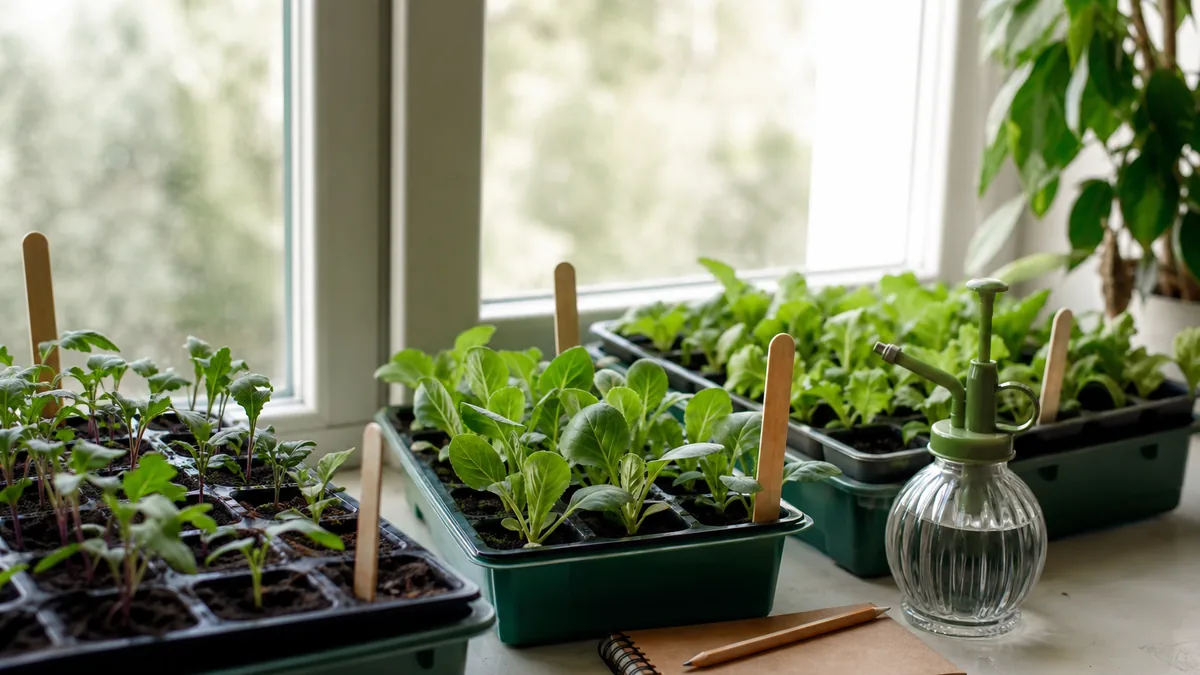
Start Seeds Indoors: The Rule in Four Steps
- Find your last frost date. Use the median, the date by which half of years have had their last frost.
- Look up the crop’s weeks. Slow crops such as celery need 10 to 12 weeks (University of Alaska Fairbanks Extension). Fast ones such as squash need 2 to 4.
- Subtract. Last frost date minus the weeks is your sowing date. Tomatoes at 6 to 8 weeks before an Apr 23 frost means Feb 26 to Mar 12.
- Check the set-out date. Tender crops go outside after the last frost. Cool-season crops can go out 2 to 5 weeks before it (University of Idaho Extension).
When Should You Start Seeds Indoors? The Count-Back Rule
Seedlings need weeks, not days, to reach a size that survives outdoors. University of Maine Cooperative Extension says seedlings may take 4 to 12 weeks to become ready to transplant, and the Rutgers fact sheet on starting vegetable seeds indoors lists a “weeks to grow” figure for each crop, from 2 to 3 weeks for cucumbers, squash and melons up to 10 to 12 weeks for onions and celery. So you choose the day a plant should go outside and count back. This post is the rule and the reasons behind it. For the month-by-month version of the same dates, our seed starting calendar lays them out in order.
Warm-season crops: count from the day they go outside
Tomatoes, peppers, eggplant and basil die in a frost, so their set-out date comes after the last frost. University of Idaho Extension says warm-season crops such as tomatoes and peppers can go into the garden about 1 to 3 weeks after the average last frost date. Our planting calendar sets tomato transplants 1 to 2 weeks after the last frost, and peppers and basil 2 or more weeks after, with the note that tomatoes wait until nighttime lows stay above 50°F. Count back the crop’s weeks from there. Our guide to growing tomatoes from seed walks through sowing, potting up and hardening off for the most common crop on the list.
Cool-season crops: they go out before the last frost
Broccoli, cabbage, onions and lettuce shrug off light frost. University of Idaho Extension says cool-season crops such as broccoli and onions can be transplanted outside 2 to 5 weeks before the average date of last frost, and Utah State University Extension says cabbage transplants should be planted 2 to 3 weeks before the last frost free date. That is why these crops start earlier on the calendar than the tender ones you will set out beside them.
How Do You Find Your Last Frost Date?
Everything above hangs on one date, so get it right. Our frost data come from NOAA’s U.S. Climate Normals for 1991 to 2020. The date we use is the median last 32°F night of spring, meaning half of years have a later one, and each page also shows the date only 1 year in 10 beats. Enter your ZIP code below and the calculator picks the nearest weather station for you.
If you only want a ballpark, use your zone’s median. The zone 5b frost dates page gives Apr 30, zone 6b gives Apr 23, and zone 7a gives Apr 16. A zone date is a starting point and nothing more: across the ZIP codes in zone 6b the median last frost runs from Apr 11 to May 11 (10th to 90th percentile in our data). A hardiness zone is a winter minimum, not a frost date, as USDA hardiness zones explained shows, so look up frost dates separately.
Two other places publish last frost dates, and they can differ from NOAA’s. Our comparison of Farmers Almanac frost dates and NOAA explains why. If you plan around the almanac’s calendar, our look at the Farmers Almanac planting calendar covers how it sets its dates. For dates zone by zone, see the planting calendar by zone.
When to Start Vegetable Seeds Indoors: Chart of 18 Crops
The weeks below are ranges, and the Source column names where each came from. Where our planting calendar has an indoor-start rule for a crop, that is the number shown. Where it does not, the number comes from an extension table that counts back from the last frost. Warm-season vines are different, and sit in their own table.
Counted back from your last frost date
| Crop | Start indoors, weeks before last frost | Source and note |
|---|---|---|
| Tomatoes | 6 to 8 | HarvestMath planting calendar. Clemson says 6, Alaska says 7 to 9. |
| Peppers | 8 to 10 | Planting calendar. Clemson says 8, UGA says as early as 8, Alaska 6 to 7, UMN about 8 weeks before planting outside. |
| Eggplant | 8 to 10 | Clemson says 8. Rutgers lists 8 to 10 weeks to grow. |
| Basil | 6 to 8 | UF/IFAS Extension says 6 to 8 weeks before the last frost. WVU says 6. |
| Broccoli | 6 to 8 | Planting calendar. Alaska says 4 to 6, and NC State says 6 to 7 weeks before transplanting. |
| Cabbage | 6 to 8 | Planting calendar. Alaska says 4 to 6. Utah State says 6 to 7 weeks to grow. |
| Cauliflower | 6 to 8 | Planting calendar, a middle estimate. Iowa State says 4 to 5 weeks before planting outdoors. |
| Head lettuce | 4 to 6 | Alaska says 4 to 6 for an early harvest. Rutgers lists 5 to 6 weeks to grow. |
| Onions from seed | 8 to 10 | Alaska says 8 to 10. Maine says 8 weeks to grow, Rutgers 10 to 12. |
| Celery | 10 to 12 | Alaska says 10 to 12 and calls it slow growing. Rutgers agrees. |
| Marigolds | 4 to 6 | Alaska says 4 to 6. WVU lists 6 to 8 weeks. |
| Zinnias | 4 to 6 | Alaska says 4 to 6. WVU lists 4. |
Counted back from the day you transplant
Cucumbers, squash, pumpkins and melons grow fast and dislike having their roots disturbed, so a long head start backfires. Count their weeks back from the day they go into warm ground, which is on or after the last frost.
| Crop | Weeks indoors before transplanting | Set out | Source |
|---|---|---|---|
| Cucumbers | 3 to 4 | 1 to 2 weeks after last frost (planting calendar) | WVU says 3 to 4. Rutgers lists 2 to 3. Clemson says sow 4 weeks or fewer before last frost. |
| Summer squash and zucchini | 2 to 3 | 0 to 1 weeks after last frost (planting calendar) | Rutgers and WVU both list 2 to 3. Idaho lists 3 to 4 for squash. |
| Winter squash | 3 to 4 | After the last frost, once soil is warm | University of Alaska Fairbanks Extension. |
| Pumpkins | 3 to 4 | 0 to 1 weeks after last frost (planting calendar) | WVU Extension. |
| Cantaloupe (muskmelon) | 3 to 4 | After the last frost, once soil is warm | Idaho and Maine say 3 to 4. Rutgers lists 2 to 3. |
| Watermelon | 4 to 6 | After the last frost, once soil is warm | WVU Extension. Purdue says northern Indiana gardeners should use transplants. |
Purdue Extension says cucurbit seedlings need 2 to 3 weeks to grow to transplant size, which is why the window is short. The planting calendar’s own set-out offsets for these crops are in the middle column; every other cell is an extension figure.
Why Do Extension Sources Give Different Weeks?
They are not disagreeing as much as they look. Three things move the numbers.
- The starting line differs. Clemson and Alaska count back from the last frost. Rutgers and Maine give weeks to grow, Maine counting from germination. A cool-season plant set out 3 weeks before the frost needs a start 3 weeks earlier than the “weeks to grow” figure alone suggests.
- The climate differs. Alaska’s table is written for Alaska gardeners, and Clemson’s for South Carolina ones. University of Minnesota Extension gives dates, not weeks: about 5 to 6 weeks indoors for tomatoes, 9 for peppers and eggplant.
- The target plant differs. Utah State says cabbage needs 6 to 7 weeks to reach 4 to 6 mature leaves, and sets it out 2 to 3 weeks before the last frost, which would put the sowing at 8 to 10 weeks before the last frost, longer than the 6 to 8 our calendar uses.
The Idaho table is a good illustration of the spread: it lists tomatoes at 5 to 9 weeks indoors and peppers at 6 to 9. Peppers sit at the long end of the common fruiting vegetables in the chart, and the pepper guide linked in the table explains why they ask for the earliest, warmest start. When two sources give you a range, our reading is to choose by your setup: the longer end suits a bright light stand with room to pot up, and the shorter end suits a tight shelf. The next sections show what that choice costs.
When to Plant Seeds Indoors: Worked Example for Zone 6b
Take the zone 6b median last frost from our frost data, Apr 23, and subtract each crop’s weeks. Zone 6b includes parts of Ohio and Illinois, so gardeners there can compare this table with the full crop tables on the Ohio planting calendar and the Illinois planting calendar. Any ZIP code can sit earlier or later than the zone median.
| Crop | Weeks before Apr 23 | Sow indoors |
|---|---|---|
| Celery | 10 to 12 | Jan 29 to Feb 12 |
| Peppers, eggplant, onions | 8 to 10 | Feb 12 to Feb 26 |
| Tomatoes, basil, broccoli, cabbage, cauliflower | 6 to 8 | Feb 26 to Mar 12 |
| Head lettuce, marigolds, zinnias | 4 to 6 | Mar 12 to Mar 26 |
| Cucumbers (set out Apr 30 to May 7) | 3 to 4 before set-out | Apr 2 to Apr 16 |
| Pumpkins (set out Apr 23 to Apr 30) | 3 to 4 before set-out | Mar 26 to Apr 9 |
The arithmetic is plain. Eight weeks is 56 days, so 8 weeks before Apr 23 is Feb 26. Ten weeks is Feb 12 and twelve is Jan 29. Six weeks is Mar 12, four weeks is Mar 26. For cucumbers, the earliest set-out is 1 week after the frost, Apr 30, minus 4 weeks, which gives Apr 2; the latest is May 7 minus 3 weeks, Apr 16. Pumpkins work the same way from Apr 23 and Apr 30.
Move the frost date and everything shifts with it. In zone 5b, with a median last frost of Apr 30, tomatoes start Mar 5 to Mar 19 and peppers Feb 19 to Mar 5. In zone 7a, with Apr 16, tomatoes start Feb 19 to Mar 5 and peppers Feb 5 to Feb 19. To get this for your own station without doing the subtraction, enter your ZIP code and get this month’s list. If you would rather have every date for your own ZIP code in one plan, the Season Planner does that.
What Happens If You Start Seeds Too Early?
The Rutgers fact sheet puts it in capitals: “DON’T START PLANTS TOO EARLY.” It says early-started plants become elongated, pale green and weak, and that the goal is a stocky, moderately sized plant that recovers quickly when planted outdoors. Purdue Extension’s Rosie Lerner says gardeners with leggy tomatoes “probably started your tomato seeds too early”, and that home light is low enough that transplants stretch in search of it.
Cornell Cooperative Extension’s vegetable program adds the cost beyond looks. Judson Reid writes that pot-bound or leggy transplants can run short of nutrients because the foliage outgrows the roots, can put their energy into flowers and fruit instead of shoot growth and stay permanently stunted, are more likely to blow over or burn on plastic mulch, and are harder to handle. His rule of thumb for early high tunnel tomatoes is to aim for 6 weeks before transplant. The causes and cures for stretched stems are in our guide to leggy seedlings.
When to start growing seeds inside depends on your light
The calendar only works if the seedlings get enough light for all those weeks. Clemson Extension says window light is typically not enough and produces leggy seedlings, and recommends lights 2 to 4 inches above the plants for 12 to 16 hours a day. University of Minnesota Extension says lack of light is the major cause of elongated, skinny stems. If you have a south window and one shelf, take the short end of each range. If you are weighing fixtures, LED vs fluorescent grow lights compares them for seedlings.
If you already started too early
Cornell says that when wet or cold weather delays transplanting, you can pot plants into larger containers, 3 or 4 inch rounds, to keep them vegetative for a few more weeks. West Virginia University Extension warns that crowded seedlings and cool, soggy mix raise the risk of damping off, so give each plant room and water lightly; our damping off guide has the full prevention list. Our note on plant pot sizes covers what each container size holds.
Which Seeds Should You Skip Starting Indoors?
Not every crop gains from an indoor start. Our planting calendar lists beans, carrots, peas, radishes, spinach, beets, corn and kale as direct-sow crops, each timed from the last frost. Carrots are the classic case: our calendar sows them 2 to 5 weeks before the last frost, straight in the bed, and the carrots from seed guide shows why. Beans go in 0 to 1 weeks after the last frost, and Utah State University Extension says bean seed rots in cold, wet soil, so wait for 60°F. For that crop, growing beans from seed starts outdoors.
The vines are the exception that proves the rule. University of Minnesota Extension says fiber or paper pots suit cucumbers and squash because they do not transplant well, and Clemson says cucurbits transplant best when very small, after the first true leaves appear. That is why their chart rows are short.
Lettuce works either way. Our calendar direct sows it 2 to 4 weeks before the last frost, and Alaska’s table gives 4 to 6 weeks if you want a head start indoors. The lettuce from seed guide compares both. Lettuce also suits repeat sowings, which succession planting turns into a schedule.
When Do Seedlings Go Outside?
The sowing date is only half of the plan. Seedlings raised indoors are soft, and University of Idaho Extension says hardening off usually takes at least a week of gradual exposure. University of Minnesota Extension says two weeks, and Maine gives one to two, so a week is the minimum and two is safer. The soil matters as much as the calendar for the warm crops: our planting calendar notes that cucumbers want soil of 70°F or more at 1 inch deep, and the soil temperature for planting guide shows how to take a reading. When you have the dates and the soil right, the remaining steps of the season are in how to plant a garden.
When to start seeds indoors for a fall garden
The same count-back works for fall, with the first frost as the anchor. University of Minnesota Extension says cabbage and broccoli for fall crops may be started indoors in June or July. Our calendar counts fall crops back from the first frost by days to maturity plus a 14-day safety margin; for broccoli it uses 70 to 80 days, from NC State Extension.
Free book · 23 pages, PDF
When to Start Seeds Indoors FAQ
When should you start seeds indoors?
Count back from your average last frost date by the crop's weeks. Clemson Extension says to sow tomatoes 6 weeks before it, peppers and eggplant 8 weeks, and cucumbers, melons and squash 4 weeks or fewer. Slow crops start earlier: University of Alaska Fairbanks Extension lists celery at 10 to 12 weeks and onions at 8 to 10.
When to start growing seeds inside if I do not know my last frost date?
Look it up first, because every date depends on it. Use the frost date calculator for your ZIP code, or your zone's median as a starting point. Our frost data list Apr 23 for zone 6b, from NOAA 1991 to 2020 normals, but the 10th to 90th percentile spread across zone 6b ZIP codes runs Apr 11 to May 11.
Is it too early to start seeds indoors in January?
For most crops, yes. Only the slowest need a January start in a zone like 6b: celery at 10 to 12 weeks (Alaska) lands on Jan 29 to Feb 12 for an Apr 23 frost. Rutgers warns against starting plants too early because they become elongated, pale green and weak.
When to plant seeds indoors for tomatoes and peppers?
Tomatoes 6 to 8 weeks before the last frost, peppers 8 to 10, per our planting calendar. Clemson says 6 and 8 weeks, and University of Idaho Extension says tomatoes and peppers can go into the garden 1 to 3 weeks after the last frost, once nights are warm.
How long do seedlings stay indoors before transplanting?
From about 2 weeks to 12, depending on the crop. Rutgers lists 2 to 3 weeks for cucumbers, squash and melons, 6 to 8 for tomatoes, 8 to 10 for peppers and eggplant, and 10 to 12 for onions and celery. University of Maine Extension says 4 to 12 weeks overall.
When to start indoor seeds for a fall garden?
Count back from your first frost, not your last. University of Minnesota Extension says cabbage and broccoli for fall crops may be started indoors in June or July. Our planting calendar uses days to maturity plus a 14-day margin, such as 70 to 80 days for broccoli (NC State Extension).
Sources & further reading
Weeks and timing by crop: Rutgers Cooperative Extension, FS787 Starting Vegetable Seeds Indoors, Clemson Cooperative Extension, FAQs about Starting Vegetable Seeds Indoors, University of Idaho Extension, Start Seeds Indoors with Success (CIS 1209), University of Alaska Fairbanks Extension, Seed Starting and Transplanting (HGA-00032), University of Maine Cooperative Extension, Starting Seeds at Home (Bulletin 2751), WVU Extension, Seed Starting and University of Minnesota Extension, Starting seeds indoors.
Individual crops: University of Minnesota Extension, Growing peppers, NC State University, Crop Guide: Broccoli, Utah State University Extension, How to Grow Cabbage in Your Garden, Iowa State University Extension, Growing Cauliflower in the Home Garden, UF/IFAS Extension Pasco County, A Beginner’s Guide to Growing Basil, UGA Extension, Seed Starting and Purdue Extension, Growing Cucumbers, Melons, Squash, Pumpkins and Gourds (HO-8-W).
Starting too early: Purdue Extension, Leggy Tomatoes and Cornell Cooperative Extension, It’s All About the Transplant (VegEdge). Frost dates in the worked example come from the site’s own frost data, built on NOAA’s U.S. Climate Normals for 1991 to 2020, and the transplant offsets from the site’s planting calendar, which lists an extension source for each crop.
Free book · 23 pages, PDF
The Spacing & Planting Cheat Sheet
Sent