When people search for how to grow lettuce from seed, a good chunk of what comes back is actually about regrowing a store-bought lettuce stub in a glass of water. It’s a fun kitchen windowsill trick, but a different thing entirely from growing a real crop (we cover that separately below). This guide is about the real version: sowing lettuce seed and growing it to harvest. It’s also worth reading right after starting tomatoes or peppers, because lettuce breaks nearly every rule those two follow: it wants light instead of darkness to germinate, cool soil instead of warm, and can often skip the indoor head start entirely.
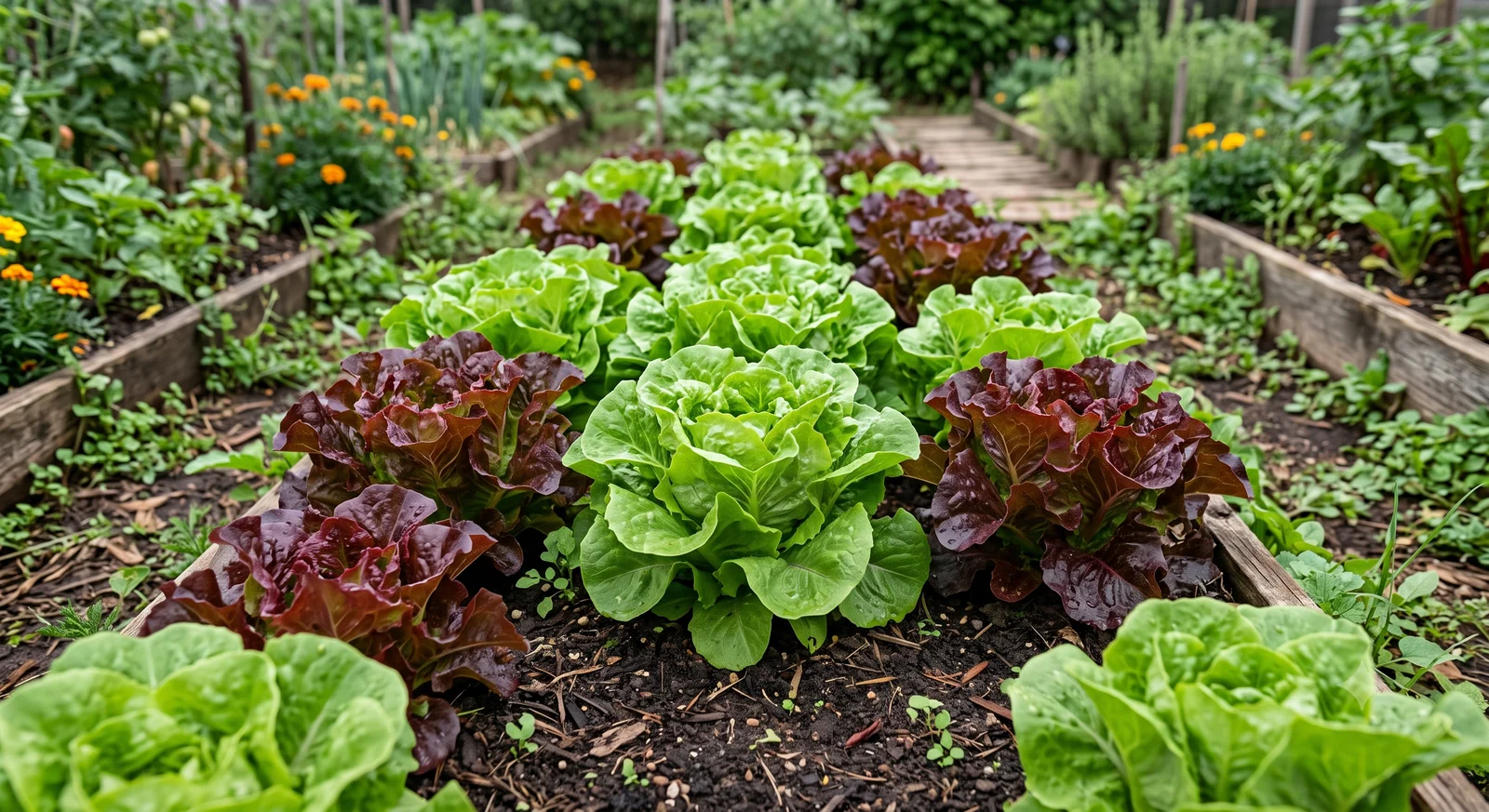
Lettuce Seeds Need Light: Don’t Bury Them
This is the single biggest difference between lettuce and the crops covered in our tomato and pepper seed-starting guides: lettuce seeds need light to germinate, not darkness. Tomato and pepper seeds get sown and covered because they don’t need light and actively want the insulation of soil while they warm up. Lettuce is the opposite: bury it too deep and a meaningful share of the seed simply won’t sprout.
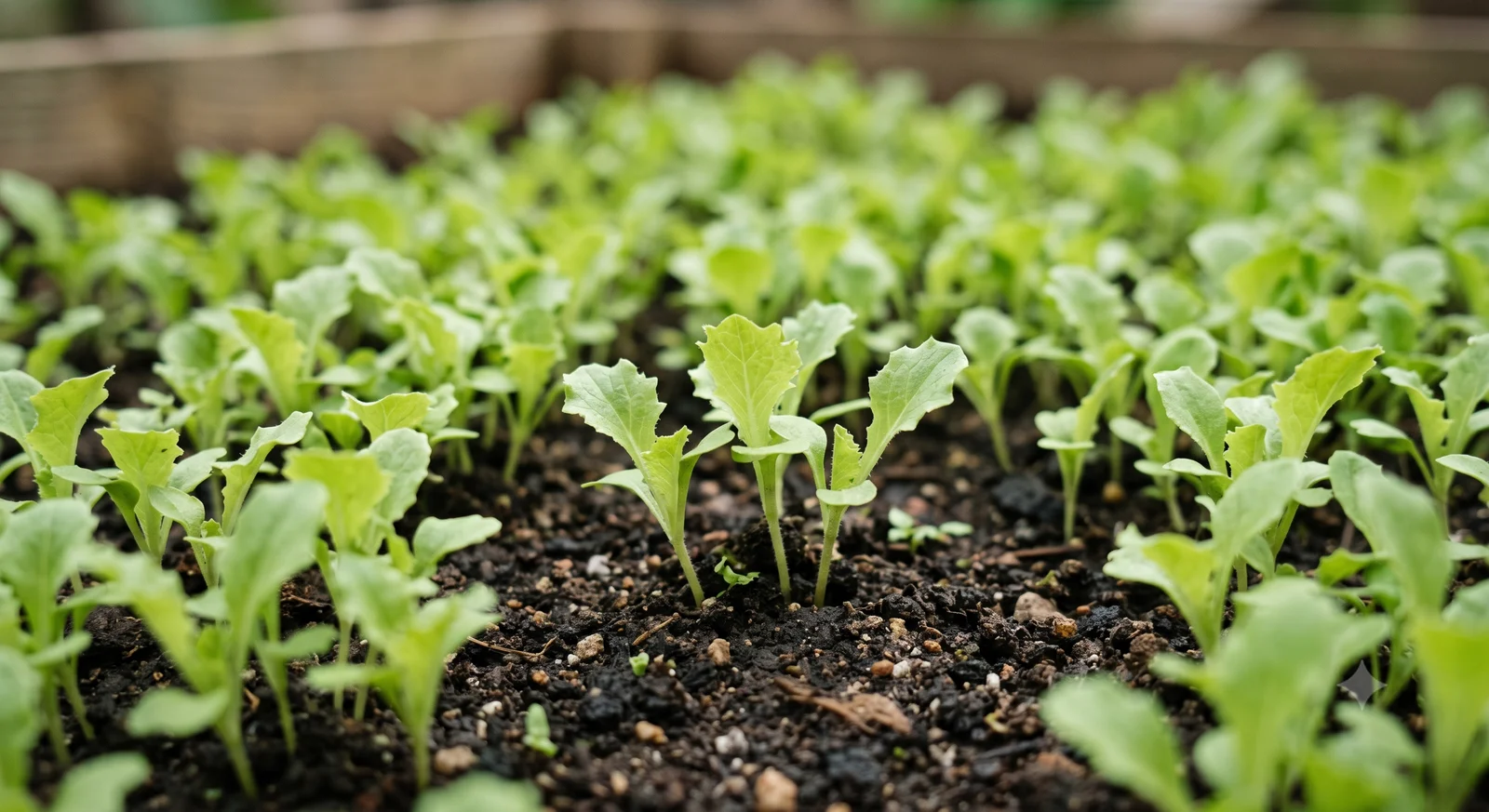
Sow lettuce seed ¼ to ½ inch deep at most, barely covered with a light dusting of soil or vermiculite. You should still be able to see the seed’s outline through the covering. For baby leaf lettuce grown for cut-and-come-again harvests, go even shallower: as little as ⅛ inch, almost surface-sown. Press the seed down gently for good soil contact, but don’t bury it looking for the coverage you’d give a tomato or pepper seed.
The Heat Problem: Thermal Dormancy
Lettuce’s second rule-breaking trait is temperature. Where peppers need 80–90°F soil just to germinate reliably, lettuce does the opposite: Utah State University Extension puts lettuce’s germination sweet spot at 55–65°F, with seedlings emerging in 7–10 days at that range. Push soil temperatures past 80°F and germination rates drop sharply: some seed enters thermal dormancy and simply refuses to sprout until the soil cools back down, no matter how long you wait.
If you’re sowing lettuce in real summer heat, a few things help: pre-sprout seeds on a damp paper towel in the refrigerator for a few days before sowing (the cold breaks dormancy and gives you a head start once you do sow), start seed indoors in a cool room rather than a warm greenhouse or windowsill, or shade the seedbed with row cover or a board propped over it until seedlings emerge. None of these are complicated, but skipping them in the middle of summer is the most common reason lettuce “won’t germinate.”
When to Sow Lettuce
Direct-sown lettuce goes in the ground 2 to 4 weeks before your last frost date, per HarvestMath’s own Seed Starting Calculator, a stark contrast to peppers, which don’t go outside until 2–3 weeks after last frost. Lettuce tolerates a light frost fine once established; it’s heat, not cold, that actually threatens the crop.
Lettuce also works well as a fall crop, planted again once summer heat breaks. Utah State University Extension recommends timing a fall planting so the crop matures 1–2 weeks before your first fall frost. For most varieties that means sowing roughly 50–75 days ahead of that target date. If you don’t already know your frost dates, our Frost Date Calculator estimates both the spring and fall windows by ZIP code.
Direct Sow or Start Indoors?
Lettuce is one of the few crops in this cluster that’s genuinely fine either way. Unlike tomatoes and peppers, which both need to start indoors, lettuce germinates and grows well direct-sown straight into the garden. That makes it one of the easier ways to learn how to grow lettuce from seeds without a grow light setup, which is part of why growing lettuce for beginners so often starts here: direct sowing is simpler and lower-effort, and it’s the standard approach for leaf and baby-leaf types especially.
Starting indoors and transplanting has one real advantage: an earlier harvest, since the plants are already partway grown by the time they go in the ground. Our Seed Starting Calculator lists head lettuce at 4–6 weeks of indoor growing before it’s ready to transplant, 2–3 weeks before your last frost date. If you’re short on grow light space, direct sowing lettuce and saving the indoor real estate for tomatoes and peppers is a reasonable way to divide up the season. Carrots take the direct-sow rule even further than lettuce: they can’t be transplanted at all, since disturbing the root ruins it; see our How to Grow Carrots from Seed guide for that stricter case. Cucumbers, on the other hand, genuinely work either way, same as lettuce. See our How to Grow Cucumbers from Seed guide for that flexible case, plus why cucumber plants flower without fruiting. Beans are direct-sow only as well, same as carrots. See our How to Grow Beans from Seed guide for that case, and an honest look at what beans really do for soil nitrogen.
Spacing and Thinning
Spacing depends on what you’re growing lettuce for. Our Plant Spacing Calculator puts head lettuce at about 12 inches apart in both directions for a dense bed layout; traditional row gardens often run looser, with sources like Utah State University Extension citing 8–12 inches between plants in the row and 12–18 inches between rows. See our Lettuce Spacing guide for the full leaf-vs-head breakdown. Leaf lettuce can go tighter: our calculator uses roughly 6 inches apart once thinned, though you’ll see wider ranges up to 8–10 inches cited elsewhere depending on variety and how large you want the leaves. Baby leaf grown for cut-and-come-again harvests is sown far denser still, at 4–6 seeds per inch, since you’re harvesting young and small rather than growing full heads.
Thin seedlings once they have 3–4 true leaves. The thinned-out seedlings aren’t waste. They’re perfectly edible on their own, and if you lift them carefully with some root intact, you can transplant them to fill a gap elsewhere in the bed instead of tossing them.
Succession Sowing for Continuous Harvest
Lettuce is the textbook succession crop: sow a new batch every 2–3 weeks through your cool-season window instead of planting it all on one day, and you get a steady trickle of harvestable lettuce instead of a single glut that bolts before you can eat it all. Because lettuce matures fast and takes up relatively little space, it’s one of the easiest crops to slot into small succession windows between other plantings.
Our Succession Planting guide covers the staggered-sowing approach in full, including how to time it against your other crops so nothing sits empty or gets crowded out.
Days to Harvest
Baby leaf lettuce is ready fast: 25 to 30 days from sowing for a first cut-and-come-again harvest. Mature heads take considerably longer: roughly 60 days from seed if direct sown, or 30–40 days after transplanting if you started seedlings indoors first, since those seedlings already used up several weeks of that timeline before going in the ground.
Our Vegetable Yield Calculator estimates how much lettuce a given number of plants or bed area will actually produce, using the same per-plant figures behind the numbers above.
Bolting: Why Lettuce Turns Bitter
Bolting is what happens when heat stress pushes a lettuce plant to shift from growing leaves to producing a flower stalk and going to seed, which is its way of rushing to reproduce before conditions get worse. Once a plant bolts, the leaves turn noticeably more bitter, and there’s no reversing it; the best move at that point is to harvest whatever’s still usable and pull the rest.
Michigan State University Extension notes that growing lettuce in summer heat is exactly what triggers this: the plant either tastes bitter outright or bolts and then tastes bitter, with neither problem showing up when lettuce grows in cooler temperatures. Utah State University Extension puts a rough number on it too: lettuce grown above 80°F is notably more prone to bitterness and premature bolting. Afternoon shade in warm climates, consistent watering (drought stress accelerates bolting), and choosing heat-tolerant or slow-bolt varieties for late-spring and summer plantings all help push the timeline out.
Growing Lettuce in Containers
Lettuce is genuinely well-suited to container growing, since its roots are shallow, and a single pot can produce a real, useful harvest of leaf lettuce or a couple of heads. A container around 6–8 inches deep is enough for most lettuce, since it doesn’t need the root depth a tomato or pepper does; width matters more than depth, and a wider, shallower container fits more plants than a narrow, deep one.
If you’re not sure what size pot fits your setup, our Pot Size Calculator works out container dimensions and soil volume for whatever you’re growing.
Regrowing Lettuce from a Store-Bought Stub
This is the technique a lot of people are actually picturing when they ask about growing lettuce, so it’s worth covering honestly: it’s a different thing from growing lettuce from seed, and it doesn’t produce a full new head.
Save the base of a head of romaine or butterhead lettuce after you’ve cut off the leaves, and set it in a shallow dish with about half an inch of water, cut side up. Keep it on a sunny windowsill and change the water every day or two. Within a week or so you’ll usually see small new leaves emerging from the center. That’s about where it stops, though: the regrowth is thin, small, and doesn’t have the root system or energy reserves to build out into a full head the way a seed-grown plant does. It’s a fun, nearly-free kitchen experiment and a good way to get a few extra leaves out of lettuce you were about to compost anyway, but if you actually want a real lettuce harvest, growing from seed is the way to do it.
Free book · 23 pages, PDF
Growing Lettuce from Seed FAQ
How long does lettuce take to grow from seed?
It depends on what you're harvesting: baby leaf is ready in 25–30 days from sowing, while mature heads take roughly 60 days from seed if direct sown, or 30–40 days after transplanting if you started seedlings indoors first. Baby leaf is the fastest path to an actual harvest by a wide margin.
How long does it take for lettuce seeds to germinate?
At the ideal 55–65°F soil temperature, lettuce seeds typically germinate in 7 to 10 days. Germination slows in cooler soil and can stall out entirely if soil temperatures push much above 80°F.
How many lettuce seeds do you plant in one hole?
Lettuce seed is tiny and germination isn't perfect, so most gardeners sow 2–3 seeds per spot and thin down to the strongest single seedling once true leaves appear. For baby leaf grown densely, you're not planting individual holes at all. Seed is scattered or sown in a line at several seeds per inch.
How do you regrow store-bought lettuce?
Place the cut base of a head in a shallow dish with about half an inch of water, cut side up, on a sunny windowsill, changing the water every day or two. You'll typically see small new leaves within a week, but it won't regrow into a full head, so treat it as a kitchen experiment, not a real harvest.
Can lettuce grow in a pot?
Yes, lettuce is one of the better container vegetables, since its roots are shallow and don't need much depth. A container around 6–8 inches deep is enough for most varieties, and width matters more than depth for fitting multiple plants.
Can you plant lettuce and tomatoes together?
Yes, and it's a genuinely useful pairing: lettuce prefers to avoid intense heat, and tomato plants provide welcome afternoon shade once they size up, which can help keep nearby lettuce from bolting as early. Our Companion Planting Chart covers lettuce directly. Good companions include carrots, radishes, onions, and chives, and lettuce genuinely benefits from a tomato plant's afternoon shade once it sizes up, which helps keep nearby lettuce from bolting as early.
Sources & further reading
For lettuce-specific growing conditions, spacing, and thinning technique, see Utah State University Extension’s guide to growing lettuce in your garden. For more on heat stress and bolting, see Michigan State University Extension’s lettuce growing fact sheet. For more on how we source and review the facts behind every calculator and guide on this site, see our methodology page. And for more on spacing, timing, and companion planting across the whole garden, see our complete guide to spacing and planting.