A seed starting calendar for a zone 6b garden starts peppers indoors Feb 12 to Feb 26 and ends with fall greens in August, all counted from the Apr 23 median last frost in HarvestMath’s NOAA-based frost data. Zone 7a runs about a week earlier. University of Minnesota Extension puts peppers at about eight weeks before planting outside, and the rest of the dates follow the same kind of rule, as in the other spacing and planting guides.
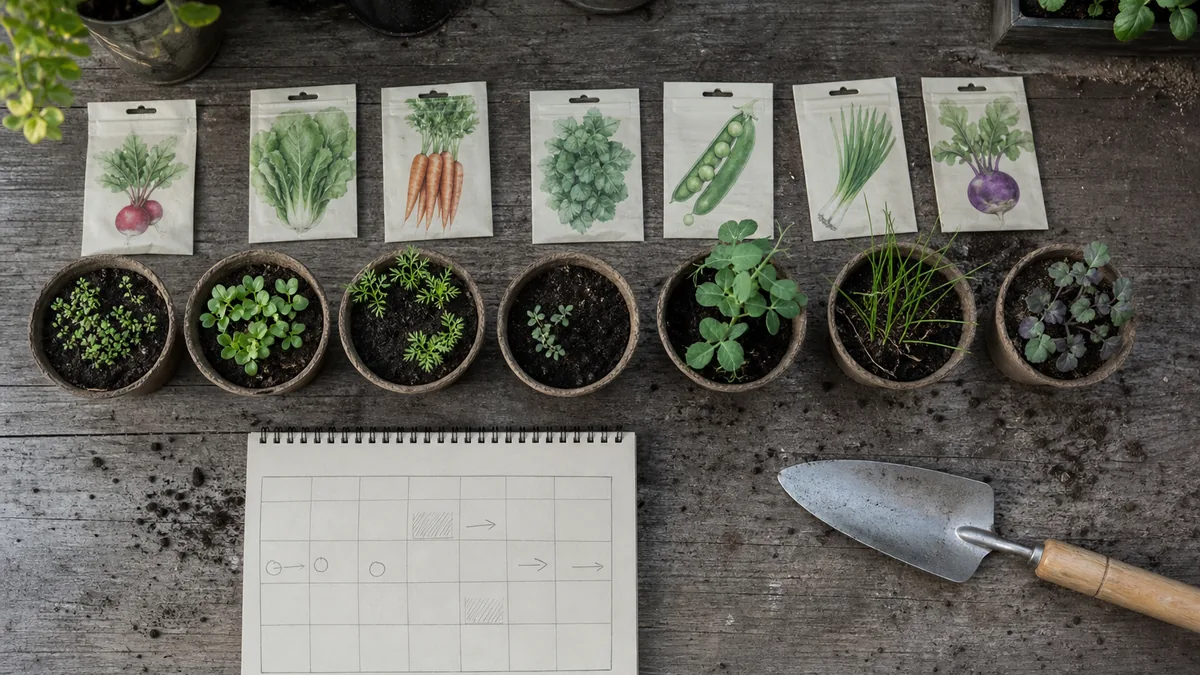
This page is the month-by-month planner. The reasons behind each rule, such as light, temperature and why seedlings should not be started too early, live in our guide to when to start seeds indoors.
Seed Starting Chart at a Glance
The first date in each row is the earliest zone 6b date for that month’s work. Zone 7a dates are about a week earlier, and the month tables below give both.
| Month | Start indoors | Sow or plant outdoors | First zone 6b date |
|---|---|---|---|
| February | Peppers, tomatoes, broccoli, cabbage, cauliflower, basil | Nothing yet | Feb 12 |
| March | Finish the brassicas and tomatoes | Peas, spinach, radishes, kale, carrots, lettuce, beets, onions | Mar 12 |
| April | Optional cucumbers | Beans, squash, corn, pumpkins, cucumbers; tomato transplants | Apr 23 |
| May and June | Nothing new | Pepper and basil transplants; succession sowings | May 7 |
| July to September | Nothing new | Fall broccoli, spinach, lettuce and kale | Jul 18 |
How Is This Seed Sowing Calendar Built?
Every date comes from two inputs: a frost date and a crop offset. The frost dates are the zone medians in our frost data, built from NOAA climate normals. The offsets are the weeks before or after the last frost that our planting calendar uses for each crop, the same rules behind every state page. The tables show a start and an end date because an offset is a range.
| Zone | Median last spring frost | Median first fall frost |
|---|---|---|
| 6b | Apr 23 | Oct 20 |
| 7a | Apr 16 | Oct 25 |
The arithmetic is plain. Eight weeks before Apr 23 is 56 days earlier, Feb 26, and four weeks before is Mar 26. The same eight weeks before Apr 16 gives Feb 19. These are medians, so half of years have a later last frost. Extension sources differ on some crops, and where they do, the sections below say so. Our zone pages for zone 6b frost dates and zone 7a frost dates show the earlier and later ends of each range, and the almanac approach to the same job is compared in our look at the Farmers’ Almanac planting calendar.
To turn any row in the tables below into a date for your own garden, follow the same four steps:
- Find your median last spring frost. Use the date by which half of years have had their last frost.
- Look up the crop’s offset. Each table row lists the weeks before or after that frost.
- Count the weeks. Subtract for indoor starts and cool-season crops, add for tender warm-season crops.
- Hold the date loosely. Soil warmth and the weather that week can move it by several days.
February: Indoor Seed Planting Chart for the First Starts
February is for the slow crops. Nothing is sown outdoors yet, so the whole month is trays on a heat mat under lights. The windows below start with the earliest zone 6b date.
| Crop (start indoors) | Weeks before last frost | Zone 6b (frost Apr 23) | Zone 7a (frost Apr 16) |
|---|---|---|---|
| Peppers | 8 to 10 | Feb 12 to Feb 26 | Feb 5 to Feb 19 |
| Tomatoes | 6 to 8 | Feb 26 to Mar 12 | Feb 19 to Mar 5 |
| Broccoli | 6 to 8 | Feb 26 to Mar 12 | Feb 19 to Mar 5 |
| Cabbage | 6 to 8 | Feb 26 to Mar 12 | Feb 19 to Mar 5 |
| Cauliflower | 6 to 8 | Feb 26 to Mar 12 | Feb 19 to Mar 5 |
| Basil | 6 to 8 | Feb 26 to Mar 12 | Feb 19 to Mar 5 |
Peppers go first because they are slowest. University of Minnesota Extension says to start pepper seeds about eight weeks before planting outside and to keep the flat at 80 to 90°F with a heating mat until seedlings emerge. Our guide to growing peppers from seed covers germination in more detail. UGA Extension agrees that peppers are often started as early as eight weeks before the last frost date.
Tomatoes are where sources split. The planting calendar uses 6 to 8 weeks before the last frost, but University of Minnesota Extension says to start tomato seeds five to six weeks before planting outside. For an Apr 30 transplant, that works out to Mar 19 to Mar 26, later than the calendar’s Feb 26 to Mar 12 window. Missouri Extension lists tomato crop time at 6 to 8 weeks for packs and 8 to 10 weeks for pots. If your seedlings tend to stretch, take the later end of the range, and read how to grow tomatoes from seed for the temperature side. Illinois Extension gives broccoli a shorter 4 to 6 weeks, so the brassica row is also a range.
Light is the usual February problem. Missouri Extension says to keep seedlings about 6 inches from the lamps and run them 14 to 16 hours a day. Seedlings that reach for a window anyway are covered in leggy seedlings, and a damp, crowded tray also invites damping off.
March: Seed Planting Calendar for Cool-Season Crops
March is when the first seed goes straight into the ground. These crops tolerate cold, so they are timed backward from the last frost. The first four rows start on the same day.
| Crop (direct sow) | Weeks before last frost | Zone 6b (frost Apr 23) | Zone 7a (frost Apr 16) |
|---|---|---|---|
| Peas | 4 to 6 | Mar 12 to Mar 26 | Mar 5 to Mar 19 |
| Spinach | 4 to 6 | Mar 12 to Mar 26 | Mar 5 to Mar 19 |
| Radishes | 4 to 6 | Mar 12 to Mar 26 | Mar 5 to Mar 19 |
| Kale | 4 to 6 | Mar 12 to Mar 26 | Mar 5 to Mar 19 |
| Carrots | 2 to 5 | Mar 19 to Apr 9 | Mar 12 to Apr 2 |
| Lettuce | 2 to 4 | Mar 26 to Apr 9 | Mar 19 to Apr 2 |
| Beets | 2 to 4 | Mar 26 to Apr 9 | Mar 19 to Apr 2 |
| Onion sets or transplants | 2 to 4 | Mar 26 to Apr 9 | Mar 19 to Apr 2 |
UConn’s Home and Garden Education Center says pea seed can be direct sown as soon as the soil becomes workable and will germinate in soil as cold as 50°F. Penn State Extension says to plant spinach about four to eight weeks before your average last frost date, and notes that spinach seed germinates best at soil temperatures between 45 and 68°F. The calendar’s 4 to 6 weeks sits inside that range, and a thermometer reading from the bed, as described in soil temperature for planting, settles any doubt. UConn also says to stagger pea plantings every two weeks through mid-May.
Lettuce and carrots come a little later in the month. Michigan State University Extension says to sow lettuce 2 to 4 weeks before the last frost and again every 2 to 3 weeks, matching the table. Seed depth and the light requirement are in how to grow lettuce from seed, and slow carrot germination is the subject of growing carrots from seed. The repeat sowings are a form of succession planting, and the calendar notes the same idea for radishes every 1 to 2 weeks.
Onions fit this window too. Our guide to how to plant onion sets explains the depth and spacing, and the table’s 2 to 4 weeks before the last frost is for long-day varieties. Potatoes are not part of the calendar’s crop list, but they go in during the same weeks, and how to grow potatoes gives the extension timing and the soil temperature to wait for.
April: Warm-Season Sowing Starts After the Last Frost
The last frost date is the turning point of the calendar. From here the offsets run after it, and soil temperature, not the date, is the real trigger.
| Crop | Weeks after last frost | Zone 6b (frost Apr 23) | Zone 7a (frost Apr 16) |
|---|---|---|---|
| Beans (direct sow) | 0 to 1 | Apr 23 to Apr 30 | Apr 16 to Apr 23 |
| Squash and zucchini (sow or transplant) | 0 to 1 | Apr 23 to Apr 30 | Apr 16 to Apr 23 |
| Corn (direct sow) | 0 to 1 | Apr 23 to Apr 30 | Apr 16 to Apr 23 |
| Pumpkins (direct sow) | 0 to 1 | Apr 23 to Apr 30 | Apr 16 to Apr 23 |
| Cucumbers (sow or transplant) | 1 to 2 | Apr 30 to May 7 | Apr 23 to Apr 30 |
| Tomatoes (transplant outdoors) | 1 to 2 | Apr 30 to May 7 | Apr 23 to Apr 30 |
Beans are a good example of a crop where the sources do not match. Utah State University Extension says to sow after the soil warms to above 60°F, and that germination is greatly reduced below it. It also says to start planting beans one week before the last frost-free date, and 2 to 3 weeks before with plastic mulch or row covers. The calendar’s window starts at the last frost and runs a week, so it is the cautious end. Check the soil first, then follow how to grow beans from seed.
Cucumbers are the same story. Utah State says to direct sow when soil is 65°F and to plant after the last frost has passed, and that transplants take 4 to 6 weeks to grow. For a zone 6b transplant on Apr 30, that puts an indoor start between Mar 19 and Apr 2. Details are in how to grow cucumbers from seed. Vine crops follow one pattern, covered for squash and pumpkins: seed or transplants into warm soil, after frost.
Tomato transplants can wait until the same week as cucumbers. University of Minnesota Extension says to move plants outdoors only after all danger of frost has passed and the soil has warmed. Harden seedlings off first. UGA Extension says to begin at least a week before planting outdoors, while Missouri Extension says about two weeks and no outside time below 45°F. Planning the whole garden around these dates is the subject of how to plant a garden.
May and June: Transplants and Succession Sowings
The calendar’s remaining spring offsets are for the crops that hate cold nights. Pepper and basil transplants wait the longest.
| Crop (transplant outdoors) | Weeks after last frost | Zone 6b (frost Apr 23) | Zone 7a (frost Apr 16) |
|---|---|---|---|
| Peppers | 2 or more | May 7 and later | Apr 30 and later |
| Basil | 2 or more | May 7 and later | Apr 30 and later |
University of Minnesota Extension says to move peppers outdoors once nighttime low temperatures are above 50°F. That, not May 7, is the trigger, and the table’s “and later” is there for exactly that reason. After transplanting, the gaps in the bed are filled with repeat sowings. The calendar’s notes say to sow lettuce every 2 to 3 weeks, and radishes every 1 to 2 weeks, through spring. How many plants each of those sowings holds is worked out in the callout below.
The calendar has no new spring offsets for June, which is a useful signal: June is for watering, thinning and tending, plus fall planning. Gardeners who want the planting dates for every crop in one list can enter your ZIP code and get this month’s list, which uses the frost dates at your own address, not a zone median.
Veg Sowing Calendar for Fall: July to September
Fall sowing runs on a different rule, because it is counted back from the first fall frost. The calendar subtracts each crop’s days to maturity plus a 14-day safety margin from the median first frost. The dates are cutoffs, so the “sow by” range is the latest sensible date.
| Crop | Days to maturity plus margin | Zone 6b sow by (frost Oct 20) | Zone 7a sow by (frost Oct 25) |
|---|---|---|---|
| Broccoli | 70 to 80 plus 14 | Jul 18 to Jul 28 | Jul 23 to Aug 2 |
| Spinach | 50 to 60 plus 14 | Aug 7 to Aug 17 | Aug 12 to Aug 22 |
| Lettuce | 40 to 50 plus 14 | Aug 17 to Aug 27 | Aug 22 to Sep 1 |
| Kale | 40 to 50 plus 14 | Aug 17 to Aug 27 | Aug 22 to Sep 1 |
NC State Extension gives the days to maturity used here: broccoli 70 to 80, spinach 50 to 60, kale 40 to 50 and leaf lettuce 40 to 50. It tells gardeners to find the average first killing frost and count backward from it by each crop’s days to maturity. The margin is the calendar’s own addition, and it is why these dates are conservative. Penn State Extension takes a different view for spinach: it says to sow six to eight weeks before the average first frost, which is Aug 25 to Sep 8 in zone 6b, later than the calendar’s cutoff. Treat the calendar’s date as the stricter cutoff and Penn State’s as the later option.
Lettuce sown in August is cut as the weather cools, and how to harvest lettuce shows how to take outer leaves so one sowing keeps producing. Cilantro is another cool-weather herb for the same weeks, and growing cilantro explains the late-summer sowing.
How to Shift the Seed Calendar for Your Zone
Seed calendars are only as good as the frost date under them, so the shift is simple: replace Apr 23 and Oct 20 with your own, keep the offsets, and redo the arithmetic. The table does that for six zones using the same offsets and the median frost dates from our zone data.
| Zone | Median last frost | Tomatoes indoors | Lettuce direct sow | Beans direct sow | Kale sow by (fall) |
|---|---|---|---|---|---|
| 5b | Apr 30 | Mar 5 to Mar 19 | Apr 2 to Apr 16 | Apr 30 to May 7 | Aug 8 to Aug 18 |
| 6a | Apr 27 | Mar 2 to Mar 16 | Mar 30 to Apr 13 | Apr 27 to May 4 | Aug 14 to Aug 24 |
| 6b | Apr 23 | Feb 26 to Mar 12 | Mar 26 to Apr 9 | Apr 23 to Apr 30 | Aug 17 to Aug 27 |
| 7a | Apr 16 | Feb 19 to Mar 5 | Mar 19 to Apr 2 | Apr 16 to Apr 23 | Aug 22 to Sep 1 |
| 7b | Apr 5 | Feb 8 to Feb 22 | Mar 8 to Mar 22 | Apr 5 to Apr 12 | Aug 29 to Sep 8 |
| 8a | Mar 28 | Jan 31 to Feb 14 | Feb 28 to Mar 14 | Mar 28 to Apr 4 | Sep 4 to Sep 14 |
The pattern is that each zone step moves the spring dates by roughly a week or more, and the fall dates the other way, because warmer zones also have a later first frost. The page for each zone, such as zone 7b frost dates, lists the median and the earlier and later ends of the range. If you do not know your zone, our growing zones directory is the place to look it up. Our guide to planting by zone compares the zones side by side.
A state is a rougher cut than a zone, but it is often easier to use. The Ohio planting calendar and the Virginia planting calendar carry the full table for 19 crops using that state’s own frost dates, so a reader there can check this page’s 6b and 7a dates against local numbers. Both are written for the whole state, so a mountain ZIP code and a coastal one will differ from the table.
If you would rather not redo the arithmetic crop by crop, the Season Planner puts every date for your own ZIP code into one plan. The paper method above works without it: pick a zone, copy the offsets, and mark the dates on a wall calendar.
Free book · 23 pages, PDF
Seed Starting Calendar FAQ
What is a seed starting calendar?
A seed starting calendar lists when to sow each crop, counted in weeks from your last spring frost or first fall frost. For zone 6b, with a median last frost of Apr 23, the first entry is peppers indoors from Feb 12 to Feb 26, using eight to ten weeks before the last frost. University of Minnesota Extension says to start peppers about eight weeks before planting outside.
How early can I start seeds on a seed start calendar?
Peppers can start about eight weeks before planting outside, according to University of Minnesota Extension, and tomatoes five to six weeks. Missouri Extension lists tomatoes at 6 to 8 weeks for packs and 8 to 10 weeks for pots. Starting earlier than the crop needs gives you a larger plant to keep under lights, not an earlier harvest.
Is a seed sowing calendar the same as a planting calendar?
They overlap, but a sowing date is when seed goes into the tray or soil, and a planting date is when transplants go outside. Peppers show the difference: the sowing window is Feb 12 to Feb 26 in zone 6b, and University of Minnesota Extension says to transplant once nighttime lows are above 50°F, which is the May 7 and later column here.
Can I use one veg sowing calendar for every zone?
No, shift it. Each zone has a different median last frost, so the same offsets give different dates. Using the offsets here, tomatoes start indoors Mar 5 to Mar 19 in zone 5b, Feb 26 to Mar 12 in zone 6b and Jan 31 to Feb 14 in zone 8a. The table in this guide lists six zones.
When should I stop sowing vegetables for fall?
Count back from your first fall frost by the crop's days to maturity. NC State Extension gives 70 to 80 days for broccoli, 50 to 60 for spinach and 40 to 50 for kale and leaf lettuce. In zone 6b, with a median first frost of Oct 20, the calendar adds a 14-day margin, so broccoli goes in by Jul 18 to Jul 28.
How long should I harden off seedlings?
Start at least a week before planting outdoors, according to UGA Extension, and up to two weeks, according to Missouri Extension. Missouri also says to begin in shade, build up the sun gradually, and keep tender seedlings in when it is below 45°F or windy. Use the longer period for peppers and tomatoes.
Sources & further reading
Indoor starting and transplanting: University of Minnesota Extension, Growing peppers, University of Minnesota Extension, Growing tomatoes in home gardens, UGA Extension, Fulton County, Seed starting, University of Missouri Extension, Starting Plants Indoors From Seeds and University of Illinois Extension, When should I start my seeds?
Direct sowing: Utah State University Extension, Beans in the Garden, Utah State University Extension, Cucumber in the Garden, Penn State Extension, Growing spinach, UConn Home & Garden Education Center, Peas and Michigan State University Extension, How to grow lettuce.
Fall timing: NC State Extension, Growing a Fall Vegetable Garden. The crop offsets and zone medians in every table come from the site’s own planting calendar and frost data (NOAA U.S. Climate Normals), which list an extension source for each crop.
Free book · 23 pages, PDF
The Spacing & Planting Cheat Sheet
Sent