How do you grow potatoes? Plant certified seed potatoes, whole or cut into pieces with at least one eye, 3 to 5 inches deep and 10 to 12 inches apart in rows 30 to 36 inches apart, a few weeks before your last frost once the soil reaches 45 to 50°F. Pile soil around the stems as they grow, give them about an inch of water a week, and dig 90 to 120 days later. New to growing food? Start with our beginner vegetable garden guide, and look up your local frost dates before you plant.
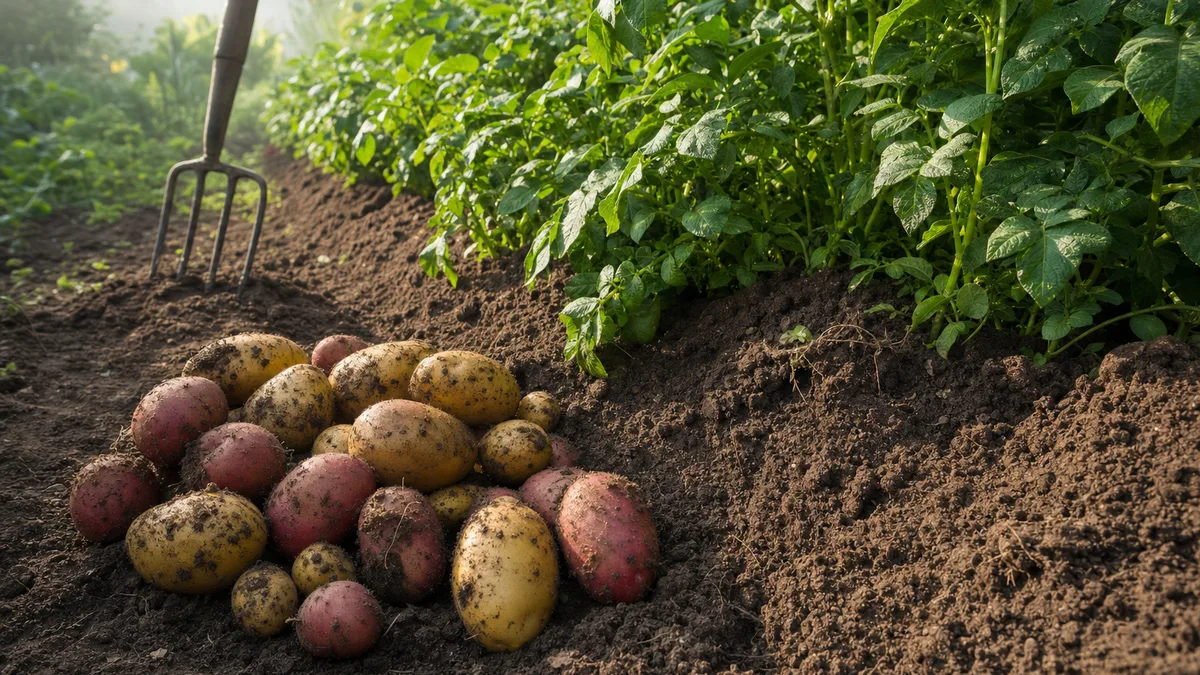
Potato Quick Facts
| What | Answer | Source |
|---|---|---|
| Soil temperature to plant | 45 to 50°F | Penn State, NDSU, Utah State, Maine |
| Planting depth | 3 to 5 inches, cut side down | Minnesota, Clemson, Maryland |
| Spacing | 8 to 12 inches in the row, rows 24 to 36 inches apart | Maryland, Minnesota |
| Seed piece | About 1.5 to 2 ounces with at least one eye | Maryland, Maine, Oklahoma State |
| Sun | At least 6 hours of direct sun | Iowa State, Maryland, West Virginia |
| Water | About 1 to 2 inches a week | Iowa State, Utah State |
| Days to harvest | 90 to 120 days for full-size tubers | Iowa State, Maryland, Clemson |
| Plant height | 1 to 2 feet | NC State Plant Toolbox |
How Do Potatoes Grow?
A potato plant starts from a piece of last year’s tuber, not from a true seed. Each eye on the seed piece sends up a stem, and the roots and underground side stems grow from the buried part of that stem. NC State’s Plant Toolbox describes the plant as producing stolons that bear the edible underground tubers, with erect, branching stems and flowers that may be white, pink, purple or blue.
How tall do potato plants get?
Not very. NC State’s Plant Toolbox lists the plant at 1 to 2 feet tall and 1 to 1.5 feet wide. That is a compact plant, which is one reason potatoes fit a raised bed.
When do the potatoes actually form?
West Virginia University Extension says tubers begin forming when plants are 6 to 8 inches tall, usually 4 to 8 weeks after planting. Temperature matters here. Illinois Extension says tuber formation is best at soil temperatures of 60 to 70°F and fails at 80°F, and Maryland Extension agrees that soil above 80°F holds tubers back. That is why potatoes are planted early in spring and why a hot summer can wreck a late planting.
Best Time to Plant Potatoes
Potatoes are a cool-season crop, and they go in before the soil is truly warm. Two signals work in every climate: soil at 45 to 50°F, and a date a couple of weeks before your average last frost. Penn State, NDSU, West Virginia and South Dakota State give 45°F as the minimum, while Maine and Utah State say 50°F. NDSU says to plant up to two weeks before the average last frost, and Utah State gives 14 to 21 days before it. Vermont Extension widens that to 2 to 4 weeks.
| Region | Planting window | Source |
|---|---|---|
| Florida (north) | Late January through February | UF/IFAS |
| Coastal Carolinas | February 1 to March 31 (Clemson coastal); February 15 to March 31 (eastern NC) | Clemson, NC State |
| Piedmont South Carolina | March 15 to April 30 | Clemson |
| Mid-Atlantic | March 15 to May 1; early varieties through June 1 | University of Maryland |
| Illinois | March or early April; mid and late varieties as late as July 1 | Illinois Extension |
| Upper Midwest | Early April in the Twin Cities, May in the north; mid-May to early June in South Dakota | Minnesota, South Dakota State |
| Pacific Northwest | Late March through May in the Willamette Valley; April and May in central and eastern Oregon | Oregon State |
Your own frost date beats any regional table. Find it, count back two to three weeks, and check that the soil has reached 45°F before the seed goes in. Seed pieces in cold, wet soil are prone to rot, Maine Extension warns. If two sources give you different frost dates, our comparison of Farmers’ Almanac and NOAA frost dates shows where the numbers come from.
The planting calendar by state shows what to sow by month, which is a handy cross-check on your dates.
Seed Potatoes: Choosing, Cutting and Chitting
Buy certified seed potatoes
Use certified seed potatoes sold for planting. Maine Extension says not to plant grocery-store potatoes, which are often treated to stop sprouting, and Utah State recommends certified seed to reduce disease risk. Pick a variety by how long you are willing to wait; maturity classes are covered in the days-to-harvest section below.
How to cut a seed potato
Small tubers can go in whole. Maine Extension says whole seed under 2 inches across is fine, and anything under 1 inch is too small. Larger tubers get cut into blocky pieces, each with at least one eye. The target piece size differs a little by source: Maine says 1.75 to 2.25 ounces, Maryland says 1.5 to 2 ounces (about a 1.5-inch cube) with one to three eyes, and Utah State wants at least 2 ounces. Make smooth cuts, because jagged ones invite rot, per Maine.
Cut surfaces need to heal before planting. Clemson says to cut 3 to 5 days ahead. Iowa State suggests holding pieces at 60 to 70°F and 85 percent humidity for several days until they callus, and Minnesota gives a similar 60 to 70°F drying period.
Chitting (pre-sprouting) seed potatoes
Chitting, which Maine Extension calls green sprouting, gives you a head start. Spread the seed in a single layer in a bright spot above freezing, at about 70°F and high humidity, turning the pieces now and then. Aim for short, stubby sprouts under 1 inch; if they grow longer, Maine says to keep the seed cool until planting day. If your seed arrives with sprouts, Minnesota says to avoid rubbing them off while planting.
How Deep to Plant Seed Potatoes and How Far Apart
Most extension sources agree on a trench roughly 3 to 5 inches deep, with the seed piece cut side down and the sprouts up. Minnesota covers the pieces with 4 inches of soil or compost, Clemson and Maryland say 3 to 5 inches, and Penn State digs a 4-inch trench. Maine digs a deeper furrow, 4 to 6 inches, then covers the seed with just 2 inches and fills the rest in as the plants grow. Illinois Extension is the shallow outlier at 1 to 3 inches.
| Measurement | Range in extension guides | Good default |
|---|---|---|
| Depth | 1 to 6 inches (most say 3 to 5) | 4 inches |
| Between plants in the row | 6 to 12 inches (most say 8 to 12) | 10 to 12 inches |
| Between rows | 24 to 36 inches | 30 to 36 inches in open ground, 24 inches minimum |
Spacing sets tuber size. Maryland Extension suggests about 9 inches apart if you mostly want new potatoes and up to 20 inches for large storage potatoes.
How to Plant Potatoes, Step by Step
- Pick a sunny, well-drained spot. Iowa State asks for at least six hours of direct sun and loose, fertile, slightly acidic soil.
- Test the soil. Clemson recommends a pH between 5.8 and 6.5 for potatoes.
- Prepare the seed. Cut large tubers into pieces with an eye or two, let them heal, and chit them if you have time.
- Dig the trench. Make it about 4 inches deep, with rows 30 to 36 inches apart.
- Set the seed. Place pieces cut side down, sprouts up, 10 to 12 inches apart.
- Cover lightly. Cover with 2 to 4 inches of soil, as Maine and Minnesota describe, and leave the rest of the trench for hilling.
- Water and wait. Water if the soil is dry. Expect shoots in a couple of weeks, covered below.
If your soil test is unfamiliar, our guide to reading soil test results explains the pH and nutrient numbers.
Hilling Potatoes
Tubers form above the seed piece, not below it, and they turn green in light. Hilling, which means mounding soil up around the stems, gives them room and keeps them covered. NDSU says hilling provides space for the developing tubers and helps prevent greening, and Iowa State describes it as keeping tubers covered.
Sources differ on when to start. Maine, Oregon State, West Virginia and Penn State start when the shoots are about 6 to 12 inches tall; Minnesota waits until stems are about a foot tall. Utah State and NDSU say to hill at planting or within four weeks of it. Repeat it: Maine says up to three hillings may be needed, and Minnesota’s schedule is one start plus once or twice more. Minnesota ends with 6 to 8 inches of total soil along the plants. Peanuts are another garden crop where soil gets mounded around the plants, though for a different reason, as our guide to growing peanuts explains.
There is a no-hill option. Clemson describes laying seed pieces on the soil surface or 1 inch below and covering them with 12 to 18 inches of straw or pine needles, so tubers form in the mulch and harvest is easier. Our guide to organic and inorganic mulch compares straw, pine needles and other options. Utah State describes a similar method with a 1 to 2 inch planting depth and 4 to 6 inches of mulch, topped up as it settles.
Water, Sun and Feeding
How many hours of sun do potatoes need?
Iowa State asks for at least six hours of direct sun a day. Maryland Extension says at least 6 hours, with 8 to 10 preferred, and West Virginia gives 6 to 8 hours.
How much water
Iowa State recommends about 1 inch a week, with extra attention in early to mid June when tubers are developing, and says uneven watering causes hollow heart, growth cracks and knobs. Utah State gives 1 to 2 inches a week, preferably by drip, and says to ease off as plants yellow and die back at the end of summer. Clemson notes that water is most critical when blossoms form.
Feeding potatoes
Without a soil test, Iowa State suggests 1 to 2 pounds of a 10-10-10 type fertilizer per 100 square feet, and warns that large amounts of manure may raise scab. Utah State advises against heavy feeding, which pushes leaves at the expense of tubers, and suggests a nitrogen side-dress about 6 weeks after emergence.
How Long Do Potatoes Take to Sprout and Grow?
How long does it take for potatoes to sprout?
UF/IFAS Extension says sprouts usually emerge 10 to 14 days after planting in Florida, and recommends adding 2 to 3 inches of soil to the row when they do. The northern sources reviewed here give no day count for emergence, and cold soil is a rot risk, per Maine. Indoors, chitting takes about two weeks at room temperature in Maine’s schedule.
How long does it take to grow potatoes?
There are two harvests, and they take different lengths of time. New potatoes are small, thin-skinned tubers dug while the vines are still green. University of Minnesota Extension says they can be dug about seven to eight weeks after planting, Maryland gives 6 to 8 weeks, usually once plants have flowered, and West Virginia says 60 to 90 days, about three weeks after flowering. Iowa State says to use them within ten days, and Oregon State notes they do not store well.
Full-size storage potatoes take longer. Iowa State and Maryland give 90 to 120 days, Clemson, NC State and West Virginia say 100 to 120, and UF/IFAS gives 80 to 115 days in Florida. NDSU sorts varieties by maturity class: early means up to 110 days after planting, medium 111 to 120, and late more than 120.
How long do red potatoes take to grow?
The extension sources reviewed do not give a separate day count for red potatoes. Red skin is not what sets the schedule; the variety’s maturity class is. NDSU lists Red Norland and Viking as early, Dakota Jewel as medium, Red Pontiac as medium to late and Dakota Rose as medium to late. University of Georgia Extension lists Red Pontiac as medium maturity and Red LaSoda as late. Everything else in this guide applies to red potatoes unchanged.
How Many Potatoes Per Plant, and How Much Per Row
Extension sources count pounds, not tubers, and the numbers vary a lot with variety, spacing, soil and weather. South Dakota State says 2 to 5 pounds per plant, or 10 to 20 pounds per 10 feet of row; West Virginia says 5 to 10 pounds per plant. Per row, Maryland says 6 to 15 pounds per 10-foot row, Iowa State 20 to 30 pounds with good management, Utah State 75 to 100 pounds per 100 feet, and Maine 1 to 2 pounds per foot. NDSU notes that Viking sets few tubers per plant, so they grow large. Treat the low end as a safe planning number.
Here is simple arithmetic from sourced spacing for a 4x8 raised bed (our 4x8 raised bed soil guide covers filling one). Two rows 24 inches apart (Maryland’s lower row spacing) and 12 inches apart in the row (Minnesota, Illinois) put 8 pieces along each 8-foot row, so 16 seed pieces. At about 2 ounces a piece (Maine’s 1.75 to 2.25 range), that is roughly 2 pounds of seed. With 16 feet of row and Maryland’s 6 to 15 pounds per 10 feet, expect very roughly 10 to 24 pounds. Hilling needs loose soil several inches deep, so see our guide to filling a raised garden bed.
Growing Potatoes in Pots and Containers
Potatoes grow in containers, with a few conditions. Penn State Extension suggests a 10 to 15 gallon opaque, food-safe container with drainage holes: start with 4 inches of potting mix, set 3 to 5 tubers on top, cover with 3 inches of mix, and keep adding mix as the stems grow. Oregon State’s guidance is bigger, at least 18 inches wide and 3 feet deep, with fewer potatoes from shallower pots. South Dakota State lists grow bags, drained garbage cans and tires, and says to avoid dark containers or paint them so roots stay cool. Maryland Extension cautions that potato towers usually do not work. Our pot size guide explains gallon sizes.
Harvesting, Curing and Storing Potatoes
For storage potatoes, let the plants die back and then wait. Clemson says to harvest about two weeks after the vines die down, Maryland says to leave tubers in the ground two weeks after die-back so the skins thicken, and Idaho says to kill or pull the vines and leave them dead for 2 to 3 weeks. Iowa State’s skin test helps: dig a hill, and if the skin rubs off easily, wait a few more days. Dig with a fork when the soil is dry, and handle tubers gently.
Curing heals small wounds and thickens skin. The guides agree on cool and humid but not on length: Maryland and West Virginia say 10 to 14 days, Iowa State two weeks at 50 to 60°F and 85 to 90 percent humidity, and NDSU, Utah State and Idaho two to three weeks. After curing, Iowa State stores potatoes at about 40°F and 90 percent humidity in the dark, notes that below 38°F they turn sugary and above 50°F they sprout after 2 to 3 months, and says to keep them away from apples and other fruit that give off ethylene.
Green skin means light exposure. Clemson says green areas are poisonous and bitter and should be cut off and discarded, and Maryland identifies the toxic compound as solanine.
Free book · 23 pages, PDF
How to Grow Potatoes FAQ
How many potatoes does a potato plant produce?
Extension sources give weight rather than a tuber count. South Dakota State University Extension says 2 to 5 pounds per plant, and West Virginia University Extension says 5 to 10 pounds. Variety matters: NDSU notes that Viking sets few tubers per plant, so they grow large.
How long does it take for potatoes to sprout?
UF/IFAS Extension says sprouts usually emerge 10 to 14 days after planting in Florida. The northern sources reviewed here give no day count for emergence. Chitting seed indoors at about 70°F, per Maine Extension, gets short sprouts going before planting.
How long do red potatoes take to grow?
It depends on the variety. NDSU lists Red Norland as early, meaning up to 110 days from planting, and Red Pontiac as medium to late. New red potatoes can be dug 6 to 8 weeks after planting, per University of Maryland Extension, once plants have flowered.
How tall do potato plants get?
The NC State Plant Toolbox lists potato plants at 1 to 2 feet tall and 1 to 1.5 feet wide. Hilling starts at 6 to 12 inches, depending on the source.
How many hours of sun do potatoes need?
At least six hours of direct sun, according to Iowa State University Extension. University of Maryland Extension says 6 hours minimum and 8 to 10 preferred.
How long after potatoes flower are they ready?
For new potatoes, West Virginia University Extension says about three weeks after flowering. Oregon State University Extension says small potatoes can be dug any time after the plants flower and before the tops die. Full-size potatoes wait until the vines die back.
Can I grow potatoes from a grocery store potato?
It is not recommended. University of Maine Cooperative Extension says store potatoes are often treated to prevent sprouting and advises certified seed potatoes. Certified seed is also what Utah State University Extension recommends to reduce disease risk.
Sources & further reading
Planting dates, depth, spacing, hilling and storage figures come from University of Minnesota Extension, University of Maine Cooperative Extension Bulletin 2077, Penn State Extension, University of Maryland Extension, Utah State University Extension, Iowa State University Extension, Clemson HGIC, NDSU Extension, Illinois Extension and Oregon State University Extension. Yield, containers, sprouting time and regional dates come from West Virginia University Extension, South Dakota State University Extension, UF/IFAS Extension, UF/IFAS Escambia County, University of Vermont Extension, NC State Extension, NC State Plant Toolbox, University of Georgia Extension, University of Idaho Extension and Oklahoma State University Extension. For how we source the facts on this site, see our methodology page.
Free book · 23 pages, PDF
The Spacing & Planting Cheat Sheet
Sent