How to Use This Calculator
- Enter your in-row spacing and your between-row spacing, or switch to Beds with paths and enter the bed width, path width, and rows per bed.
- Enter your field size, the germination on your seed tag, and the survival you expect (use 100 for germination when you set out transplants).
- Read plants per acre or hectare, the count per 1,000 square feet and per square foot, and how many seeds or transplants to order. Choose In-row spacing to work backward from a target population.
How to Calculate Plant Population
Plant population is the number of plants on a unit of land, and it comes from one idea: each plant owns a rectangle of ground, its in-row spacing times its between-row spacing. An acre is 43,560 square feet, so the plants per acre are 43,560 divided by that rectangle, with both distances in feet. University of Georgia Extension writes the same step as 1 plant ÷ (spacing length × spacing width) × 43,560 sq ft per acre in its Circular 1313.
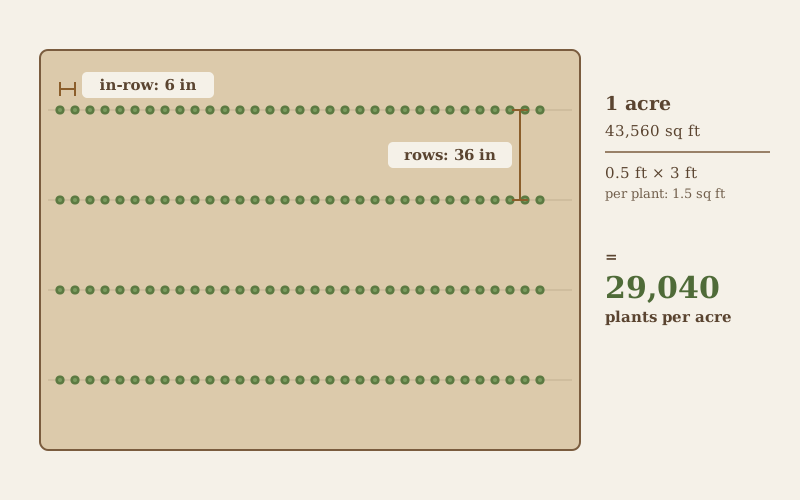
Spacings are usually quoted in inches, so convert first: 6 inches is 0.5 ft and 36 inches is 3 ft. In metric the same logic uses 10,000 square meters per hectare and spacings in meters. Both unit systems follow the exact conversions in the NIST Guide to the SI (1 sq ft is 0.09290304 m² and 1 hectare is 10,000 m²), which puts one hectare at about 2.471 acres.
The table above shows the result for common spacings. The populations in the first table match Table 7 of the Vegetable Crop Handbook for the Southeastern United States, which prints plants per acre for a grid of spacings. Where a crop has a range of recommended spacings, the crop table lists the populations at the tight and wide ends of that range, so you can see how much a few inches in the row changes the count.
Worked Example
Say you are planting sweet corn on 36-inch rows with a seed every 6 inches, on a 5-acre field. This follows the sweet corn example in University of Georgia Extension’s Circular 1313, then adds the seed order using Ohio State University Extension’s planting-rate formula.
- Convert to feet: 36 in = 3 ft between rows; 6 in = 0.5 ft in the row.
- Area per plant: 0.5 ft × 3 ft = 1.5 sq ft.
- Plants per acre: 43,560 ÷ 1.5 = 29,040. That is 667 plants per 1,000 sq ft.
- Aim for 30,000 instead: 43,560 ÷ (30,000 × 3 ft) = 0.484 ft, or 5.81 inches between seeds.
- Seeds to order: to end with 30,000 plants per acre at 95% germination and 97% survival, plant 30,000 ÷ (0.95 × 0.97) = 32,556 seeds per acre.
- For the field: 32,556 × 5 acres = about 162,800 seeds (the calculator rounds up once for the whole field and shows 162,779).
In the calculator, choose In-row spacing, enter 30,000 as the target, 36 inches between rows, a 5-acre field, 95% germination, and 97% survival. It returns 5.81 inches and 162,779 seeds.
Beds, Paths & Plantable Ground
Market gardens and plasticulture farms plant several rows on a raised bed and leave a path between beds, so the distance that matters is the bed spacing: bed width plus path, measured center to center. The row spacing for the math is that bed spacing divided by the rows per bed. A 30-inch bed with a 42-inch path is a 72-inch (6 ft) bed spacing; with two rows per bed, each row owns 36 inches of width, the same as a single-row field on 36-inch centers.
University of Georgia Extension works the same method for bell peppers (two rows per bed, 6 ft bed spacing, 10 inches in the row) and onions (four rows per bed on 6 ft beds, 4 inches in the row). The calculator also reports the share of the ground that is planted bed. In that 30-inch bed with a 42-inch path, 30 ÷ 72 = 42% of the ground carries plants; the rest is path, which is why a bed layout holds fewer plants per acre than the same in-bed spacing with no paths.
Seeds or Transplants to Order
Not every seed becomes a plant. Ohio State University Extension notes that final stands are always less than the seeds planted: cold, wet soil, insects, disease, and cultivation reduce emergence, and you can generally expect up to 5 to 10 percent fewer plants at harvest than seeds planted. Its planting-rate formula is the desired population per acre divided by germination (from the seed tag) times expected survival (what reaches harvest under normal conditions).
OSU also suggests raising the seeding rate by about 5 percent when you plant very early into cool soil or no-till into heavy residue. The calculator does not add that on its own, so lower your survival percentage to build it in. For transplants, enter 100 for germination and the survival you see on your own farm, then add the few percent you want in reserve for replanting.
Common Mistakes
- Using the bed width instead of the bed spacing. The path is part of the ground each bed uses. Enter bed width and path width separately, or use the center-to-center bed spacing as the between-row distance with one row per bed.
- Mixing units. Inches and centimeters differ by 2.54, and an acre is 0.4047 of a hectare, so a per-hectare population is about 2.47 times the per-acre number for the same spacing. The calculator converts your numbers when you switch units.
- Forgetting germination and survival. Ordering exactly the plants you want leaves the field short. Divide by germination times survival, then round up.
- Counting ground that is not planted. Headlands, waterways, and wide turn areas do not carry the crop. Enter the planted acreage as the field size.
- Ignoring uneven spacing. Ohio State University Extension reports that stands with uniform spacing yield better than stands with gaps: yield falls an additional 5 percent with gaps of 4 to 6 feet in the row and 2 percent with gaps of 1 to 3 feet. A correct average population does not cure poor uniformity.
- Applying another region’s spacing. The crop spacings in the table come from the Southeastern handbook and Utah State University, and Ohio State’s populations come from Ohio trials. Check your own state extension guide and your seed company before you commit.
Plants per Acre Calculator FAQ
How many plants per acre do I need?
It depends on your spacing, so work it out from the two distances you plant at. Divide 43,560 square feet by the area each plant gets: sweet corn 6 inches apart in rows 36 inches apart gets 0.5 ft × 3 ft = 1.5 sq ft, which is 29,040 plants per acre (University of Georgia Extension, Circular 1313). For a sense of range, the crop table below runs from about 900 to 1,400 plants per acre for vine pumpkins up to roughly 12,000 to 35,000 for sweet corn.
How do I calculate plants per hectare?
Divide 10,000 square meters by the area each plant gets, with both spacings in meters. Plants 15 cm apart in rows 90 cm apart get 0.15 m × 0.9 m = 0.135 m², which is 74,074 plants per hectare. Switch the calculator to Metric and it does this directly. To convert a per-acre figure instead, multiply by 2.471, since one hectare is about 2.471 acres.
Can I use this as a plant population calculator for corn and soybeans?
Yes, for the spacing math. Ohio State University Extension reports final corn stands of 24,000 to 34,000 or more plants per acre for grain, with 31,000 to 32,000 optimizing yield in most Ohio fields, and 100,000 to 120,000 plants per acre for soybeans planted before May 20 in narrow rows. Choose In-row spacing, enter the population you want and your row width, and the calculator gives the seed spacing. Follow your seed company and local extension for the population itself.
How do I find the in-row spacing for a target population?
Divide 43,560 by the target and by the row spacing in feet. For 30,000 seeds per acre on 36-inch (3 ft) rows, that is 43,560 ÷ (30,000 × 3) = 0.484 ft, or 5.81 inches between seeds (University of Georgia Extension, Circular 1313). Choose "In-row spacing" in the calculator, enter the target and your row width, and it returns the distance in inches or centimeters.
How many seeds or transplants should I order for a field?
Divide the plants you want at harvest by germination times expected survival. Ohio State University Extension's example: a 30,000 plants per acre target with 95% germination and 97% survival means planting 30,000 ÷ (0.95 × 0.97) = about 32,556 seeds per acre. Multiply by your acres and round up. For transplants, use 100% for germination and your own survival rate.
How do I check my plant population in the field?
Count the plants in a measured length of row and multiply. Ohio State University Extension's method uses the length of row that covers 1/1000 acre: 17 ft 5 in for 30-inch rows, 14 ft 6 in for 36-inch rows, and 13 ft 1 in for 40-inch rows. If you count 21 plants in 17 ft 5 in of a 30-inch row, the population is 21,000 plants per acre. The calculator shows this length for your row width.
How do beds with paths change the plants per acre?
Paths use ground that holds no plants, so use the bed spacing, bed width plus path, as the distance across the planting and divide it by the rows per bed. Two rows of peppers on a 6 ft bed spacing, 10 inches apart in the row, give 2 ÷ (6 ft × 0.833 ft) × 43,560 ≈ 17,400 plants per acre (Circular 1313 prints 17,431 because it rounds 10 inches to 0.833 ft). The calculator also shows what share of the ground is planted bed.
How is this different from the Plant Spacing Calculator?
The Plant Spacing Calculator counts plants in a garden bed of a given length and width, by the row or square-foot method. This page works at field scale: population per acre or hectare, spacing worked back from a target, seed or transplant orders for your acreage, and beds with paths. Use that one for a raised bed and this one for a market garden or farm field.
Sources & further reading
- University of Georgia Extension, Circular 1313, “Common Agricultural Calculations Using Unit Conversions” (McAvoy, Oliveira, Porter, Kumari, Sparks): the plants per acre formula, the sweet corn, watermelon, pepper, and onion examples, and the bed spacing method.
- Ohio State University Extension, “Plant Populations and Seeding Rates”: the planting-rate formula and its worked example, the corn population ranges, the 1/1000 acre stand-count lengths (Table 4-12), and the notes on uneven spacing.
- Ohio State University Extension, “Soybean Planting Date, Row Width, and Seeding Rate Recommendations” (C.O.R.N. Newsletter, 2017): the soybean final stand.
- Southeastern Vegetable Extension Workers, 2025 Vegetable Crop Handbook for the Southeastern United States (hosted by the University of Arkansas Division of Agriculture): Table 7, plants per acre at several spacings, and the crop spacing ranges.
- Utah State University Extension, Tomato, Pepper, Eggplant: Planting and Spacing: pepper spacing and the 16,000 to 29,000 plants per acre it supports.
- NIST, Guide to the SI, Appendix B.8: the exact square foot to square meter factor and the hectare.
For how we source and check every calculator, see the methodology page. For the rest of the planting sequence, see our complete guide to spacing and planting.