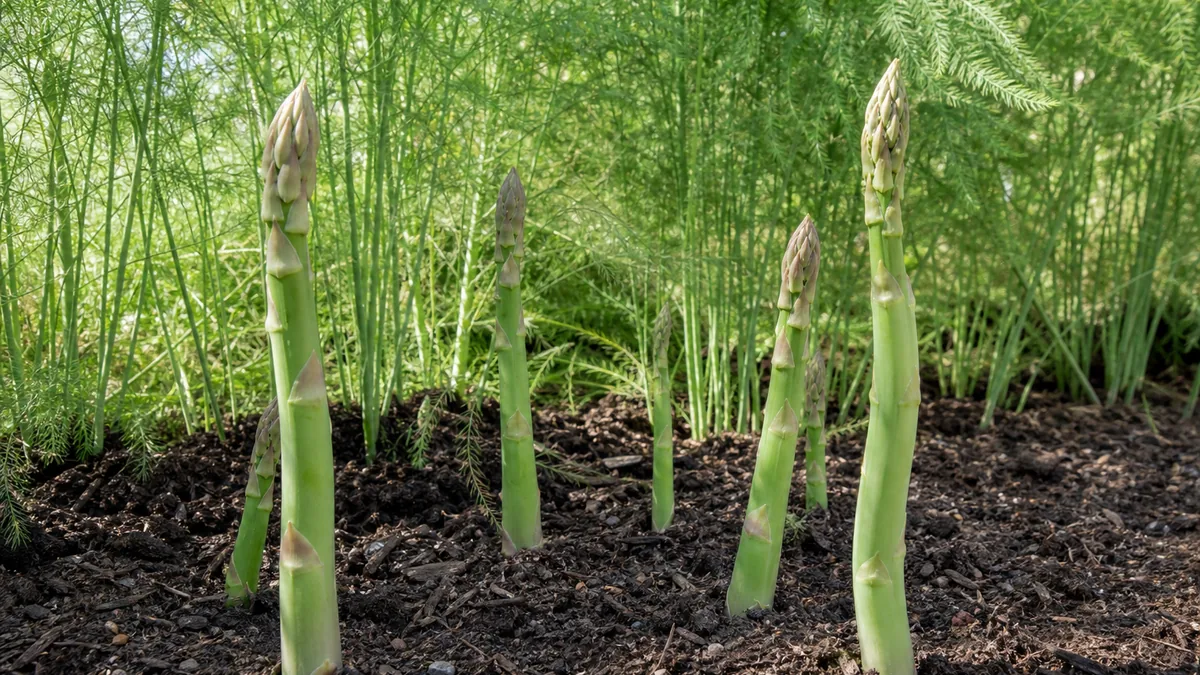
How does asparagus grow? It is a perennial that comes back from a permanent clump of buds and fleshy roots called a crown. Each spring the crown pushes up edible spears; spears left alone open into tall, feathery ferns that feed the roots for next year. The crown needs a couple of seasons to build strength, so the first real harvest comes late, and the bed is worth laying out carefully before you plant.
Asparagus at a Glance
Most rows show a range because the guides differ. “Year 1” here means the year you set the crowns in the ground.
| Topic | What the sources say |
|---|---|
| Plant type | Perennial; 10 to 15 years of spears (Colorado State, Utah State, UNH) up to 15 to 20 years (Illinois, Iowa State) |
| Planting stock | One-year-old crowns preferred (Illinois, NC State, UNH) |
| Sun | At least 6 hours (Iowa State, Maryland), and 8 hours or more is better (Colorado State, UNH) |
| Soil pH | 6.0 to 6.7 (NC State), 6.5 to 7.0 (Minnesota), 6.5 to 6.8 (UNH) |
| Trench depth | About 6 to 12 inches, shallower in clay and deeper in sand (Minnesota) |
| Crown spacing | 9 to 18 inches apart in the row |
| Row spacing | At least 3 feet (Minnesota), 4 to 5 feet in most others |
| First harvest | Second or third spring after planting crowns, for 2 to 4 weeks |
| Full harvest | 6 to 10 weeks each spring from about year 4 (NC State, Illinois, Utah State) |
How Asparagus Grows: Crowns, Spears and Ferns
UNH Cooperative Extension describes the cycle simply. The spears you eat are young shoots; if they are left to grow, they turn into bushy ferns, and the ferns make food by photosynthesis. That food is stored in the crown and its roots and drives the next spring’s spears. Utah State Extension puts the same idea this way: plants need healthy ferns to store enough food for good spear growth.
The root system is not small. Illinois Extension says the roots form a mat that spreads sideways, and over the years it can reach 5 feet or more.
Asparagus plants are also either male or female, according to Illinois Extension. Females put energy into red berries and seeds, which sprout as weedy seedlings. Males produce thicker, larger spears, and Iowa State Extension adds that male plants live longer and are more productive. That is why many gardeners buy all-male varieties; Utah State names Jersey Giant and Jersey Knight as ones that perform well there.
The crown sits in the ground all year, so winter lows matter. Check your zone in our guide to USDA hardiness zones, then pick a variety recommended by your own state extension.
How to Grow Asparagus: Crowns or Seed
The easy answer is crowns. Colorado State Extension calls crowns the easiest way to start, and Illinois and NC State both prefer one-year-old crowns. Look for bare-root crowns with 8 to 10 large roots and a healthy bud cluster, as Colorado State and Utah State describe, and soak them in warm water for 2 to 4 hours before planting, as Colorado State suggests. Crowns are sometimes sold as asparagus bulbs, but they are roots with buds, and they go in the ground the same way.
Seed is possible, with a catch. Illinois Extension says seed adds a year to establishing the bed but gives fresh plants and a wider choice of varieties. Minnesota Extension says harvest begins two years after planting crowns and three years after planting seed. If you want to start asparagus from seed, NC State drills it in spring about 1/2 inch deep and 2 inches apart in a nursery row, then moves the crowns the following spring. UNH suggests starting seed in pots 6 to 8 weeks ahead and setting the plants out after frost danger passes.
Best Place to Plant Asparagus: Sun and Soil
Because the bed will sit for a decade or more, choose with care. Minnesota Extension says to choose its spot carefully, since a plant can last 15 years. These are the points the sources agree on:
- Sun. Iowa State Extension asks for at least 6 hours of direct sun. Maryland Extension notes the plant prefers 8 to 10 hours, and Colorado State and UNH both say 8 hours or more.
- Drainage. Minnesota Extension says to avoid shallow soils and soils that stay saturated, and to avoid low-lying spots where late spring frosts can kill emerged spears.
- Soil pH. NC State Extension says to amend to a pH of 6.0 to 6.7 using a soil test report, UNH gives 6.5 to 6.8, and Minnesota gives 6.5 to 7.0 and warns that asparagus does not tolerate very acidic soil. Our guide to reading soil test results explains how to act on the number.
- Weeds. NC State Extension advises a site with few perennial broadleaf weeds and no nutsedge.
- Placement. In a larger vegetable garden, Minnesota Extension suggests the north end so the tall ferns do not shade other crops.
Colorado State Extension recommends working about 4 inches of well-composted organic material into the soil to a depth of 12 inches before planting. Utah State Extension advises against tilling an established bed because it damages the crown, so the bed is easiest to improve before the crowns go in. If you are still sorting out your site, our vegetable garden starter guide covers choosing sun, space and bed layout.
When Is the Best Time to Plant Asparagus
The best time to plant asparagus is early spring, as soon as the soil can be worked. Illinois Extension and Iowa State Extension both say this. The calendar date then depends on where you live:
- Eastern North Carolina: February, per NC State Extension. Piedmont and mountains: late winter, after hard freezes end but before growth starts.
- Maryland: crowns are usually shipped and set out in March or April, per University of Maryland Extension.
- Utah: April, per Utah State Extension.
- Minnesota: early May to early June, per Minnesota Extension.
Use your own last frost date to translate those into a plan. The frost dates by city pages list the average date for your area, and the planting calendar shows what else goes in around the same time. Where dates disagree, our comparison of Farmers’ Almanac frost dates and NOAA data explains why sources disagree.
How to Plant Asparagus Plants: Trench, Depth and Spacing
The traditional best way to plant asparagus is in a trench, with the crowns set low and soil returned over them as the shoots climb. Depth and spacing vary by state, and the table shows the spread.
| Source | Trench depth | Between crowns | Between rows |
|---|---|---|---|
| Minnesota Extension | 6 to 8 inches in clay, 10 to 12 in very sandy soil | About 12 inches | At least 3 feet |
| Iowa State Extension | 6 to 8 inches in heavier soil, 8 to 10 in light sandy soil | 12 to 18 inches | 4 to 5 feet |
| Illinois Extension | 6 inches deep, 12 to 18 inches wide | 9 to 12 inches | Not given |
| NC State Extension | 8 inches | 12 inches | 5 feet |
| Utah State Extension | 8 inches | 12 inches | 4 feet |
| UNH Extension | About 8 inches deep and 10 inches wide | 18 inches | 5 feet |
| Maryland Extension | Traditionally 12 inches deep, though a 6-inch trench works for many gardeners | 15 to 18 inches | 4 to 5 feet |
A good default from that spread is a trench about 8 inches deep, crowns 12 to 18 inches apart and rows at least 4 feet apart. NC State Extension notes that closer in-row spacing raises yield, while narrower rows may shorten the life of the bed, so give the rows room. Here is the sequence:
- Prepare the bed. Pull perennial weeds and mix in compost or the amendments your soil test calls for.
- Dig the trench. Make it 12 to 18 inches wide, as Illinois Extension describes, and as deep as your soil and climate suggest (see the table).
- Set the crowns. Place them in the trench with the buds pointing up and the roots spread out. Minnesota Extension sets them head to toe at the chosen spacing.
- Cover lightly. Cover the crowns with 2 to 3 inches of the soil you removed, per Minnesota Extension. Illinois Extension says 2 inches.
- Backfill as shoots grow. Fill the trench gradually through the first summer. The pace varies: Colorado State adds 1 to 2 inches weekly, while Utah State adds 2 inches every other month. The goal is the same, a level bed without burying the new fern.
- Water and mulch. Keep the soil moist and add a layer of organic mulch once the trench is filled.
Worked Example: A 25-Crown Asparagus Bed
Utah State Extension says 25 plants should supply enough spears for fresh eating and some storage, and that a mature plant can produce about 3/4 pound of spears during the harvest period. Here is simple arithmetic from those sourced figures and a 12-inch crown spacing, using the 6-inch trench depth and 12-inch trench width from Illinois Extension:
- Row length: 25 crowns at 12 inches apart need about 25 feet of row, for example two rows of 12 to 13 feet.
- Trench soil: 25 feet x 1 foot wide x 0.5 foot deep is 12.5 cubic feet, or about 0.46 cubic yard to move and return.
- Bed width: two rows 4 feet apart means the planted strip is about 5 feet wide once you include the trenches.
- Eventual yield: 25 x 3/4 pound is about 19 pounds a year from mature plants, a rough ceiling and not a guarantee.
How to Care for Asparagus
Caring for asparagus plants is mostly about keeping the ferns healthy through summer, because that is when the crown refills. Four jobs matter most.
Water
Minnesota Extension says established patches need at least 1 inch of water a week, with more frequent watering on sandy soil in dry spells. Utah State recommends less frequent but deeper watering: 1 to 2 inches every other week for the first two years, then every 3 weeks after year 3. Colorado State gives 1 to 2 inches a week for the first two years.
Weeds and mulch
Weeds are the main competitor. Minnesota Extension says any cultivation must be very shallow, less than 2 inches deep, and done only before spears emerge in spring or after harvest but before ferns come up in late June. Utah State advises against tilling asparagus beds because it damages the crown. A 2 to 3 inch layer of organic mulch, which Colorado State and Utah State both recommend, holds moisture and blocks weeds. Our guide to organic vs. inorganic mulch helps you choose.
Feeding
NC State Extension fertilizes each spring just before spears emerge and again at the end of the cutting season. Utah State fertilizes in early June or after harvest is over, and Illinois Extension fertilizes right after the final harvest to support fern growth. The common thread is a feed after the last cut. Minnesota Extension suggests testing established beds every three years and says never to use a fertilizer that contains an herbicide, since it can damage vegetables. Compost works as a gentle feed, and what to put in the pile is covered in what can you compost.
Pests and disease
Illinois Extension notes that rust disease can overwinter on dead foliage, and UNH says removing dead ferns also takes away shelter for asparagus beetles. Both point to the same habit, a tidy bed in late fall.
How to Care for Asparagus in the Fall
Fall care comes down to one question: when do you cut the ferns? The sources do not agree on whether to cut in fall or spring, but they agree on not cutting too soon.
- Wait for dead ferns. NC State Extension says to let ferns turn brown, because cutting before frost reduces next year’s spear crop. UNH says to wait until the ferns are completely dead.
- Cut after frost. Maryland Extension cuts the foliage to 2-inch stubs after frost, when it yellows, and before red berries drop on female plants. Illinois Extension says tops may be removed after fall freezes to reduce rust overwintering.
- Mow and mulch. Utah State mows the dead ferns and leaves them on the bed as mulch.
- Leave them until spring. Colorado State lets ferns stand through winter and trims them in spring before new spears appear.
If your bed had rust or beetles, cut and remove the ferns in late fall. If it stayed clean, mowing in place or waiting until spring is fine. Either way, finish by mulching: Maryland Extension says asparagus should be mulched in autumn, and Colorado State recommends 2 to 3 inches of organic material for winter protection. For the rest of the garden, use our winterize your garden checklist.
When Can You Harvest Asparagus
Be patient and let the crowns build strength first. Sources split on whether the first picking comes in year 2 or year 3:
- Second spring: Minnesota Extension allows about two weeks of picking in the first harvest year, and says some growers wait until year 3. Maryland Extension picks lightly for 3 to 4 weeks in year two. NC State allows no more than two weeks.
- Third spring: Illinois Extension and Iowa State Extension say to wait until the third year after planting crowns. Utah State allows up to 4 weeks in year 3, and UNH gives 2 to 3 weeks.
- Seed-grown beds: Minnesota Extension says harvest begins three years after planting seed.
- Full seasons: NC State harvests 6 to 8 weeks each spring from year 4 onward, and Illinois Extension says up to 8 to 10 weeks. Utah State builds to 6 weeks in year 4 and up to 8 weeks after five years.
Minnesota Extension says to begin when spears are 6 to 8 inches long, and Utah State says to stop when most spears are smaller than a pencil. Colorado State agrees on the pencil rule, harvesting only spears thicker than a pencil. Cut or snap spears at ground level, as NC State advises, taking care not to damage emerging spears. After the last cut, let the ferns grow.
How Long Does an Asparagus Patch Last
A well-sited bed lasts a long time, with sources giving a range. Colorado State, Utah State and UNH say 10 to 15 years of production. Maryland Extension says 12 to 15 years or longer, and NC State and Minnesota Extension say 15 years or more. Illinois and Iowa State go further, with beds productive for 15 to 20 years.
Longevity depends on what you do in the first three years: pick a spot that drains, plant good crowns, keep the ferns healthy, never cut ferns while they are green and avoid tilling. If you like the idea of a bed that keeps giving, garlic is another crop that goes in once in fall and rewards patience, as how to plant garlic explains.
Free book · 23 pages, PDF
How Does Asparagus Grow FAQ
How long does it take for asparagus to grow?
Expect about two to three years from planting crowns to a real harvest. Minnesota Extension says harvest begins two years after planting crowns and three years after planting seed, while Illinois and Iowa State Extension say to wait until the third year after planting crowns. Full harvest seasons of 6 to 10 weeks come around year 4.
Can you grow asparagus from seed?
Yes, but it adds time. Illinois Extension says seed adds a year to establishing the bed, though it gives fresh plants and more varieties. NC State Extension drills seed in spring 1/2 inch deep, grows the plants for a year, then transplants the crowns the following spring.
How deep and how far apart do you plant asparagus crowns?
Extension guides use trenches from about 6 to 12 inches deep, depending on soil, with crowns 9 to 18 inches apart and rows 3 to 5 feet apart. Minnesota Extension covers crowns with 2 to 3 inches of soil at planting and fills the trench in as the shoots grow.
When should I cut back asparagus ferns?
Wait until they have died back. NC State Extension says cutting before frost reduces next year's crop, and UNH says to wait until they are completely dead. Maryland Extension cuts to 2-inch stubs after frost, while Colorado State leaves them standing and trims in spring before spears appear.
Why are my asparagus spears so thin?
Thin spears usually mean the crown is young or has been picked too hard. Utah State Extension says to stop harvesting when most spears are smaller than a pencil, and Colorado State Extension harvests only spears thicker than a pencil. Healthy ferns after harvest rebuild the crown.
Do I need both male and female asparagus plants?
No. Illinois Extension says male plants produce thicker, larger spears because they put no energy into seeds, and Iowa State Extension says males live longer and are more productive. Utah State Extension names Jersey Giant and Jersey Knight as all-male varieties that perform well in Utah.
Sources & further reading
Planting, spacing, harvest and longevity figures come from the University of Minnesota Extension’s guide to growing asparagus, University of Maryland Extension, NC State Extension’s home garden asparagus production guide, Illinois Extension, Utah State University Extension, Colorado State University Extension, UNH Cooperative Extension’s asparagus fact sheet and Iowa State University Extension. For how we source the facts on this site, see our methodology page.
Free book · 23 pages, PDF
The Spacing & Planting Cheat Sheet
Sent