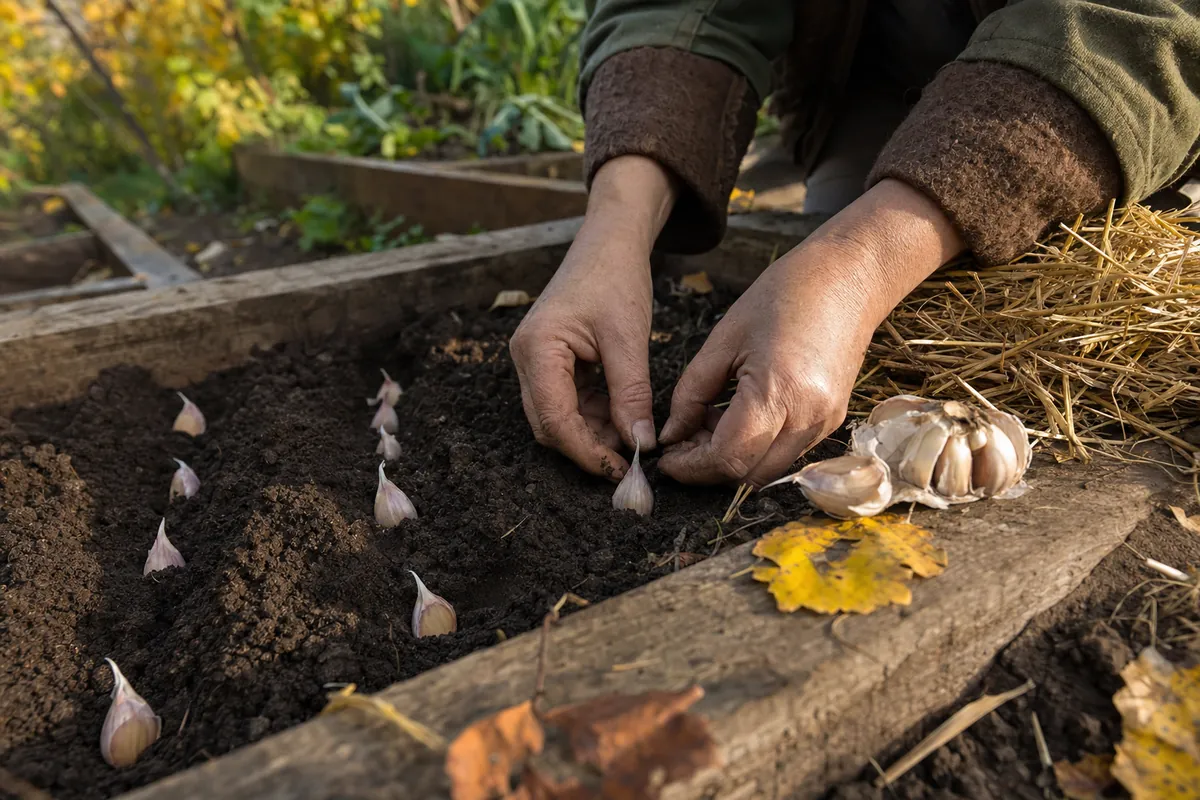
To plant garlic, push individual cloves into loose soil in fall, pointed end up, about 2 to 3 inches deep and roughly 6 inches apart, then cover the bed with straw once the weather turns cold. The cloves root before winter, sit quietly under the mulch, and grow into full bulbs by early summer. The only part people get wrong is the timing, so that comes first.
When to Plant Garlic
Garlic goes in during fall, and the clock that matters is your first fall frost, not the calendar. The goal is a clove that grows roots before the ground freezes but does not push much green growth above the soil before winter. The University of Minnesota Extension times it at one to two weeks after the first killing frost. South Dakota State University Extension gives one to three weeks after that frost, with soil around 50°F. Penn State Extension counts from the other end: about three weeks before the ground freezes, so roots have time to develop but shoots stay underground.
In mild-winter areas the ground may never freeze, so the window is set by months instead. Garlic also needs a cold spell to form a proper bulb: University of Georgia Extension notes cloves need 6 to 8 weeks of cool weather below 40°F after planting. Planting in fall is how most gardeners give it that cold.
| Region | When to plant | Typical months | Usual harvest |
|---|---|---|---|
| Cold north (roughly zones 3 to 5: MN, WI, IA, northern New England) | 1 to 3 weeks after the first killing frost, soil near 50°F | October to early November | Late June to August |
| Mid (roughly zones 6 to 7: PA, NJ, OH, Pacific Northwest) | About 3 weeks before the ground freezes | Mid to late October (September to November in Oregon) | Early to mid July |
| South and mild-winter (roughly zones 8 and up: GA, SC, TX, CA) | Once soil at 2 inches is below 85°F; ground rarely freezes | Late September through November | Late May to mid July |
Cold north: University of Minnesota, South Dakota State and Iowa State extensions. Mid: Penn State and Oregon State extensions. South: University of Georgia, Texas A&M AgriLife and UC Master Gardeners. Zone ranges are a rough guide; your own frost date is the better signal.
If you do not know your first fall frost date, look it up before you buy seed garlic. The calculator below gives it by ZIP code, and the frost dates pages list it by city and hardiness zone.
Choosing Garlic Bulbs for Planting
Growing garlic from cloves is simple: each clove you plant becomes one whole bulb by summer, so the quality of what you plant sets the ceiling on what you harvest. Buy garlic bulbs for planting from a garden center, a seed company, or a local grower, and pick firm, heavy heads with no soft spots or mold.
Skip the grocery store bulb. Rutgers and Ohio State extensions both warn that supermarket garlic may have been treated to prevent sprouting, and it is often a variety grown for a warmer climate than yours. Seed garlic from a regional grower is more likely to be suited to your winters.
Split the heads into cloves no more than a day before planting, as Penn State Extension advises, and keep the papery skin on each clove. Then sort: plant the biggest cloves and cook with the small ones. Bigger cloves grow bigger bulbs, a point Rutgers, Oregon State and Penn State all make. If you grow your own, the University of Minnesota suggests saving your best bulbs each year as next fall’s planting stock.
Hardneck Garlic Planting vs. Softneck: Pick by Climate
There are two main types, and your winter decides which one to grow.
Hardneck garlic grows a stiff central flower stalk called a scape and forms a single ring of fairly large cloves, roughly 4 to 12 per bulb according to Rutgers. It is the more cold-hardy type, and Penn State Extension says hardneck varieties grow best in its region. Hardneck garlic planting is the default choice in the cold north and most of the mid-latitude states. The tradeoff is storage: Iowa State notes hardnecks do not keep as long as softnecks.
Softneck garlic does not grow a scape, has more and smaller cloves in several layers, stores longer, and is the type you can braid. University of Georgia Extension says softnecks are well adapted to the South because they handle erratic winter temperatures without bolting, and Clemson recommends Creole softnecks for South Carolina while advising against Rocambole hardnecks there. NC State Extension also recommends softnecks for southern gardens.
In short: cold winters, grow hardneck; mild winters, grow softneck. In the middle zones both usually work, so it comes down to whether you want scapes and big cloves or longer storage.
How Deep to Plant Garlic and How Far Apart
For how deep to plant garlic, most northern sources land on 2 to 3 inches. The University of Minnesota says to set the base of the clove 2 to 3 inches below the surface, and Utah State says 2 to 3 inches deep. Shallower planting is common where the ground does not freeze: Clemson covers cloves with about 1 inch of soil in South Carolina, and Georgia gives 1 to 3 inches. The deeper figures come from cold-winter states and the shallow ones from the South, so match your depth to your winters.
| Measurement | Range in extension guides | Good default |
|---|---|---|
| Depth (to the base of the clove) | 1 to 3 inches | 2 to 3 inches in the north, about 1 to 2 in the South |
| Between cloves in the row | 3 to 8 inches | 6 inches |
| Between rows | 6 to 24 inches | 6 inches in a raised bed, 12 inches or more in open rows |
In-row spacing of 6 inches matches the University of Minnesota and Georgia, with Penn State at 6 to 7 inches and Utah State as tight as 3 to 4. Row spacing varies most because it depends on how you weed: Utah State allows 6 to 10 inches between rows, Penn State 1 foot, and Ohio State and Iowa State 18 to 24 inches for tilled garden rows. In a raised bed you never walk on, a 6-inch grid works well; South Dakota State simply says at least 6 inches apart in all directions.
How to Plant Garlic Cloves, Step by Step
- Prepare the bed. Pick a sunny spot with loose, well-drained soil. Work in compost and pull out weeds, since garlic competes poorly with them.
- Split the bulbs. Break the heads apart on planting day or the day before. Leave the skins on.
- Mark the grid. Lay out rows and stations at the spacing you chose, about 6 inches apart.
- Plant pointed end up. Push each clove into the soil with the flat root end down and the pointed tip up, until the base sits 2 to 3 inches deep (shallower in the South). A clove planted upside down still grows, but the shoot has to curl around to find the surface.
- Cover and water. Fill the holes, firm the soil lightly and water once if the soil is dry, so the cloves start rooting.
- Mulch later. In cold areas, wait for the weather to turn cold before adding the winter mulch, covered next.
Mulching Garlic for Winter
In cold regions, mulch keeps the soil from freezing and thawing over and over, which can heave cloves out of the ground. The University of Minnesota and Penn State both recommend 3 to 4 inches of straw or shredded leaves; Iowa State goes to 4 to 6 inches, applied in November. Use straw that is free of weed seed. Timing matters: put it down once the soil is cooling toward freezing, not right after planting while the weather is still warm.
In spring, once hard freezes are over, rake the mulch off the rows so the soil can warm, and leave it between the rows to hold down weeds, as Ohio State suggests. In the South the job is different: University of Georgia Extension recommends 2 to 3 inches of mulch after the garlic has come up, kept 2 to 3 inches back from the stems, mainly for weeds and moisture rather than cold.
Worked Example: Garlic in a 4x8 Raised Bed
A 4x8 bed is 48 inches by 96 inches. Using a 6-inch grid and keeping each clove 3 inches in from the frame:
- Across the 4-foot width: stations at 3, 9, 15, 21, 27, 33, 39 and 45 inches, so 8 rows.
- Along the 8-foot length: 96 ÷ 6 = 16 cloves per row.
- Total: 8 × 16 = 128 cloves, which grows about 128 bulbs.
If you prefer rows 12 inches apart with cloves 6 inches apart in the row (closer to Penn State’s spacing), you get 4 rows of 16, or 64 cloves.
To turn cloves into bulbs to buy, divide by the large cloves per head. A hardneck with about 6 good planting cloves means roughly 128 ÷ 6 ≈ 22 heads for the tight grid, or about 11 heads for the 12-inch rows. Softnecks have more cloves per head, but many are small, so plan on extra heads if you only want to plant the big outer ones. Buy a few heads more than the math says.
When it is time to dig, the bulbs need the right timing and a few weeks of curing to store well. That is a separate job, covered in the harvest guide.
Free book · 23 pages, PDF
How to Plant Garlic FAQ
Can I plant garlic in the spring?
You can. Iowa State Extension lists spring planting, as soon as the soil can be worked, as an option. Expect a smaller harvest, though: UC Master Gardeners note yields are higher from fall planting, and University of Georgia Extension says cloves need 6 to 8 weeks below 40°F to form a bulb, which fall planting supplies naturally.
Which way up do garlic cloves go?
Pointed tip up, flat root end down. The flat end is where the roots grow from. A clove planted sideways or upside down usually still comes up, but it wastes energy turning around and the neck can grow crooked.
Can I plant garlic from the grocery store?
It is not recommended. Rutgers and Ohio State extensions warn that store garlic may be treated to stop it sprouting, and it is often a softneck grown in a mild climate, which may not suit cold winters. Seed garlic from a garden center or regional grower is a safer bet.
Should I water garlic after planting?
Water once at planting if the soil is dry, so the cloves can start rooting. After that, fall rain is usually enough. Do not keep the bed soggy over winter; garlic wants well-drained soil, and waterlogged cloves can rot.
My garlic sprouted green leaves in the fall. Is it ruined?
No. A little top growth before winter is common, especially after a warm fall, and Ohio State Extension even describes leaves emerging before freezing temperatures as ideal. Mulch the bed as usual once it turns cold. The leaves may get frost-burned, but the clove underground is what matters.
Sources & further reading
Timing, depth, spacing and mulch figures come from the University of Minnesota Extension’s guide to growing garlic in home gardens, South Dakota State University Extension’s garlic guide, Penn State Extension on fall planting and its guide to growing and using garlic, Iowa State University Extension, Utah State University Extension, Ohio State University Extension, Rutgers NJAES fact sheet FS1233 and Oregon State University Extension. Southern timing, vernalization and variety advice come from University of Georgia Extension’s Garlic Production for the Gardener, Clemson HGIC, NC State Extension, Texas A&M AgriLife’s garlic crop guide and the UC Master Gardeners. For how we source the facts on this site, see our methodology page. When your garlic is ready to dig, see our guide to when to harvest garlic.