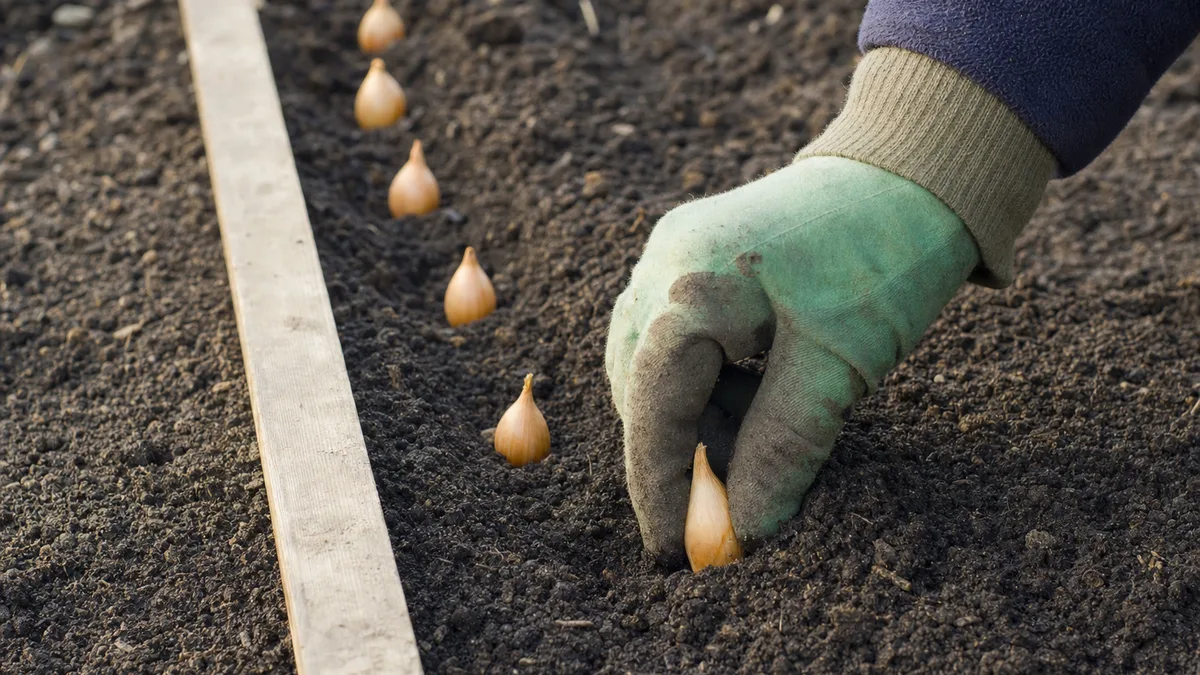
To plant onion sets, press small, firm sets pointed end up into loose soil about 1 inch deep and 3 to 4 inches apart, in rows 12 to 15 inches apart. Plant as soon as the soil can be worked in spring, which is roughly late March to early May depending on your USDA hardiness zone. Water them in, then keep the bed evenly moist until the tops fall over in summer.
Onion Sets Quick Facts
| What | Answer | Source |
|---|---|---|
| When to plant | As soon as the soil can be worked in spring | Illinois, Missouri, Oregon State, Minnesota |
| Depth | About 1 inch (guides range from 1/2 to 2 inches) | Illinois, Maryland, Iowa State, Ohio State |
| Spacing in the row | 3 to 4 inches for bulbs (guides range from 2 to 8) | Utah State, Ohio State, Oregon State |
| Row spacing | 12 to 15 inches | Iowa State, Oregon State, Illinois |
| Best set size for bulbs | Small, about 1/2 to 3/4 inch across (avoid sets over 1 inch) | Illinois, Iowa State, Clemson |
| Soil pH | 6.0 to 6.8 | Ohio State (Missouri 6.2 to 6.8, Minnesota 6.0 to 7.0) |
| Days to harvest | About 90 to 120 days from planting | Ohio State |
| Cold | Onions tolerate light frost | South Dakota State, Minnesota |
Onion Sets vs Seeds vs Transplants
Onion sets are tiny bulbs grown the season before and dried for spring planting. South Dakota State University Extension describes them as small onions harvested in fall and dried, and that is why they are the easiest way to start: no seedlings to raise, and they go straight into the ground. Ohio State University Extension says seeds are the least expensive route but need the most work, while sets or transplants are easier and support better yields.
| Start | What it takes | What extension says |
|---|---|---|
| Sets | Plant straight into soil in early spring | Easy, but sets can bolt (Illinois, South Dakota State) |
| Transplants | Buy seedlings or start seed indoors 6 to 12 weeks ahead | Illinois says transplants, not sets, most reliably produce large dry bulbs |
| Seed | Direct sow as soon as soil can be worked, or start indoors | Cheapest, most work (Ohio State) |
If you want the easiest start and a good crop of everyday cooking onions, sets are the right choice. If your goal is the biggest possible bulbs, read the big-onion section below, because the start you pick matters.
When to Plant Onion Sets in Zones 5, 6 and 7
The rule in almost every extension guide is the same: plant sets as soon as the soil can be worked in spring. University of Minnesota Extension, Missouri Extension and Oregon State University Extension all say it in nearly those words, and South Dakota State University Extension adds that onions tolerate light frost but that it is best to plant close to your last frost date. In practice, that means the soil is thawed and crumbles instead of clumping when you squeeze it. Not sure which last frost date to use? Our comparison of Farmers’ Almanac and NOAA frost dates explains the differences.
Extension publishes by state, not by hardiness zone, so the table pairs each zone with state guides written for a similar winter. It is a starting point, not an official calendar. Not sure if you are zone 5, 6 or 7? The callout below looks it up by ZIP code.
| Zone | Spring planting window | Guides behind it |
|---|---|---|
| Zone 5 | April to early May, once the ground can be worked | Iowa State says early April to early May. Utah State says April for sets and late April for storage onions. |
| Zone 6 | Late March to early April, as soon as the garden can be worked | Illinois Extension says late March or early April in prime regions. Maryland says early spring as soon as you can cultivate. |
| Zone 7 | Mid February to the end of March in the warmer Southeast | Clemson Extension gives February 15 to March 30 for spring sets in the South Carolina Piedmont. |
Planting too early has one cost. Maryland Extension warns that planting too early, with exposure to cold temperatures, can cause seed stalk development, and Illinois Extension says extremely cold weather early in the season may also push onions grown from sets to flower. So wait for workable soil, but do not rush into a hard freeze.
Can You Plant Onion Sets in Fall or Autumn?
In zones 5 and 6, fall is not the season for ordinary bulb sets. The fall onion plantings that extension guides do describe are of other kinds. Maryland Extension says fall is for perennial or multiplier types: multiplier bulbs can go in during September or October, and shallot cloves are best planted from late September through mid October. Illinois Extension says to plant sets of Egyptian or walking onions 1 inch deep in August, spaced 4 to 5 inches apart, and to put those perennials at the edge of the garden. Utah State sows seed, not sets, in mid to late August for overwintered onions that mature in June or July.
In the South it is different. Clemson Extension lists fall sets for the South Carolina Piedmont from September 15 to October 15, and from September 15 to November 15 on the coast. If you are in zone 7 or warmer and want sets in the ground in autumn, a short-day variety is the matching choice, since Clemson says short-day onions bulb at about 12 hours of daylight and are suited to all of South Carolina. Garlic is the classic fall-planted allium, and our guide to how to plant garlic covers its timing.
How to Choose Onion Sets: Size, Type and Day Length
Pick small, firm sets for bulbs
Set size matters more than most people expect. Illinois Extension says small sets, under a dime across, make the best dry onions, while large sets, bigger than a dime, are best used for green onions. Iowa State University Extension gives 1/2 to 3/4 inch as the size most likely to mature into a good bulb, and Clemson Extension says to avoid sets over 1 inch because they are likely to bolt. Oregon State says to buy sets while they are firm and dormant. Use larger sets for green onions and smaller sets for bulbing onions.
Storage onions vs green onions
The same sets can go two ways. For green (spring) onions, plant larger sets close together: Illinois says 1 1/2 inches deep and close enough to touch, Oregon State says 1 1/2 to 2 inches deep and 1 inch apart, and Iowa State says about 1 inch apart. For bulbs, plant small sets farther apart, as in the next section.
Short-day vs long-day onions
Onions form bulbs in response to day length. Texas A&M AgriLife Extension lists short-day types as bulbing at 11 to 12 hours of daylight, intermediate-day at 12 to 13 hours, and long-day at 14 to 16 hours. Illinois Extension says to use long-day varieties in the North and short-day varieties in the South, and that long-day types may not bulb in the Deep South. Oregon State says most Oregon onions are long-day types, which bulb at about 14 hours. University of Minnesota Extension notes that most sets sold in Minnesota are short-day types, which generally form small bulbs, one reason sets rarely give the biggest onions in the North.
How Deep and How Far Apart to Plant Onion Sets
Extension guides do not agree on one number, because depth and spacing depend on whether you want green onions or bulbs. The ranges below come from the guides we checked, with a sensible default for bulb onions.
| Measurement | Range in extension guides | Good default for bulbs |
|---|---|---|
| Depth | 1/2 inch (Oregon State) to 2 inches (Ohio State) | About 1 inch |
| Between sets | 2 to 8 inches (Missouri, Maryland) | 3 to 4 inches |
| Between rows | 12 to 24 inches (Maryland) | 12 to 15 inches |
| Green onions | Touching to 2 inches apart | 1 inch apart, 1 1/2 inches deep |
Here is what the spacing means in a bed. A 4 by 8 foot bed measures 48 by 96 inches. With rows 12 inches apart you fit 4 rows across the 48-inch width. Along each 96-inch row, sets 4 inches apart with a 2-inch margin at each end give 24 sets. That is 4 × 24 = 96 onion sets for the bed. Space them at 3 inches instead and you fit more, but Utah State Extension warns that dense planting reduces bulb size unless water and nutrients are adequate.
How to Plant Onion Sets, Step by Step
- Choose a sunny, well-drained spot. Ohio State Extension recommends full sun and loose, well-drained, fertile soil with plenty of organic matter.
- Check the soil pH. Ohio State gives 6.0 to 6.8, Missouri gives 6.2 to 6.8 and Minnesota targets 6.0 to 7.0. A soil test, as Minnesota advises, tells you what to add.
- Loosen the soil and rake it level. Remove clods and stones so the sets sit evenly.
- Make a shallow trench or furrow. About 1 inch deep, with rows 12 to 15 inches apart.
- Set each onion pointed end up. Maryland Extension says sets are planted pointed end up and covered with 1 inch of soil. Space them 3 to 4 inches apart for bulbs.
- Firm the soil and water gently. South Dakota State says to water the row gently after planting and to water again if the soil dries out.
- Mulch once they are established. Iowa State suggests 1 to 2 inches of straw between rows, and Missouri recommends mulch to control weeds and hold in moisture.
- Feed and water through the season. Iowa State says to side-dress about 4 to 5 weeks after planting and to water once a week in dry weather.
Onions have shallow roots. University of New Hampshire Extension says to keep the bed weed-free and to avoid disturbing the roots, so use shallow cultivation or hand weeding between rows.
Planting Onion Sets in Containers and Raised Beds
Onion sets in pots
Onions grow well in containers. Illinois Extension’s container guide lists onions with crops that need a container at least 10 inches across, and its soil-volume table puts a 10-inch container at about 3 gallons. Use a pot with drainage holes and a loose potting mix. Plant sets 1 inch deep, pointed end up, and keep the same 3 to 4 inch spacing, which in a 10-inch pot fits a handful of onions. For more plants, use a wider pot or a long trough.
Watering is the main job. Illinois Extension says to check the top inch: if the potting mix feels dry there, water, and to water until it trickles out of the drainage holes. In warm, dry weather it says containers may need water more than once a day.
Onion sets in raised beds
Raised beds suit onions because the soil is loose and drains well. The trade-off is water: University of Minnesota Extension says raised beds dry out more quickly than in-ground gardens and need to be watered more frequently, and Clemson Extension says the same. Keep the soil pH near the 6.0 to 6.8 range, mulch between rows, and use the same spacing as in the ground. If you are filling a new bed, our raised-bed soil guide covers how much mix you need.
How to Grow Big Onions From Sets
Be realistic about sets: Illinois Extension says transplants, not sets, most reliably produce large dry bulbs. You can still get good onions from sets, and the extension advice is consistent about how.
- Start with small sets. Illinois and Missouri both say large sets flower more easily, and flowering means smaller bulbs.
- Plant early. Oregon State says the size of the bulb depends on the size of the plant when bulbing begins, so earlier planting lets plants grow larger before day length triggers bulbing.
- Give them room. Maryland Extension gives 4 inches for moderate bulbs and 8 inches for large bulbs. Illinois says closer spacing significantly decreases bulb size, and Utah State warns that dense planting reduces size unless water and nutrients are adequate.
- Go easy on nitrogen. UNH Extension says excessive nitrogen can delay bulb formation, maturity and storability. Oregon State advises fertilizing every 2 to 3 weeks until bulbing starts, so feed early, then stop.
- Keep water steady. Iowa State says to water once a week in dry weather, and South Dakota State says heat and drought can trigger bolting.
- Do not hill or bend the tops. Illinois says hilling onions meant for storage can cause neck rot, and breaking the tops over early stunts the bulbs.
- Match variety to your latitude. Long-day types in the North, short-day in the South, as covered above.
What to Do With Sprouted Onion Sets
Green shoots on sets that sat in the bag or on the shelf are common. We could not find an extension guide that gives a separate rule for sprouted sets, so this advice is built from the guidance on set size and bolting, and you should treat it as practical judgment, not a published number.
- Plant them anyway. A sprout means the set is alive. Plant it pointed end up, covered with about 1 inch of soil as Maryland advises, so the green tip is close to the surface.
- Sort by size. Large sets are more prone to bolting (Illinois), so put your biggest, most sprouted sets into the green onion row and save the small ones for bulbs.
- Harvest bolters first. South Dakota State says sets tend to bolt because they begin their second season of growth. Cut off the hollow flower stalk, and use bolted onions first because they will not store well. Missouri says to remove the flower head as soon as it appears.
- Check sets before you buy. Oregon State advises buying sets while they are firm and dormant, so look for that and plant soon after.
Harvest and Curing: Getting Onions From Sets to Storage
Ohio State Extension gives about 90 to 120 days from planting to harvest, when most of the tops have wilted. South Dakota State says the bulbs are ready when the tops dry and fall over, and Utah State says to stop watering at that point, since excess water late in maturity delays curing and causes storage problems.
- Pull the bulbs on a dry day. Remove loose soil and keep the outer scales intact (South Dakota State).
- Dry them in the open for a few days. Oregon State says to cure for 7 to 10 days, covering them at night, while Illinois says to move them into shade on hot, sunny days.
- Finish curing with good airflow. Maryland says 1 to 2 weeks in a well-ventilated attic or porch out of direct sun, and Illinois says full air circulation for 2 to 3 weeks.
- Trim the tops. Maryland says about 1 inch above the bulb, and Illinois says 1 1/2 to 2 inches.
- Store cool and dry. South Dakota State says ideally around 50°F, and not frozen.
The curing basics for onions and garlic are close cousins, and our guide to when to harvest garlic walks through drying and storing in more detail.
Free book · 23 pages, PDF
How to Plant Onion Sets FAQ
How deep do you plant onion sets?
About 1 inch deep, pointed end up. Illinois Extension says 1 inch for small sets, and Maryland Extension says to cover them with 1 inch of soil. Guides range from 1/2 inch (Oregon State) to 2 inches (Ohio State). For green onions, go a little deeper, 1 1/2 inches.
How far apart do you plant onion sets?
For bulbs, 3 to 4 inches apart in rows 12 to 15 inches apart. Utah State and Ohio State both give 3 to 4 inches, and Maryland says 4 inches for moderate bulbs and 8 inches for large ones. For green onions, plant them about 1 inch apart.
When should I plant onion sets in zones 5, 6 and 7?
Plant as soon as the soil can be worked. As a guide, Iowa State and Utah State point to April in cooler zone 5 areas, Illinois points to late March or early April for zone 6, and Clemson gives February 15 to March 30 for the warmer Southeast. Check your last frost date to refine it.
Can you plant onion sets in the fall?
In cold zones, not ordinary bulb sets. Maryland Extension says fall is for multiplier onions and shallots, planted September to October, and Illinois says Egyptian onion sets go in during August. In the South Carolina Piedmont, Clemson lists fall sets from September 15 to October 15.
Can I grow onion sets in pots?
Yes. Illinois Extension lists onions among crops that need a container at least 10 inches across, which holds about 3 gallons. Use drainage holes, plant 1 inch deep, and water when the top inch of mix feels dry.
Why did my onion sets go to seed?
Sets begin their second season of growth, so they tend to bolt, according to South Dakota State Extension. Large sets are more prone to it (Illinois), and early cold can also trigger flowering. Cut off the flower stalk and use those onions first.
Can I plant sprouted onion sets?
Yes. We found no extension rule against it. Plant them pointed end up with about 1 inch of soil over them, and use the largest sprouted sets for green onions, since larger sets bolt more readily.
Sources & further reading
Planting dates, depth, spacing, set size and curing figures come from South Dakota State University Extension, University of Maryland Extension, University of Illinois Extension, Iowa State University Extension, Ohio State University Extension, Utah State University Extension, University of Minnesota Extension, Oregon State University Extension, University of Missouri Extension and UNH Extension. Southern dates and day-length types come from Clemson Home and Garden Information Center and Texas A&M AgriLife Extension. Container and raised-bed advice comes from the Illinois Extension container gardening guide, University of Minnesota Extension on raised beds and Clemson Extension on raised beds. For how we source the facts on this site, see our methodology page. Growing garlic too? See how to plant garlic.
Free book · 23 pages, PDF
The Spacing & Planting Cheat Sheet
Sent