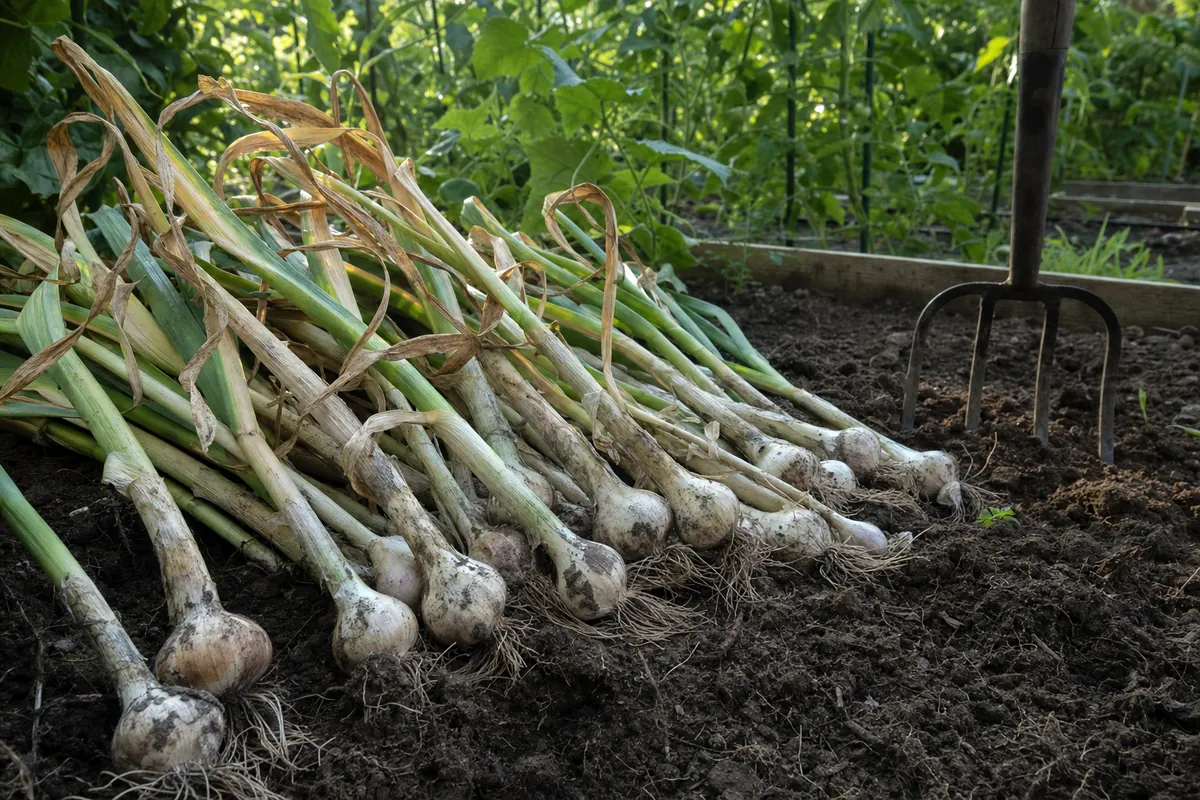
Harvest garlic when the lowest leaves have turned brown but roughly half of the leaves are still green. For fall-planted garlic that usually falls between late June and late July in the north, and as early as late May in the South. Dig the bulbs, do not pull them, then cure them somewhere warm, dry, shaded and airy for a few weeks before you store them.
When Is Garlic Ready to Harvest? Read the Leaves
Garlic tells you it is ready through its leaves. The plant browns from the bottom up, and you want to dig partway through that process, not at the end of it. Extension guides describe the same moment in slightly different ways:
- University of Minnesota: the lower leaves are brown and half or slightly more than half of the upper leaves are still green.
- Penn State: the leaves are just beginning to brown and at least 4 leaves are still partly green.
- Iowa State: harvest can begin when only 5 green leaves remain.
- University of Georgia: one-third to one-half of the leaves have died back.
- UConn: once the bottom 3 leaves are brown, you have about a 2-week window to finish harvesting.
Put together, the rule is simple: when the bottom few leaves are dead and four to six leaves are still green, start digging. Softnecks often flop over at the neck when they are close, which is another useful sign.
To check, dig up one plant and cut the bulb across. Oregon State University suggests doing this from late June: the bulb is ready when it is divided into plump cloves and the outer skin is thick, dry and papery. If the cloves are not yet distinct, wait a few days and test another.
Harvesting garlic a little early costs you some size. Harvesting late costs you storage. Oregon State notes that bulbs left in the ground too long can split apart and the skins can split, exposing the cloves so they do not store well, and UConn warns that after the 2-week window the outer skin breaks down and the bulbs will not cure or store properly. Of the two mistakes, early is the cheaper one.
When to Harvest Garlic by Region
The leaves are the real signal, but it helps to know when to start watching. These are typical windows for garlic planted the previous fall.
| Region | Typical harvest | Source |
|---|---|---|
| Cold north (MN, SD, IA) | Mid June to late July; July or August in Iowa | U. of Minnesota, South Dakota State, Iowa State |
| Mid (PA, Pacific Northwest) | Start checking late June; most dug early to mid July | Penn State, Oregon State |
| South (GA, SC) | Late May to mid July, as leaves yellow in early summer | U. of Georgia, Clemson |
A warm spring pushes these dates earlier and a cool one pushes them later, so start checking the leaves a couple of weeks before your usual window.
How Long Does Garlic Take to Grow?
Fall-planted garlic takes about 8 to 9 months from planting to harvest. University of Georgia Extension says garlic needs up to 8 months to mature, and a UC Master Gardener who planted in fall reports waiting about 8 months for the lower leaves to die back. In Pennsylvania, Penn State’s timeline runs from mid to late October planting to an early to mid July harvest, close to 9 months. Texas A&M AgriLife’s crop guide lists 150 to 200 days after planting under Texas conditions.
Most of that time is winter, when nothing visible happens. The bulb itself sizes up fast in late spring and early summer, which is why the last few weeks before harvest matter so much and why digging too early is a real loss.
Garlic Scapes: When and Why to Cut Them
Hardneck garlic sends up a flower stalk called a scape in late spring. Softnecks do not, so if you grow only softnecks you can skip this step.
Why cut them: removing scapes sends the plant’s energy into the bulb. Penn State, Ohio State and Iowa State all say it helps produce larger bulbs, and Oregon State recommends it for the same reason. UConn is a little more cautious, describing the benefit as the thinking behind the practice. Either way, it costs nothing and you get a crop out of it.
When to cut them: usually in late May or June. The University of Minnesota and South Dakota State say to snap or cut them just after they start to curl. Penn State adds to take them while young, before they straighten out and turn stiff. Oregon State notes they get more fibrous and less edible as they mature, so early is better for eating too.
Cut or snap the stalk just above the top leaf. Young scapes are good sauteed, grilled or blended into pesto.
How to Harvest Garlic
Ohio State puts the main rule plainly: garlic should be dug, not pulled. Yanking on the stem can snap it off or tear the neck, and a damaged bulb will not store.
- Stop watering. Let the soil dry out somewhat in the days before harvest so the bulbs come out cleaner. Dry weather is the best time to dig.
- Loosen, then lift. Push a garden fork or spade into the soil a few inches out from the plant, as a UC Master Gardener describes, and lever it up underneath the bulb. Penn State recommends lifting with a spade or shovel rather than pulling on the stems.
- Handle gently. Fresh bulbs bruise easily. Do not bang them together or drop them into a bucket.
- Brush, do not wash. Shake or brush off loose soil. Leave the leaves and roots on for curing. Do not wash or scrub the bulbs; the intact skins protect them in storage.
- Get them out of the sun. Move the harvest into shade soon after digging.
Curing Garlic
Curing dries the outer skins and the neck so the bulb seals itself off for storage. Sources agree on the conditions and differ only on how long it takes:
| Source | Curing time | Conditions |
|---|---|---|
| Utah State | 1 to 2 weeks | Shady, warm spot, whole plant |
| Clemson | About 2 to 3 weeks | Warm, shady, good air movement |
| University of Minnesota | 3 to 4 weeks | Warm, dry, airy place |
| UConn | 10 days to 4 weeks | About 50% humidity, below 90°F |
| Rutgers | 4 to 6 weeks | Shady, dry, cool, well ventilated |
So plan on 2 to 4 weeks in most years, longer if the air is humid. Hang the plants in small bundles or spread them in a single layer on a rack in a garage, shed, barn or covered porch with good airflow and no direct sun. Clemson’s test for done is simple: the neck is dry and the outer skin is papery.
Once cured, trim the stems about 1/2 to 1 inch above the bulb and cut the roots close to the base, as the University of Minnesota advises. Softnecks can be braided instead of trimmed, as long as you braid them while the leaves are still a little pliable. Brush off any remaining dry soil and peel away only the dirtiest outer layer, keeping the rest of the wrapper intact.
Storing Garlic
Keep cured garlic in a dark, dry place with good air circulation, such as mesh bags, a basket or a braid hung in a cool room. Extension advice splits on cold storage. Iowa State gives 32 to 40°F with 65 to 70% humidity, Utah State gives 32 to 40°F, and UConn gives 32 to 35°F at 65 to 70% humidity, figures that suit a cold room with controlled humidity. Oregon State, on the other hand, says not to keep garlic in the refrigerator because cold combined with moisture triggers sprouting. For most home gardeners, a cool, dry, airy spot away from the fridge is the practical answer.
How long it keeps depends on the type. South Dakota State says softnecks store for 6 to 8 months, while most hardnecks last only a few months, with Porcelain and Purple Stripe types lasting up to six. Clemson gives 6 to 8 months for most varieties stored well. Eat the hardnecks first and save the softnecks for winter.
Before you cook through the whole harvest, set aside your largest, best bulbs for replanting. That is next year’s crop, and it goes back in the ground in fall.
Free book · 23 pages, PDF
When to Harvest Garlic FAQ
What happens if I harvest garlic too early?
The bulbs are smaller and the cloves may not be fully formed, and the skins are thinner, so they may not keep as long. The garlic is still perfectly edible. Use early bulbs first and leave the rest of the bed a little longer.
What happens if I leave garlic in the ground too long?
The bulb starts to fall apart. Oregon State notes bulbs can split and skins can crack open, exposing the cloves, and UConn says the outer skin breaks down after the roughly 2-week harvest window. Overmature garlic is fine to eat soon but stores poorly.
Should I cut off the leaves right after digging?
No. Leave the leaves and roots attached while the garlic cures. The University of Minnesota says to trim the stems to 1/2 to 1 inch and the roots close to the base only after the 3 to 4 week cure.
Can I eat garlic right after harvesting?
Yes. Fresh, uncured garlic is good to eat straight away and has a milder, juicier flavor. Curing is only needed for garlic you want to store for months.
Can I replant cloves from my own harvest?
Yes, and many gardeners do. The University of Minnesota recommends keeping the biggest bulbs from each crop for planting the next fall. Choose healthy, disease-free heads and plant only the large cloves.
Sources & further reading
Harvest signs, timing, curing and storage figures come from the University of Minnesota Extension’s guide to growing garlic, Penn State Extension’s guide to growing and using garlic, Iowa State University Extension, South Dakota State University Extension, UConn Extension’s Garlic Cultivation in Connecticut, Oregon State University’s garlic primer, Utah State University Extension, Rutgers NJAES fact sheet FS1233 and Ohio State University Extension. Southern timing comes from University of Georgia Extension and Clemson HGIC; days to harvest in Texas come from Texas A&M AgriLife’s garlic crop guide; digging and handling notes draw on the UC Master Gardeners’ garlic harvest and cure post. For how we source the facts on this site, see our methodology page. For timing, depth and spacing at planting time, see our guide to how to plant garlic.