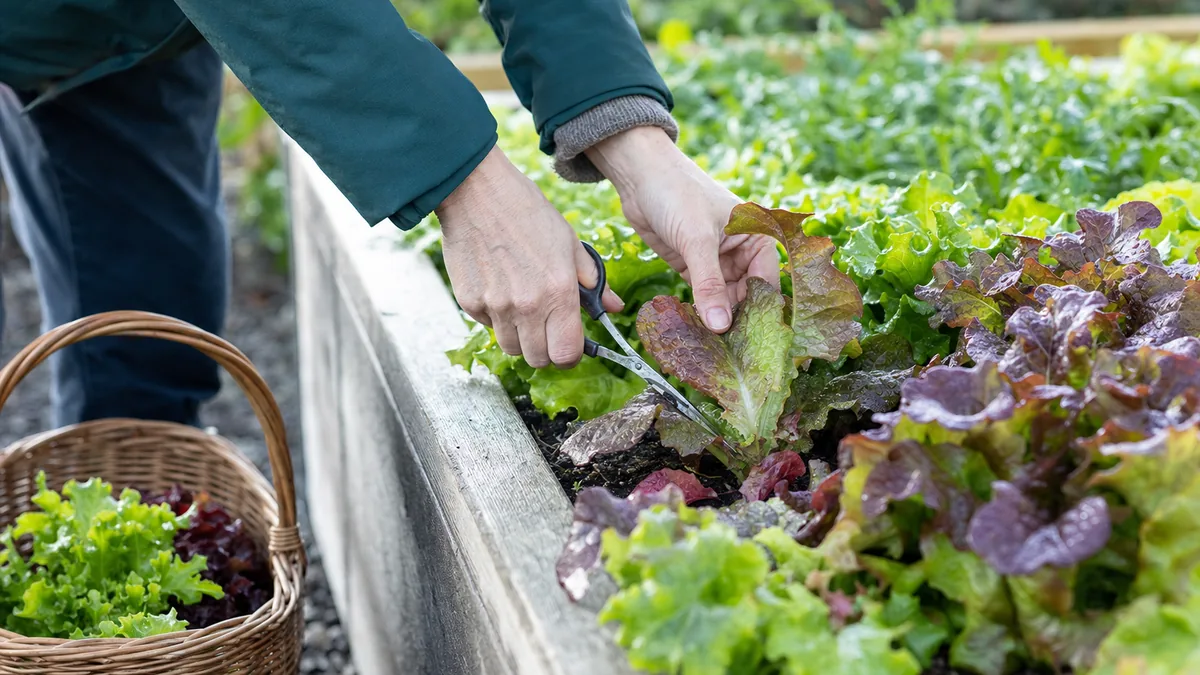
How to harvest lettuce: for leaf types, pick the older outer leaves once plants are about 4 to 6 inches tall and leave the center to keep producing. For head types, wait until the head is formed, then cut the stem near the soil. Harvest in the cool of the morning, before hot weather turns the leaves bitter. This guide covers every lettuce type and the growing side that comes before it.
Harvesting Lettuce: Quick Facts
Each row names who said it.
| Question | Short answer | Source |
|---|---|---|
| Leaf lettuce, first pick | When plants are about 4 to 6 inches tall | Nebraska, Clemson, Maryland |
| Romaine, ready | Head about 4 inches wide at the base and 6 to 8 inches tall | Nebraska, Maryland, Clemson |
| Butterhead or Bibb, ready | Leaves cup inward into a loose head | Nebraska, Maryland, Clemson |
| Best time of day | Morning, once dew has dried and before it gets hot | Nebraska, Clemson |
| Cut-and-come-again height | About 1 inch above the soil | Maryland, Utah State |
| Second cutting | 2 to 4 weeks later | Maryland, Nebraska |
| Fridge life | About 1 week to 4 weeks, depending on type and dryness | Florida, Clemson, Maryland |
How to Know When Lettuce Is Ready to Harvest
Lettuce is one of the fastest crops in the garden, and University of Maryland Extension says the whole range runs from 40 to 80 days to maturity depending on the type. University of Florida IFAS Extension says lettuce should be ready within 4 to 6 weeks of planting, while Clemson HGIC says head lettuce can be harvested from about 55 days and leaf lettuce at about 75 days. Those are wide ranges because variety, season and temperature all change the clock.
Size and shape are better signals than the calendar:
- Leaf lettuce: University of Nebraska-Lincoln Extension says to start once plants are 4 to 5 inches tall. Clemson HGIC says 4 to 6 inches, and Maryland says 5 to 6 inches.
- Romaine (cos): Nebraska and Maryland both say it is ready when the leaves have lengthened and overlapped into a fairly tight head about 4 inches wide at the base and 6 to 8 inches tall.
- Butterhead and Bibb: mature when the leaves begin to cup inward and form a loose head (Nebraska, Maryland and Clemson all describe it this way).
- Crisphead (iceberg): mature when the leaves overlap into a firm, compact head, like the ones in a store.
Utah State University Extension says delayed or overmature harvests make lettuce bitter and tough. Nebraska also says to harvest mid-morning, after the dew has dried and before the day gets hot, to reduce wilting, and Clemson HGIC says almost all vegetables are best picked early in the morning. University of Minnesota Extension adds that watering often in the days before harvest gives crisper leaves.
How to Pick Leaf Lettuce and Salad Leaves
This works for loose-leaf types, baby leaves and salad blends. Take the outer leaves and leave the center, where the plant makes new ones.
- Pick your moment. Go out in the morning after the dew has dried (Nebraska). Water regularly in the days before, which Minnesota says gives crisper leaves.
- Check the size. Plants should be at least 4 to 6 inches tall. University of Minnesota Extension says to harvest single leaves as soon as they reach a usable size.
- Choose the outer leaves. Maryland says to take the older, outer leaves first. Minnesota says that picking outer leaves at the baby stage and leaving the small inner leaves allows multiple harvests.
- Snap or snip near the base. Hold the leaf near where it joins the plant and snap it off, or cut it with clean scissors. Nebraska suggests picking a few leaves from each of several plants.
- Leave the heart. Keep the small center leaves on the plant. Florida says to cut the larger outer leaves first and allow the inner leaves to develop, which prolongs the harvest.
- Bring it in. Move the leaves into shade right away. Clemson HGIC says produce not picked in the morning should be kept out of direct sunlight and cooled quickly.
Thinning is a second way to harvest. Maryland says to harvest every other one of the largest plants, which gives the rest room to grow. Nebraska says you can start thinning when plants are only a few inches tall, cutting leaves from the crown, and notes that this does not suit crisphead types. Spacing decides how big each plant can get, so it is worth setting up at planting. Minnesota gives about 5 inches apart for leaf lettuce picked at baby size and 10 to 12 inches apart for plants grown to full size. For more on layouts see the Spacing & Planting hub.
How to Harvest Lettuce So It Keeps Growing
Lettuce is short-lived, but it can give several harvests from one sowing. Extension sources describe two methods.
The outer-leaf method
Keep taking the outer leaves and the plant keeps replacing them from the center. It is the same idea we describe for herbs in our guide to how to snip cilantro.
The cut-and-come-again method
Here you cut the whole plant down and let it regrow. The cutting height varies slightly between sources:
- About 1 inch above the soil: University of Maryland Extension says to cut lettuce about 1 inch above the soil with scissors, and Utah State says to clip salad greens 1 inch above the soil. Maryland’s salad-table page says baby greens are ready at 4 to 6 inches tall, and its lettuce guide cuts salad mixes at 6 to 10 inches.
- Close to the soil: Nebraska says to cut whole plants down close to the soil.
- Two-thirds of the way down: University of Florida IFAS Extension says you can cut the whole head about two-thirds of the way down, leaving the base and the central crown, and that this can be done multiple times.
Maryland says cut plants produce new leaves from the base. For timing, Maryland’s salad-table guide says a second harvest is possible in 3 to 4 weeks (25 to 30 days in another section of the same guide), while its lettuce guide says to cut again 2 to 3 weeks later if the plants are watered and fertilized. Nebraska says 3 to 4 weeks and adds that a third cutting is sometimes possible. So plan on a second cutting roughly 2 to 4 weeks after the first.
A staggered sowing keeps this going. Sow a short row every couple of weeks, as our succession planting guide explains, and you will always have one block ready to cut while another regrows.
How to Harvest Romaine Lettuce
Romaine gives you two good options, and which one you choose depends on whether you want a whole head or a longer harvest.
Outer leaves first
Nebraska says to take outer leaves from romaine as you would from leaf lettuce, or thin the plants. Starting as soon as the outer leaves are big enough to use stretches the harvest.
The whole head
Once the head is formed, wait for the signs Nebraska, Maryland and Clemson describe: leaves that have elongated and overlapped into a fairly tight head, around 6 to 8 inches tall. Then cut: Clemson HGIC says to harvest whole lettuce heads by cutting the stem near the soil line, and Minnesota says to cut the whole plant at or just above the soil surface. Use a sharp knife for a clean cut, then trim damaged outer leaves and move the head to shade. Florida’s two-thirds cut, which leaves the base and crown in place, is worth a try if you want a second crop, though results vary by variety and weather.
Romaine will bolt in heat like any other lettuce. Nebraska advises a final harvest of entire plants when flower stalks begin to form, because leaf quality and flavor decline rapidly once plants bloom.
How to Harvest Butter Lettuce, Bibb and Crisphead
Butterhead types, which include Bibb, form a soft, loose rosette instead of a firm head. Nebraska, Maryland and Clemson all say Bibb lettuce is mature when the leaves begin to cup or curl inward and form a loose head. You can harvest it in two ways:
- Outer leaves: remove the outer leaves as with leaf lettuce, or thin the plants (Nebraska). This is a good choice if the weather is warming, because you take what you can before it turns.
- Whole head: cut the head near the base once the center is cupped. Florida says the two-thirds cut, which leaves the base and crown, can be repeated on butterhead as well as on leaf and romaine.
Maryland says Bibb becomes bitter under high summer temperatures, and Clemson says it becomes bitter readily when temperatures exceed 75°F.
Crisphead (iceberg) is different. Florida says it is harvested once, as a whole head, and the leaves do not regrow after cutting. Nebraska says to cut the stem beneath a firm, compact head. Because crisphead goes to seed as soon as temperatures rise, Maryland recommends choosing a slow-bolting variety.
What to Do When Lettuce Bolts
Bolting is when lettuce stops making leaves and sends up a flower stalk. University of Minnesota Extension says it is triggered by long days, high light intensity and heat, and that multiple days of high temperatures (greater than 75°F) can cause lettuce plants to flower. Maryland describes the result: seedstalk formation and bitter flavor. Minnesota adds that bolting makes plants extremely bitter and ends the possibility of harvest, and that slow-bolt varieties reduce the risk but do not eliminate it.
- If the center is just starting to lengthen: harvest everything now. Nebraska says to take entire plants when flower stalks begin to form.
- If the stalk is up and the leaves taste bitter: stop harvesting for the kitchen. Decide whether to pull the plant or let it set seed (see below).
- To delay it: Florida says that above 85°F lettuce should have afternoon shade or shade cloth, and Minnesota says to harvest spring crops before hot, dry weather arrives.
Florida also gives the temperatures lettuce prefers, 50° to 75°F, and Clemson gives 55 to 65°F for optimum growth. That is why timing matters more than technique: aim your sowings at the cool weeks. Look up your average frost dates and count back from them, and see our vegetable garden guide for planning a whole cool-season bed.
How to Wash and Store Harvested Lettuce
Freshly cut lettuce keeps best when it is cold, moist and handled gently. Utah State says leafy greens bruise easily, and it describes a commercial routine of washing in very cold water and drying in salad spinners.
Washing
Extension sources agree on the basics and differ on soaking:
- Wash just before you eat it. Colorado State University Extension says to wash leaves just before use, not in advance, and University of Minnesota Extension food safety says unless greens are visibly dirty, wait until you are ready to prepare them.
- Use cold water. Minnesota says to wash under cool, running water, never use soap, detergent or bleach, and to remove and discard the outer leaves of heads first.
- Soaking is debated. Colorado State says to separate the leaves and soak them in a bowl of cold water for a few minutes to loosen sand and dirt. Minnesota says to avoid letting produce soak and to use fresh water for each batch.
- Dry them. Colorado State says to blot dry with paper towels or use a salad spinner, and Minnesota says to air dry or pat with a disposable towel.
Storing
Colorado State says to refrigerate salad greens at 35 to 40°F in a plastic bag or lettuce keeper. Maryland says the ideal conditions are very cool (32°F) and moist (95 percent relative humidity), and recommends harvesting when the plants are dry, removing outer leaves without washing, and keeping the lettuce in a mesh or plastic bag in the crisper drawer.
How long it lasts depends on who you ask, and on the type:
| Type | What the source says | Source |
|---|---|---|
| Crisphead | About 2 weeks (Maryland, Clemson); 2 to 3 weeks (Florida) | Maryland, Clemson, Florida |
| Leaf and Bibb | Up to 4 weeks if the leaves are dry when bagged | Maryland, Clemson |
| Other types, general | Up to about 1 week, bagged in the crisper | Florida |
| Salad greens, general | Use within 1 week; romaine stores well, red leaf is more perishable | Colorado State |
Plan on the short end for washed leaves and treat four weeks as a best case with dry, unwashed leaves.
How to Harvest Lettuce Seed
If a plant bolts, you can turn the loss into next year’s seed. NMSU Extension says lettuce loses its eating quality once it bolts, and suggests saving seed from lettuces that bolt later in the season, which gradually selects for slower bolting. University of Maine Cooperative Extension lists lettuce among the self-pollinated crops, which makes it one of the easier seeds to save.
- Leave a plant or two. Oregon State University Extension says to leave a plant or two to produce a seed stalk.
- Wait for the seed head. Oregon State says seeds are ready after the plant flowers and forms a seed head that resembles a dandelion head.
- Cut and bag. University of Maine says to cut each flower stalk below the lowest flower and place it head first in a paper bag.
- Dry it. Maine says to leave the bag open at the top in a warm, dry area with good air circulation for one to two weeks, until the seed heads are completely dry and starting to shatter. NMSU says that if weather prevents drying on the plant, you can pull the whole plant and dry it indoors.
- Separate the seed. Oregon State says to rub the seeds with your fingers to separate them from the chaff. NMSU also describes winnowing with a household fan on low or a screen.
- Store it cool and dry. NMSU says to keep seed in a cool, dry, dark place at temperatures below 50°F and humidity of 50 percent or lower.
How long the seed lasts: Oregon State lists a storage life of 4 to 5 years for lettuce, and Maine gives 5 years under ideal conditions. NMSU’s general figure for correctly stored seed is at least 3 to 5 years. Sow it in cool soil, and our lettuce from seed guide (linked at the top of this page) and soil temperature guide cover germination.
Free book · 23 pages, PDF
How to Harvest Lettuce FAQ
How do you harvest lettuce so it keeps growing?
Take the outer leaves and leave the center, or cut the whole plant about 1 inch above the soil and let it regrow. University of Maryland Extension says cut plants produce new leaves from the base, and University of Nebraska-Lincoln Extension says they can be cut again in about 3 to 4 weeks, with a third cutting sometimes possible.
How do you harvest romaine lettuce?
Take outer leaves as you would from leaf lettuce, or wait for a full head. Nebraska Extension and Maryland Extension say romaine is ready when it forms a fairly tight head about 4 inches wide at the base and 6 to 8 inches tall. Clemson HGIC says to cut head lettuce at the stem near the soil line.
How tall should leaf lettuce be before you pick it?
About 4 to 6 inches. Nebraska says 4 to 5 inches, Clemson HGIC says 4 to 6 inches, and Maryland says 5 to 6 inches. Take the older outer leaves first and leave the small inner leaves.
What is the best time of day to pick lettuce?
Morning. Nebraska Extension says to harvest mid-morning, after the dew has dried and before the day gets hot, to reduce wilting. Clemson HGIC says almost all vegetables are best harvested early in the morning.
How do you harvest butter lettuce or Bibb lettuce?
Harvest when the leaves begin to cup inward and form a loose head, which Nebraska, Maryland and Clemson all describe. Pick outer leaves as with leaf lettuce, or cut the head. Clemson says Bibb becomes bitter readily when temperatures exceed 75°F, so do not wait.
How long does harvested lettuce last in the fridge?
It depends on the type. Maryland and Clemson say crisphead lasts up to two weeks, and leaf and Bibb up to four weeks if the leaves are dry when bagged. University of Florida IFAS says other types last up to about a week, and Colorado State says to use salad greens within a week.
How do you harvest lettuce seed?
Let one plant bolt and form a dandelion-like seed head (Oregon State Extension). University of Maine Extension says to cut the stalk below the lowest flower, put it head first in a paper bag, dry it one to two weeks in a warm, dry spot, then rub out the seed. Oregon State lists a storage life of 4 to 5 years.
Sources & further reading
Harvest size, cutting height and regrowth come from University of Nebraska-Lincoln Extension on harvesting greens, University of Maryland Extension on growing lettuce in a home garden, its page on harvesting plants grown in salad tables, UF/IFAS Gardening Solutions on lettuce, University of Minnesota Extension, Clemson HGIC on lettuce and its harvesting vegetables fact sheet, and Utah State University Extension on leafy greens harvest and storage. Washing and storage come from Colorado State University Extension on salad greens and University of Minnesota Extension on washing fresh fruits and vegetables. Seed saving comes from Oregon State University Extension, University of Maine Cooperative Extension bulletin 2750 and New Mexico State University guide H-262. For how we source the facts on this site, see our methodology page.
Free book · 23 pages, PDF
The Spacing & Planting Cheat Sheet
Sent