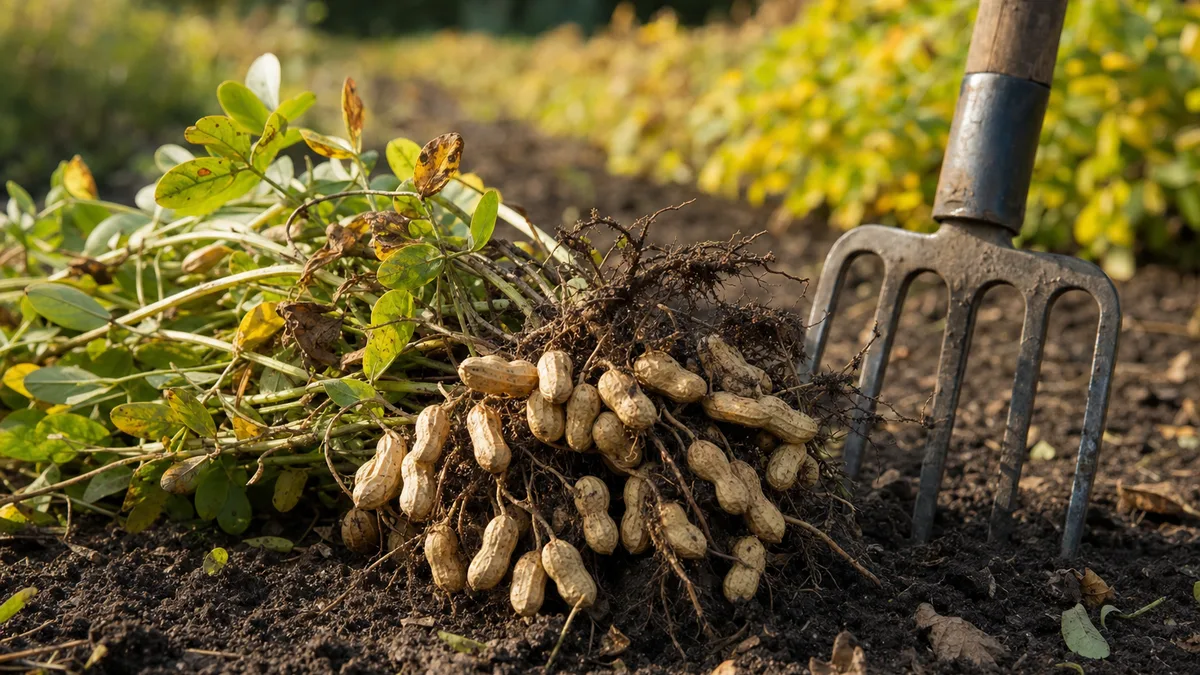
To grow peanuts, sow raw seed about 1 to 2 inches deep in warm, loose, sandy soil once frost has passed and the ground is at least 65°F, then keep the plants watered through flowering. Each flower stem bends down into the soil and forms a pod underground, so the soil has to stay loose. Most types are ready to dig 120 to 150 days after planting. Check your frost dates before you sow, and if your soil is heavy, a raised bed lets you build the loose soil peanuts need.
| Quick fact | What extension guides say |
|---|---|
| Soil temperature to sow | 65°F or warmer (Iowa State, Utah State) |
| Seed depth | 1 to 3 inches, deeper in sand (Clemson, Arkansas, Iowa State) |
| Distance between plants | 2 to 12 inches in the row, depending on type and source |
| Row spacing | 20 to 36 inches |
| Days to harvest | 120 to 150 for dry nuts; as few as 75 to 110 for green boiling peanuts |
| Soil pH | About 5.7 to 7.0, with plenty of calcium in the top 6 inches |
How Peanuts Grow: Flower, Peg and Underground Pod
Peanuts are warm-season annual legumes, and they are odd in one way: the crop develops below ground even though the plant flowers above it. NC State Extension describes small yellow, self-pollinating flowers that sit near the base of the plant and open from about 40 days after planting. Iowa State Extension adds that the flowers bloom over several weeks, which is why a plant never ripens all its pods at once.
Once a flower is fertilized and fades, the stalk under it lengthens and turns downward. University of Florida IFAS calls this stalk a peg, and Iowa State says it takes about 10 days to reach the soil. The tip pushes in and swells into a pod about a week later. Clemson Extension puts peg depth at 1 to 2 inches, and says the pegs first enter the soil 8 to 12 days after pollination. Utah State Extension warns that if a peg never reaches soil, or gets buried too deep, no pod forms. The University of Arkansas adds that only about 15 percent of flowers end up as pegged peanuts, and that pegs go into loose soil but not hard, baked soil.
That whole sequence is why peanut advice keeps coming back to the same three things: loose soil, steady moisture and calcium at the pegging zone.
The plant goes by several names. NC State lists goober, earthnut, monkey nut and groundnut for the same species, so a recipe or seed packet that says groundnut is the peanut you want here.
How Long Peanuts Take to Grow, by Type
The short answer is 120 to 150 days from planting to dig. NC State Extension gives 120 to 150 days, Mississippi State Extension gives the same range, and UC Master Gardeners say about four months. The long answer depends on the type, and the numbers differ a little between sources.
| Type | Days to harvest | Habit and use |
|---|---|---|
| Valencia | UF/IFAS: as few as 75 days for boiling. Arkansas: about 95. Utah State: 120 to 130 | Upright plant; 3 to 5 small seeds per pod (Clemson); often boiled fresh |
| Spanish | Arkansas: 105 to 115 for named varieties. UF/IFAS: about 120. Utah State: 90 to 130 | Upright plant; small kernels, 2 to 3 per pod (Iowa State) |
| Virginia | UF/IFAS and Arkansas: about 135. Utah State: 120 to 130 | Low, spreading plant; large seeds that suit roasting (UF/IFAS) |
| Runner | Arkansas: 130 to 150. UF/IFAS: about 135 to 155. Utah State: 125 to 165 | Low plant; medium seeds, two per pod (Clemson); good home garden yields in the Southeast (UF/IFAS) |
Habit descriptions: Mississippi State Extension says Virginia and Runner types are mostly low-growing and Spanish and Valencia types mostly erect. Days vary with the variety and planting date, so use these as ranges, not promises.
Green boiling peanuts come sooner. Clemson Extension gives 90 to 110 days after planting for boiling and 130 to 150 for dry roasting, and Florida notes harvest dates can shift by 15 to 30 days with planting date. Utah State and Iowa State say to plan for at least 110 to 120 frost-free days; if yours is shorter, pick a Spanish or Valencia type.
When to Plant Peanuts
Peanuts do not tolerate frost and need warm soil to sprout. Iowa State Extension says germination requires 65°F soil, and Utah State says to sow once the soil is above 65°F, usually around the last frost date. Clemson finds germination best between 68 and 95°F. Pumpkins follow a similar warm-soil rule, covered in our guide to how to grow pumpkins.
Timing by region differs a lot. University of Florida IFAS lists March through May for North and Central Florida. Clemson gives April 1 to May 31 on the South Carolina coast and May 1 to June 30 in the Piedmont, and warns that planting after June 1 leaves too little time for dry peanuts to mature.
If two sources give you different dates, our comparison of Farmers’ Almanac and NOAA frost dates shows where the numbers come from, and our post on what temperature frost forms explains why the thermometer reading and the first frost do not always match.
Best Soil for Peanuts: Loose, Sandy and Calcium-Rich
Because the pods form underground, texture matters more than fertility. Utah State Extension prefers light, humus-rich sandy soil, and Mississippi State says coarse sandy loam is best, since fine-textured soils make Virginia and Runner types hard to harvest and leave many pods behind. Iowa State says to avoid poorly drained clay. If your soil is heavy, grow in a raised bed; our guide to 4x8 raised bed soil helps you fill one.
pH and calcium
The pH targets are fairly wide. Clemson recommends 5.8 to 6.2, the University of Arkansas gives 5.7 to 7.0, and UF/IFAS says the optimum is near 6.0. Calcium is the part people miss. The Arkansas guide wants it readily available in the top 6 inches, and Clemson says foliar calcium sprays are not effective for peanuts. Mississippi State says peanuts are very sensitive to low pH and low calcium, and suggests about 2½ pounds of gypsum per 100 feet of row when plants begin to flower, to prevent poorly filled pods. UC Master Gardeners suggest adding calcium too, naming bone meal as one source. Clemson notes that Virginia types need more calcium than smaller-seeded ones.
A soil test tells you whether you need any of this. Our post on how to read soil test results shows where pH and calcium appear on the report. Arkansas says high-nitrogen fertilizer is not needed, and that inoculant may be needed at planting on a site that has never grown peanuts. UF/IFAS also says to wait at least two years before planting peanuts in the same soil again. Peanuts are legumes like beans, so our guide to how to grow beans from seed is a useful companion read on inoculant.
How to Plant Peanuts From Seed
Peanuts are grown from seed sown straight into the garden. Utah State Extension says to use seed rather than transplants, though UC Master Gardeners start seed indoors 6 to 8 weeks before the last frost for short-season sites, then transplant after frost.
Raw shelled or in-shell seed
Use raw peanuts, never roasted, boiled or salted. UC Master Gardeners say raw in-shell peanuts from a grocery, feed or pet store may work, and to avoid the boiled, salted or roasted kind. Utah State says seeds can go in the ground in the shell or shelled, and that shelled seed germinates faster. Florida IFAS reports raw in-shell peanuts germinate fastest, so extension sources do not agree on which is quicker. If you shell them, be gentle: UC warns not to remove the red seed coat, and Utah State says a cracked or damaged coat usually means the seed is dead.
- Wait for warm soil. Sow when the soil is 65°F or warmer and frost is behind you.
- Loosen the bed. Till or fork the soil 8 to 12 inches deep, as Clemson recommends, and rake out clods and stones.
- Add what the soil test asks for. Lime to reach the right pH, and gypsum if calcium is low.
- Sow at the right depth. Clemson gives 2 to 3 inches in light sandy soil and 1½ to 2 inches in clay. Iowa State, for northern gardens, says 1 to 1½ inches.
- Space the seeds. Use the ranges in the next section, then firm the soil and water well.
- Expect sprouts. Clemson says plants emerge 5 to 10 days after planting; UC says germination can take 10 to 15 days in consistently moist soil.
How Far Apart to Plant Peanuts
Spacing guidance varies widely because it was written for different types and for field versus garden use. Low, spreading Virginia and Runner types get wider rows than upright Spanish types.
| Source | In the row | Between rows |
|---|---|---|
| Iowa State Extension | 6 to 8 inches | 24 inches (bunch types), 36 inches (runner types) |
| Utah State Extension | 18 inches, 4 seeds per mound | 24 inches |
| University of Arkansas | 10 to 12 inches | 36 inches |
| NC State Extension | 6 to 9 inches | About 3 feet |
| Mississippi State Extension | 3 to 4 inches (Virginia, Runner); 2 to 3 inches (Spanish) | 3 feet (Virginia, Runner); 2 feet (Spanish) |
The tight in-row figures come from field production guides, and the wider ones from home garden guides. For a home bed, a middle path is safe: about 6 to 8 inches between plants in rows 24 to 36 inches apart, wider rows for sprawling Virginia and Runner types. A seed packet figure for your variety wins if it differs. Seed quantities are small: Mississippi State says half a pound sows 100 feet of row.
Worked example: peanuts in a 4x8 bed
This is simple arithmetic from Iowa State’s figures of 6 to 8 inches between plants and 24-inch rows for bunch types. A 4x8 bed is 48 by 96 inches. Two rows, 24 inches apart and each 12 inches in from a bed edge, fit across the 4-foot width. Along the 96-inch length, plants at 8 inches give about 12 per row, and plants at 6 inches give 16. That is roughly 24 to 32 plants. With the wider 3-foot rows that runner types prefer, only one or two rows fit, so a short bed holds far fewer.
For other crops see the plant spacing guides by crop.
Watering, Hilling and Weeding Peanuts
Water matters most at three points. Clemson Extension flags planting time, the pegging and pod-filling stretch from about 60 to 110 days after planting (the most critical), and the weeks before harvest. Mississippi State says a water shortage while the pegs enter the soil greatly reduces yield. For quantity, UC Master Gardeners suggest about 1 inch a week, and Utah State 1 to 2 inches a week applied deeply and evenly. Both agree on stopping before harvest: Clemson says to quit irrigating 10 days to two weeks ahead, and UC says about two weeks.
Hilling is where the extension guides disagree. Utah State says to mound 6 inches of soil around plants when they are about a foot tall, then add compost or grass clippings. UC Master Gardeners hill at a foot tall and again when flowering begins, so pegs have deep loose soil to enter. The University of Arkansas also says to keep soil loose and hilled up to the row. Mississippi State goes the other way and advises against pulling soil toward the plants, because it can damage leaves, interfere with flowering and raise disease risk. UF/IFAS likewise says to cultivate shallowly without throwing soil onto the vines. A reasonable reading: loosen the soil early, mulch lightly, and do not bury the foliage. Potatoes are hilled too, for a different reason, and our guide to growing and hilling potatoes compares the schedules.
Arkansas suggests a light 1 to 2 inch layer of loose organic mulch to keep the surface from crusting. Once the pegs have gone in, stop cultivating: Arkansas says not to disturb the soil, and Utah State says to cultivate no more than a few inches deep. Pull weeds in the row by hand.
How to Pick Peanuts: Digging, Drying and Curing
Peanuts are not picked off the plant like beans. You dig up the whole plant. Harvest is in late summer or fall, when the foliage starts to yellow, according to UC Master Gardeners, Iowa State and the University of Arkansas. Utah State says to dig when the leaves yellow or after the first frost.
To check maturity, pull a plant or two and open some pods. Clemson says to lift three or four plants at random and, for dry roasting, look for at least 65 percent of the pods dark inside the hull with pink to copper-red seed coats. UF/IFAS gives about 75 percent dark hulls. Mississippi State says 75 percent brown for Spanish types and 65 percent for Runner types. Clemson suggests starting these checks 15 to 20 days before your expected harvest date.
- Dry the soil. Stop watering about two weeks before, so the ground is crumbly and the plants lift easily.
- Loosen first. Work a garden fork or spade under the row, wide of the plants, then lift the whole plant by its base. Clemson says to turn plants over so the taproot points up.
- Check the hole. Utah State says to sift the soil for pods that broke off.
- Dry the plants whole. Leave them in the sun about a week (Clemson, UC) or hang them in a warm, dry shed or garage for one to two weeks (Iowa State, Utah State). Iowa State adds a warning to watch for mice.
- Pull the pods. Shake off the soil and strip the pods from the vines.
- Finish drying the pods. Spread them in a thin layer in a cool or warm dry, airy place for another 1 to 3 weeks. Utah State puts total drying at about four weeks.
Mold is the main storage risk. UF/IFAS warns to prevent mold, which can produce toxins, so only store peanuts that are fully dry and never bag damp ones. Keep cured peanuts in mesh bags in a cool, dry place, as Clemson, UC and Iowa State all advise. NC State suggests leaving the roots in the soil after digging so they break down and release nitrogen.
How Many Peanuts Per Plant, and How Big Do Plants Get?
Extension sources give surprisingly little per-plant data. The University of Arkansas guide lists 50 to 75 peanuts per hill, which is the closest figure for a single plant station, though a hill may hold more than one plant if you sow several seeds. Utah State reports trials in Wisconsin and Canada that produced 4 to 7 pounds of nuts per 100 square feet. Mississippi State gives about 1 bushel per 100 feet of row for Virginia and Runner types, which it equates to 35 to 45 pounds green or about 15 pounds dry. None of those is a promise for a backyard, since moisture, calcium and season length all swing results.
Size depends on the type. NC State Extension lists mature plants at about 9 to 18 inches tall and 9 to 18 inches wide. The University of Arkansas says seedlings emerge with three clover-like leaflets and grow to 18 to 20 inches tall. Mississippi State notes Virginia and Runner types stay low, while Spanish and Valencia types stand upright.
Growing Peanuts at Home: Containers and Cooler Climates
Containers. None of the extension guides reviewed for this post gives pot sizes, so there are no tested numbers to quote. What they do establish is the requirements: loose, deep, well-drained soil, room for pegs to enter, calcium and steady moisture. A deep container of light potting mix with a calcium source mixed in can meet those, but treat it as an experiment, expect a smaller crop, and keep the mix evenly moist.
Cooler climates. Peanuts can work well north of the Southeast. Iowa State Extension says peanuts can be grown in Iowa, and that it is a fun addition to home gardens. The limit is the length of the warm season. Utah State says gardens need more than 110 frost-free days and that peanuts grow best around 85°F, and suggests avoiding frost pockets and using hoop houses, cold frames or floating row cover. It also says to remove plastic mulch when plants begin to flower. Quicker Spanish or Valencia types suit short seasons, and UC Master Gardeners start seed indoors when the season is tight.
Free book · 23 pages, PDF
How to Grow Peanuts FAQ
Can I plant a grocery store peanut?
Possibly. UC Master Gardeners say raw, in-shell peanuts from a grocery, feed or pet store may work, but not boiled, salted or roasted ones. Avoid damaging the red seed coat, because Utah State Extension says a cracked or damaged coat usually means a dead seed. Seed sold for planting is more reliable.
How long does it take for peanuts to germinate?
Clemson Extension says peanut plants emerge 5 to 10 days after planting, while UC Master Gardeners give 10 to 15 days in consistently moist soil. Warm ground speeds it up: Clemson finds germination best between 68 and 95°F, and Iowa State Extension says 65°F is the minimum.
Do you have to hill peanuts?
Sources differ. Utah State Extension and UC Master Gardeners say to mound soil around plants at about a foot tall so pegs have loose soil to enter, while Mississippi State Extension advises against pulling soil toward the plants because it can damage leaves and flowering. Either way, keep the soil loose and avoid burying the foliage.
How many peanuts does one plant produce?
Extension guides give few per-plant numbers. The University of Arkansas lists 50 to 75 peanuts per hill. Utah State Extension reports 4 to 7 pounds of nuts per 100 square feet in Wisconsin and Canada trials. Results depend heavily on water, calcium and the length of the season.
Are groundnuts and peanuts the same thing?
For this crop, yes. NC State Extension lists groundnut among the common names for Arachis hypogaea, alongside goober, earthnut and monkey nut. So instructions for how to plant groundnut seed in a garden are the same as for peanuts.
When do you stop watering before harvest?
Clemson Extension says to stop irrigating 10 days to two weeks before harvest, and UC Master Gardeners say about two weeks. Drier soil makes the plants easier to lift, and Mississippi State Extension also says to stop watering as plants begin to mature.
Sources & further reading
Planting dates, depth, calcium, harvest checks and curing come from Clemson Home and Garden Information Center’s peanut fact sheet, Utah State University Extension’s Peanuts in the Garden, Iowa State University Extension’s guide to growing peanuts in the home garden and its answer on growing peanuts in Iowa, and the University of Arkansas Cooperative Extension publication FSA 6093. Spacing, field production and gypsum rates also draw on Mississippi State University Extension, UF/IFAS publication SSAGR31 and UF/IFAS Gardening Solutions. Plant size, flowers and common names are from the NC State Extension Plant Toolbox, and start-indoors and hilling advice from UC Master Gardeners. For how we source the facts on this site, see our methodology page.
Free book · 23 pages, PDF
The Spacing & Planting Cheat Sheet
Sent