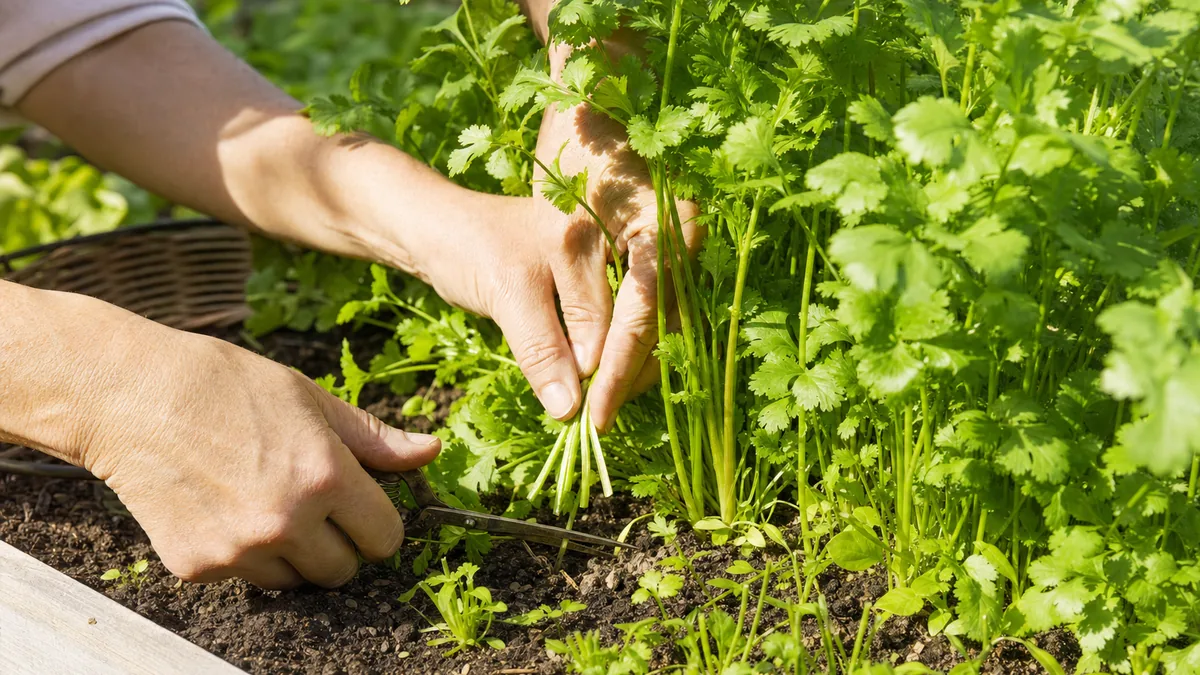
How to snip cilantro: wait until the plant is about 4 to 6 inches tall, then cut the outer stems close to the base with clean scissors or a sharp knife and leave the center to keep growing. Or cut the whole plant 1 to 2 inches above the soil. Do it in the morning, before the plant flowers, and refrigerate the sprigs soon after. This guide covers the harvest side of growing cilantro.
Snipping Cilantro: Quick Facts
Extension guides agree on the method and differ a little on the numbers, so each row names who said it.
| Question | Short answer | Source |
|---|---|---|
| When to start cutting | At 4 to 6 inches tall (some guides say 6 inches) | Texas A&M, Utah State, UW-Madison, UC Marin |
| Which leaves first | The older, outside leaves | Texas A&M, UW-Madison, UC Marin |
| Whole-plant cut | 1 to 2 inches above the soil | Texas A&M (UW-Madison says 1 inch) |
| Best time of day | Early, after the plants dry off and before it gets hot | Illinois Extension |
| How much you can take | Annual herbs can be cut back 50 to 75 percent | Illinois Extension |
| Fridge life | About a week (5 to 6 days in one guide) | Illinois, UW-Madison, Texas A&M |
| Seed (coriander) ready | Light brown seed, dry plant, about 2 to 3 weeks after flowering | UW-Madison |
How to Know When Cilantro Is Ready to Harvest
There are two signals: size and timing. Texas A&M AgriLife Extension says leaves are ready about 45 to 70 days after seeding, and University of Wisconsin-Madison Extension gives 45 to 80 days. Both are ranges because cool weather slows the plant and warm weather speeds it up. For the full growing timeline, see the cilantro growing guide linked at the top of this page.
Size is the more useful check. The guides disagree slightly on the number:
- 4 to 6 inches: Texas A&M says to cut the outer leaves once they reach 4 to 6 inches long, and Utah State says to harvest when leaves are about 4 to 6 inches tall. University of Maryland Extension says to pick sparingly at 4 to 6 inches.
- About 6 inches: UW-Madison says to pick any time after the plants are about 6 inches tall but before they bolt, and UC Marin Master Gardeners say the same, adding that outer leaves can be picked about one month after sowing.
A sensible reading of that range is to start with a light pick at 4 inches and take larger cuts once the plant passes 6 inches. The second signal is the calendar and the weather. Texas A&M says cilantro starts to bolt when temperatures rise above 85°F, and UW-Madison warns that leaves can develop a disagreeable flavor at the bolting stage, so harvest before then.
How to Snip Cilantro Step by Step
This is how to cut cilantro from the plant so the cut is clean and the plant can recover. The timing and tool advice comes from extension; the way we hold the bunch is simply what works.
- Pick the time. Illinois Extension says to harvest early in the day, after the plants dry off and before it gets hot. The University of Massachusetts Extension adds that herbs are best picked before they bloom, in the morning after the dew has dried.
- Use something sharp and clean. Illinois Extension recommends a sharp knife or pruners for clean cuts. Small kitchen scissors or herb snips do the same job on cilantro.
- Check the plant. Look for stems at least 4 to 6 inches tall and no flower stalk rising from the center.
- Choose your cut. Either take the outer leaves (the method in the next section), or cut the whole plant. Texas A&M says to cut the entire plant about 1 to 2 inches above soil level, while UW-Madison says to cut it as a bunch an inch above the ground.
- Cut close to the base. For outer leaves, follow each stem down and cut near the base of the plant, leaving the small center leaves in place.
- Bring it in. Move the sprigs out of the sun and into the kitchen or the refrigerator soon after cutting (storage is covered below).
Illinois Extension also says to be certain that the plants have not been sprayed with pesticides, because many insect and disease products are not approved for herbs grown for eating. Only use a product whose label allows it on herbs.
How to Harvest Cilantro So It Keeps Growing
Cilantro is an annual with a short life, so no method keeps it growing forever. But you can get several pickings from one plant if you cut in a way that protects the growing point.
The outer-leaf method (regrowth without killing the plant)
Take the older, outside leaves and leave the center. UW-Madison says to remove older outside leaves to encourage new growth, and UC Marin Master Gardeners note that new growth emerges from the center stem. That is why this method is the safest: you are not touching the part of the plant that makes the next leaves. Take a few stems from different sides of the plant rather than stripping one side.
The whole-plant cut and how much to take
A hard cut gives you a big handful at once. UW-Madison says that when you cut the plant as a bunch at an inch above the ground, it can regrow for a second cutting. Texas A&M puts the cut at 1 to 2 inches above the soil. For how much you can take, Illinois Extension says annual herbs, which includes cilantro, can be cut back 50 to 75 percent and still recover, while it gives one-third for perennial herbs. Treat the whole-plant cut as a final harvest if the weather is already warm, since a plant in warm weather is already close to bolting.
Pinching and pruning flower stalks
If you are asking how to prune cilantro, the answer is mostly about flower stalks. University of Maryland Extension says to pinch off flower stems to extend the leaf harvest, and Illinois Extension says removing flowers as they appear keeps new leaves coming. Both are short-term fixes. UW-Madison says that once bolting starts, the plant puts up a flower stalk 2 to 3 feet tall, so pinching buys days, not months.
Container growers can use every one of these methods. Our plant pot sizes guide covers choosing a pot that holds enough root room for repeated cutting.
What to Do When Cilantro Bolts
Bolting means the plant has switched from making leaves to making flowers and seed. Oregon State University Extension says that in midsummer cilantro typically bolts and produces seed within four to six weeks, while in cooler spring or fall weather plants grow leaves for several weeks or months before flowering. Clemson HGIC says the foliage can become bitter and less palatable as the plant matures and temperatures rise.
- If the flower stalk is just starting: pinch it off and harvest the outer leaves right away (Maryland and Illinois above).
- If it has fully bolted: the leaves on the flower stalk turn lacy and fern-like, and UW-Madison says flavor can turn disagreeable. Stop cutting leaves for the kitchen and decide whether to let it go to seed.
- Plan the next batch: Oregon State says to plant in early spring and again in late summer as a better strategy than fighting the summer heat. Our succession planting guide shows how to stagger sowings so a new batch is always coming on.
To time those sowings, look up your average frost dates and count back from them. The planting calendar pages have state-by-state dates.
How to Harvest Coriander Seeds (Same Plant, Different Crop)
Cilantro and coriander are the same plant. If you let a bolted plant finish, the flowers turn into seed, and that seed is coriander. If you want to know how to harvest coriander, the leaf harvest above is replaced by a seed harvest after the plant has flowered.
When the seed is ready
Extension sources describe the same signs in slightly different words:
- UW-Madison says to harvest when seeds turn light brown and the entire plant is dry, usually 2 to 3 weeks after flowering.
- UC Marin Master Gardeners say to harvest as the seed turns from green to tannish, in the morning before the dew dries, to reduce seed shatter.
- Utah State and Maryland say to wait until the plants turn brown and the flower heads turn brown.
- Clemson HGIC notes that the plants are prolific seeders, so seed that falls on its own may give you volunteers next season.
UW-Madison also says a seed crop needs at least 100 days of growing season, so seed is a longer project than a leaf harvest.
How to cut and dry the seed heads
- Cut before it shatters. UW-Madison says to cut the stems before much shattering occurs. Oregon State says to harvest the seeds before they drop.
- Catch what falls. Utah State cuts off the seed heads, puts them in a paper bag and hangs the bag until the plant dries and the seeds fall to the bottom. UW-Madison also suggests laying the stems over a cloth.
- Dry them somewhere warm and airy. UW-Madison says to hang the stems in a warm, airy place and to make sure the fruit is thoroughly dry, which develops the seed flavor. Illinois Extension keeps the bag in a cool, dry place and shakes it to loosen the seed pods.
- Separate the seed. Illinois Extension says rolling the pods in your hand releases the seeds. UW-Madison says to rub the dried pods to release the seed from the seed coat.
The warm versus cool drying place is a real difference between guides. Either works, so pick whichever spot is dry, airy and out of the rain, and leave the seed there until the pods are fully dry.
Space matters if you plan for seed. Utah State says to space plants 8 to 10 inches apart for a seed crop, and Texas A&M gives 8 inches apart in rows 15 inches apart, compared with 2 inches for a leaf crop. For more on layouts, see the Spacing & Planting hub and the plant spacing pages.
How to Store Cilantro After Harvest
Cilantro is best used fresh, and UW-Madison says so directly. These are the storage methods extension sources describe, from shortest to longest.
| Method | What the source says | Source |
|---|---|---|
| Refrigerator, in plastic | Loosely wrapped, keeps about a week | Illinois Extension |
| Refrigerator, washed and bagged | Separate the bunch, wash, bag, refrigerate immediately, use within 5 to 6 days | Texas A&M |
| Stems in water in the fridge | Stand the cut stems in water, like a small bouquet | UC Marin, UW-Madison |
| Freezer | Leaves in a resealable bag; UMass says freezing preserves the best flavor in cilantro | Utah State, UMass Extension |
| Dried | Sources disagree; flavor loss is the issue | Utah State, UW-Madison, UC Marin |
In the refrigerator
Illinois Extension says leaves loosely wrapped in plastic keep for a week in the refrigerator. Texas A&M’s parsley and cilantro page is stricter: separate the bunch, wash it, put it in a plastic bag and refrigerate immediately, and use it within 5 to 6 days of harvest. Both UW-Madison and UC Marin describe standing the cut stems in water in the refrigerator, like a small bouquet. Pick the method that fits your fridge. All of them point to roughly a week as the limit.
In the freezer
UMass Extension says freezing preserves the best flavor in cilantro, chervil, chives, dill, fennel, sweet cicely and tarragon. Its method is to gather leaves and short stems, wash them gently and dry them by shaking or patting, seal them in small freezer bags with some air left as a cushion, and freeze. To use, tap the bag on the counter to crush the frozen leaves. Utah State’s version is simpler: place the leaves in a resealable bag and put it in the freezer. UMass adds that frozen herbs keep better color and flavor the less they are cooked, so add them near the end.
Drying (the disagreement)
Utah State says you can dry cilantro by hanging it upside down in a warm place. UW-Madison says dried leaves lose much of their flavor, and UC Marin Master Gardeners say leaves do not dry well, so drying is not a good storage method. Texas A&M describes a middle path: dry the herbs in the refrigerator in a brown paper bag, which it says keeps them for a month and leaves them dry but aromatic. If you want the flavor, freeze it. If you want dry leaves, expect less taste.
How to Store and Save Cilantro Seeds
Once the coriander seed is dry, there are two uses: the kitchen and next year’s sowing. The storage is similar for both, and every source says to keep the seed dry and sealed.
- Container: UC Marin says to store dried seeds in glass jars until next season, Utah State says sealed containers, and UW-Madison says an airtight container in a cool, dark place, where culinary seed can be stored for months. Illinois Extension says closed containers.
- For planting seed: UW-Madison says that for seed saving, you can store whole pods in a cool, dry location.
- Longer term: Illinois Extension’s seed viability sheet says to store seed in low humidity and low temperature, below 45°F, in a sealed jar or bag in the refrigerator, and to let it reach room temperature before opening. Colorado State University Extension says to dry seed to below 8 percent moisture, store it in a moisture-proof container such as a sealed can or jar, and that seed kept on a room-temperature shelf keeps for at least one year without significant loss of germination. Neither sheet lists coriander on its own, so treat the one-year figure as a general rule, not a cilantro-specific one.
When you sow the saved seed, the usual cilantro rules apply: Oregon State gives 55 to 68°F as the soil range where cilantro seed germinates, which you can check with our soil temperature guide. The cilantro growing guide covers the depth and spacing.
Free book · 23 pages, PDF
How to Snip Cilantro FAQ
How do you cut cilantro so it keeps growing?
Take the older, outside leaves and leave the center. UW-Madison Extension says removing older outside leaves encourages new growth, and UC Marin Master Gardeners say new growth emerges from the center stem. Illinois Extension adds that annual herbs can be cut back 50 to 75 percent and still recover.
How tall should cilantro be before you harvest it?
Guides give 4 to 6 inches or about 6 inches. Texas A&M and Utah State say 4 to 6 inches, while UW-Madison and UC Marin say any time after about 6 inches tall but before the plant bolts. Start with a light pick and cut harder as the plant grows.
Can you harvest cilantro more than once?
Yes. UW-Madison says that after you cut the plant an inch above the ground, it can regrow for a second cutting, and the outer-leaf method lets you pick again as new leaves form. Cilantro is a short-lived annual, though, so Oregon State's advice to plant again in late summer still applies.
How long does cut cilantro last in the fridge?
About a week. Illinois Extension says leaves loosely wrapped in plastic keep for a week in the refrigerator, and Texas A&M says to use washed, bagged cilantro within 5 to 6 days of harvest.
Can you freeze cilantro?
Yes. UMass Extension says freezing preserves the best flavor in cilantro. Wash and dry the leaves and short stems, seal them in small freezer bags, and crush the frozen leaves when you use them. Utah State also lists freezing in a resealable bag.
When are coriander seeds ready to harvest?
UW-Madison Extension says when the seeds turn light brown and the whole plant is dry, usually 2 to 3 weeks after flowering. UC Marin Master Gardeners say to pick in the morning before the dew dries, to reduce seed shatter.
How do you stop cilantro from bolting while you harvest?
You can only delay it. University of Maryland Extension says to pinch off flower stems to extend the leaf harvest, Illinois Extension says removing flowers keeps new leaves coming, and Texas A&M says cilantro starts to bolt once temperatures pass 85°F. Sow again every few weeks for a steady supply.
Sources & further reading
Harvest height, cutting method, bolting and seed timing come from University of Wisconsin-Madison Extension on cilantro and coriander, UC Marin Master Gardeners, Texas A&M AgriLife Extension’s cilantro guide (E-277), University of Maryland Extension, Utah State University Extension, Oregon State University Extension and Clemson HGIC. General herb harvest advice comes from Illinois Extension’s guide to harvesting herbs and its page on cilantro. Storage comes from Texas A&M’s parsley and cilantro page, the UMass Extension preserving herbs fact sheet, the Illinois Extension seed viability sheet and Colorado State University Extension on storing seeds. For how we source the facts on this site, see our methodology page.
Free book · 23 pages, PDF
The Spacing & Planting Cheat Sheet
Sent