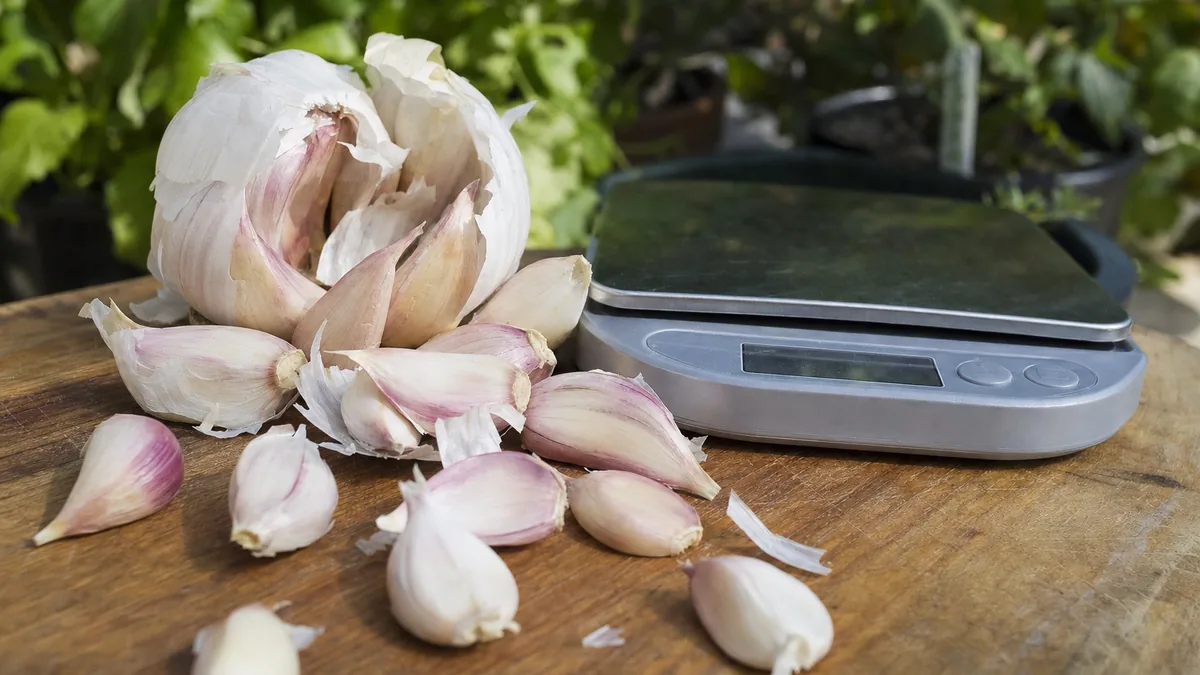
How much is a clove of garlic? The USDA’s FoodData Central lists one average clove at 3 grams, close to a teaspoon of chopped garlic. A head holds anywhere from about 4 cloves to 40, depending on the type, and a pound is roughly 50 cloves. If you plan to grow your own, each clove you set makes one new bulb, as our guide to how to plant garlic explains.
Garlic Clove Quick Facts
| What | Answer | Source |
|---|---|---|
| One average clove | 3 grams (about 0.1 ounce) | USDA FoodData Central |
| One teaspoon of garlic | 2.8 grams | USDA FoodData Central |
| Cloves in a hardneck head | 4 to 12 (some sources go to 15) | Rutgers, University of Wisconsin, NDSU |
| Cloves in a softneck head | 10 to 40 | Rutgers, University of Wisconsin, NDSU |
| Cloves in an elephant garlic bulb | 3 to 6, very large | UF/IFAS, University of Wisconsin, University of Georgia |
| Cloves per pound | About 50 (27 to 200 by variety) | UMass, University of Wisconsin, New Mexico State |
| Weight of one head | 0.09 to 0.22 pound (roughly 40 to 100 grams) | New Mexico State |
| Bulbs from one planted clove | One | Rutgers, Utah State, New Mexico State |
| Seed garlic for 100 feet of row | About 2 to 3 pounds | University of Georgia |
How Much Does a Clove of Garlic Weigh? How Big Is One?
The USDA’s FoodData Central entry for raw garlic lists three household portions: one clove at 3 grams, three cloves at 9 grams, and one teaspoon at 2.8 grams. Treat 3 grams as the average clove you meet in a supermarket head, a little over a tenth of an ounce. It is a handy number for recipes, but it is only an average, because garlic varies a lot. If you also grow onions, our guide to how to plant onion sets is a useful companion read.
New Mexico State University’s garlic production guide (H-234) gives a table for nine varieties that shows how wide the spread is. Cloves per pound run from 27 for ‘Asian Tempest’, a hardneck, to 200 for ‘Locati’, a softneck. Dividing a pound (454 grams) by those counts, my arithmetic gives roughly 17 grams for the biggest clove and about 2 grams for the smallest. So a single clove from one variety can weigh seven or eight times as much as a clove from another, and the 3 gram figure sits near the small end of that range.
Size follows type. The University of Wisconsin says hardnecks hold their cloves in a single ring around the stalk, while softnecks pack in more cloves in several layers. North Dakota State University Extension notes that hardneck cloves are fewer but individually larger than softneck cloves, and it calls the larger outer cloves of a head the best ones. For when to lift the bulbs, see our guide to when to harvest garlic.
How Many Cloves Are in a Head (Bulb) of Garlic?
The answer depends on the type, which is why you see so many different numbers online. The extension sources agree on the shape of it, with small differences in the edges of the range.
Hardneck garlic
Rutgers NJAES and the University of Wisconsin Extension both say hardneck garlic typically has 4 to 12 cloves around a central flowering stalk. North Dakota State puts it at 4 to 15. The University of Wisconsin breaks it down by group: rocamboles 6 to 11, porcelains 4 to 6, and purple stripes usually 8 to 12. UMass says a hardneck bulb has about six cloves, and the University of Maryland says 6 to 7 for large hardneck garlic. Utah State gives a single figure of 10 to 15 cloves per bulb at harvest.
Softneck garlic
Rutgers, the University of Wisconsin and North Dakota State all give 10 to 40 cloves for softnecks. The University of Wisconsin adds that they are usually arranged in three to five layers, and that silverskins have 8 to 12 or 18 to 24. UMass says a softneck bulb has roughly twice as many cloves as a hardneck. The University of Georgia gives 12 to 20 for silverskin and many artichoke strains, and the University of Maryland says softneck is the type typically found in grocery stores. Garlic also appears in our companion planting chart if you are planning its neighbors.
Elephant garlic
Elephant garlic is a different plant. The University of Wisconsin and UF/IFAS Extension both say it is Allium ampeloprasum, a type of leek, and not a true garlic. UF/IFAS says a bulb usually has about six cloves and can reach a pound or more. The University of Wisconsin gives 5 to 6, up to about a pound, and the University of Georgia says elephant garlic usually has only three or four very large cloves. Its flavor is milder than true garlic, per UF/IFAS, so recipes written for regular cloves do not behave the same way.
How Many Heads and Cloves Are in a Pound of Garlic?
For cloves, UMass Extension and the University of Wisconsin Extension both say about 50 cloves make a pound. New Mexico State’s table is wider, because it is by variety: 27 cloves per pound for ‘Asian Tempest’, 58.8 for ‘Spanish Roja’ and ‘German Red’, 76.9 for ‘Inchelium Red’ and ‘Carpathian’, 111.1 for ‘Mild French’ and 200 for ‘Locati’. So 50 is a fair middle, and a pound of small-clove softneck garlic can hold several times that many.
For heads, the same New Mexico State table lists average bulb weights from 0.090 pound (‘Locati’) to 0.224 pound (‘Asian Tempest’). Turned into counts, that is roughly 4 to 11 heads per pound, again my arithmetic. The University of Maryland gives 6 to 7 bulbs per pound for large hardneck garlic, which sits inside that range. If you are buying seed garlic by the pound, our guide to how to plant garlic covers what to do with the cloves.
| Variety (type) | Avg. head weight | Avg. cloves per head | Cloves per pound |
|---|---|---|---|
| ’Asian Tempest’ (hardneck) | 0.224 lb | 5.5 | 27 |
| ’Inchelium Red’ (softneck) | 0.125 lb | 8.9 | 76.9 |
| ’Locati’ (softneck) | 0.090 lb | 15.9 | 200 |
Selected rows from Table 1 of New Mexico State University’s Garlic Production in New Mexico (H-234, revised 2011).
Garlic Measures for Cooking: Clove, Teaspoon, Scape
By USDA weights, one clove (3 grams) and one teaspoon of garlic (2.8 grams) are close enough that one clove is about one teaspoon. Three cloves (9 grams) is about a tablespoon, and a cup of garlic is 136 grams. The USDA lists these as portions of the raw food, so they are averages, not rules. If your cloves are large hardneck cloves, one may fill two teaspoons, and if they are small softneck cloves it may take two to make one. Judge by the size of the clove and your taste for garlic.
Garlic scapes, the curling flower stalks of hardneck garlic, are a different measure. The University of Nebraska-Lincoln says scapes are milder than garlic cloves, and Illinois Extension says they can be used in place of garlic. None of the extension pages I read gives a fixed scapes-per-clove ratio. The one recipe Illinois Extension gives swaps them evenly, 2 minced scapes or 2 minced cloves. Treat that as a starting point and add more scape if you want the same punch.
If you grow hardnecks, the scapes are a bonus crop from the same bed. Our guide to when to harvest garlic covers when to cut them, how to dig and how to cure the bulbs afterward.
How Much Garlic Does One Clove Grow in the Garden?
One clove makes one bulb. Rutgers says it plainly, “one clove will yield one bulb,” Utah State says each planted clove produces one bulb, and New Mexico State adds that the new bulb contains 5 to 16 cloves. So a single planted clove turns into a whole head holding several more cloves, which is why garlic is easy to keep growing from year to year.
By weight, UMass Extension says one pound of garlic “seed” bulbs will usually yield between four and eight pounds at harvest. That is a range, not a promise, and the first thing that moves it is clove size. Rutgers, the University of Georgia and the University of Maryland all say larger cloves produce larger bulbs, so the clove you plant sets the ceiling. Plant the large outer cloves and eat the small inner ones.
Potatoes work on the same idea: a piece of last year’s crop becomes this year’s plant, as our potato growing guide shows.
How Many Cloves to Plant and How Much Seed Garlic to Buy
The shopper’s question flips for the gardener, because now you count cloves. It takes three numbers: the spacing, the size of the bed, and how many good cloves each head gives.
Spacing gives the clove count
Extension spacing differs a bit. Rutgers says to space cloves 3 to 6 inches apart in rows with 9 to 24 inches between rows. The University of Minnesota says to plant in double rows with the cloves six inches apart. Penn State gives 6 to 7 inches in the row and a foot between rows, and Utah State allows 3 to 4 inches in the row with rows 6 to 10 inches apart, noting that planting that close reduces bulb size unless water and nutrients are good. Rutgers adds that a lower density gives larger, healthier bulbs. For a bed you never walk on, a 6-inch grid is a safe default, which makes 4 cloves per square foot.
The University of Georgia gives an easy rule for row planting: about 2 to 3 pounds of seed bulbs plants 100 feet of row, with cloves 6 inches apart and rows 12 to 14 inches apart. At 6 inches, 100 feet holds about 200 cloves, so that is roughly 65 to 100 cloves per pound, my arithmetic. That is more cloves per pound than the 50 given by UMass and the University of Wisconsin, a reminder that the weight of seed garlic you buy depends on how many of the cloves you plant and how big they are.
From cloves to pounds of seed garlic
The quickest route is cloves divided by cloves per pound. For a 4x8 bed, work through it in this order:
- Pick the spacing. A 6-inch grid is the safe default above, which makes 4 cloves per square foot.
- Count the cloves. A 4x8 bed on a 6-inch grid holds 128 cloves, the worked example in our planting guide.
- Convert to pounds. At about 50 cloves per pound (UMass, University of Wisconsin), that is around 2.6 pounds of seed garlic.
- Convert to heads. A hardneck head with six good planting cloves gives about 22 heads for the same bed.
- Buy a few extra. Some cloves will be too small to plant.
To know when to order, the planting calendar shows the fall window for your state.
Think about next year before you eat the crop. New Mexico State says growers hold back about 10 to 12 percent of the harvest as planting stock, and the University of Georgia advises planting only the larger outer cloves from your best bulbs. Keeping the biggest heads is the cheapest way to restock.
Mulch, companions and neighbors
The University of Wisconsin Extension says to mulch newly planted garlic with 3 to 4 inches of clean straw, which falls inside the 3 to 4 inch ceiling in our list of mulch mistakes that hurt your plants. Onions are the other allium in many beds, and how to plant onion sets shows how that crop is counted and spaced.
Garlic also turns up in companion planting advice. Our guide to what to plant with tomatoes covers garlic as a tomato neighbor, and the companion planting chart lists it among the plants to keep away from beans. For more on bed math, browse the spacing and planting guides.
Free book · 23 pages, PDF
How Much Is a Clove of Garlic FAQ
How many cloves are in a head of garlic?
It depends on the type. Rutgers NJAES says a hardneck head typically has four to twelve cloves and a softneck typically ten to forty. UMass Extension says a hardneck has about six and a softneck roughly twice that. New Mexico State measured 5.5 to 15.9 cloves per head across nine varieties.
How much does a clove of garlic weigh?
USDA FoodData Central lists one raw clove at 3 grams, and three cloves at 9 grams. Real cloves vary: New Mexico State's table works out to about 2 to 17 grams per clove between its smallest and largest varieties, so use 3 grams as an average, not a rule.
How many cloves of garlic are in a pound?
About 50, according to UMass Extension and the University of Wisconsin Extension. New Mexico State lists 27 cloves per pound for a large hardneck such as 'Asian Tempest' and 200 per pound for a small-clove softneck such as 'Locati'.
How many heads of garlic are in a pound?
The University of Maryland Extension says about 6 to 7 bulbs per pound for large hardneck garlic. New Mexico State's average head weights, 0.09 to 0.224 pound, work out to roughly 4 to 11 heads per pound, depending on variety.
How much garlic do you get from one clove?
One clove grows one bulb, per Rutgers and Utah State, and the new bulb holds 5 to 16 cloves, per New Mexico State. UMass Extension says one pound of seed bulbs usually yields four to eight pounds at harvest. Larger cloves give larger bulbs.
How many garlic scapes equal a clove of garlic?
No extension source gives a fixed ratio. The University of Nebraska-Lincoln and Illinois Extension both say scapes are milder than cloves, and an Illinois Extension recipe swaps them evenly, two minced scapes for two minced cloves. Start there and add more scape if you want a stronger flavor.
How much is a clove of garlic in teaspoons?
USDA FoodData Central lists one clove at 3 grams and one teaspoon of garlic at 2.8 grams, so a clove is about a teaspoon. Three cloves, at 9 grams, is about a tablespoon. Large hardneck cloves can run more and small softneck cloves less.
Sources & further reading
Clove, teaspoon and cup weights come from the USDA’s FoodData Central entry for raw garlic (FDC ID 169230). Cloves per head, cloves per pound and head weights come from New Mexico State University’s Garlic Production in New Mexico (H-234), Rutgers NJAES fact sheet FS1233, UMass Extension’s garlic fact sheet, University of Wisconsin Extension’s garlic article, University of Maryland Extension, North Dakota State University Extension’s From Garden to Table: Garlic, Utah State University Extension and University of Georgia Extension’s Garlic Production for the Gardener. Elephant garlic facts come from UF/IFAS Extension (MV065). Scape notes come from the University of Nebraska-Lincoln and Illinois Extension. Spacing and planting-stock advice also draws on the University of Minnesota Extension and Penn State Extension. For how we source the facts on this site, see our methodology page.
Free book · 23 pages, PDF
The Spacing & Planting Cheat Sheet
Sent