What grows with tomatoes? Extension sources back basil, parsley, chives, onions, early lettuce and peas, and they name potatoes, fennel, the cabbage family and corn as poor neighbors. West Virginia University Extension says companion planting is not an exact science, so treat every pairing as a low-risk bet. Our companion planting chart covers other crops; this guide goes deep on what to plant with tomatoes.
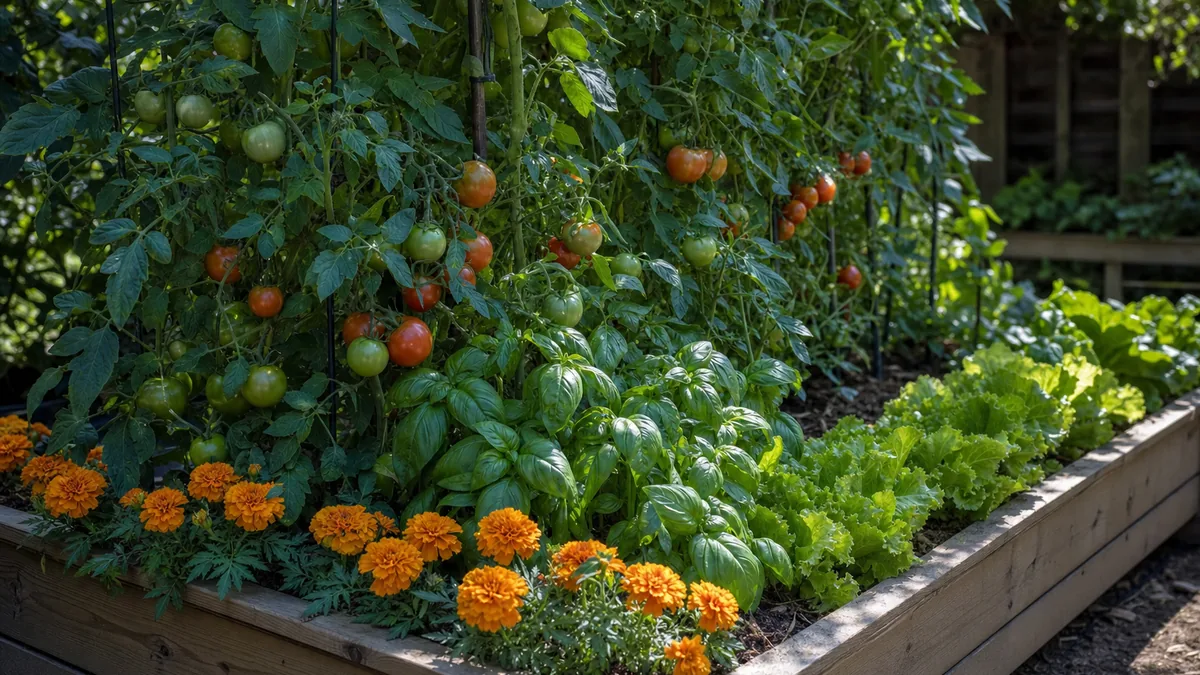
Quick Facts: What Grows With Tomatoes
| What | Answer | Source |
|---|---|---|
| Herb companions | Basil, parsley, chives, oregano (dill is disputed) | Oregon State, WVU |
| Vegetable companions | Onion family, early lettuce and spinach, peas in early spring | WVU, Maryland, Minnesota |
| Poor neighbors | Irish potatoes, fennel, cabbage family, corn | WVU |
| Never near | Black walnut trees (juglone is very toxic to tomatoes) | UNH Extension |
| Plant spacing | 18 to 36 inches in rows, 48 to 60 inches between rows | Maryland Extension |
| Rotation | Do not follow peppers, eggplant or potatoes with tomatoes | Clemson, Penn State |
What Grows Well With Tomatoes: The Best Companions
University of Minnesota Extension says a few studies show that basil and marigolds can reduce thrips on tomatoes in both field and greenhouse conditions, and that intercropping with basil may even help tomato growth. University of Illinois Extension is more cautious: many recommended companions have never been tested, but there is no harm in trying them, because a basil plant is still basil if it fails to deter anything.
With that caveat, these are the companions in extension guidance:
- Basil. Oregon State Extension says basil enhances tomatoes and may distract thrips. WVU Extension lists it as a tomato companion, and Maryland Extension even uses a basil, tomato, basil, tomato row as its example of alternating plants.
- Parsley, chives and oregano. Oregon State lists all three as plants that enhance tomatoes, and WVU lists parsley.
- Marigolds. Oregon State says marigolds enhance all crops, and Maryland shows them at the ends of tomato rows, where their flowers feed beneficial insects. Our guide to planting marigold seeds covers sowing them, and how to grow marigolds covers the care after that. Minnesota calls the evidence for marigolds mixed: sometimes yes, sometimes no.
- Low salad greens. Maryland suggests shade-tolerant salad greens on the north side of tomatoes, which is covered in the raised bed section below.
What Vegetables and Herbs to Plant With Tomatoes, Pair by Pair
Here is a plain verdict for each pair, with who said it. “Untested” means none of the extension pages we opened name that pair either way. If you are raising the tomatoes themselves from seed, our guide to growing tomatoes from seed covers that step.
| Plant next to tomato | Verdict | What the sources say |
|---|---|---|
| Basil | Yes | WVU, Oregon State and Minnesota all list it; Minnesota cites thrips studies |
| Onions | Yes | WVU lists tomatoes among the onion family’s good neighbors |
| Garlic | Untested | No tomato pairing found; WVU only says to keep garlic away from beans |
| Dill | Mixed | WVU lists it; a Wisconsin Extension column says it stunts mature tomatoes |
| Sage | Untested | Not on Oregon State’s tomato list; WVU pairs sage with the cabbage family |
| Corn | No | WVU lists tomatoes as a poor neighbor for corn; they share an insect |
| Peas | Yes, early | Maryland plants them at the base of tomato cages in early spring |
| Squash | Untested | Not named for tomatoes in the pages we opened; see how to grow squash for its own needs |
| Potatoes | No | WVU, Clemson and Penn State advise keeping the family apart |
| Beets | Untested | WVU pairs beets with the onion family, not tomatoes |
| Lettuce | Yes | Maryland and Minnesota both suggest it, for space and shade |
| Mint | Mixed | Oregon State calls mint very aggressive; keep it in a pot |
Are onions and tomatoes good companion plants? Can garlic go with them?
Onions, yes. WVU Extension’s chart lists tomatoes among the good neighbors for the onion family. Garlic is a different story on paper: no extension page we opened pairs garlic with tomatoes, and WVU’s only garlic warning is to keep it away from beans. Garlic is an onion relative, so it is a reasonable but untested bet. Timing helps: Minnesota Extension describes planting early crops in the same bed as later crops such as tomatoes, and fall-planted garlic comes out in early summer, as our guide to how to plant garlic explains. If you do tuck a few cloves between plants, how much is a clove of garlic shows how many cloves a head holds and how big each one is. Our guide to planting onion sets has the spring timing for onions.
Is dill a companion plant for tomatoes?
The honest answer is that sources disagree. WVU Extension lists dill among the herbs that are good neighbors for tomatoes. A companion planting column posted by University of Wisconsin Extension in Kenosha County says dill helps tomatoes until it matures and then stunts them, though that column cites no experiments. Oregon State’s herb list does not name dill for tomatoes at all, and says it helps lettuce, onions and the cabbage family. If you want dill, grow it a few feet away from the stems.
What herb is the best companion plant for tomatoes?
Basil has the most support. It is the one herb named by WVU, Oregon State and Minnesota, and it is the one with studies behind it, on thrips in tomatoes. Parsley, chives and oregano are second-tier choices from Oregon State’s list.
What Not to Plant Next to Tomatoes
Fewer sources agree on the pairs to avoid, so each item here names who says it:
- Irish potatoes. WVU Extension lists potatoes as a poor neighbor for tomatoes, and tomatoes as a poor neighbor for potatoes. Both are in the nightshade family and share pests and diseases, so give our potato growing guide its own bed.
- Fennel and the cabbage family. WVU lists both as poor tomato neighbors. It also lists tomatoes in the poor column for the cabbage family, so the advice runs in both directions. It gives no mechanism.
- Corn. WVU lists tomatoes as a poor neighbor for corn. A reason is plausible: Iowa State Extension says the tomato fruitworm is the same species as the corn earworm, and University of Wisconsin Extension says it may attack tomatoes late in the season, when corn is less attractive.
- Black walnut. University of New Hampshire Extension lists tomatoes, eggplant, peppers and potatoes as very toxic to juglone, the compound black walnut roots release. It gives no safe distance, saying instead to put gardens far from the tree or use lined raised beds that limit root contact. Affected plants develop yellowed, wilting leaves and eventually die.
What to Plant With Tomatoes to Keep Pests Away
Pest control is where companion planting has the most evidence, though still not much for tomatoes. Minnesota Extension cites a few studies in which basil and marigolds reduced thrips on tomatoes, and Illinois Extension describes an Iowa State study that tested companions with tomato, zucchini, broccoli, cabbage and lettuce and found any herb companion helped pest management compared with a plain control. Illinois adds that you may need many more of the companion plants for the effect to last, so a single basil plant is not a shield.
The hornworm is better handled by watching than by planting. University of Minnesota Extension does not mention companion plants for it. It calls handpicking the most effective control and says to check plants at least twice a week in summer. It also says that if a caterpillar carries white cocoons that look like rice grains, leave it, since the braconid wasps will emerge and attack other hornworms.
If leaves are riddled with holes, our guide to holes in plant leaves helps match damage to the pest. Our guide to companion planting flowers with vegetables covers what the research says about predator-attracting flowers.
What Can I Plant With Tomatoes in a Raised Bed?
A raised bed makes pairing easy and crowding easy too. Start with the tomato: Maryland Extension gives 18 to 36 inches between plants in a row and 48 to 60 inches between rows, with cages at least 4 feet apart, and wants at least 6 hours of direct sun, preferably 8 to 10. Iowa State Extension gives 2 to 2.5 feet for determinate plants and 2.5 to 3 feet for caged indeterminate ones. Our guide to growing tomatoes in raised beds turns those figures into plant counts for 4x4 and 4x8 beds, and our tomato plant spacing guide lists the ranges by variety.
Then fit companions into the gaps, in this order, working with time and light:
- Early crops first. Minnesota Extension suggests lettuce, spinach or basil early in the season, then transplanting tomatoes into the bed as the early crop matures. Our guide to growing lettuce from seed covers the cool-season side.
- Peas on the north side. Maryland says to plant peas at the base of tomato cages, on the north side, in early spring, where the filled-in vines act as a wind shield.
- Greens in the shade. Maryland recommends low, shade-tolerant salad greens on the north side of tomatoes, so the tall plants shade the lettuce and not the other way around.
- Keep it from crowding. Clemson notes that cages can crowd growth and reduce air circulation, and Illinois says proper spacing lets plants dry faster. A companion that blocks airflow can cost you more than it gives.
For layouts that combine several of these, see our companion planting garden layouts. Squash is a sprawler, so give it its own room as described in our squash growing guide. To fit the tomato bed into a whole garden with sun, paths and planting dates, see how to plan a vegetable garden.
What to Put Around Tomato Plants
Around the base, the best cover is mulch, not another crop. Clemson Extension suggests laying wet newspaper around tomatoes and topping it with a thin layer of mulch, which creates a barrier between spore-carrying soil and the leaves. At the ends of rows, Maryland Extension shows marigolds planted for the beneficial insects their flowers feed. In between, low herbs such as basil, parsley and chives sit well under a tomato canopy. Oregon State warns that rosemary has a big root system and can compete with its neighbors.
Clemson recommends drip irrigation over overhead watering to cut splash onto leaves, and Illinois Extension advises avoiding evening watering to keep foliage dry. Our guide on how often to water tomatoes gives amounts, and the blossom end rot guide explains why uneven watering matters so much to the fruit.
Rotation: Where Tomatoes Should Not Follow Tomatoes
Rotation is better documented than any pairing. Penn State Extension lists tomatoes in the Solanaceae family with peppers, potatoes, eggplant and tobacco, and says it is not recommended to plant the same family in succession, because plants in a family share susceptibility to diseases, insects and nematodes. Clemson Extension agrees in practical terms: move tomatoes to a different part of the garden each year, and not to where peppers, eggplants or potatoes grew the previous year. Peppers are in that group too, so keep that in mind when you plan a bed for growing peppers from seed.
The reason is that disease carries over. Illinois Extension says early blight can persist in soil, seed or plant debris for a year, and Septoria leaf spot for up to three years on infected debris. It also admits that avoiding solanaceous crops in the same area is hard in a backyard garden. Clemson recommends removing diseased plant parts and pulling plants at the end of the season.
If lower leaves are already yellowing, our guide to why tomato leaves turn yellow walks through the causes. The spacing and planting hub collects our bed-layout articles.

Free book · 23 pages, PDF
What Grows With Tomatoes FAQ
What can be planted with tomatoes?
Oregon State Extension lists basil, chives, parsley and oregano as plants that enhance tomatoes. WVU Extension adds the onion family, and Maryland Extension suggests low greens on the north side and early peas at the base of cages.
What not to plant next to tomatoes?
WVU Extension lists Irish potatoes, fennel and the cabbage family as poor neighbors for tomatoes, and corn as well. University of New Hampshire Extension says black walnut roots release juglone, which is very toxic to tomatoes, so keep the bed far from the tree or use a lined raised bed.
Are onions and tomatoes good companion plants?
Yes, according to WVU Extension, which lists tomatoes among the good neighbors for the onion family. Illinois Extension notes that most companion advice has not been tested in a research study.
Can garlic and tomatoes be planted together?
Probably, but it is untested. No extension page we opened pairs garlic with tomatoes, and WVU Extension only warns to keep garlic away from beans. Minnesota Extension describes sharing a bed between early and later crops such as tomatoes, which fits garlic dug in early summer.
Is dill a companion plant for tomatoes?
Sources are mixed. WVU Extension lists dill as a good neighbor for tomatoes, while a University of Wisconsin Extension column says dill helps young tomatoes but stunts mature ones, without citing a test. Oregon State does not list dill for tomatoes.
What herb is the best companion plant for tomatoes?
Basil. WVU Extension, Oregon State Extension and University of Minnesota Extension all name it, and Minnesota cites a few studies in which basil and marigolds reduced thrips on tomatoes. Parsley, chives and oregano are also on Oregon State's list.
What can I plant with tomatoes in a raised bed?
Basil between plants, lettuce or spinach on the north side, and early peas at the base of cages. Maryland Extension spaces tomatoes 18 to 36 inches apart in rows. Leave room for airflow, since Clemson Extension notes crowding reduces circulation.
Sources & further reading
Pairings, warnings, spacing and rotation advice come from these extension sources:
- West Virginia University Extension: Companion Planting
- University of Minnesota Extension: Companion planting in home gardens
- University of Maryland Extension: Vegetable Succession and Companion Planting
- University of Maryland Extension: Tomatoes
- Oregon State University Extension: Herbs and Flowers in the Vegetable Garden
- University of Illinois Extension: Companion Planting, Anecdotal or Tried and Tested?
- University of Illinois Extension: Common tomato diseases
- University of Wisconsin Extension, Kenosha County: Companion plants article
- University of Wisconsin Extension Horticulture: Corn earworm
- Iowa State University Extension: Proper spacing when planting tomatoes
- Iowa State University Extension: Tomato fruitworm
- University of Minnesota Extension: Tomato hornworms
- Clemson Home and Garden Information Center: Cultural management of tomato diseases
- Penn State Extension: Plant Rotation in the Garden Based on Plant Families
- University of New Hampshire Extension: Are black walnut trees bad for gardens?
See our methodology page for how we source facts.
Free book · 23 pages, PDF
The Companion Planting Chart
Sent