Part of our Plant Problem Diagnosis series
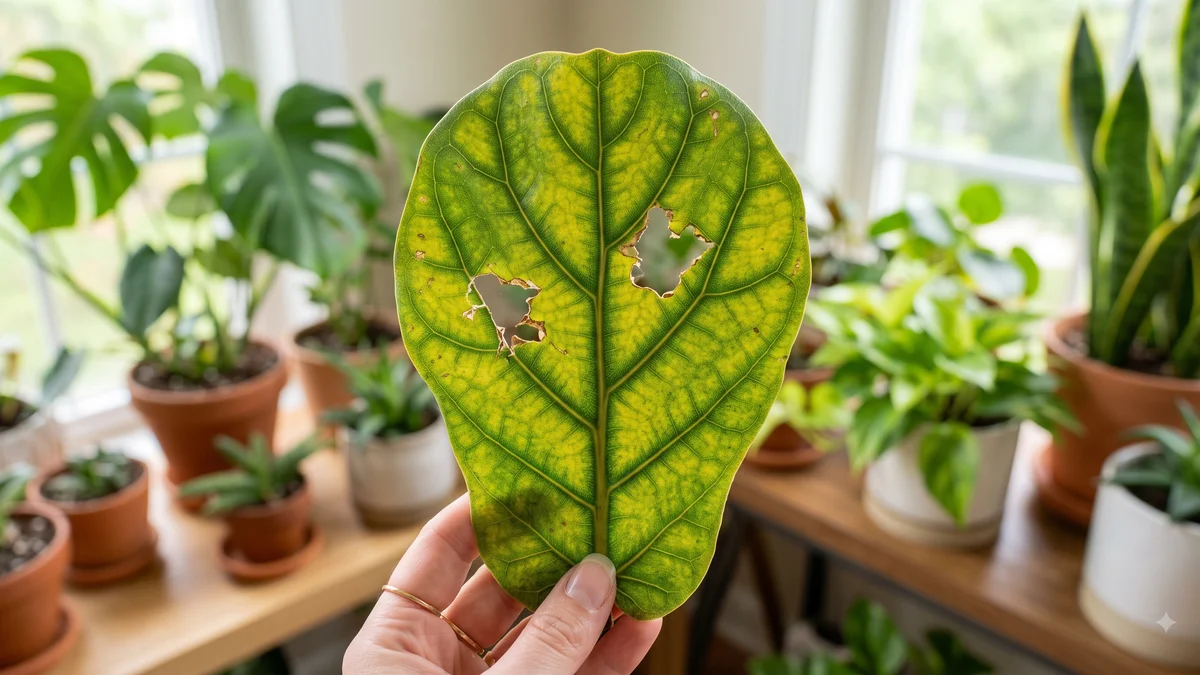
Why are there holes in my plant leaves? The honest answer is that “holes” covers a lot of ground: ragged bite marks, tiny shotgun-pattern perforations, neat rounded cutouts, and sometimes no real damage at all, just natural leaf fenestration on a plant that’s supposed to look this way. If you’ve searched why do my plants leaves have holes and landed here, you’re not alone; it’s one of the most common versions of this question, and the answer depends entirely on what the holes actually look like and whether you can see what’s making them. One quick note before diagnosing anything: this isn’t about stomata, the microscopic pores every leaf uses for gas exchange. Those are invisible to the naked eye and have nothing to do with a hole you can actually see. If your plant is also dealing with yellowing leaves alongside the holes, that’s a separate diagnosis worth running too.
Quick Answer: Why Are There Holes in My Plant Leaves?
What causes holes in plant leaves? Three broad categories: pests you can actually see, pests that fed at night or already moved on, and, less obviously, no pest at all. Three questions sort out which one you’re dealing with.
Not Actually a Problem: Natural Leaf Fenestration
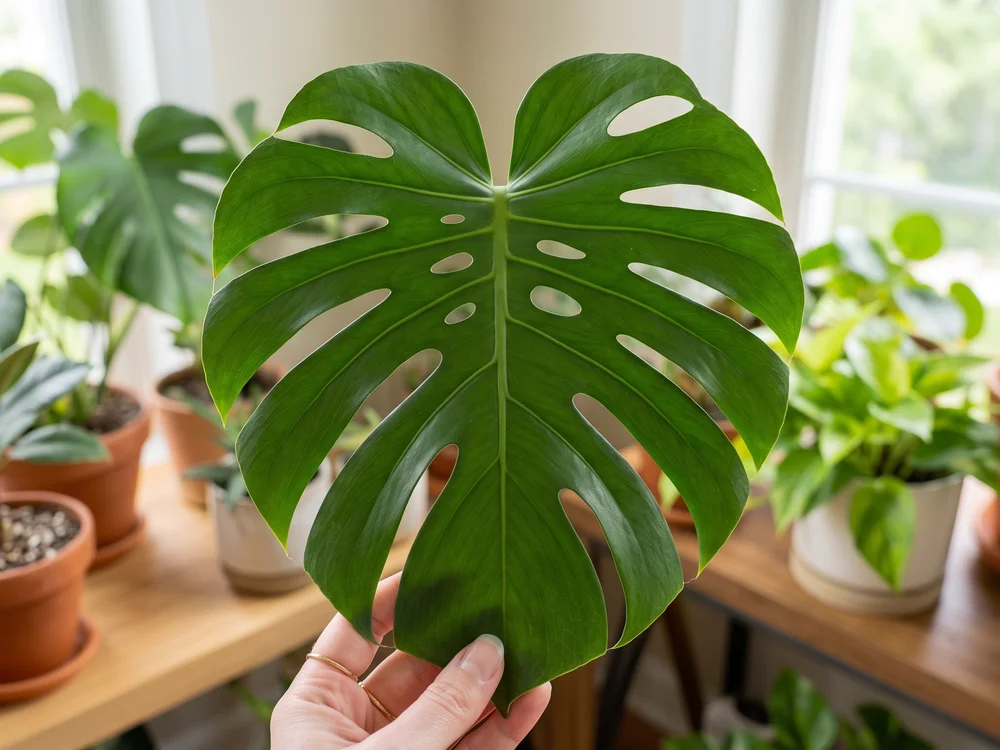
Monstera deliciosa and other aroids naturally develop holes and splits as they mature. It’s a genuine adaptation, not damage. The leading theories are that fenestration helps the plant capture more scattered light through a forest canopy, reduces wind resistance so big leaves don’t tear in a storm, or lets rain drain through to the roots below instead of pooling on the leaf surface. Nobody has fully settled on which mechanism matters most, but all three point the same direction: this is the plant working as designed, not something going wrong.
The tell is the pattern. Natural fenestration holes and splits are symmetrical, follow the leaf veins, and appear on new growth as it unfurls, not scattered randomly across an already-mature leaf. If that matches what you’re looking at and the plant is a known fenestrating species, there’s genuinely nothing to fix here. The real value in this section is permission to stop worrying about a leaf that’s doing exactly what it’s supposed to.
Visible Culprit: The Two Most Common Real Pests
What causes holes in the leaves of plants when you can actually see something moving? Two insects account for most of the visible, daytime damage, with two more showing up often enough to name specifically.
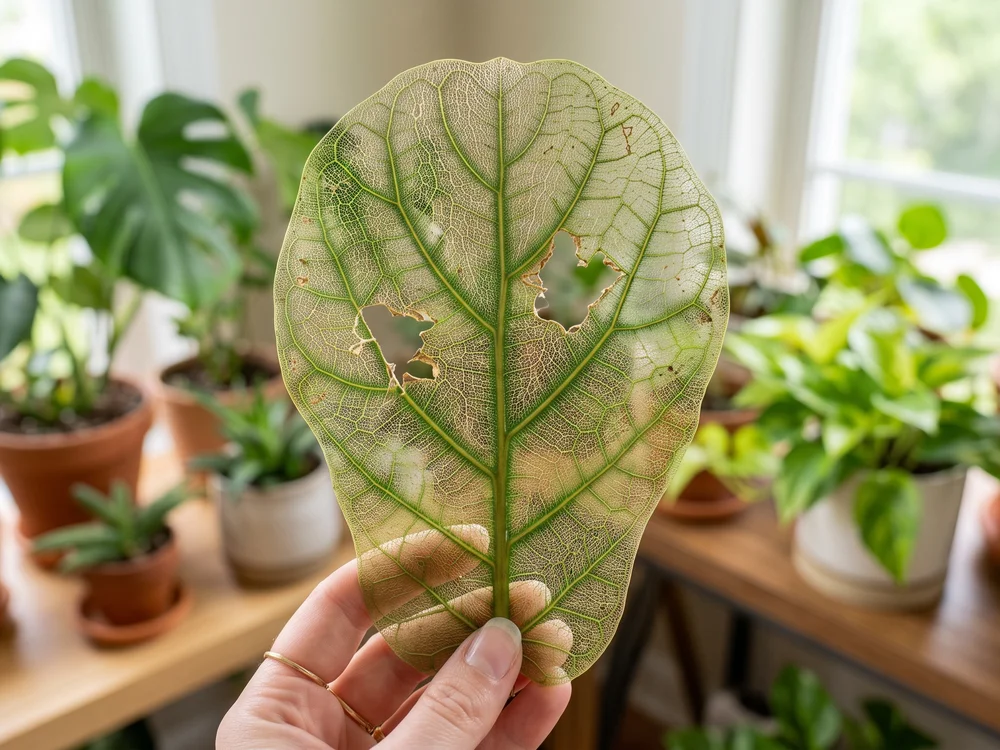
Japanese beetles (Popillia japonica) skeletonize leaves: they chew the soft tissue between the veins and leave the veins themselves intact, creating a lacy, see-through pattern rather than clean holes. You’ll usually spot the metallic-green beetles themselves feeding in groups during the day, worst from mid-to-late summer. A full ID and control guide for Japanese beetles specifically is coming soon to this series.
Flea beetles leave a completely different signature: tiny, numerous holes in a “shotgun” pattern, especially on eggplant, radishes, and other brassicas. The beetles themselves are hard to spot directly: they jump like fleas the moment you disturb the plant, which is usually the first clue you’re dealing with them rather than something slower-moving. A full ID and control guide for flea beetles is also coming soon.
Slugs and snails leave large, ragged holes, usually concentrated on lower or inner leaves that stay shaded and damp. The giveaway is the silvery slime trail left behind, and damage is almost always worse after rain or during humid stretches, since both feed at night and retreat to cover during the day.
Caterpillars chew large, irregular holes and often leave visible frass (droppings) on the leaf or on the soil beneath it. Look closely along the leaf edges and midrib: caterpillars are frequently well camouflaged against the leaf color and easy to miss even when they’re right there.
No Bugs Visible: Now What?
Holes in leaves but no bugs anywhere in sight usually means one of three things, and only one of them is actually a pest.
Nocturnal feeders. Slugs, snails, and many caterpillars feed at night and hide during the day. Check the plant after dark with a flashlight, or look for indirect evidence, slime trails or frass, left behind from the previous night’s feeding.
The pest already moved on. Damage that isn’t actively growing day to day is often just old evidence of feeding that finished a while ago. If the holes stop appearing on new leaves, whatever caused them is gone.
Not a pest at all: shot hole disease. This is the real answer behind a lot of “no bugs” searches, and it’s genuinely not an insect problem. Shot hole is a fungal and bacterial disease, mostly affecting stone fruit trees and shrubs (cherry, cherry laurel, plum, peach, and related Prunus species). Infected leaf tissue develops small brown or reddish spots, and later in the season that dead tissue dries up and drops out entirely, leaving a round hole that looks exactly like something chewed through it. Per the University of Maryland Extension and UC IPM, the disease is favored by warm, wet spring weather, and in most cases on an otherwise healthy plant it’s cosmetic rather than dangerous: no treatment is strictly necessary, though removing fallen leaves in autumn reduces the following year’s spore load. The Georgia and UGA Extension offices see the same pattern regularly enough that it’s one of the most common “is this bugs?” questions their agents field on ornamental cherries each spring.
Specific Plants Worth Naming
A few plants come up often enough in real-world hole complaints that they’re worth calling out directly rather than leaving to the general pest list above.
Roses are a frequent target for roseslugs (despite the name, actually sawfly larvae, not slugs or caterpillars). Per the University of Illinois Extension, several roseslug species skeletonize rose leaves in a pattern that’s easy to mistake for Japanese beetle damage, especially early in the season before Japanese beetles are even active yet.
Coleus (Coleus scutellarioides) shows up constantly in hole-damage reports as a magnet for slugs, Japanese beetles, and caterpillars alike, not because it’s uniquely vulnerable, but because its soft, broad leaves make any feeding damage highly visible against the colorful foliage.
Treating It: Including Naturally
How to treat holes in leaves depends entirely on what’s actually causing them, but most of the effective options are low-effort and don’t require reaching for a broad-spectrum pesticide first.
Hand-picking works well for larger, visible pests: Japanese beetles, caterpillars, and slugs can all be picked off by hand (a container of soapy water makes quick work of them) and it’s often enough on its own for a light infestation.
Diatomaceous earth and iron phosphate slug bait are both lower-toxicity options specifically for slugs and snails, safe to use around most other garden life when applied as directed.
Neem oil offers broader coverage against soft-bodied pests and works as both a repellent and a mild insecticide, though it needs reapplication after rain and works best applied in the evening to avoid harming pollinators.
Row covers are the most effective physical prevention, but only if they go on before pests arrive: once beetles or caterpillars are already established under the cover, it traps them in with the plant instead of keeping them out.
Companion planting is a genuine prevention strategy worth building in from the start rather than reaching for after damage shows up; see our companion planting chart for pairings like marigolds, dill, and chives that are specifically documented to reduce pest pressure around vegetables.
Quick Reference Table
Match the hole pattern you’re seeing to the likely cause below.
| Hole Pattern | Likely Cause | Fix |
|---|---|---|
| Neat, symmetrical, following the veins on a Monstera or similar | Natural fenestration | Nothing: this is normal growth |
| Lacy, see-through pattern, only veins remain | Japanese beetle (skeletonizing) | Hand-pick beetles; neem oil |
| Tiny, numerous “shotgun” holes | Flea beetles | Row covers before pests arrive |
| Large, ragged, with silvery slime trails | Slugs or snails | Diatomaceous earth; iron phosphate bait |
| Large, irregular, with visible frass nearby | Caterpillars | Hand-pick; check at night with a flashlight |
| Small round holes, no bugs, on cherry or related trees | Shot hole disease (fungal/bacterial) | Usually cosmetic; remove fallen leaves in fall |
| Skeletonized rose leaves specifically | Roseslugs (sawfly larvae) | Hand-pick; forceful water spray on larvae |
Symptom doesn’t match? Holes aren’t the only thing that goes wrong with plant leaves. See our full Plant Problem Diagnosis guide to find the right symptom group and the right diagnosis.
Free book · 23 pages, PDF
Holes in Plant Leaves FAQ
Why do my plants have holes in the leaves?
Most often, an insect is physically chewing the tissue: Japanese beetles, flea beetles, slugs, snails, and caterpillars are the usual suspects. Less commonly, a fungal or bacterial disease called shot hole causes the same visible result on stone fruit trees, and on species like Monstera, holes can simply be a natural growth pattern called fenestration rather than damage at all.
What are the tiny holes in leaves called?
Tiny, numerous holes in a scattered pattern are usually called shotgun damage, most often caused by flea beetles. When an insect eats all the leaf tissue between the veins and leaves only the vein network behind, that's called skeletonizing, which looks different from shotgun damage: lacy and see-through rather than dotted with small punctures.
Holes in leaves but no bugs: what does that mean?
It usually means one of three things: the pest feeds at night and is hiding during the day (check with a flashlight after dark), the pest already finished feeding and moved on, or, especially on cherry and other stone fruit trees, it's shot hole disease, a fungal and bacterial issue that isn't caused by insects at all despite looking exactly like insect damage.
Can I eat leafy greens or vegetables with holes in them?
Yes, in almost all cases. A hole from insect feeding or shot hole disease doesn't make the rest of the leaf unsafe to eat. Just wash the produce as you normally would and trim away any area that looks slimy, rotten, or has visible mold, which would indicate secondary decay rather than simple feeding damage.
Should I remove leaves that have holes in them?
Not necessarily. A leaf with a few holes is still photosynthesizing normally and doesn't need to come off just for appearance. Remove a leaf only if it's mostly skeletonized, yellowing, or showing signs of disease beyond the holes themselves. Otherwise, treating the actual cause matters more than removing the evidence.
Sources & further reading
Shot hole disease information comes from the University of Maryland Extension’s guide to cherry shot hole disease, the UC Statewide IPM Program’s page on shot hole (Coryneum blight), and the University of Georgia Extension’s Bartow County resource on cherry shot hole disease. Roseslug information comes from the University of Illinois Extension’s guide to roseslugs. Japanese beetle behavior comes from Penn State Extension’s guide to Japanese beetles in the home garden. For more on our sourcing approach, see our methodology page.