How to plan a vegetable garden: pick crops you will eat, start with 50 to 100 square feet (University of Maryland Extension suggests 50 to 75), choose a spot with 6 to 8 hours of sun (Penn State Extension), keep beds no wider than 4 feet and time planting from your last frost. Our spacing and planting guides go deeper on each step.
Vegetable Garden Plan Quick Reference
| Planning step | Number to use | Source |
|---|---|---|
| Starter size | 50 to 75 sq ft (Maryland); about 100 sq ft, or a 4 x 8 bed (Iowa State); up to 100 sq ft per person (Colorado State) | Maryland, Iowa State, Colorado State |
| Sun | At least 6 hours; 6 to 8 hours is the usual range; 8 to 10 is ideal (NC State) | Penn State, Maryland, NC State |
| Water | About 1 inch per week; a tap or barrel close to the beds | NC State, Maryland |
| Bed width | No wider than 4 feet (3 feet for children) | Oklahoma State, UGA, Iowa State |
| Path width | 12 inches at the very least; 18 to 24 inches comfortable; 3 feet for aisles in a square-foot bed | UGA, UC Master Gardeners, UF/IFAS |
| Orientation | Beds and rows north to south; tall crops on the north side | Oklahoma State, UGA, NC State, Purdue |
| Frost | Plant warm-season crops after the last spring frost; cool-season crops can go in earlier | NC State, Iowa State, NOAA |
| Spacing | By crop; see the spacing table below | Purdue, UW-Madison, NC State |
| Records | Map each year’s layout, planting and harvest dates | Iowa State, Purdue |
A plan is more than a sketch. It needs a layout, planting dates and a shopping list, and you can make all three on paper with the steps below. If you would rather not draw it, the garden planner lays out your beds square by square and works out the watering, the planting dates and the shopping list in one plan, and there is a free demo near the end of this guide.
What Should I Grow? Start the Plan With the Crops
Write the crop list before you draw anything. NC State Extension’s advice is to grow what your family likes to eat and what you have space for. Where space is short, it points to crops that give a high yield per area, such as leafy greens, root crops, pole beans and tomatoes. Iowa State Extension lists tomatoes, peppers, green beans, potatoes and zucchini as easy vegetables for a first garden, and adds leaf lettuce, kale, sweet corn, winter squash, radish, basil and cilantro as other beginner-friendly choices.
Keep the first list to five to eight crops, and note how many plants each needs. Cool-season crops such as lettuce and carrots take little room and finish early, which frees the space for a second crop. Colorado State Extension adds that squash can sit on the edge of the garden so it can spread onto uncultivated ground, and that sweet corn grows better in square blocks than in single rows, so those crops shape the layout from the start.
How Big Should a Vegetable Garden Be?
Smaller than you think, for the first year. University of Maryland Extension calls 50 to 75 square feet a good starter size. Iowa State Extension suggests around 100 square feet (10 by 10 feet) and says a 4 by 8 foot plot can be easier for beginners. Colorado State Extension says to plant 100 square feet or less per person in a household, starting with the easiest crops and adding area as skills grow. NC State Extension agrees on the principle: start small and expand as you have time and interest.
The range is wide because the goal differs. NC State says about 1,050 square feet should be adequate to supply most of the produce for a family of four through the growing season, which is a very different project from a salad-and-tomato bed. Decide which one you are planning before you pick a size. If this is your first season, our guide on how to start a vegetable garden covers the beginner decisions in more depth.
Where Should I Put a Vegetable Garden? Sun, Soil and Water
Sun comes first. Penn State Extension says most vegetables and flowers need at least 6 to 8 hours of full sun every day, University of Maryland Extension says at least 6 hours, preferably more, and NC State Extension says at least 6 hours, with 8 to 10 hours ideal. Oklahoma State Extension notes that fruiting vegetables may benefit from afternoon shade during hot summer periods. Maryland also says to avoid shade from trees, shrubs and buildings where possible. UC Master Gardeners suggest watching how light moves across the spot through the day and the year before you commit.
Water is next. University of Maryland Extension says easy access to water is essential, and NC State Extension says vegetable gardens need about 1 inch of water a week, minus whatever rain supplies. A tap that reaches the beds with a hose is the simplest plan. If it does not, a rainwater collection system can put a barrel near the bed, and our tomato watering guide shows how that weekly inch turns into a schedule for one crop.
Then soil. University of Maryland Extension describes good garden soil as deep, crumbly, well drained and rich in organic matter, and says to test it for nutrients, pH and lead, which should read less than 400 ppm. NC State gives an ideal pH of 6.0 to 6.5 and says to repeat the soil test every two to three years. Our guide to reading soil test results explains the report. On bare ground, Maryland says to dig in at least two inches of compost before planting.
How Do I Plan a Vegetable Garden Around Frost Dates?
Look up your average last spring frost and first fall frost, then plan backward and forward from them. NOAA’s climate.gov defines the last spring freeze as the date after which temperatures stay above 32°F for the rest of the season, and its map, built on the 1991 to 2020 NOAA climate normals, shows the date when the chance of freezing drops below 50 percent. It warns that the exact date varies year to year and is only known after it has passed.
NC State Extension, explaining the same NOAA tables, says the 10 percent date is the low-risk choice, the 50 percent date is moderate and the 90 percent date is aggressive. Pick your own risk level. Two sources can also give two dates for one town, which our comparison of Farmers’ Almanac and NOAA frost dates sorts out, and the site’s frost dates by place list the NOAA-based numbers.
Then sort the crop list. NC State says warm-season vegetables generally go in after the last frost date. Iowa State Extension puts cool-season crops in from early to mid April to early May in central Iowa, and warm-season crops after the last frost, typically early May there. Illinois Extension uses an average frost-free date of April 22 for its example and says the actual date varies two weeks or more either way. For fall, NC State says to adjust planting dates by counting back from the frost date by each crop’s days to maturity. Seed germination also depends on soil temperature for planting, so check it before you sow.
How Do I Lay Out Vegetable Garden Beds, Paths and Rows?
Width first. Oklahoma State Extension says the maximum recommended width of a raised bed is about four feet, because the average adult can reach about two feet into the bed from each side. UGA Extension gives 4 feet for adults and 3 feet for children, and suggests keeping dimensions in multiples of 2 or 3 feet to minimize waste. Length is flexible, and Oklahoma State calls eight feet an average length.
Paths come next, and sources disagree on how much room to leave. UGA Extension calls 12 inches the absolute minimum between beds, 18 to 24 inches ideal and 4 feet if you will use carts or a wheelchair. UC Master Gardeners say 18 to 24 inches is the minimum for a path a wheelbarrow can pass. UF/IFAS Gardening Solutions calls 3-foot aisles a good width for square-foot beds, and UW Extension says to separate beds by 2 or 3 feet. Choose by what you will roll through them.
Direction matters less than people fear, but the extension advice is consistent. Oklahoma State says to build beds in a north/south orientation for best light, and UGA adds that tall crops can shade lower crops in neighboring beds when beds run east to west and sit close together. Purdue Extension says to group tall crops at the north end of the garden, and NC State says to put tall crops and trellised vines on the north side. In a bed, that means tomatoes and pole beans at the north end and lettuce at the south.
If you build raised beds, size them with our guide to soil for a 4 x 8 raised bed and follow the layering steps in how to fill a raised garden bed. NC State describes raised beds as generally 8 to 12 inches high and 3 to 4 feet wide, while UW Extension suggests frames 6 to 8 inches deep.
What Spacing Do Vegetable Garden Plans Use?
There are two systems, and the sample plan below uses both. Row spacing comes from Purdue Extension’s table for a traditional garden, with a distance between rows and a distance between plants in the row. Grid spacing, used in a square-foot bed, comes from University of Wisconsin Extension in Taylor County, which divides a 4 by 4 foot frame into sixteen 1 foot squares and lists how many plants fit in each. NC State Extension notes that in an intensive bed tomatoes can sit 18 to 24 inches apart, closer than a row garden allows.
| Crop | Between rows (Purdue) | In the row (Purdue) | Plants per square foot (UW-Madison) |
|---|---|---|---|
| Tomato (plants) | 4 ft | 24 in | 1 |
| Pepper (plants) | 2 ft | 18 in | 1 |
| Bush snap bean | 2 ft | 2 in | 5 |
| Leaf lettuce | 1 ft | 4 in | 4 |
| Carrot | 1 ft | 2 in | 16 |
| Beet | 1 ft | 3 in | 9 |
| Spinach | 1 ft | 3 in | 9 |
| Radish | 1 ft | 1 in | 16 |
| Onion (sets) | 1 ft | 2 in | 16 (small onions) |
| Summer squash | 4 ft | 48 in | 1 |
Treat the numbers as ranges. UF/IFAS Gardening Solutions, for example, lists string beans at nine per square foot, against five from UW Extension, and Oklahoma State says smaller spacings than its row table are fine for square-foot and container gardens. Our plant spacing by crop pages give the in-row and between-row numbers for fifteen individual vegetables.
Sample Vegetable Garden Plan: A 4 × 8 Foot Bed
This sample plan puts the numbers together for one bed. It is 4 feet wide and 8 feet long, runs north to south, and holds 32 one-foot squares. Row 1 is the north end, so the tall tomatoes cannot shade anything. Planting windows are Purdue Extension’s for Indianapolis; shift them to your own frost date.
| Rows (north to south) | Squares | Crop | Plants | Planting window (Purdue) |
|---|---|---|---|---|
| 1 and 2 | 8 | Tomato (plants) | 4, two squares each | May 15 to June 20 |
| 3 | 4 | Pepper (plants) | 4 | May 15 to July 1 |
| 4 | 4 | Bush snap beans | 20 | May 10 to July 20 |
| 5 | 4 | Leaf lettuce | 16 | March 20 to June 15 |
| 6 | 4 | Carrots | 64 | April 10 to June 20 |
| 7 | 2 + 2 | Spinach and beets | 18 and 18 | March 20 to June 15; April 1 to June 25 |
| 8 | 2 + 2 | Radishes and onion sets | 32 and 32 | March 20 to June 15; April 1 to May 1 |
The tomatoes get two squares each, more than the one square the grid table lists, because Purdue gives 24 inches in the row and NC State 18 to 24 inches for intensive planting. Bush beans fill row 4 with 5 per square, the UW Extension figure. The cool-season rows (lettuce, spinach, radishes, beets, carrots, onion sets) go in first in spring, and the warm-season rows wait for the soil to warm. Which crops sit well together is a separate question, and companion planting garden layouts works through bed plans of its own. Tomato neighbors are listed in what to plant with tomatoes, and the bean row follows the steps in how to grow beans from seed.
How to Plan a Vegetable Garden Step by Step
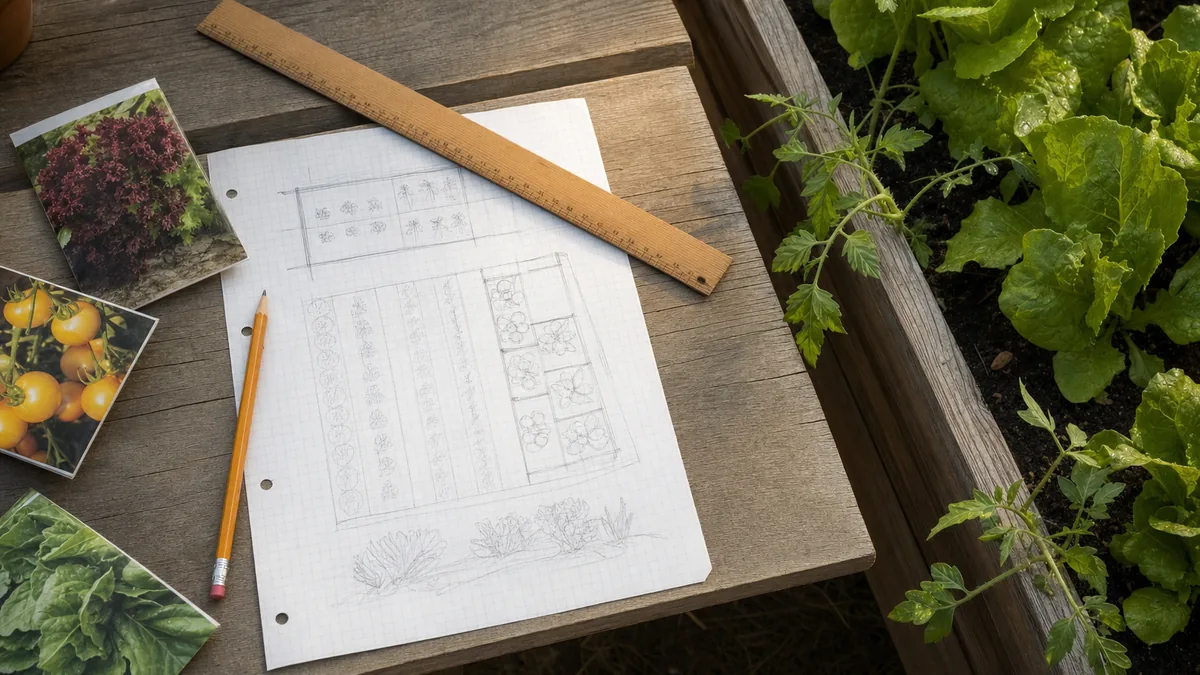
This is the whole method in order, whether you use graph paper or an app. NC State Extension suggests graph paper or a scale so you can draw the beds and plants accurately, with a north arrow and notes on the sun’s path.
- List the crops. Five to eight vegetables your household eats, with the plants needed for each.
- Size the space. 50 to 100 square feet for a first season, per Maryland, Iowa State and Colorado State.
- Check the site. At least 6 hours of sun, water close by, soil tested for nutrients, pH and lead.
- Find your frost dates. Write down the average last spring and first fall frost for your ZIP code.
- Draw the beds. Beds no wider than 4 feet, paths 18 to 24 inches or wider, long sides running north to south.
- Place the crops. Tall crops and trellises on the north side, short crops on the south, thirsty crops near the water.
- Apply the spacing. Use the table above, row by row or square by square, and count the plants.
- Set the planting dates. Cool-season crops early, warm-season after the last frost, with a second sowing for crops that finish early.
- Make the shopping list. Plants, seed packets, onion sets, compost and labels, counted from the plan.
- Keep records. Save the map and the dates so next year’s plan starts from real data.
Planting Dates, the Shopping List and Records
Dates turn the drawing into a calendar. In the sample plan, radishes, spinach and lettuce can go in as soon as the soil can be worked, and the tomato and pepper plants wait until after the last frost. Iowa State Extension says succession planting every 7 to 10 days spreads the harvest of radish, carrots, beets, lettuce and beans, and Oregon State Extension suggests short rows of lettuce at 14 day intervals. Our guide to succession planting shows how to reuse the bed once an early crop finishes. To start tomatoes yourself, growing tomatoes from seed covers the timing, and you can enter your ZIP code at the planting calendar by ZIP code to see this month’s list.
The shopping list falls out of the plan. For the sample bed it is 4 tomato plants, 4 pepper plants, seed for 20 bush beans, 16 lettuce, 64 carrots, 18 spinach, 18 beets and 32 radishes, plus 32 onion sets and enough compost and soil to fill the frame. Add a few extra seeds for thinning. Work the soil and compost quantity out from the bed’s length, width and depth rather than eyeballing it.
Finally, keep records. Iowa State Extension says a garden journal can hold planting and harvest dates, garden maps and favorite varieties, and Purdue Extension suggests mapping each year’s vegetable layout so you can rotate crops. NC State says to avoid planting related vegetables in the same place more than once every three years. If you want the layout, watering, planting dates and shopping list kept in one place, you can try the free demo of the Garden app, which plans your garden square by square, and the paper method above works the same way without it.
5 free books · 120 pages, PDFs
Vegetable Garden Planning FAQ
How do you plan a vegetable garden for beginners?
Start with a short crop list, a 50 to 100 square foot space and a sunny site, then draw beds, set spacing and write planting dates from your last frost. University of Maryland Extension calls 50 to 75 square feet a good starter size, and NC State Extension advises starting small and expanding.
How big should a first vegetable garden be?
Between 50 and 100 square feet is the usual extension range. Maryland Extension suggests 50 to 75 square feet, Iowa State Extension about 100 square feet (10 by 10 feet) or a 4 by 8 foot plot, and Colorado State Extension says 100 square feet or less per person.
How many hours of sun does a vegetable garden need?
At least 6 hours a day. Penn State Extension says most vegetables need at least 6 to 8 hours of full sun, and NC State Extension says 6 hours is the minimum with 8 to 10 hours ideal. Oklahoma State Extension notes fruiting vegetables may appreciate afternoon shade in hot summers.
How wide should vegetable garden beds and paths be?
Beds should be no wider than about 4 feet, so you can reach the middle from either side. Oklahoma State Extension gives that figure and a reach of about 2 feet from each side. UGA Extension says paths of 12 inches are the absolute minimum and 18 to 24 inches are ideal.
Which direction should vegetable garden rows run?
North to south where you can. Oklahoma State Extension says to build beds in a north/south orientation for best light, and Purdue Extension says to group tall crops at the north end so they do not shade smaller plants.
How do I plan planting dates for a vegetable garden?
Anchor them to your average last spring frost. NC State Extension says warm-season vegetables generally go in after the last frost date, and Iowa State Extension plants cool-season crops from early to mid April to early May in central Iowa. NOAA's climate.gov explains that the last freeze date varies by year.
Sources & further reading
Planning, size and crops: University of Maryland Extension, NC State Extension Gardener Handbook, Vegetable Gardening, Iowa State Extension, Colorado State PlantTalk, Penn State Extension and Oregon State Extension EC 871.
Layout and spacing: Oklahoma State Extension on raised beds, Oklahoma garden planning guide, UGA Extension on raised bed dimensions, UC Master Gardeners of Mariposa County, Purdue Extension HO-32-W, UW Extension Taylor County on square foot gardening and UF/IFAS Gardening Solutions.
Dates and records: NOAA climate.gov on the last spring freeze, NC State Extension on NOAA freeze probabilities, Illinois Extension on planting by cold hardiness, Iowa State Extension on garden journaling and Purdue Extension on garden journals.
5 free books · 120 pages, PDFs
The Garden Starter Bundle
Sent