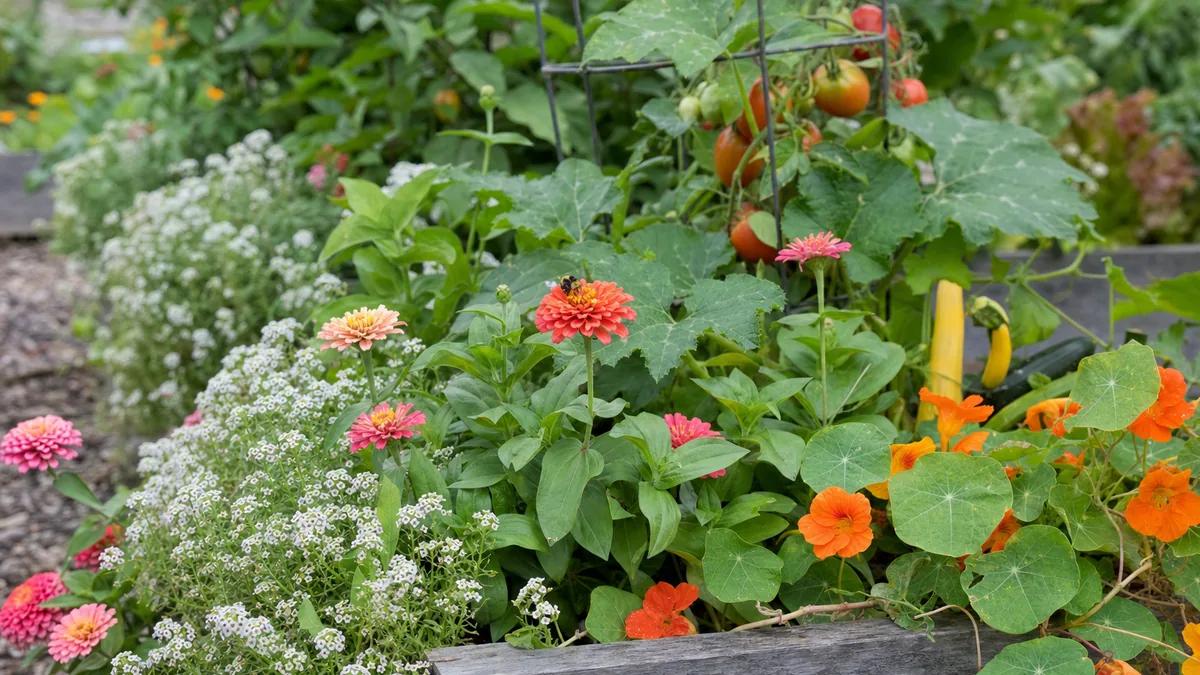
Companion planting flowers with vegetables works best as habitat, not as a repellent: flowers such as sweet alyssum, cosmos, zinnia and dill feed hoverflies, lacewings and bees right beside your crops. University of Minnesota Extension warns that online charts overstate pest-repelling claims, so start with our companion planting chart for tested pairs and our guide to planting marigold seeds for the most popular flower.
Companion Planting Flowers With Vegetables: Quick Facts
| What | Answer | Source |
|---|---|---|
| Best-supported job | Feeding hoverflies and other beneficial insects, and bringing bees to fruiting crops | University of Minnesota, University of New Hampshire, NDSU |
| Most hoverflies in a New Hampshire trial | Alyssum, buckwheat, cilantro and dill | University of New Hampshire Extension |
| Weakest claim | Marigolds repelling flea beetles or Colorado potato beetles | University of Minnesota Extension |
| Crops that need bees to set fruit | Cucumber, melon, pumpkin and squash | NDSU Extension |
| Alyssum sowing | Several weeks before the last spring frost | Clemson HGIC, NC State Extension |
| Zinnia sowing | After the last frost, 1/4 inch deep, blooms 8 to 12 weeks later | Clemson HGIC |
| How much space for flowers | 1 to 5% of the area in farm guidance; no home-garden figure found | University of Arizona Cooperative Extension |
Does Companion Planting With Flowers Work?
Partly, and the part that works is the one people talk about least. University of Minnesota Extension says companion plants can help by providing habitat and food for predators and parasitoids, and that adult syrphid (hover) flies are attracted to a wide variety of flowers while their larvae eat aphids. It also says that charts online are not always accurate or backed by research. If you are still planning the garden itself, our guide to starting a vegetable garden covers the basics.
The repellent claims are shakier. Minnesota reports that multiple studies found marigolds did not deter Colorado potato beetles, and that for flea beetles there is little research behind marigolds and some of it contradicts the claim. Where marigolds do have support, it is narrower: a few studies found basil and marigolds reduced thrips in tomatoes, and in an Iowa study nasturtium and marigolds both reduced squash bug and cucumber beetle damage. University of Illinois Extension adds that much of the recommended companion advice has not been tested in a research study, but that there is no harm in trying, since a flower that fails as a pest fix still gives you flowers.
So treat flowers as a way to build a more varied garden and bring in the insects that do the work, and do not count on them to replace scouting. If you find damage and are unsure of the cause, our guide to why there are holes in plant leaves can help you identify it. The University of New Hampshire trial below shows why the distinction matters.
Best Flowers to Plant With Vegetables
Flowers that bring in hoverflies and other beneficial insects
University of New Hampshire Extension ran a two-year trial (2017 and 2018) of insectary plants as part of the Brassica Pest Collaborative. Alyssum, buckwheat, cilantro and dill attracted more hoverflies throughout the season than calendula, phacelia and fennel. Alyssum was low maintenance and flowered continuously, and it drew the hoverfly Toxomerus marginatus from July until frost. The same report cautions that more work is needed to show whether hoverflies on these plants meaningfully control aphids or other pests.
Other flowers have extension backing for beneficial insects too. Utah State Extension says cosmos attracts lacewings, tachinid flies, hoverflies and parasitic miniwasps, which prey on destructive insects. University of Vermont Extension says the same of cosmos and adds that zinnias attract predatory insects. Illinois Extension recommends a sweet alyssum border around the garden and cites an Iowa State figure that some adult ladybugs can eat as many as 50 aphids a day.
Flowers that bring in bees and other pollinators
NDSU Extension suggests cosmos, marigolds, sunflowers and zinnias as easy annuals, with borage, chives, basil and bee balm among the herbs, and says to plant flowers in clusters, which are more visible to foraging bees. Illinois Extension points to open-face blooms (zinnia, sunflower, cosmos) as a landing pad and to tubular ones such as salvia and nasturtium for long-tongued pollinators. Oregon State Extension lists calendula, zinnia, borage and lavender as plants that attract bees or many pollinators.
Flowers with some pest-control research
Nasturtium has the better record. Minnesota says research supports nasturtium with squash, where it can reduce squash bug populations, and with thyme and onion it reduced cabbage looper and imported cabbageworm damage in broccoli in an Iowa study. A Florida study cited by Minnesota found that African marigolds and sweet alyssum planted with squash increased the natural enemies of aphids, with a slightly positive impact on yield. University of Maryland Extension says African and French marigolds deter soil-dwelling nematodes, a claim that University of Vermont Extension calls unproven for French marigolds. For growing the flower itself, see our guide to growing marigolds.
Companion Vegetables and Flowers, Pair by Pair
Here is what the sources support for each crop. These are flower companions for vegetables where an extension source names the pairing, not folklore.
Squash, cucumbers and pumpkins
This is the strongest case, because these crops need visitors. NDSU Extension lists cucumber, melon, pumpkin and squash as crops that need bee pollination to fruit, notes that fruit-bearing flowers are generally receptive for only one day, and says many need multiple bee visits that day. Illinois Extension explains why: cucurbits have separate male and female flowers. Add the pest research (nasturtium and marigolds with squash in Iowa, alyssum and African marigold in Florida) and these crops justify a flower edge. Spacing and pollination detail for each crop is in our guides to growing squash and growing cucumbers from seed. Oregon State Extension also lists borage as helping cucumbers and melons.
Tomatoes, peppers and eggplant
NDSU says tomato, pepper and eggplant do not require bee pollination, though bee wing vibrations on their flowers can still increase yields. The pest case is thinner. University of Maryland Extension shows marigolds at the ends of tomato rows as a source of nectar and pollen for beneficial insects, and Oregon State lists sunflower as enhancing corn and tomatoes. University of Vermont Extension warns that tall zinnias and cosmos can shade crops, so choose varieties that will not block needed sunlight. Herb partners are covered in what to plant with tomatoes.
Broccoli, cabbage and other brassicas
Minnesota cites the Iowa result for nasturtium with thyme and onion, and the New Hampshire trial was run on brassicas. Oregon State lists dill as enhancing cole crops and agastache and hyssop as distracting cabbage loopers. Remember the caution from the New Hampshire report: alyssum hosted flea beetles and calendula hosted imported cabbageworm, both brassica pests.
Beans and peas
Oregon State lists nasturtium as enhancing peas, beans, cucumbers and melons, and cilantro as enhancing spinach, peas and beans. Beans do not depend on bees, so the value here is mostly a more varied bed. Our guide to growing beans from seed covers spacing for the crop itself.
Flowering Herbs: Dill, Cilantro and Fennel
Some of the best insectary flowers are herbs you let bolt. University of Maryland Extension says herbs allowed to flower, especially in the mint and carrot families (cilantro, basil, dill), draw pollinators, and Illinois Extension says dill, parsley and carrot foliage feed caterpillars and, if allowed to bloom, give adult insects pollen and nectar. Cilantro and dill were among the plants that drew the most hoverflies in the New Hampshire trial, which is a good reason to stop cutting a few plants. Our cilantro growing guide covers when it bolts and how to sow in succession so some plants are always in flower.
Fennel is the exception. It drew fewer hoverflies than alyssum, buckwheat, cilantro and dill in the New Hampshire trial, and the report notes it did not flower in 2017. Oregon State lists dill as helping lettuce, onion, garlic, cole crops, cucumbers and melons, and lavender as attracting many pollinators and enhancing tomatoes and squash. If you want a perennial flowering edge, see our lavender planting and care guide.
How Many Flowers to Plant, and How Far Apart
There is no tested home-garden ratio. The nearest figure we found is for farms: University of Arizona Cooperative Extension gives a guideline of 1 to 5% of total field area for insectary plantings, set in rows between crops or along borders. Illinois Extension adds that you may need many more of a companion plant than you expect for the effect to last, without giving a number. Because no home-garden number exists, here is a practical way to size it: give flowers a border or a strip, then fill every gap, and judge by how many insects visit.
For the plants themselves, extension sources give spacing, which is the part you can calculate:
| Flower | Spacing | Source |
|---|---|---|
| Sweet alyssum | Spreads 6 inches to 1 foot (NC State) or 12 inches or more (Clemson) | NC State Extension, Clemson HGIC |
| Zinnia | 8 to 9 inches for dwarf types, about 1 foot for 2 to 3 foot types | Clemson HGIC |
| Cosmos | 1 to 2 feet | Utah State Extension |
| Nasturtium | Thin to 8 to 12 inches | Nebraska Extension |
| Calendula | 10 to 12 inches in the row | K-State Research and Extension |
| Borage | 12 inches between plants, 18 between rows | University of Maryland Extension |
| Sunflower | 6 inches for smaller types, 12 for taller ones | WVU Extension |
As arithmetic, a 4 by 8 foot bed with sweet alyssum along both 8 foot sides at 12 inch spacing holds 8 plants per side, or 16 plants. Marigolds or a row of zinnias at the end of the bed add a handful more.
When to Plant Flowers Among Vegetables
The aim is to have flowers open at the same time as your crops. Work through it in this order:
- Check bloom times. Oklahoma State Extension suggests checking seed packets to confirm that bloom times overlap with the vegetables.
- Sow cool-season flowers early. University of Vermont Extension says sweet peas, pansies and other cool-season flowers go in early spring to attract early pollinators.
- Sow warm-season flowers after frost. Vermont says zinnias, cosmos, marigolds, calendulas and nasturtiums are sown directly after the last frost danger has passed. For the soil side of timing, see our guide to soil temperature for planting.
| Flower | Timing | Source |
|---|---|---|
| Sweet alyssum | Sow outdoors several weeks before the last frost, or start indoors 6 to 8 weeks ahead (Clemson) or 5 to 6 weeks ahead (NC State). Seed-grown plants flower in 6 to 8 weeks | Clemson HGIC, NC State Extension |
| Zinnia | After the last frost, soil and air near 70°F, 1/4 inch deep. Blooms 8 to 12 weeks after planting | Clemson HGIC |
| Cosmos | After frost danger and once the soil reaches 65°F, 1/8 inch deep. Germinates in 7 to 14 days | Utah State Extension |
| Nasturtium | After the last frost in warm soil, covered with 1/2 to 1 inch of soil | Nebraska Extension |
| Calendula | Direct sow after the last frost (Vermont). Seed sprouts in 1 to 2 weeks and flowers run from early summer until a killing frost (K-State) | University of Vermont Extension, K-State Research and Extension |
| Borage | Direct sow; sow three times at 4 week intervals to extend the harvest | University of Maryland Extension |
| Sunflower | After the last frost, 1 to 2 inches deep; replant every 2 to 3 weeks for continuous bloom | WVU Extension |
Sweet alyssum has one timing quirk. Clemson says seed-grown plants may stop flowering as summer temperatures rise, and recommends sowing in September for fall-into-winter flowers where that fits, and NC State says an August sowing gives fall bloom. For a steady supply, sow in waves, as in our guide to succession planting. Your frost dates by location set the starting line for all of these.
Companion Flower Planting: Where the Flowers Go
Oklahoma State Extension advises planting ornamentals in the same bed as the vegetables rather than in separate areas, and NDSU says you can grow flowers in a nearby plot or mix them among the vegetables. Arizona’s guidance puts insectary plants in rows between crops or along borders. In a home garden that gives three simple layouts:
- A low border. Sweet alyssum or nasturtium along the bed edge, as Illinois Extension suggests for alyssum.
- Clusters between crops. NDSU says clusters are more visible to foraging bees than single plants.
- Tall flowers where they will not shade crops. University of Vermont Extension warns that tall zinnias and cosmos can shade crops, so choose varieties that will not block needed sunlight.
Whole-bed plans, including the Three Sisters mound and raised-bed grids, are in our companion planting garden layout guide, and the spacing and planting hub collects the rest of our spacing guides. If you are still deciding where the vegetable beds and paths go before adding flowers, how to plan a vegetable garden walks through that first.
When Flowers Cause Problems
- They can host pests. The New Hampshire report found flea beetles on alyssum and imported cabbageworm on calendula. University of Vermont Extension advises asking, before you choose a trap crop, whether it might attract a pest you have not had before.
- Nasturtium draws aphids. Vermont says nasturtium attracts aphids and should be planted away from aphid-prone crops such as cabbage and green beans.
- Some spread. Vermont says borage and mint grow aggressively, so plant them in pots or where there is room. Oregon State warns that rosemary has a big root system and can compete with neighbors.
- Insecticides undo the work. NDSU says most insecticides kill bees and that over 90% of the insects in a garden are beneficial or neutral. If you must spray, it says to spray in the evening and avoid open blooms.
Companion Planting for Flowers Themselves
Do flower beds need companions? We did not find extension research on companion planting for ornamental flowers, only on flowers placed in vegetable gardens, so we will not claim rose or dahlia pairings. NC State Extension does describe sweet alyssum as mat-forming and useful as a filler between taller plants, and says it attracts pollinators and predatory insects, so it is a safe low edge in a flower bed too. Gardeners who want cut blooms from the same beds can see our guide to drying flowers. University of Vermont Extension says to harvest some blooms and leave the rest for pollinators, and to deadhead annuals for more flowers.
Free book · 23 pages, PDF
Companion Planting Flowers FAQ
What flowers are best to plant with vegetables?
Sweet alyssum, cosmos, zinnia, sunflower, nasturtium and borage have the most extension support. In a University of New Hampshire trial, alyssum, buckwheat, cilantro and dill drew more hoverflies than calendula, phacelia and fennel, and NDSU Extension suggests cosmos, marigolds, sunflowers and zinnias for bees.
Does companion planting flowers and vegetables really work?
Partly. University of Minnesota Extension says flowers provide habitat and food for predators and parasitoids, and an Iowa study found nasturtium and marigolds reduced squash bug and cucumber beetle damage. It also says online charts are not always backed by research, and Illinois Extension notes much of the advice is untested.
What flowers should I plant with squash and cucumbers?
Nasturtium and marigolds reduced squash bug and cucumber beetle damage in an Iowa study cited by University of Minnesota Extension, and African marigolds and sweet alyssum increased natural enemies of aphids on squash in a Florida study. Oregon State Extension also lists borage for cucumbers and melons.
How many flowers should I plant in a vegetable garden?
No tested home-garden figure exists in the extension sources we read. University of Arizona Cooperative Extension gives 1 to 5% of total field area for insectary plants on farms, and Illinois Extension says you may need many more companion plants than expected for a lasting effect. Use each flower's spacing to fill a border or strip.
When should I plant flowers in my vegetable garden?
Sweet alyssum goes in several weeks before the last frost, according to Clemson HGIC and NC State Extension. Zinnias, cosmos, marigolds, calendulas and nasturtiums are sown after the last frost, says University of Vermont Extension. Cosmos wants soil at 65 degrees F, according to Utah State Extension.
Do marigolds really keep bugs away from vegetables?
Not reliably. University of Minnesota Extension says multiple studies found marigolds did not deter Colorado potato beetles, and there is little research behind the flea beetle claim. Some studies found basil and marigolds reduced thrips in tomatoes, and marigolds with nasturtium reduced squash bug and cucumber beetle damage in Iowa.
Can flowers attract pests to my vegetables?
Yes. The University of New Hampshire report found flea beetles on alyssum and imported cabbageworm on calendula, and University of Vermont Extension says nasturtium attracts aphids and should be kept away from cabbage and green beans.
Sources & further reading
Evidence on what flowers do for vegetables comes from University of Minnesota Extension’s companion planting guide, University of New Hampshire Extension’s insectary plant report (with the full report), University of Illinois Extension on how well tested companion planting is and its posts on marigolds and sweet alyssum and flowers for the vegetable garden. Pairings and herb notes are from University of Maryland Extension, Oregon State University Extension’s herbs and flowers list and University of Vermont Extension’s biodiverse vegetable garden article. Pollination and layout advice is from NDSU Extension on attracting bees, Oklahoma State Extension on pollinators in the vegetable garden and University of Arizona Cooperative Extension on farmscaping. Planting details come from Clemson HGIC on sweet alyssum, Clemson HGIC on zinnias, NC State Extension Plant Toolbox on sweet alyssum, Utah State Extension on cosmos, Nebraska Extension on nasturtium, K-State Research and Extension on calendula, University of Maryland Extension on borage and WVU Extension on sunflowers. For how we source the facts on this site, see our methodology page.
Free book · 23 pages, PDF
The Companion Planting Chart
Sent