Lavender how to comes down to three things: plenty of sun, soil that drains fast, and a light hand with water and fertilizer. University of Florida extension says to give it at least 6 to 8 hours of sun, and Utah State extension spaces plants 18 to 24 inches apart. Check what your hardiness zone means first, because the type you can grow depends on it.
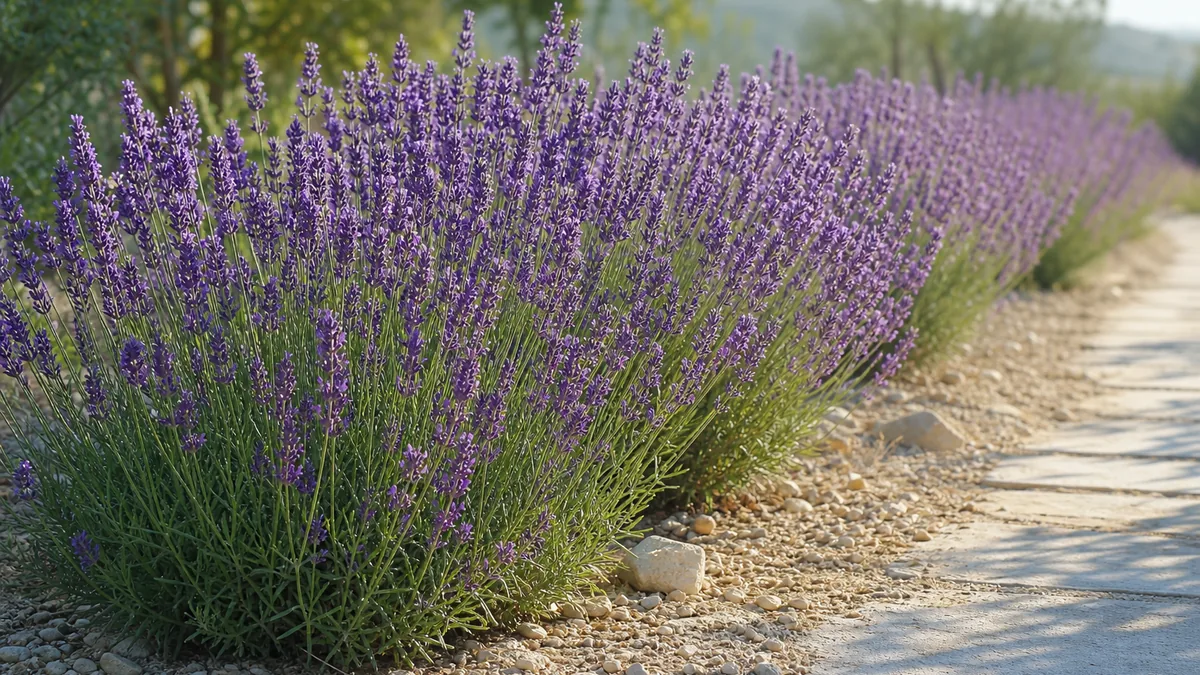
Lavender at a Glance
Lavender is a Mediterranean shrub, so extension sources say to copy its dry, sunny, lean home conditions. The table gathers the key numbers, with ranges where sources differ.
| Need | What extension sources say |
|---|---|
| Sun | Full sun; 6 to 8 hours or more (UF/IFAS Pasco County, Illinois Extension) |
| Soil | Well-drained, gravelly or sandy; pH 6.5 to 7.5 (Utah State) or 6 to 8 (Washington State) |
| Spacing | 18 to 24 inches (Utah State) up to 24 to 36 inches (UF/IFAS) |
| Mature size of English lavender | About 1 to 2 feet tall and wide (Utah State); 1 to 3 feet tall, 2 to 3 feet wide (UF/IFAS) |
| Planting time | Spring after the last frost, or early fall where winters are mild |
| Pruning | After flowering, remove one third to one half (Illinois Extension) |
| Lifespan | 10 to 15 years with proper care (Utah State) |
Hardiness matters as much as anything in the table. Illinois Extension says English lavender overwinters in USDA zones 5 to 8, while UF/IFAS lists Spanish and French types for zones 8 to 11. Look up your own number in the growing zones directory.
How Much Sun Does Lavender Need?
Illinois Extension puts it at full sun, about 8 hours a day. UF/IFAS Pasco County asks for at least 6 to 8 hours, and a UC Master Gardener program in El Dorado County gives 6 hours or more as the floor. In practice, pick the sunniest, most open spot you have.
There is one exception. In the heat of Central Florida, UF/IFAS Pasco County says afternoon shade helps prevent stress. If your summers are very hot and humid, morning sun with a little late shade can beat all-day exposure.
Best Place and Soil for Lavender
Where lavender grows best is any spot with sun, air movement and water that leaves quickly. Washington State University Extension calls drainage the most critical soil factor and says lavender does not tolerate clay, hardpan or saturated ground, especially from late fall to early spring. The Shasta College Master Gardener program names poor drainage as the main cause of plant death, and Utah State agrees that wet, heavy soil makes winter injury more likely.
Soil pH for lavender
Utah State recommends a pH of 6.5 to 7.5, while Washington State gives a wider 6 to 8, and UF/IFAS stresses that lavender is sensitive to pH and should stay above 6. So the sources agree on a neutral to slightly alkaline target. A basic soil test tells you where you stand; our guide on how to read soil test results explains the pH line, and the El Dorado program notes that lime raises pH and sulfur lowers it.
How to fix poor drainage
The El Dorado program offers a simple test: dig a 1-foot hole, fill it with water, let it drain, fill it again and time the second draining. It calls anything slower than 2 inches per hour poor drainage. If yours fails, Washington State suggests mounds, berms or raised beds. A raised bed is the easiest fix, and our guide to filling a raised garden bed covers the layers. Utah State also says to work in about 1 inch of coarse compost to a depth of 4 to 8 inches before planting, and a Mississippi State specialist suggests grit, pea gravel or oyster shells to keep soil gravelly and alkaline.
Best Time to Plant Lavender
The best time to plant lavender depends on how hard your winters are. Utah State says to transplant after the last spring frost and notes that fall planting only works if you have about 2 months of good weather for roots to settle before winter. Washington State says fall is generally best, but only where winters are not severe, since plants root in before summer heat. In harsh-winter areas it points to spring planting with reliable watering from day one. The El Dorado program lists spring and fall as the two good windows.
So the rule is: spring in cold climates, early fall in mild ones, and never into frozen or soggy ground. Find your average frost dates with the calculator below, and see why published dates sometimes disagree in our comparison of Farmers’ Almanac and NOAA frost dates. The planting calendar pages list timing by month for your area.
How to Plant Lavender in the Ground
Buy nursery plants rather than starting from seed. The Shasta College Master Gardener program advises buying plants and checking the botanical name, since seed germinates poorly and cuttings are the better route. Utah State agrees on cuttings, which it says root in 30 to 40 days at about 70°F. Lavandin hybrids cannot be grown from seed at all, according to Washington State.
- Pick the site and test the drain. Full sun, open air, and water that clears in an hour or two. Raise or mound the bed if it does not.
- Loosen a wide hole. The El Dorado program suggests a hole about three times the width of the root area, with coarse compost blended in rather than rich topsoil.
- Set the crown high. Washington State says to plant at or slightly above the surrounding soil level, because planting too deep reduces survival. The El Dorado program keeps the crown at least 1 inch above the soil line.
- Backfill and water in. Utah State gives about 1 gallon per plant per week for new transplants.
- Mulch with something dry. The El Dorado program suggests 2 to 3 inches of pea gravel, decomposed granite or sand, with about 6 inches of bare soil left around the stems. The Shasta program advises against bark or wood chips, which hold too much moisture.
- Hold back the flowers the first year. Washington State recommends removing flower stalks for the first year after transplanting so the plant builds roots and branches.
How Big Does Lavender Get, and How Far Apart to Plant It
Size depends on the type. Utah State says English lavender grows about 1 to 2 feet tall and wide and takes about 3 years to reach full size. UF/IFAS gives 1 to 3 feet tall and 2 to 3 feet wide for Lavandula angustifolia. The El Dorado program lists lavandins up to 3 feet, Spanish lavender at 18 inches to 3 feet, and French lavender (L. dentata) at 3 to 4 feet tall and 4 to 6 feet wide. Washington State notes that a mature ‘Grosso’ lavandin can span 5 feet or more, even with hard pruning.
Spacing follows size. Utah State says 18 to 24 inches apart, UF/IFAS says 24 to 36 inches, and a New Mexico State University trial of English and lavandin types used 36 inches in both directions. For a hedge, start at the tight end for compact English cultivars and widen it for big lavandins. Washington State adds that in a humid climate you should increase spacing so air can move between plants, and that smaller English varieties such as ‘Munstead’ can go closer together.
As simple arithmetic from those sourced figures, a 12-foot border holds about 6 plants at 24 inches (144 inches divided by 24) or 8 at 18 inches. The plant spacing pages show how this works for other plants, and our spacing and planting hub collects the rest of the series.
Planting a lavender field
If you are scaling up, the commercial numbers are bigger. Washington State says machine-harvested fields use rows 4.5 to 6 feet apart with plants 1.5 to 3 feet apart in the row. Hand-harvested lavandins use rows 5 to 7 feet apart with plants 30 to 42 inches apart, and 6 feet by 36 inches is the most common layout. The first question is winter hardiness, since the bulletin says English lavender is generally grown in zone 5 and above.
How to Care for Lavender in Pots
A pot can solve the drainage problem outright. A Mississippi State horticulturist credits the “superb drainage” of containers for lavender’s good showing in pots where it struggles in the landscape, and Illinois Extension suggests containers or raised beds filled with a potting mix without added fertilizer when your ground drains poorly. A second Mississippi State specialist recommends a fast-draining mix with pea gravel.
- Drainage holes are non-negotiable. Mississippi State says the container must drain freely.
- Plan for size. UF/IFAS says a small potted plant can grow into a shrub about 3 feet across, depending on the variety, so pick a roomy pot. Our guide to plant pot sizes explains the numbers.
- Water more often than ground plants. UF/IFAS says potted and raised-bed plants need more frequent watering in summer. Let the mix dry out between drinks.
- Protect the roots in winter. The extension sources reviewed give no cold limit for potted plants, so check your zone and move a pot to a sheltered spot if winters are harsh.
Watering and Fertilizing Lavender
How much to water
New plants need steady moisture; established ones need very little. Utah State gives about 1 gallon per plant per week for new transplants, then roughly half a gallon every 2 weeks once established and before flower buds form, rising to 1 or 2 times per week from flowering to harvest. Illinois Extension simplifies it: water regularly the first year, then only when the soil dries, since lavender tolerates drought.
How you water matters more than how much. Washington State prefers drip irrigation to overhead sprinklers because it reduces fungal disease and keeps stems from falling open, and the El Dorado program says overwatering causes root and crown rot. The same dry-between-drinks habit that suits cactus applies, so our succulent watering guide will feel familiar. If a plant yellows and sags despite wet soil, read our root rot guide.
Best fertilizer for lavender
The honest answer is very little. Utah State says compost at planting usually covers the first year, and a single slow-release application of about 1 tablespoon per plant covers a growing season. Illinois Extension says added fertilizer is unnecessary and can mean more leaves but fewer blooms. The El Dorado program says mature plants need none, and UF/IFAS warns that too much fertilizer makes plants leggy and cuts fragrance. One outlier is Mississippi State, which suggests a slow-release product roughly twice a year for Spanish lavender in the South, so the sources range from none to twice a year. Start with less, and read common fertilizing mistakes before you feed.
Pruning and Fall Care for Lavender
Prune every year, but never into bare wood. Illinois Extension says to remove one third to one half of the plant after flowering, which may encourage a second bloom, and to cut dead stems back to the first set of green leaves in spring. Utah State says to shear back by about half. The El Dorado program starts pruning in the second year and, in fall, takes one third to one half of the green growth while leaving at least two nodes above the woody stems.
Timing varies by climate. UF/IFAS Pasco County prunes in spring after new leaves appear and takes no more than one third at a time, while Washington State prunes in early fall before hard frosts where winters are harsh. Every source warns not to cut into old, leafless wood, because it may not resprout. Spanish and French types, per the El Dorado program, need gentler trimming after the first flush rather than a hard cut.
How to care for lavender in the fall
Cut spent stems, clear leaves from the crown, and keep the base dry. UF/IFAS says to protect the crowns with several inches of mulch over winter, and Utah State notes that heavy mulch helps fall-planted lavender survive. Pick a dry, airy material, and compare options in our guide to organic vs inorganic mulch. Utah State adds that the cultivar ‘Lady’ can survive zone 4 winters if mulched or planted on a south-facing site. If you cut stems to keep, see how to dry flowers for hanging and desiccant methods.
English vs Spanish vs French Lavender
Four groups cover most garden plants. Washington State says English lavender (L. angustifolia) is the shortest and hardiest of the common commercial species, and lavandin (L. x intermedia) is a sterile hybrid with larger flower heads and much longer stems. Spanish lavender (L. stoechas) and French lavender (L. dentata) are more tender.
| Type | Hardiness | Size | Notes |
|---|---|---|---|
| English | Zones 5 to 8 (Illinois Extension) | Most stay under 2 feet (El Dorado program) | Hardiest; widest color range; best choice for cold climates |
| Lavandin | Mostly grown in zone 5 and up (Washington State) | Up to 3 feet (El Dorado program) | Propagated by cuttings, not seed; includes ‘Grosso’ and ‘Provence’ |
| Spanish | Zones 8 to 11 (UF/IFAS) | 18 inches to 3 feet (El Dorado program) | Early bloomer; least hardy group; best in hot, humid South |
| French | Zones 8 to 11 (UF/IFAS) | 3 to 4 feet tall, 4 to 6 feet wide (El Dorado program) | Toothed, fringed leaves; needs gentle pruning |
For an English variety, Utah State recommends ‘Munstead’ and ‘Hidcote’. The El Dorado program says Spanish lavender should not be eaten, so check the type before cooking with any plant.
How to Grow Lavender in Florida and Humid Climates
Humidity, not cold, is the main limit in the Southeast. UF/IFAS Pasco County calls English lavender the most difficult to grow in Central Florida because of summer heat and humidity, and rates Spanish lavender best for the region. It also lists ‘Phenomenal’, a lavandin, as doing well in humid places. A UF/IFAS Escambia County newsletter says local conditions quickly killed its English lavender and suggests Spanish selections or ‘Phenomenal’ on the Gulf Coast. Mississippi State likewise recommends Spanish lavender for its state.
The fixes are the same as everywhere, applied more strictly. UF/IFAS advises raised beds or containers to improve drainage and help prevent root rot, watering in the early morning, skipping overhead irrigation to limit leaf spot, and giving plants room to avoid crowding. It also lists aphids and spider mites as the main pests. Washington State adds that humid growers should widen spacing and keep air moving. Have the soil tested first; UF/IFAS Extension offers low-cost testing in Florida.
Free book · 23 pages, PDF
Lavender How To FAQ
How much sun does lavender need?
Full sun. Illinois Extension says about 8 hours a day, UF/IFAS Pasco County says at least 6 to 8 hours, and the El Dorado County Master Gardener program says 6 or more. In very hot Florida summers, UF/IFAS says afternoon shade can reduce stress.
What is the best time to plant lavender?
Spring after the last frost in cold climates, according to Utah State Extension. Fall works where winters are mild, and Utah State says it needs about 2 months of good weather for roots to establish. Washington State Extension says fall is generally best, but only where winters are not severe.
How far apart should you plant lavender?
Utah State says 18 to 24 inches for English lavender, and UF/IFAS says 24 to 36 inches. Washington State says to increase spacing in humid climates and notes that compact types such as 'Munstead' can go closer together.
How big does a lavender plant get?
English lavender is about 1 to 2 feet tall and wide by Utah State, or 1 to 3 feet tall and 2 to 3 feet wide by UF/IFAS. The El Dorado program says French lavender can reach 3 to 4 feet tall and 4 to 6 feet wide, and Washington State says a mature 'Grosso' can span 5 feet or more.
How do you care for lavender plants in pots?
Use a container with drainage holes and a fast-draining mix. Mississippi State credits container drainage for lavender's success in pots, and UF/IFAS says potted plants need more frequent summer watering than ground plants. Let the mix dry out between waterings.
What is the best fertilizer for lavender?
Often none. Utah State says compost at planting usually covers the first year, with one slow-release application of about 1 tablespoon per plant covering a season. Illinois Extension says extra fertilizer can mean more leaves and fewer flowers.
Can you grow lavender in Florida?
Yes, with the right type. UF/IFAS Pasco County says Spanish lavender is best for Central Florida and English is the hardest. It recommends raised beds or containers, early morning watering and no overhead irrigation to reduce root rot and leaf spot.
Sources & further reading
Spacing, size, watering, fertilizer and pH figures come from Utah State University Extension’s English Lavender in the Garden and University of Illinois Extension’s lavender tips. Species differences, field spacing, drainage and planting depth are from Washington State University Extension’s Growing and Marketing Lavender (EB2005). Florida and humid-climate notes are from UF/IFAS Extension Pasco County’s beginner guide to growing lavender, UF/IFAS publication FP337 and the UF/IFAS Escambia County July 2025 newsletter. Container advice and Mississippi recommendations come from Mississippi State University Extension’s Lavender column and its container design article. The plot-trial spacing is from New Mexico State University’s lavender research report. The drainage test, mulch and pruning schedule come from the UCCE Master Gardeners of El Dorado County’s All About Lavender, and buying and mulch advice from the Shasta College Master Gardener program. For how we source the facts on this site, see our methodology page.
Free book · 23 pages, PDF
The Tree Care Cheat Sheet
Sent