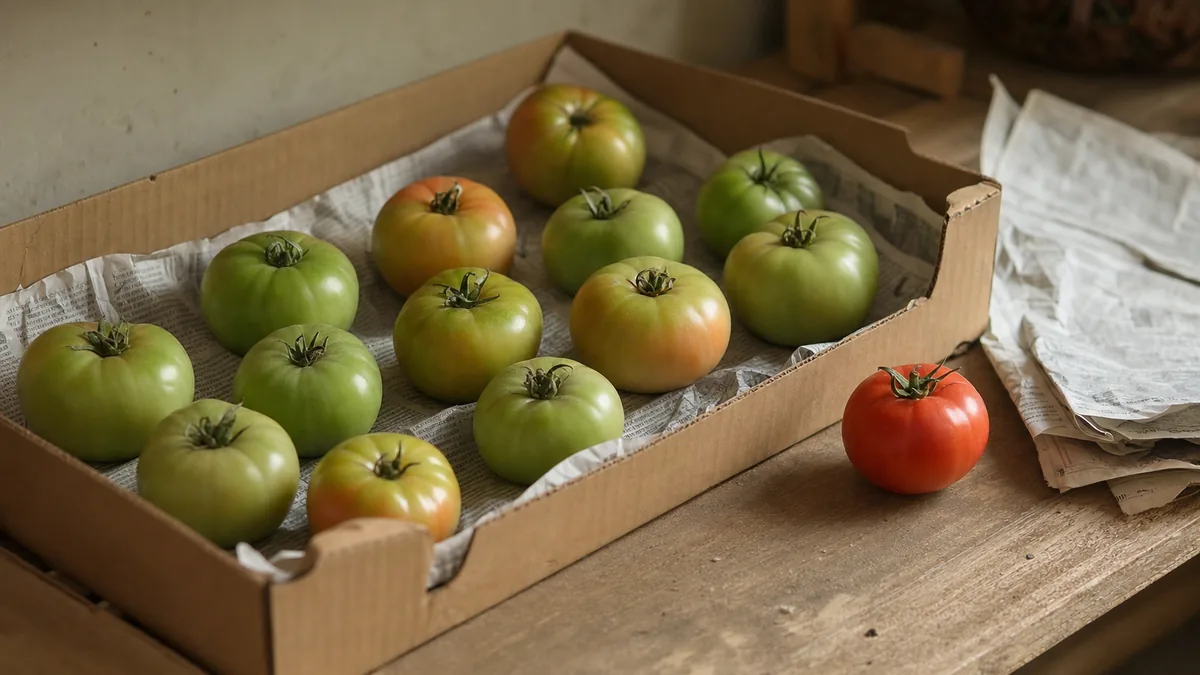
To ripen green tomatoes, pick the mature green ones (full size, glossy, pale green to whitish) before the first frost, remove the stems, and keep them in a single layer at about 65 to 70°F, out of direct sun. Clemson and Colorado State extension both say mature green fruit colors up in about 14 days at those temperatures. Small, matte green fruit will not ripen.
Ripening Green Tomatoes: Quick Facts
| What | Answer | Source |
|---|---|---|
| Which fruit ripens | Mature green or later. Immature green fruit never ripens. | Purdue, Colorado State |
| When to pick | Just before the first frost, or when frost is forecast | Iowa State, Clemson, Oklahoma State |
| Ripening temperature | 65 to 70°F is the common figure (range in guides: 55 to 77°F) | Iowa State, Clemson, UC Davis, Purdue |
| Time to color | About 2 weeks at 65 to 70°F, 25 to 28 days at 55°F | Clemson |
| Too cold | Below 50°F harms unripe fruit and stops red color | Clemson, Oklahoma State, Colorado State |
| Too hot | Red pigment is not made above 85°F | Purdue, Colorado State |
| Light | Not needed. Keep out of direct sun. | New Mexico State, Iowa State |
Which Green Tomatoes Will Ripen Off the Vine
Not every green tomato can turn red. New Mexico State University Extension explains that tomatoes keep ripening after harvest as long as they are mature, and it defines mature fruit by its seeds: they are fully developed and viable. Since you cannot see seeds from the outside, extension guides give outward clues instead.
| Stage | How it looks | Will it ripen? |
|---|---|---|
| Immature green | Matte green, often smaller (Colorado State) | No. Purdue says to compost it; Colorado State says to cook with it. |
| Mature green | Full size, glossy, light green to whitish; Colorado State adds a pale star shape at the blossom end | Yes, but Colorado State says flavor will not fully develop |
| Breaker or blush | A first pink or red tinge at the blossom end | Yes. Colorado State says it ripens without any loss of flavor. |
Iowa State University Extension describes mature green fruit as having a glossy, whitish green color and mature size, and Clemson Extension says full-sized and light green to whitish. Purdue Extension suggests looking for a shift to a lighter green, and says a slight blush is better. Colorado State’s PlantTalk adds a practical limit: by September in Colorado, newly set, small, very green fruit generally will not mature, and it is best pruned off.
When to Pick Green Tomatoes Before Frost
The decision rule is the same across extension guides. Iowa State says to pick fruit just before the first frost, Clemson says the same, and Oklahoma State University Extension says that when local forecasts indicate frost, gardeners will need to harvest their green tomatoes. Whether the fruit has time to ripen on the plant depends on when the first heavy frost arrives. To find your own date, look up your area on our frost dates by city pages.
| Situation | What the extension guides suggest |
|---|---|
| Frost is forecast in the next day or two | Pick mature green, blushing and ripe fruit and bring it in (Iowa State, Oklahoma State, Clemson) |
| Fruit is nearly red | Covering the plants works well (Colorado State PlantTalk) |
| Fruit is mature green | Covers work less well, so harvest rather than gamble (Colorado State PlantTalk) |
| Only a few weeks of season left | Removing some mature green fruit may help the rest ripen (Colorado State PlantTalk) |
| Fruit is small and matte green | Do not expect it to ripen; use it for green tomato recipes (Colorado State, Purdue) |
Colorado State’s Eagle County extension agent found that fruit left under frost blankets in October stalled: it was not progressing, but it was not dying either. She calls that a stall, not a ripening method, and she brought the fruit in once temperatures stayed below freezing. She recommends harvesting at the light blush stage and finishing indoors, and Oklahoma State adds that picking early reduces cracking and losses to birds and worms. Even watering through the season also helps prevent split fruit, as our guide to how often to water tomatoes explains.
The frost temperature guide linked at the top of this page explains how to read a frost forecast. We found one number for how cold the fruit itself can get. The UC Davis Postharvest Technology Center, on a page last updated in 1997, says freezing injury to tomatoes begins around 30°F, depending on sugar content. Treat that as a rough guide and not a promise, since a frost forecast can mean a lower reading in your low spots.
How to Ripen Green Tomatoes Indoors, Step by Step
- Choose sound fruit. Iowa State says to use fruit from strong, healthy vines and to skip fruit with disease, insect or mechanical damage. Iowa State’s yard and garden team asks for fruit that is solid, firm and free of defects.
- Clip the stems short. Colorado State PlantTalk says to leave a very short piece of stem, because tearing the stem out opens the fruit to decay. Iowa State adds that stems can puncture neighboring fruit.
- Clean and dry them. Iowa State says to wash dirty fruit gently and let it air dry. Colorado State says to dry them on a clean paper towel out of direct sunlight.
- Sort by stage. Colorado State PlantTalk groups fruit as mature green, pink, light red and fully red, so each group ripens on a similar schedule and you can find the ones to eat first.
- Pack them loosely. Iowa State says one to two layers deep in a box or in a plastic bag with a few holes for air. Oklahoma State says a single layer in a cardboard box with 2 to 3 inches between fruit, which reduces the spread of rot. Iowa State’s yard and garden team and Oklahoma State both suggest wrapping firm green fruit individually in newspaper.
- Put the box somewhere warm enough and dark. See the temperature section below. Light is not required: New Mexico State says tomatoes do not even need light to ripen.
- Check every few days. Colorado State says to check every couple of days and remove ripe or nearly ripe fruit. Iowa State’s yard and garden team says to discard anything damaged or rotting, and Clemson says to discard any tomato that develops mold.
- Finish at room temperature. Iowa State’s yard and garden team says to unwrap tomatoes once they start to color and move them to room temperature. Clemson says to bring almost-ripe fruit to room temperature for a few days before using.
Humidity matters. Iowa State, Clemson and Colorado State agree that too much causes mold and rot and too little makes the fruit shrivel, and Iowa State says it takes some trial and error. Colorado State’s agent raises humidity by holding the fruit in a strainer over a little water in a covered container, keeping the fruit off the water.
Best Temperature to Ripen Tomatoes Indoors
Sources agree on the middle of the range and differ at the edges. The numbers below are what each source actually says, not an average.
| Source | What it says |
|---|---|
| Iowa State (Answerline) | 65 to 70°F ripens in about 2 weeks. As cool as 55°F slows ripening and gives inferior quality. |
| Clemson | 65 to 70°F gives eating stage in 14 days; 55°F takes 25 to 28 days. Do not expose unripe tomatoes to temperatures below 50°F. |
| Iowa State (yard and garden) | 60 to 65°F for newspaper-wrapped fruit in a cool, dark place |
| Colorado State PlantTalk | Store ripening tomatoes at 55 to 70°F. About 14 days at 70°F. Chilling injury on green fruit at 50°F. |
| Colorado State (Eagle County) | Between 55 and 70°F. Fruit ripened below 50°F will be bland. |
| Oklahoma State | Ripens quickly at about 72°F, stores well at 60°F, and red color will not develop below 50°F |
| Purdue | Optimum ripening range 68 to 77°F; store mature green to slightly blushed fruit at 60 to 65°F, or warmer to hurry it |
| UC Davis Postharvest | Standard ripening 65 to 70°F, best color at 68°F, and above 77°F fruit turns more yellow and softer. Mature green storage 55 to 60°F. |
The practical reading: aim for the mid to upper 60s, as Iowa State and Clemson do. Colder is slower, and the sources agree that below 50°F is a problem. UC Davis adds that tomatoes are sensitive to chilling below 50°F if held longer than 2 weeks, and that injury can appear at 41°F after 6 to 8 days, with failure to ripen, blotchy color and pitting among the symptoms. That is why Purdue and Colorado State both say a home refrigerator is too cold for green tomatoes, with Colorado State putting 40°F as too cold for mature green and ripe fruit alike.
How Long Do Green Tomatoes Take to Ripen?
Plan on about 2 weeks at room temperature, and longer if it is cool. Clemson, Iowa State and Colorado State PlantTalk all give about 14 days at 65 to 70°F. Clemson gives 25 to 28 days at 55°F, and Colorado State’s Eagle County agent says about a month near 55°F. New Mexico State Extension harvested green tomatoes at its Los Lunas research center on October 15, 2021, and reports that they turned red within 4 weeks of harvest. For the stages that come before ripening, see how long do tomatoes take to grow.
Colorado State’s agent also warns that what you get is a compromise. Tomatoes ripened indoors may be less flavorful than those ripened on the vine earlier in the season, a point Oklahoma State and Iowa State both make. Iowa State still calls them much better than store-bought.
How to Ripen Tomatoes Faster
There are two levers: warmth and ethylene gas. Purdue Extension says temperature and ethylene are the two main factors controlling ripening and color. Oklahoma State adds that aging fruit gives off ethylene, which softens the tomato. Tomatoes keep ripening after picking, which is not true of every fruit: pomegranates do not, as our guide to telling when a pomegranate is ripe explains. UC Davis Postharvest says dragon fruit is non-climacteric as well, and our guide to telling if a dragon fruit is ripe covers it.
- Add a ripe tomato. Iowa State, Clemson and Colorado State all say to put green or partly ripe fruit in a box or bag with a ripe tomato, because ripe tomatoes release ethylene. Colorado State says one or two red tomatoes.
- Keep it in the 68 to 77°F zone. Purdue gives this as the optimum range for ripening mature green tomatoes, and says storage warmer than 60 to 65°F speeds ripening. Oklahoma State says fruit ripens quickly at about 72°F.
- Do not go above the heat limit. UC Davis says above 77°F fruit becomes more yellow and softer, and Oklahoma State’s whole-plant method keeps storage below 80°F.
- Use a loosely closed paper bag. Clemson recommends a loosely closed paper bag at room temperature and says to check it daily.
Paper Bag, Banana, Windowsill or Hanging Vine: What Sources Say
Online advice for these four methods is confident and varied. Here is how much extension support each one has, from the pages we read.
| Method | What extension says |
|---|---|
| Paper bag | Clemson recommends a loosely closed paper bag at room temperature, checked daily. Iowa State and Oklahoma State describe boxes and bags with holes instead. No source we read gave a time saving for the bag itself. |
| Banana | Colorado State’s agent adds a banana or one or two red tomatoes to speed ripening. Iowa State and Clemson name only a ripe tomato as the ethylene source, so the banana has less backing. |
| Windowsill | Oklahoma State sets fruit already showing red on a counter or windowsill. For firm green fruit it prefers newspaper in a cool box. Iowa State and New Mexico State say light is not needed, and Iowa State says to avoid direct sun. |
| Hanging the whole vine | Oklahoma State pulls the plant with roots and hangs it upside down in a cool area with indirect light, below 80°F. Iowa State’s yard and garden team says a cool, dark spot. New Mexico State notes some gardeners use a dark, cool garage or basement. |
So the safe summary is this. A ripe tomato in the box has the broadest support. A paper bag is fine if you leave it loose and check it. A banana is likely harmless but is mentioned by one extension source in our reading. A sunny sill is a place to finish fruit that is already coloring, not to start green ones. Hanging works if you have the space.
How to Get Tomatoes to Ripen on the Vine
If the fruit is still on the plant and frost is not close, your options are limited. Purdue Extension says pigment production stops above 85°F, and that long periods outside the 68 to 77°F optimum can nearly halt ripening. Its advice is to wait for cooler weather, since ripening should resume once temperatures are favorable. Colorado State PlantTalk agrees that cooler September temperatures help, because the red pigments lycopene and carotene are not produced above 85°F. Oklahoma State says fruit left on the vine in July and August heat generally becomes red-orange rather than red. Heavy nitrogen feeding can also delay ripening, so go easy on it as the season winds down, as our best tomato fertilizer guide explains.
- Pick at first blush in hot weather. Oklahoma State says to pick earlier and move fruit somewhere cooler to get the expected red.
- Thin the load late in the season. Colorado State PlantTalk says ripening many fruit draws a lot of energy from the leaves and can delay the whole crop. With a few weeks left, it suggests removing some mature green fruit may help the rest.
- Cover nearly red fruit, but not mature greens. Colorado State PlantTalk says covers work well for nearly red tomatoes and less well for mature green ones.
If a pile of green fruit is a yearly problem, our guide to growing tomatoes from seed covers variety choice and sowing dates.
How to Store Green Tomatoes to Ripen Later (or Keep Them Green)
You do not have to ripen the whole harvest at once. Sorting regularly slows the process: Iowa State says to remove ripe fruit from the green tomatoes each week, and Clemson says to sort every 7 to 10 days. The ripe tomato is the ethylene source, so removing it slows the others. Next year, our planting calendar by state shows when to start so fewer tomatoes are still green at frost.
- Holding mature greens for later: UC Davis gives 55 to 60°F as mature green storage, with up to 14 days at 55°F before decay becomes likely to rise. Home guides from Iowa State and Clemson add only that humidity should be neither too high nor too low.
- Keep ripe fruit out of the fridge if you can. Oklahoma State says to avoid refrigerating ripe tomatoes, since temperatures below 55°F damage the fruit. Clemson says ripe tomatoes usually keep 2 to 3 days under refrigeration, and Iowa State’s Answerline says about a week but with lost flavor.
- Hold ripe fruit cool, not cold. Purdue says ripe fruit can be kept as cool as 45°F, and UC Davis gives 44 to 50°F for firm-ripe fruit for 3 to 5 days.
The refrigerator advice varies. Oklahoma State says to avoid it and Purdue says a typical home refrigerator is too cold, while Clemson and Iowa State give keeping times for refrigerated ripe fruit with a cost to flavor. For unripe fruit, every source we read says to keep it out of the cold.
Greenhouse and Cherry Tomatoes
We did not find extension pages written specifically for ripening greenhouse or cherry tomatoes off the vine, so we will not invent separate rules. The temperature logic above applies to any tomato: Purdue says pigment production stops above 85°F and ripening is best between 68 and 77°F, and a closed greenhouse can overshoot that on a sunny day. Clemson, Oklahoma State and Colorado State all treat 50°F as the line below which unripe fruit gets into trouble. Whatever the size of the fruit, it still has to be mature to ripen, and we did not find a separate maturity test for cherry types.
Free book · 23 pages, PDF
How to Ripen Green Tomatoes FAQ
How do you ripen green tomatoes off the vine?
Pick mature green fruit (full size, glossy, light green to whitish), remove the stems, dry them, and keep them in a single layer in a box at 65 to 70°F. Clemson says they reach the eating stage in about 14 days at that temperature. Colorado State says to check every couple of days and move ripening fruit out.
Do green tomatoes ripen faster in a paper bag?
Clemson Extension recommends a loosely closed paper bag at room temperature, checked daily. We found no extension number for how much time it saves. Iowa State and Clemson say what speeds ripening is a ripe tomato in the container, which gives off ethylene.
How long does it take for green tomatoes to ripen?
About 2 weeks at 65 to 70°F, according to Clemson, Iowa State and Colorado State. At 55°F Clemson says 25 to 28 days. New Mexico State reports that fruit harvested in mid October turned red within 4 weeks.
When should I pick green tomatoes before frost?
Just before the first frost, or as soon as the forecast calls for it, say Iowa State, Clemson and Oklahoma State. Colorado State PlantTalk says covers work well for nearly red fruit but less well for mature green fruit, so pick the mature greens.
Will small green tomatoes ripen?
Not if they are immature. Purdue says fruit that has not reached the mature green stage will never ripen, and Colorado State says matte green fruit will not ripen off the vine. Use those for green tomato recipes, or compost them.
Why are my tomatoes not turning red on the vine?
Most often temperature. Purdue and Colorado State both say red pigment is not made above 85°F, and Purdue says ripening nearly halts when temperatures stay outside 68 to 77°F for long. Wait for cooler weather, or pick at first blush, as Oklahoma State suggests.
Should I put green tomatoes in the refrigerator?
No. Clemson says not to expose unripe tomatoes to temperatures below 50°F, Purdue says a typical home refrigerator is too cold, and Oklahoma State says red color will not develop below 50°F. Cold storage can stop ripening and cause blotchy, pitted fruit.
Sources & further reading
Maturity stages, ripening temperatures and timing come from Clemson Home and Garden Information Center, Iowa State University Extension Answerline, Iowa State Yard and Garden, Colorado State University Extension (Ripening Tomatoes Indoors), PlantTalk Colorado, Oklahoma State University Extension (tomato ripening and holding) and Oklahoma State on ripening tomatoes indoors. Heat limits and optimum ranges come from Ask Extension, the same figures given in Purdue Extension. Post-harvest storage and chilling figures come from the UC Davis Postharvest Technology Center, and ripening after harvest from New Mexico State University Southwest Yard & Garden. For how we source the facts on this site, see our methodology page.
Free book · 23 pages, PDF
The Spacing & Planting Cheat Sheet
Sent