How to tell if a dragon fruit is ripe starts with the skin. A ripe fruit has full, even color for its variety, feels heavy for its size and is firm but slightly soft to the touch, with no shriveling or bruising. Unlike a banana, it is picked close to full ripeness, so choose it ready to eat. The same is true of a pomegranate, and our guide to telling if a pomegranate is ripe shows how another fruit that will not ripen off the plant is judged.
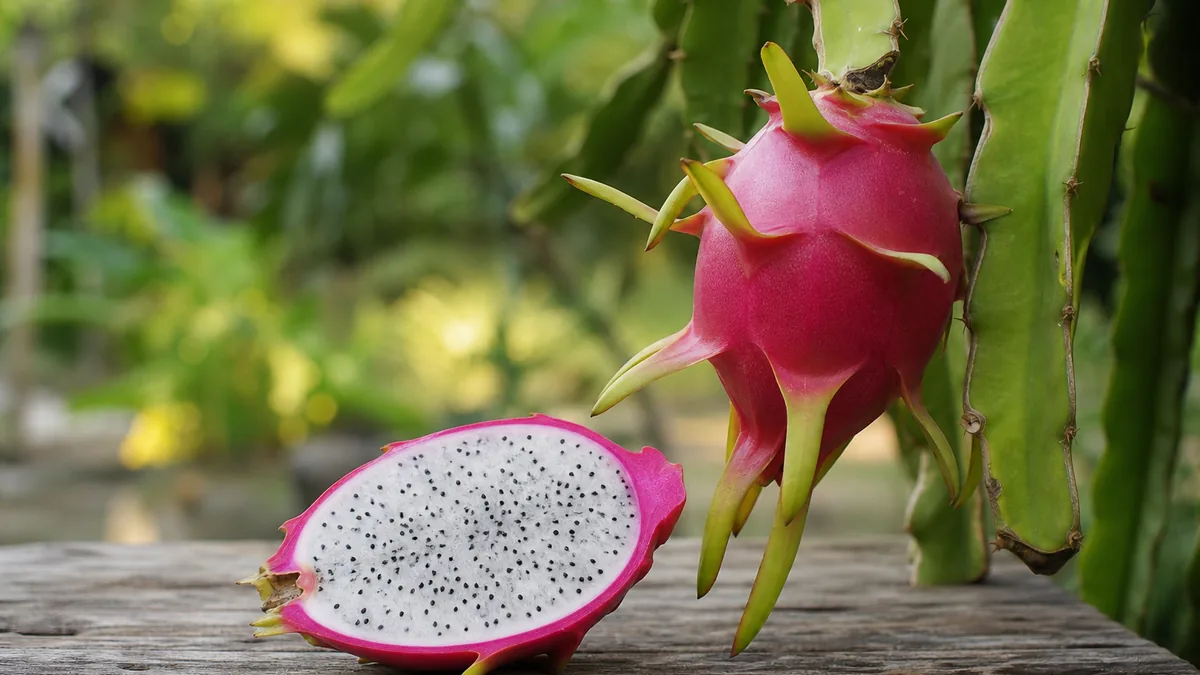
Dragon Fruit Ripeness at a Glance
Dragon fruit, also called pitaya, gets less attention from extension services than apples or tomatoes, so the sources describe some cues well and others barely at all. Here is what they say, and where they are silent.
| Cue | What the sources say |
|---|---|
| Color | Skin color intensity, red or yellow, is a maturity index (UC Davis Postharvest); harvest only well-colored, mature fruit (UF/IFAS) |
| Feel | Firm but slightly soft to the touch (Harvard Health) |
| Weight | Heavy for its size, with no shriveling or bruising (Harvard Health) |
| Time on the plant | Minimum 27 to 33 days after flowering (UC Davis); 32 to 35 days recommended (University of Hawaii CTAHR) |
| Scales or wings | Not described as a ripeness cue in the extension sources reviewed |
How to Pick a Ripe Dragon Fruit at the Store
Most people ask this question in the produce aisle, where you cannot count days since the flower. Harvard Health, in an article by staff writer Joyce Hendley, gives the clearest checklist: look for fruit that feels heavy for its size, with no shriveling or bruising, and a ripe one will feel firm but slightly soft to the touch.
- Check the color. Harvard says red dragon fruit is usually bright pink and yellow dragon fruit is bright yellow, with smaller scales. Dull, faded or patchy skin is a reason to keep looking, though the University of Florida notes that skin and pulp color differ by species.
- Lift two or three. Keep the one that feels heaviest for its size.
- Press gently. It should give slightly, not feel like a stone and not feel mushy.
- Reject damage. Skip any fruit that is shriveled, bruised or sunken. The University of Hawaii CTAHR lists mechanical injury, which shows up as sunken areas, as one of the three major disorders.
- Do not rely on the scales. Harvard describes the green-tipped scales only as a feature of the skin. No extension source reviewed uses them to judge ripeness.
Will Dragon Fruit Ripen After Picking?
The sources do not fully agree. UC Davis Postharvest says dragon fruit are picked near full ripeness and do not continue ripening after harvest. It classifies them as non-climacteric, meaning ethylene production does not rise during ripening, and says ethylene treatment does not start color development. The University of Hawaii CTAHR gives the same classification. Harvard Health, on the other hand, suggests letting a fruit ripen on the counter if needed.
For buyers, the safe reading is the cautious one: pick a fruit that already has its full color. A fruit that was harvested early will not catch up, and early harvest also makes fruit more sensitive to cold storage, according to UC Davis. That is the opposite of a tomato, which keeps changing after it leaves the vine. Our guide to ripening green tomatoes indoors covers that case.
How to Tell When Dragon Fruit Is Ready to Harvest
Growers have an advantage: they know when the flower opened. UC Davis Postharvest says maturity is judged by days after flowering, with a minimum of 27 to 33 days depending on cultivar and production area. The University of Hawaii CTAHR gives a harvest window of 25 to 45 days from flowering, notes that one study recommended 32 to 35 days, and gives a common maturity index of skin color changing to almost full red. UF/IFAS Extension Sarasota County says simply that fruit matures approximately one month after pollination. Whether a plant flowers and sets fruit at all depends on your climate, so look up what your hardiness zone means before you plant.
A University of California Cooperative Extension trial in Southern California measured bloom to harvest for named cultivars. Most red-skinned types took 38 to 48 days. The yellow type tested was far slower, as covered below.
- Note the bloom date. Tag the flower or write the date down, since the flowers open at night, as UF/IFAS Sarasota County notes.
- Start checking around day 30. That is where the earliest sources begin, and early picks are more prone to chilling injury.
- Look for full color. UF/IFAS says to harvest only well-colored, mature fruit.
- Cut, do not pull. UF/IFAS says to use hand clippers and cut the fruit stem flush to the fruit so no stub remains. Wear leather gloves and long sleeves with thorny types.
- Pick before it splits. The University of Hawaii CTAHR says fruit more than 35 days from flowering can split when it receives rain or excessive irrigation during ripening.
Dragon Fruit Harvest Season
UF/IFAS says the ripening season for the common white-fleshed species in Florida generally runs from June to November. The California trial recorded harvest windows from late June through December or January for most red-fleshed cultivars, with a few types ending in mid-October. Harvard Health says fresh dragon fruit is available June through September in stores.
Cold limits the season. UF/IFAS says pitayas may be damaged by long exposure to below-freezing temperatures of 31°F, though they recover rapidly from light freezing injury. For what counts as frost, see what temperature frost forms, and check the frost dates by city pages for your area.
How to Tell if Yellow Dragon Fruit Is Ripe
Yellow dragon fruit is a different species from the common pink one. UF/IFAS lists yellow-peeled types with white pulp, and Harvard says the yellow fruit has smaller scales and is bright yellow. UC Davis notes that yellow pitaya (Selenicereus megalanthus) is stored at a cooler 43°F than red fruit, which is held at 50°F.
The California trial found the yellow type slow and small. The Colombiana yellow dragon fruit took 150 to 180 days from bloom to harvest, with harvest in November through February, averaged under 200 grams and had a Brix of 20.9, the highest in the trial. The report also notes the rind is spiny, so the spines must be removed during harvest. If a yellow fruit looks a bit small, that is normal for the type.
How Sweet Should a Ripe Dragon Fruit Be?
A mild fruit is not always an unripe one. The UC Cooperative Extension trial reported Brix, a measure of sugar, for each cultivar, and the range was wide: from 11.85 for Bien Hoa White and 12.18 for Seoul Kitchen up to 18.9 for Bien Hoa Red and 20.9 for the yellow type. Flesh color varied too, from white to fuchsia. The University of Hawaii CTAHR reports soluble solids reaching about 14 percent as fruit ripens, and says acidity peaks at the skin color change and then declines.
UC Davis adds that sugar rises while acidity and firmness fall as fruit ripen, and says top-quality fruit should have a minimum ratio of soluble solids to acid of 40. You cannot measure that at home. The takeaway is that flavor varies by variety, so judge ripeness by color, weight and feel first, and by taste second.
| Species | Peel | Pulp |
|---|---|---|
| Hylocereus undatus | Red | White |
| H. costaricensis and H. monacanthus | Red | Red |
| H. megalanthus (yellow pitaya) | Yellow | White |
Peel and pulp colors by species, from UF/IFAS Extension’s pitaya publication.
How to Tell if Dragon Fruit Is Bad
- Shriveled or bruised skin. Harvard Health says to avoid both.
- Sunken patches. The University of Hawaii CTAHR lists mechanical injury, with sunken areas, as a major disorder.
- Translucent, soft or browned flesh. UC Davis describes chilling injury as flesh translucency, softening, wilting, darkened scales, browning of the outer flesh and poor flavor. It can develop at 41 or 43°F depending on the genus, so very cold storage can hurt the fruit.
- Rot. CTAHR names Fusarium and Aspergillus as postharvest pathogens. Discard fruit with visible mold.
When in doubt, throw it out. That is general kitchen caution, not a sourced figure.
Storing and Cutting Dragon Fruit
UF/IFAS says fruit keeps 4 to 5 days at room temperature and several weeks in plastic bags in the refrigerator. The University of Hawaii CTAHR is more cautious, giving a storage life of about 14 days at 50°F, and 17 days at 41°F with 90 percent humidity, a temperature that risks chilling injury. UC Davis gives the same 50°F figure for red types. A practical approach is to eat within a week or so of buying and use the shorter numbers when unsure. UF/IFAS Sarasota County calls the fruit best served chilled, and the pulp is speckled with tiny edible seeds.
Harvard says the easiest way to eat a dragon fruit is to cut it in half and scoop the flesh out with a spoon, or to cut away the thick skin with a paring knife and slice the flesh into rounds.
Growing Your Own Dragon Fruit
If you are tempted to grow it, plan for a warm climate. UF/IFAS says pitayas grow best in tropical and subtropical areas mostly free of frost and freeze, tolerate temperatures up to 100°F, and are not recommended above that. It says three- to four-year-old plants may produce about 220 pounds of fruit per year, and that planting two or three different genetic types improves fruit set and size because several nursery cultivars are self-incompatible. UF/IFAS Sarasota County warns that Halley’s Comet, often sold at big box stores, tends to be less productive than other cultivars.
The California trial grew plants on a single-post trellis at 726 plants per acre, which works out to a 10 by 6 foot spacing, with sprinkler irrigation for about 2 hours per week. Most selections set fruit without hand pollination in that trial. To plan your own layout, use the spacing tool below, then browse the trees and shrubs hub for more fruit guides.
Free book · 23 pages, PDF
How to Tell if Dragon Fruit Is Ripe FAQ
How can you tell if a dragon fruit is ripe?
Look for full, even color, a heavy feel and skin that is firm but slightly soft. Harvard Health says to choose fruit that feels heavy for its size, with no shriveling or bruising. UC Davis Postharvest also uses skin color intensity as a maturity index.
Does dragon fruit ripen after it is picked?
UC Davis Postharvest says no, because dragon fruit is non-climacteric and is picked close to full ripeness. The University of Hawaii CTAHR agrees that ethylene does not start color development. Harvard Health suggests letting it ripen on the counter if needed, so choose a fruit that already looks ripe.
How long does it take for a dragon fruit to ripen on the plant?
About a month after the flower opens. UC Davis gives a minimum of 27 to 33 days after flowering, CTAHR gives 25 to 45 days with 32 to 35 recommended, and UF/IFAS Sarasota County says approximately one month after pollination. A UC Cooperative Extension trial recorded roughly 38 to 48 days for most red-skinned cultivars.
How do you know if a yellow dragon fruit is ripe?
Harvard Health says yellow dragon fruit is bright yellow with smaller scales. A UC Cooperative Extension trial found the yellow type takes 150 to 180 days from bloom to harvest and stays under 200 grams, so small size is normal.
How do you know if a dragon fruit is bad?
Shriveled, bruised or sunken fruit is past its best, according to Harvard Health and the University of Hawaii CTAHR. UC Davis lists translucent or softened flesh, darkened scales, browning and poor flavor as signs of chilling injury.
How long does a dragon fruit last?
UF/IFAS says 4 to 5 days at room temperature and several weeks in plastic bags in the refrigerator. CTAHR is more conservative, saying about 14 days at 50°F, so plan on the shorter figure at home.
Sources & further reading
Maturity indices, storage and chilling injury come from UC Davis Postharvest Technology’s Dragon Fruit fact sheet and the University of Hawaii CTAHR’s Dragon Fruit: Postharvest Quality-Maintenance Guidelines. Harvest method, season and cold tolerance are from UF/IFAS Extension’s Pitaya Growing in the Florida Home Landscape and UF/IFAS Extension Sarasota County’s August Dragonfruit. Cultivar days to harvest and Brix are from the UC Cooperative Extension trial report on pitaya cultivars. Store selection and cutting advice come from Harvard Health Publishing. For how we source the facts on this site, see our methodology page.
Free book · 23 pages, PDF
The Tree Care Cheat Sheet
Sent