To plant mangoes from seeds, cut the fibrous husk off a fresh mango pit, set the seed about 1/2 to 1 inch deep in well-drained potting mix, and keep it warm and moist. Texas A&M and a Rare Fruit Council member both report germination in 2 to 3 weeks. Be realistic about the result: a seed-grown tree is often different from its parent and can take 5 to 12 years to bear fruit, and it needs a frost-free climate to live outdoors, which in the US means USDA hardiness zones 10 and 11. For a tree that fruits in cooler climates, how long an apple tree takes to grow compares years to fruit by rootstock.
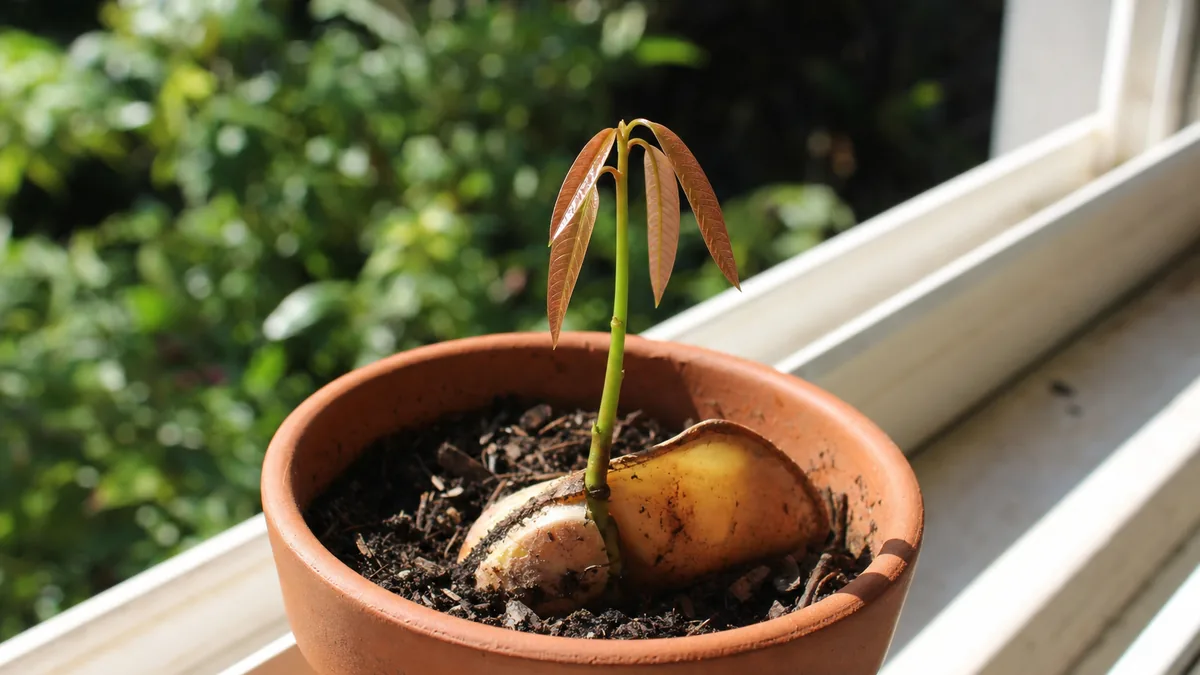
Mango Seed Quick Facts
| What | Answer | Source |
|---|---|---|
| Prepare the seed | Remove the stone from its husk before planting | Texas A&M, Fairchild |
| Planting depth | About 1/2 to 1 inch deep | Fairchild (1/2 inch), Texas A&M (1 inch) |
| Time to sprout | 2 to 3 weeks | Texas A&M, Rare Fruit Council Australia |
| Hardiness zones | USDA zones 10A through 11 | UF/IFAS Gardening Solutions |
| Young tree cold limit | Young trees may be killed at 29 to 30°F | UF/IFAS |
| Seedling to first fruit | At least 5 years, up to 12 | Univ. of Hawaii CTAHR (5+), UF/IFAS (10), Univ. of Guam (10 to 12) |
| Grafted tree to first fruit | 3 to 5 years after planting | UF/IFAS |
| Size if left unpruned | 30 to 60 feet tall, 30 to 50 feet wide | UF/IFAS Gardening Solutions (UF/IFAS HS2 says 30 to 100 feet) |
What to Expect From a Mango Seed (Honest Version)
Sprouting a mango pit is easy. Getting a tree that fruits well is the hard part, and it helps to know why before you start.
Not every seed comes true
Mango seeds come in two kinds. The Fairchild Tropical Botanic Garden describes monoembryonic seeds as having one embryo from cross-pollination, so the seedling differs from the parent. These are common in mangoes from northern India, Florida, Israel and South Africa. Polyembryonic seeds hold several embryos: one is sexual and the rest are clones of the mother tree. They are common in Southeast Asian mangoes. UF/IFAS puts it simply: polyembryonic varieties generally come true from seed, while monoembryonic varieties must be propagated vegetatively to keep the same variety. The University of Hawaii CTAHR says the same, and adds that monoembryonic trees do not come true.
The catch is that a mango from a store usually does not tell you which kind it is. The Guam extension guide (University of Guam) names Carabao and Pico as polyembryonic types and Haden as monoembryonic, so a Haden pit grows into a tree that differs from its parent.
Seedlings are slower and less predictable
UF/IFAS Gardening Solutions says trees grown from seed can take 10 years to bear fruit, and the fruit is often fibrous and bland. It advises buying a grafted tree for quick and reliable fruit. Fairchild says seed-grown trees take longer to bear and are harder to manage than grafted trees, and generally advises against seed unless you are breeding new cultivars. None of this means you should not try. A seed-grown mango is a fine project and an attractive tree. Just do not plant one expecting mangoes next summer. For a sense of how much faster a different fruit tree can bear, Clemson Extension says pomegranate plants bear well about three years after planting; see our pomegranate guide for the details, and our guide to picking pomegranate fruit for when the first harvest comes.
Where a Mango Tree Can Live: Zones and Cold
UF/IFAS Gardening Solutions lists mango for USDA hardiness zones 10A through 11. That is a narrow, warm slice of the country. Cold is the real limit. UF/IFAS HS2 says mature trees can handle air temperatures near 25°F for a few hours, with injury to leaves and small branches, while young trees may be killed at 29 to 30°F. Flowers and small fruit can be damaged or killed if temperatures fall below 40°F for a few hours. The same guide says mango does not appear to acclimate to cold and that it found no meaningful difference in cold resistance among varieties in Florida. Texas A&M agrees that leaves and twigs, especially on younger trees, can be damaged below 30°F, and that bloom is seriously affected below 40°F. Check your own zone on our growing zones by state pages, such as Florida.
That matters for seedlings, because every seed-grown tree is a young tree for years. A mild freeze that a 20-year-old mango shrugs off can kill a three-year-old. If you live outside zones 10 and 11, a potted mango can still be a houseplant-sized project, but the extension sources we checked do not document fruit from container mangoes in cold climates, so we do not promise it.
How to Germinate and Sprout a Mango Seed
Start with a fresh seed
The seed is the flat, hairy-looking stone inside the fruit. Mango seeds do not store well. Tony Welch of the Rare Fruit Council Australia reports that seed from fallen fruit is mostly viable if collected while some orange flesh remains, that older seed often has blackened kernels and germinates poorly, and that cleaned seed dried for a few days in a ventilated spot, not full sun, should not be kept longer than one week after drying. In practice: eat the fruit, clean the pit, and plant it within days.
Remove the husk
Texas A&M says to remove the fibrous stone from the seed, and Fairchild says to remove the seed from its leathery husk. The Rare Fruit Council gives a tip: cut open the edge of the husk with a sharp knife, since the seam is generally easier to open than the other side, and discard any seed with weevils or a damaged kernel.
Germinate it in potting mix, not in a jar
Many online guides suspend a pit in water. None of the extension, botanical garden or society sources we checked describe that method. Texas A&M, Fairchild and the Rare Fruit Council all plant the husked seed straight into a growing mix, so that is what we recommend. A wet container with no drainage is a good way to rot a seed, and the sources are consistent about drainage: Texas A&M says to use good potting soil, and Fairchild says to use a standard nursery mix with good drainage.
Warmth helps, since mango is a tropical tree, but we could not find an extension source that gives a germination temperature, so we leave that number out. Keep the pot in a bright, warm spot and the mix evenly moist but never soggy.
How to Plant a Mango Seed, Step by Step
- Husk the seed. Cut the fibrous husk open and remove the kernel, as Texas A&M and Fairchild describe. Throw out any kernel that is blackened, shriveled or has weevil damage (Rare Fruit Council Australia).
- Pick a pot with drainage holes. Fairchild plants husked seed about 1/2 inch deep either in nursery trays for later transplanting or directly into a 1 gallon container.
- Fill it with a loose, well-drained mix. Texas A&M calls for good potting soil. Fairchild calls for a standard nursery mix.
- Plant the seed shallow. Texas A&M says about 1 inch deep, Fairchild says 1/2 inch, and the Rare Fruit Council says to just cover the seeds. Anywhere from covered to 1 inch deep is within the guidance.
- Mind the orientation. Texas A&M says to plant the seed concave edge down. The Rare Fruit Council says to plant dehusked seed with the rounded side up, convex side up for polyembryonic seed. The two descriptions are worded differently, so look at the seed: set the curved back up and the flatter, concave edge down.
- Water it in and keep it warm. Moist, not wet. Expect a shoot in 2 to 3 weeks (Texas A&M, Rare Fruit Council).
- Sort the seedlings. A polyembryonic seed can send up more than one shoot. The Rare Fruit Council says to divide and pot them on any time after the first flush of leaves has hardened off, and that these seeds produce multiple plants that can be separated later.
Caring for a Mango Seedling
Light and warmth
Texas A&M says mango trees must receive full sun for optimum growth and fruiting, and UF/IFAS gives the same advice for planting. Indoors that means your sunniest window, and a plant that is going to stay in a pot will always be a compromise. For other fruit and shade trees, see our Trees and Shrubs hub.
Water
The extension guides we found describe watering for planted trees, not pot seedlings. UF/IFAS says new trees need water at planting and every other day for about the first week, then one to two times a week for the first couple of months. During dry spells of five or more days, young trees in their first three years get a weekly watering. For a seedling in a pot, use the same logic at a smaller scale: keep the mix evenly moist and let excess water drain. UF/IFAS Gardening Solutions warns that overwatering can reduce fruit quality and harm the tree, and says that once a tree is four years old it is drought tolerant.
Feeding
UF/IFAS HS2 gives a schedule for young planted trees: fertilize every 2 to 3 months in the first year, starting with 1/4 pound per application and increasing to 1 pound, then two to three times a year after that, scaled to tree size. Those weights are for field trees, not for a seedling in a 1 gallon pot, so follow your fertilizer label for containers. Fairchild adds that rootstock seedlings are fertilized and watered as they grow. UF/IFAS Gardening Solutions cautions against heavy fertilizing in nearby lawn areas, because mango roots extend beyond the canopy.
Planting a Mango Seedling in the Ground
If you live in a frost-free area, plant the seedling out when it has outgrown its pot, ideally in the warm season. Both UF/IFAS HS2 and the Palm Beach County extension edition of that guide give the same planting method.
- Choose a warm, sunny site. Full sun, in the warmest spot that does not stay wet after summer rains, and away from buildings, power lines and other trees.
- Remove a ring of sod. UF/IFAS says 3 to 10 feet across.
- Dig a wide, not-too-deep hole. 3 to 4 times the diameter of the root ball and about 3 times as deep as the container, per UF/IFAS.
- Set the root ball level or slightly high. The top of the container soil should be level with or slightly above the surrounding soil.
- Do not enrich the hole. UF/IFAS says not to add fertilizer, topsoil or compost to the hole. Amendments, if used at all, should be no more than a 50:50 mix with the soil you dug out.
- Water immediately and follow the schedule above.
- Mulch and protect the trunk. UF/IFAS says to use a 2 to 6 inch layer of mulch kept 8 to 12 inches from the trunk, and to keep mowers and weed eaters away from it. Our organic vs. inorganic mulch comparison helps you choose one.
If the ground floods, UF/IFAS says to plant on a mound of native soil. Mangoes tolerate occasional flooding moderately but do not do well in poorly drained soil. Texas A&M adds that mango needs good internal drainage but is not particular about soil type, and CTAHR gives a preferred pH range of 5.5 to 7.5.
How far apart, and how far from the house
Mango spacing guidance varies a lot, because mango size varies a lot. UF/IFAS says many varieties reach 30 to 100 feet if unpruned, and that vigorous or unpruned trees should be 25 to 30 feet or more from buildings, power lines and other trees. UF/IFAS Gardening Solutions says 20 to 30 feet. For a pruned, less vigorous tree, UF/IFAS says 12 to 15 feet apart, and the UF/IFAS Charlotte County office suggests pruning to keep trees around 12 feet. On the orchard end, CTAHR recommends 35 to 40 feet, and the University of Guam says 10 to 12 meters (30 to 36 feet), or 12 by 12 meters or more for seedling trees.
Seed-grown trees are hard to size up because you do not know the parent, so plan on a big tree.
Growing a Mango in a Container
Extension guidance on containers is split. Texas A&M says mango trees are normally grown in containers of soilless media at the nursery, and UF/IFAS says nursery trees are commonly sold in 3 gallon containers, standing 2 to 4 feet tall. But UF/IFAS Manatee County says mangoes are not well suited to containers because the tree prefers to spread its roots. Together, that points to a sensible reading: a container is a good way to raise a seedling, and a poor long-term home for a tree that can grow 30 feet tall.
UF/IFAS also warns against large trees in small containers, since roots may become root bound and fail to grow properly after planting. So pot up as the seedling grows, and when you plant out, wash some of the outer media off the sides and top of the root ball so the roots contact the native soil (Texas A&M). If you are working out the next size, our pot size guide explains how container volume relates to the plant.
How Long Does a Mango Tree Take to Grow and Fruit?
The answer depends on how the tree was started, and the sources give a range, not one number.
| Stage | Time | Source |
|---|---|---|
| Seed to sprout | 2 to 3 weeks | Texas A&M, Rare Fruit Council Australia |
| Seed to graftable seedling (a quarter inch thick) | About 6 months | Texas A&M |
| Seedling tree to first fruit | At least 5 years, and up to 12 | CTAHR says at least 5. UF/IFAS Gardening Solutions says it can take 10. The University of Guam says 10 to 12. |
| Grafted tree to first fruit | 3 to 5 years after planting | UF/IFAS and University of Guam (Texas A&M says the third year) |
| Flower to ripe fruit | 100 to 150 days, by variety | UF/IFAS, Texas A&M |
So how long does a mango tree take to grow? About a half year to get a sturdy seedling, then years more to get a tree that flowers. CTAHR notes grafted trees usually fruit in 3 to 5 years in dry areas, while seedling trees usually take at least 5 years. UF/IFAS Gardening Solutions is more cautious and says seed-grown trees can take 10 years. The honest summary is 5 years at the earliest, and many seedlings take longer.
Flowering also depends on weather. CTAHR says dry weather during flowering favors fruit production, and the University of Guam says flowering is thought to be triggered by cool night temperatures, which rarely occur on Guam.
If you want fruit sooner, the extension advice is consistent: buy a grafted tree, as UF/IFAS Gardening Solutions advises. For ripeness signs on another tropical fruit, see our guide to how to tell if a dragon fruit is ripe.
How fast does a mango tree grow?
Fast, by tree standards. UF/IFAS rates mango a fast grower that quickly forms a round, dense, spreading shade tree, and the University of Guam says mangos can grow more than 5 feet per year under ideal conditions. We found no extension source with a typical height at 1, 3 or 5 years, so we give none. The University of Hawaii CTAHR fact sheet adds that grafted trees grow more slowly and are often smaller than seedling trees.
How to grow a mango tree faster
No source offers a trick, but the guides agree on what holds a young tree back.
- Full sun. Texas A&M says mango trees must receive full sun for optimum growth and fruiting.
- Steady water. CTAHR says young mango trees should not lack water, and suggests irrigating about every two weeks in the first year and every three weeks in the second.
- Regular feeding. CTAHR says young trees should get 1.5 to 3 ounces of nitrogen in the first year, on top of the UF/IFAS schedule above.
- Cold protection. UF/IFAS says young trees may be killed at 29 to 30°F.
How tall and how big do mango trees get?
Very tall if you let them, and the sources disagree on how tall.
| Tree and setting | Size | Source |
|---|---|---|
| Landscape tree, unpruned | 30 to 60 feet tall, 30 to 50 feet wide (HS2 says 30 to 100 feet) | UF/IFAS |
| Large mature tree | Up to 90 feet high, 80 feet wide | Univ. of Hawaii CTAHR |
| Pruned every year | 12 to 15 feet | UF/IFAS Miami-Dade County |
| Dwarf cultivars, pruned every year | Under 12 feet | UF/IFAS Sarasota County |
Seedling versus grafted. The University of Guam guide says unpruned mango trees, especially seedling trees, can become very large, and CTAHR agrees grafted trees are often smaller.
In the ground versus a container. We found no extension source that states a mature height for a potted mango, so we give none. UF/IFAS Manatee County considers mango poorly suited to containers long term, while UF/IFAS Sarasota County calls the naturally dwarf Pickering variety, about 10 to 12 feet, good for large container growing.
How long does a mango tree live?
A very long time. The University of Guam guide calls mangos long-lived, and CTAHR says mango trees may remain in production for 40 years or more.
Mango Seed Problems: Rot, No Sprout and Slow Growth
- Seed rotted or never sprouted. The most likely causes in the sources are old or blackened seed and a seed left to dry too long. The Rare Fruit Council says old seed often has blackened kernels and poor germination, and that dried seed should not be kept beyond a week. Soggy mix is the other suspect, so use a drainage hole and a loose mix (Texas A&M, Fairchild). If the stem or roots turn soft, see our guide to root rot.
- Seedlings collapse in wet weather. The Rare Fruit Council says that in extended wet weather, fungus can affect dense seedlings. Thin crowded seedlings and avoid keeping the mix saturated.
- Leaves are scorched or dropping after a cold night. Young trees are the most exposed. UF/IFAS says they may be killed at 29 to 30°F. Bring pots under cover before a freeze.
- The plant is wilting. Check the mix and the roots before adding water.
Free book · 23 pages, PDF
How to Plant Mangoes From Seeds FAQ
How do you plant a mango seed, and how long does it take to sprout?
Remove the stone from its husk, then plant it about 1/2 to 1 inch deep in well-drained potting mix. Fairchild gives 1/2 inch in a 1 gallon pot, and Texas A&M gives 1 inch. Texas A&M and the Rare Fruit Council Australia both report a shoot in 2 to 3 weeks.
Can you grow a mango seed in water?
We found no extension or botanical garden source that recommends it. Texas A&M, Fairchild and the Rare Fruit Council all plant the husked seed in a growing mix, so that is the tested route.
How long does it take for a mango tree to fruit from seed?
At least 5 years according to the University of Hawaii CTAHR, 10 years according to UF/IFAS Gardening Solutions, and 10 to 12 years according to the University of Guam. UF/IFAS says monoembryonic varieties do not come true, so the fruit may differ from the mango you ate. Grafted trees fruit in 3 to 5 years (UF/IFAS).
What zone can you grow a mango tree in?
UF/IFAS Gardening Solutions lists zones 10A through 11. UF/IFAS says young trees may be killed at 29 to 30 degrees F, and mature trees are injured near 25 degrees F, so freeze-prone yards are risky.
How fast does a mango tree grow?
UF/IFAS rates mango a fast grower, and the University of Guam says trees can grow more than 5 feet per year under ideal conditions. To help it along, give it full sun, steady water and cold protection (Texas A&M, CTAHR, UF/IFAS).
How big does a mango tree get, and can it stay in a pot?
UF/IFAS lists 30 to 60 feet tall and 30 to 50 feet wide for an unpruned landscape tree, and UF/IFAS Miami-Dade County says annual pruning can hold one to 12 to 15 feet. Grafted trees are often smaller than seedlings (CTAHR). UF/IFAS Manatee County says mangoes are not well suited to containers long term.
How long does a mango tree live?
CTAHR says mango trees may remain in production for 40 years or more.
Sources & further reading
Climate, cold tolerance, planting, watering and fertilizer figures come from UF/IFAS Extension, Mango Growing in the Florida Home Landscape (HS2/MG216), the Palm Beach County extension edition of the same guide, UF/IFAS Gardening Solutions, UF/IFAS Charlotte County Extension and UF/IFAS Manatee County Extension. Seed, germination and grafting details come from Texas A&M AgriLife Extension and Fairchild Tropical Botanic Garden (Campbell and Ledesma, Mango Propagation). Fruiting time, soil pH and spacing come from University of Hawaii CTAHR Crop Knowledge Master and the University of Guam mango production guide. Growth, size and lifespan details also come from the UF/IFAS Mangifera indica fact sheet, the CTAHR Mango fact sheet (HC-2), the University of Guam Mango Tree Care guide, UF/IFAS Sarasota and Miami-Dade County posts. Seed handling comes from Tony Welch in the Rare Fruit Council Australia archive, a 1991 hobbyist note, so we use it only for practical handling, not for hard numbers beyond germination time. For how we source the facts on this site, see our methodology page.
Free book · 23 pages, PDF
The Tree Care Cheat Sheet
Sent