How long does an apple tree take to grow? It depends mostly on the rootstock. The University of Minnesota Extension says dwarf apple trees start bearing 2 to 3 years after planting, while standard trees can take up to 8 years. Virginia Tech Extension gives 6 to 10 years for a standard tree and 4 to 6 for a semi-dwarf. A tree grown from a seed takes longest, and may never give fruit worth eating. If you already have a tree and do not know how old it is, see how to tell the age of a tree.
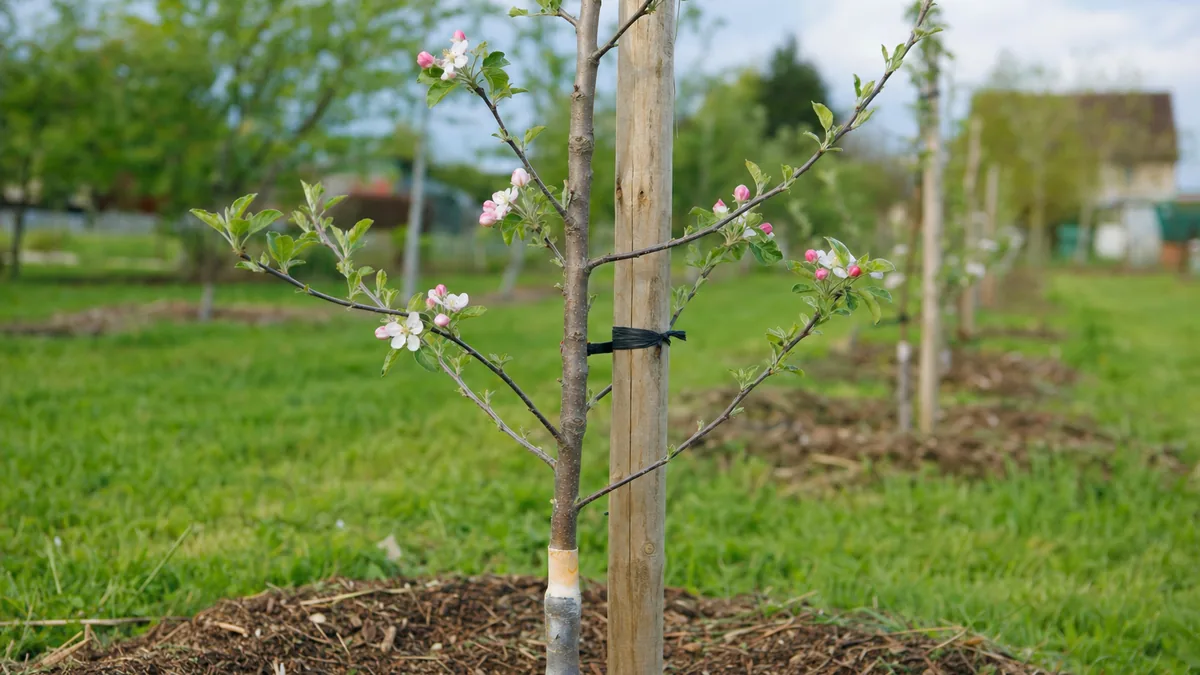
Apple Tree Growth at a Glance
Extension guides do not all agree, so the table gives the range wherever they differ. Dwarf, semi-dwarf and standard describe the rootstock the nursery tree is grafted onto, not the apple variety.
| Question | Dwarf | Semi-dwarf | Standard |
|---|---|---|---|
| Years to first fruit | 2 to 3 | 4 to 6 | 6 to 10 |
| Mature height | 6 to 15 feet | 14 to 22 feet | 20 to 30 feet |
| Spacing | 6 to 10 feet | 12 to 18 feet | 20 to 30 feet |
| Typical lifespan | 15 to 35 years | 20 to 35 years | 35 to 45 years |
Sources: University of Minnesota Extension, Virginia Tech Extension, University of Illinois Extension, University of Missouri Extension and eXtension. The sections below attribute each figure.
How Long Does It Take Apple Trees to Bear Fruit?
Think of an apple tree in two stages. First it builds a trunk and framework with no fruit at all, then it starts to flower and fruit. Rootstock decides how long the first stage lasts. Here is what each extension service says.
- University of Minnesota Extension: dwarf trees start bearing 2 to 3 years after planting, and standard trees can take up to 8 years.
- Virginia Tech Extension: standard apples take 6 to 10 years, semi-dwarf 4 to 6 and dwarf 2 to 3. It adds that trees on M.9 rootstock often produce crops in two to three years.
- University of Maine Cooperative Extension: dwarf trees begin to bear two to three years after planting, semi-dwarf apples four to five years, and standard apples can take as much as seven to ten years.
- University of Illinois Extension: dwarf trees may start bearing at 2 or 3 years old, and standard trees should start bearing after their sixth year.
- University of Missouri Extension: dwarf trees start producing the second season after planting, and semi-dwarf trees begin about four years after planting.
The sources overlap on dwarf trees (2 to 3 years) and on semi-dwarf trees (about 4 to 6 years). They spread out on standard trees, from 6 years to as many as 10. Local climate, variety and how well the tree is cared for all move the real date within that spread.
That is the answer to “how long before an apple tree bears fruit”, but the first crop is rarely the full crop. Missouri Extension says a mature dwarf tree generally produces 3 to 6 bushels and a mature semi-dwarf 6 to 10 bushels. Virginia Tech’s table lists about 8 bushels for a standard tree, 4 for a semi-dwarf and 2 for a dwarf. Those yields are for mature trees. Expect a handful of apples in the first harvest.
Grafted Nursery Tree vs Growing From Seed
If you have ever wondered how long an apple tree takes to grow from a seed, the honest answer is longer, and with a gamble at the end. University of Minnesota Extension says a nursery apple tree is two genetically different trees grafted together, a scion that sets the variety and a rootstock that sets the size. It adds that a seedling rootstock is grown from an apple seed, and each seed is a genetically different individual.
The University of Maine Cooperative Extension says fruit trees are grafted rather than grown from seed because seedlings are not true to type. Its example is that seeds from a McIntosh tree will not grow into another McIntosh, but into a unique variety. Virginia Tech Extension says seedling-rooted trees usually start fruiting at 7 to 8 years.
So a seed-grown apple can take 7 to 8 years or more to show you what you got, and the result is a new variety rather than the apple you ate. If you want a specific apple on a reliable schedule, buy a grafted tree. Growing from seed is a fine project if you accept that. Our guide to planting mangoes from seeds shows the same trade-off for another fruit tree, with sourced timelines for seed-grown against grafted trees.
How Tall and Big Do Apple Trees Get?
Height is also set by the rootstock, and the numbers again vary by source.
- eXtension (apple production): unpruned standard trees reach a height of about 30 feet with a crown about 30 feet across. Semi-dwarf trees are about 60% to 90% of standard size, roughly 14 to 22 feet tall. Dwarf trees are about 6 to 12 feet.
- University of Minnesota Extension: a standard seedling-rooted tree grows to 20 or more feet. Dwarfing rootstocks grow to 8, 12 or 15 feet, and MM.111 gives roughly a 14 to 18 foot tree in Minnesota. M.26 gives 8 to 10 feet.
- Virginia Tech Extension: a 16 to 18 foot tree on MM.111 against a dwarf of 7 to 8 feet on M.9.
- University of Missouri Extension: dwarf trees can still reach 15 feet in Missouri, and semi-dwarfs up to 20 feet.
The lesson is that “dwarf” does not mean small enough for a pot. Pruning, soil and variety all change the final size. To check how tall an established tree really is without climbing it, use the calculator below.
How Far Apart to Plant Apple Trees
Spacing follows the same three size classes. The sources overlap closely.
- University of Minnesota Extension: standard 20 to 25 feet, semi-dwarf 12 to 15 feet and dwarf 6 to 10 feet. Its rule of thumb is to give a tree at least as much horizontal space as its expected height.
- Virginia Tech Extension (minimum distances): 30 feet for standard, 18 feet for semi-dwarf and 8 feet for dwarf. It says trees should not be set closer than these minimums.
- eXtension: growers have used 26 by 20 feet for pruned standard trees, 22 by 16 feet for semi-dwarf and 20 by 14 down to 14 by 4 feet for dwarf trees.
For a backyard, 12 to 15 feet for a semi-dwarf and 6 to 10 feet for a dwarf sit inside the overlap. Remember that you also need a second variety for pollination, so plan for at least two trees. See our plant spacing guides for crop-by-crop figures, and our plant pot sizes chart if you are weighing a large container for a very small tree.
How Do Apples Grow? From Flower to Fruit
Once a tree is old enough to flower, a year of apple growing follows a fixed order.
- Winter chill. Clemson’s Home and Garden Information Center defines chill hours as the hours of cold, between 32°F and 45°F, that a plant experiences during dormancy. It says each species, and even each variety, needs a specific number. eXtension gives an apple chilling requirement of 800 to 1,200 hours, with 40°F to 45°F the optimal range. Clemson warns that a tree needing more chill than your winters supply will most likely never bear fruit, because flowering is not initiated properly.
- Bud break and bloom. eXtension says trees bloom approximately 3 to 4 weeks after leaves first appear, which can mean a difference of two weeks or more in bloom date from year to year. It gives mid-April for western North Carolina and mid-May for Minnesota.
- Pollination. Apple needs pollen from a different variety. University of Minnesota Extension says you need two varieties, a crabapple can be one of them, the second tree should be within about 100 feet, and bees and flies carry the pollen. Virginia Tech Extension recommends at least three varieties for adequate cross-pollination, and the University of Illinois Extension says to plant at least two varieties.
- Fruit set and growth. The tree sets fruit after pollination and the apples then swell through summer.
- Ripening and harvest. The University of Maryland Extension says to use days after full bloom to estimate harvest dates, but calls it only a general indicator. It says there might be 5 to 20 days between the estimated and optimal harvest date for a cultivar, so check starch and firmness as well.
The bloom window is also the frost risk. University of Minnesota Extension says a hard freeze is four straight hours of 28°F, and that fruit begins freezing around 28°F to 28.5°F. Check your frost dates against your variety’s bloom time. The same extension lists varieties by zone, for example Triumph as very good in zone 4 but not recommended for zone 3.
Our guide to USDA hardiness zones explains what a zone number does and does not tell you, including why chill hours are a separate question.
How Long Do Apple Trees Live?
Most home trees are productive for decades, not centuries. The sources again split by tree size.
- Virginia Tech Extension: standard apple trees 35 to 45 years, semi-dwarf and dwarf 30 to 35 years.
- eXtension (Ask an Expert): a dwarf apple may live 15 to 20 years, a semi-dwarf 20 to 25 years and a full-size tree 35 to 45 years. It notes these are general guides and that many trees fall outside them, and that a dwarf’s life expectancy depends partly on the rootstock used.
- University of Missouri Extension: dwarf trees generally have a life span of about 20 years, and semi-dwarf trees continue to bear for 25 years.
The sources disagree most on dwarfs, from 15 to 35 years. A fair plan is about 20 years from a dwarf or semi-dwarf and 35 to 45 from a standard tree. The University of Illinois Extension notes that trees lose some of their vigor as they age, so a very old tree is usually producing less. To estimate the age of an old orchard tree whose planting date nobody remembers, use the age guide linked at the top of this page.
How to Help an Apple Tree Grow Faster
You cannot make a standard tree fruit like a dwarf, but you can avoid the delays. These steps come straight from the extension guidance above.
- Choose the rootstock for your timeline. A dwarfing rootstock is the biggest lever. The 2 to 3 year range for dwarfs against 6 to 10 for standards comes from the table above.
- Buy a grafted tree, not a seedling. Virginia Tech says seedling-rooted trees usually fruit at 7 to 8 years.
- Plant at the right time. University of Minnesota Extension says to plant bare-root trees as soon as the soil can be worked, and potted trees after the spring frost risk has passed. Our guide to soil temperature for planting shows how to check that the ground is ready.
- Match the variety to your winter. Pick one whose chill hours and zone rating fit your site, per Clemson and the University of Minnesota.
- Plant a pollination partner. A second variety, or a crabapple, within about 100 feet.
- Prune and train early. Iowa State Extension says the most important period for pruning and training fruit trees is the first 4 to 5 years after planting, and to prune a new tree immediately after planting, cutting whips back to 30 inches.
Our guide to mulch mistakes covers how to mulch a young tree without harming the trunk. If you like long-term fruit trees, compare the timeline here with the pomegranate in our guide to planting a pomegranate. For more on choosing and planting trees, browse the trees and shrubs hub.
Free book · 23 pages, PDF
How Long Does an Apple Tree Take to Grow FAQ
How long does it take for an apple tree to bear fruit?
It depends on the rootstock. University of Minnesota Extension says dwarf trees bear 2 to 3 years after planting and standard trees can take up to 8 years. Virginia Tech Extension gives 2 to 3 years for dwarf, 4 to 6 for semi-dwarf and 6 to 10 for standard trees.
How tall do apple trees get?
eXtension says dwarf trees are about 6 to 12 feet, semi-dwarf about 14 to 22 feet, and unpruned standard trees about 30 feet. University of Minnesota Extension says a standard seedling-rooted tree grows to 20 or more feet. Rootstock, pruning and soil all change the final height.
How long do apple trees live?
Virginia Tech Extension says 35 to 45 years for standard trees and 30 to 35 for semi-dwarf and dwarf. eXtension gives 15 to 20 years for a dwarf, 20 to 25 for a semi-dwarf and 35 to 45 for a full-size tree. The University of Missouri Extension says about 20 years for dwarfs.
How fast do apple trees grow?
Growth is mostly a matter of rootstock, since dwarf trees fruit sooner and stay smaller. Iowa State Extension says the first 4 to 5 years after planting are the most important period for pruning and training, and slow-growing trees need an additional year before the second tier of scaffolds is formed.
Can you grow an apple tree from a seed?
Yes, but the result is unpredictable. University of Minnesota Extension says each apple seed is a genetically different individual, and the University of Maine Cooperative Extension says seeds from a McIntosh will not grow into another McIntosh. Virginia Tech Extension says seedling-rooted trees usually start fruiting at 7 to 8 years.
How far apart should apple trees be planted?
University of Minnesota Extension says 20 to 25 feet for standard trees, 12 to 15 feet for semi-dwarf and 6 to 10 feet for dwarf. Virginia Tech Extension gives minimums of 30, 18 and 8 feet. Minnesota's rule of thumb is at least as much horizontal space as the tree's expected height.
Do you need two apple trees to get fruit?
Usually yes. University of Minnesota Extension says you need two varieties for cross-pollination, a crabapple can be one, and the second tree should be within about 100 feet. Virginia Tech Extension recommends at least three varieties for adequate pollination.
Sources & further reading
Years to fruit, size, spacing, lifespan and pollination figures come from University of Minnesota Extension’s Growing apples in the home garden, Virginia Tech Extension’s home fruit planting guide, University of Maine Cooperative Extension’s Rootstocks and Dwarf Fruit Trees, University of Illinois Extension’s Apples, University of Missouri Extension’s Home Fruit Production: Apples, eXtension’s Understanding Apple Tree Size and eXtension’s Ask an Expert answer on apple tree lifespan. Chill hours, bloom timing and harvest come from Clemson Home and Garden Information Center’s Understanding Chill Hours, eXtension’s Timing of Apple Tree Bloom and University of Maryland Extension’s apple fruit maturity guide. Pruning and training figures come from Iowa State Extension’s How to Prune and Train Young Apple Trees. For how we source the facts on this site, see our methodology page.
Free book · 23 pages, PDF
The Tree Care Cheat Sheet
Sent