How to Use This Calculator
- Measure your trunk circumference at 4.5 ft (breast height).
- Select the tree species.
- Read the trunk diameter and estimated age range.
Free book · 23 pages, PDF
How It Works
To work out how old a tree is without cutting it down, measure the trunk circumference 4.5 ft above the ground, turn it into a diameter, and multiply by a growth factor for the species. The growth factor is the number of years a tree of that species typically takes to add one inch of trunk diameter.
Worked example: a white oak has a trunk circumference of 70 inches. Divided by 3.14, that is a diameter of about 22 inches. White oak has a growth factor of 5, so 22 × 5 gives an estimated age of about 110 years. Purdue Extension’s Lindsey Purcell uses the same oak and the same numbers in “How Old Is My Tree?”, and describes the result as a rough estimate. The calculator above shows your answer as a range around that midpoint, because soil, light and competition change how fast a trunk thickens. Growth factors for other species are in the reference table below.
How to Tell How Old a Tree Is
The standard non-destructive method (and the practical answer to how to estimate the age of a tree without cutting it down) comes from the circumference → diameter → growth factor chain. First, measure the trunk’s circumference at 4.5 ft above the ground, the standard forestry measurement point known as “breast height,” or DBH (diameter at breast height). Divide that circumference by π (about 3.14159) to get the diameter.
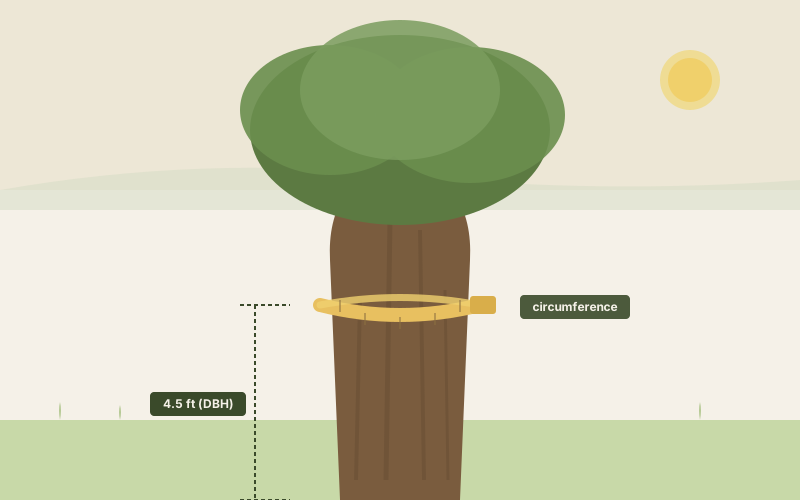
Next, multiply that diameter by a species-specific growth factor: a number, in years per inch of diameter, that reflects how fast that species typically thickens. Slow-growing species like beech or hemlock have high growth factors (6–7+); fast growers like cottonwood or pecan have low ones (1–2). Using the wrong species can throw an estimate off by decades.
It’s important to be upfront about what this method is: an estimate, not an exact measurement. Growth factors are averages compiled from typical trees of that species; any individual tree’s actual growth rate depends on soil quality, climate, sunlight, competition, and care. That’s why the calculator above shows a range rather than one falsely-precise number. The only fully exact method is counting annual growth rings, which requires cutting the tree down or extracting a small core sample.
One consistent bias to keep in mind: yard and urban trees tend to grow more slowly than trees of the same species in open woodland or forest conditions. Compacted soil, restricted root space, proximity to pavement and structures, and the general stress of an urban environment all limit annual diameter growth. Because most people using this calculator are measuring a yard tree, the true age is often somewhat older than the estimate, so treat the upper end of the displayed range as the more likely value if your tree is in a tight, built-up setting.
Telling a young conifer’s age without cutting it down
For a young pine, fir or other conifer, there is a second no-cut method that can beat the tape measure. Many conifers put on one flush of growth a year, and each flush ends in a ring of branches around the trunk called a whorl. Each whorl plus the stretch of trunk above it is one year. Count the whorls from the top down, including the stubs and knots low on the trunk where lower branches have died and dropped off, then add 2 to 4 years for the time between germination and the first visible whorl. Skip single branches growing between the main whorls: they are not a year of growth.
Whorl counting works best on conifers up to about 15 years old, and it is harder to read on cedars, hemlocks and some hardwoods. For older trees, go back to the circumference method above.
Growth Factor Reference Table
Growth factor is expressed as years of age per inch of trunk diameter. Lower numbers mean faster growth. Factors for common landscape and forest species (Oak, Maple, Pine, Sycamore, Beech, and Cottonwood) follow the widely-used International Society of Arboriculture reference chart; species without an official ISA factor (Magnolia, Live Oak, Apple, Cedar, Hemlock, Olive, Pecan) are estimated from published diameter-growth-rate research and should be treated as rougher approximations.
| Species | Growth factor (yrs/in) |
|---|---|
| Oak | 5 |
| Maple | 4.5 |
| Pine | 5 |
| Sycamore | 4 |
| Magnolia | 4 |
| Live Oak | 4 |
| Apple | 3 |
| Beech | 6 |
| Cedar | 3 |
| Cottonwood | 2 |
| Hemlock | 7 |
| Olive | 4 |
| Pecan | 1 |
| Average / Unknown species | 4 |
Worked Example
Let’s walk through an oak tree with a 60-inch trunk circumference.
- Diameter: 60 in ÷ π (3.14159) = ~19.1 inches.
- Growth factor: Oak = 5 years per inch.
- Midpoint age: 19.1 × 5 = ~95 years.
- Estimated range (±20%): roughly 75–110 years.
So a 60-inch-circumference oak is most likely somewhere between 75 and 110 years old, with ~95 years as the midpoint estimate. That range, not a single number, is the honest answer: soil, sun exposure, competition from nearby trees, and past stress (drought, storm damage, disease) can all push the real age toward either end.
What a Ring Count Tells You
In climates with a clear growing season, each ring is one year of growth, so counting rings on a stump or a core sample is the most direct answer to how old a tree is. It is not quite the tree’s full age, though. A ring count only tells you how many years the trunk has been growing at the height where you counted. The years the tree spent growing from a seedling up to that height left no ring there, so you add them back:
- Counting rings on a stump: add a couple of years for the seedling stage, plus the number of years since the tree was cut.
- Counting an increment core taken at breast height: add 6 to 10 years for the time the tree took to reach 4.5 ft. Use 6 for a tree on a good, fast-growing site and 10 for one on a poor site.
So a stump showing 73 rings came from a tree that was roughly 75 years old when it was cut. If those same 73 rings came from a breast-height core on a living tree, the tree is about 79 to 83 years old.
Rings themselves can occasionally mislead. A tree can lay down what looks like two rings in a year that starts dry and turns very wet, and it can skip a ring entirely in a very dry year. That is why researchers cross-check a count against other trees from the same area before calling it exact.
Common Mistakes
- Measuring at the wrong height. The standard point is 4.5 ft (1.4 m) above ground. Measuring at the base or at chest height on a slope gives a larger, misleading circumference. On sloped ground, measure from the uphill side.
- Ignoring species differences. A cottonwood (growth factor 2) and a hemlock (growth factor 7) with identical trunk diameters can differ in age by a factor of 3–4×. Always pick the closest species match, not just any tree.
- Treating the estimate as exact. This method is a well-established approximation, not a precise measurement. Only ring counting (via a core sample or a cut cross-section) gives an exact age.
- Confusing circumference with diameter. Circumference is the distance around the trunk; diameter is the distance across it. Skipping the ÷ π step and plugging circumference straight into the growth-factor formula overestimates age by roughly 3×.
Common questions
How to know how old a tree is without cutting it down?
Wrap a tape measure around the trunk 4.5 ft above the ground, divide that circumference by π to get the diameter, then multiply by the growth factor for the species. A white oak with a 70-inch circumference works out to about 22 inches across, and 22 × 5 = roughly 110 years. It is an estimate, so the calculator above shows a range. Only a ring count from a core sample or a stump is exact.
What is DBH, and why measure the trunk at 4.5 feet?
DBH stands for diameter at breast height, the standard forestry measuring point 4.5 ft (1.4 m) above the ground. Measuring every tree at the same height keeps estimates comparable and avoids the flared base of the trunk. If the trunk forks or bulges at that height, measure just below it.
How thick is a 100-year-old oak tree?
With a growth factor of 5 years per inch, a 100-year-old oak would be about 20 inches across at breast height, which is a circumference of roughly 63 inches (20 × π). Oaks growing faster or slower than average will land well above or below that, so treat it as a ballpark.
Can I tell how old a tree is from its height?
Not reliably. Height depends on species, soil, light and pruning, and trees that have been topped or crowded stop gaining height long before they stop thickening. Trunk circumference gives a much better estimate, and our tree height calculator is there for the height itself.
How can you tell how old a tree is?
Three real approaches, depending on what you have access to. For a living tree you don’t want to cut down, measure trunk circumference and use a species growth factor (the method this calculator uses, covered below). For a stump or a core sample, count the actual growth rings, the only fully exact method, explained in “How tree rings actually work” further down this page. And if you know when the tree was planted (a receipt, a planting record, a memory of a housewarming sapling), that beats any estimate. Absent records, the circumference method is the practical middle ground.
How do you calculate the age of a tree?
Measure the trunk circumference at 4.5 ft (breast height), divide by π to get diameter, then multiply diameter by the species’ growth factor. That gives an estimated age in years. This is the standard non-destructive method used by arborists and foresters.
How do I calculate tree age without cutting it down?
Use the circumference-to-diameter-to-growth-factor method above. No cutting or coring needed. The only fully exact alternative is counting growth rings, which requires either felling the tree or taking a small core sample with an increment borer.
How accurate is a tree age calculator?
Expect roughly ±20% accuracy for a healthy, typically-grown tree, which is why this calculator shows a range, not a single number. Stressed urban trees, deep shade, drought, or poor soil can push the true age further outside that range, usually older than the estimate suggests.
How do I measure my tree for this age of tree calculator?
Wrap a flexible tape measure around the trunk at 4.5 ft (1.4 m) above ground level, the standard "breast height." If the trunk forks or bulges there, measure just below the irregularity instead. Enter that circumference and select the closest species match.
Does calculating tree age work the same for every species?
No. growth factors vary widely by species, from about 1–2 years per inch of diameter for fast growers like cottonwood and pecan, up to about 7 for slow growers like hemlock. Always select the closest species match; using the wrong one can throw off the estimate by years or decades.
How old is a tree with 73 rings?
At least 73 years. Each ring is one year of growth at the height where you counted, and the tree spent a few years growing up to that height before it laid down the first of them. On a stump, add a couple of years for the seedling stage plus the years since the tree was cut, which puts it at roughly 75 years old when it was felled. On an increment core taken at breast height (4.5 ft), add 6 to 10 years instead, for a total of about 79 to 83 years.
How do you find the age of a tree from a stump?
Count the rings from the center out to the bark. Each year shows up as a lighter band of spring growth followed by a darker band from late summer, so count the dark bands. Then add a couple of years for the seedling stage, which the stump never recorded, and the number of years since the tree was cut down. If the center has rotted away, some of the earliest rings are gone and the tree was older than your count.
How reliable is a redwood tree age estimate from trunk size?
Not reliable enough to offer, so this calculator does not list redwood. Real redwoods vary enormously. The USDA Forest Service’s Silvics of North America reports trunk diameter growing less than 0.03 inch a year in crowded stands but sometimes more than 1 inch a year, and describes one redwood with little competition that measured 84 inches across at breast height when it was 108 years old. At the 10 years per inch factor this calculator used to apply, that tree would have come out at about 840 years. Growth that ranges from about 1 to over 30 years per inch cannot be summed up in one factor, so only a ring count from a core gives a trustworthy redwood age.
Sources & further reading
The circumference and growth-factor formula, with the 70-inch white oak example, follows Purdue Extension’s “How Old Is My Tree?” (Purdue Landscape Report, 2018). For background on why ring counting (dendrochronology) remains the only exact way to age a tree, and how modern arborists use non-destructive tools like the increment borer, see NIST’s “How Do You Measure the Age of a Tree?”. The years to add to a stump or breast-height core count come from Oregon State University Extension’s “Measuring Your Trees” (EM 9058), and the whorl-counting method from the open textbook Forest Measurements: “Field Technique Tips for Counting Whorls”. Redwood growth rates come from the USDA Forest Service’s Silvics of North America: Redwood. For a full side-by-side comparison of all three real aging methods, including their real accuracy and invasiveness tradeoffs, see how tree aging methods compare. For more on how we build and verify the formulas behind every calculator on this site, see our methodology page.