How do you plant a pomegranate? Put a container-grown plant in full sun and well-drained soil in early spring, in a hole two to three times as wide as the root ball (Iowa State Extension) and no deeper, then water it in and mulch. Clemson Extension says a pomegranate bears well about three years after planting. First check that your hardiness zone suits it, since cold is the main limit.
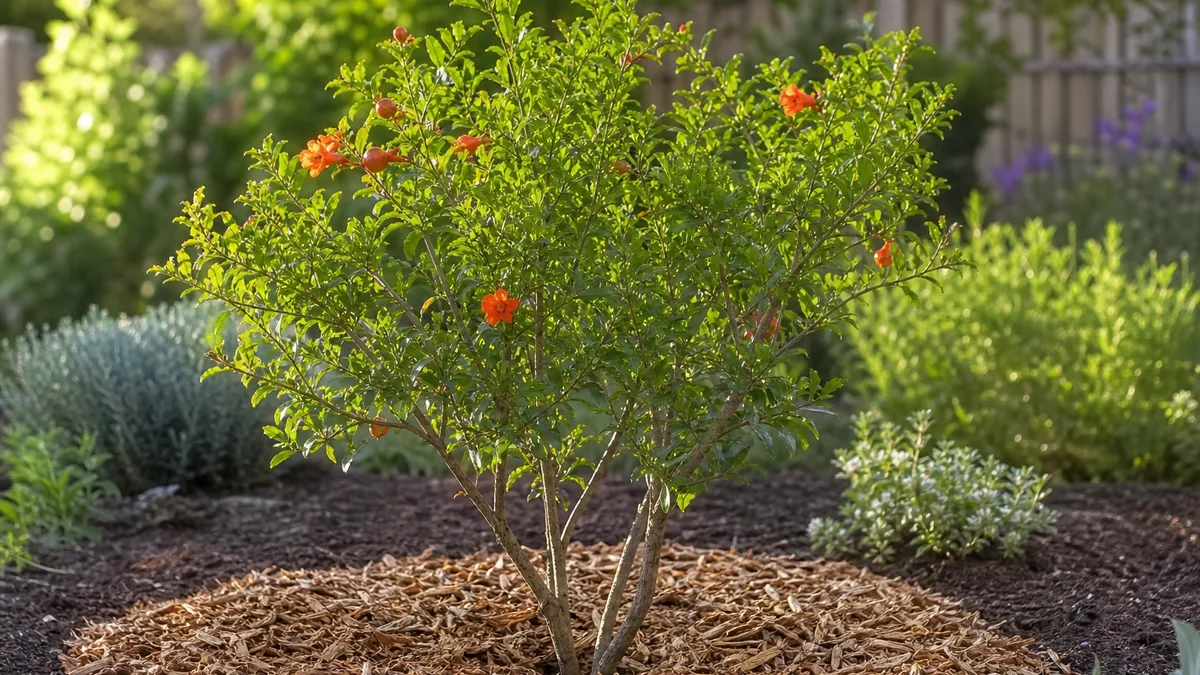
Pomegranate Planting at a Glance
Pomegranate (Punica granatum) is a deciduous shrub that is often trained into a small tree. The figures below come from university extension guides, and where they disagree the table shows the range.
| Question | Short answer | Source |
|---|---|---|
| When to plant | Early spring, February to March in Florida, or after the last frost in Arkansas | University of Florida, University of Arkansas |
| Hardiness | USDA zones 8 to 10, zone 7b with protection | Clemson, NC State |
| Sun | At least 6 hours of direct sun | University of Georgia |
| Soil | Well drained, pH 5.5 to 7.0 | University of Florida, Clemson |
| Hole | 2 to 3 times the root ball width, no deeper than the root ball | Iowa State Extension |
| Spacing | 10 to 16 feet apart as a dooryard plant, 6 to 9 feet as a hedge | University of Florida |
| Mature size | About 10 to 20 feet tall, depending on cultivar and training | University of Georgia, Clemson |
| First fruit | Year two to year four | University of Georgia, Clemson, Texas AgriLife |
| Lifespan | Long-lived, up to 200 years in some reports | University of Georgia, Clemson |
Best Time to Plant a Pomegranate Tree
Plant in early spring, once the worst frost is behind you. The University of Florida says to plant in February or March and avoid late frost, keeping the soil loosely worked and not wet. The University of Arkansas says to wait until all chance of frost has passed, and the University of Georgia plants rooted cuttings in late winter or early spring.
The University of Florida says late freezes can damage trees that are not dormant. Look up your average last frost on our frost dates pages, and see what temperature frost forms if you are unsure how a cold night differs from a hard freeze.
Pomegranate Hardiness: Will It Survive Your Winter?
Clemson Extension lists USDA zones 8 to 10, or zone 7b with protection, and NC State Extension gives zones 8a through 10b. Clemson adds that in zone 7b a plant may be damaged or killed to the ground below 10°F, but it typically resprouts from the crown. It also says the cold-hardy ‘Russian series’ cultivars are hardy up to zone 6.
The exact danger temperature depends on the source and the cultivar. The University of Florida and the University of Nevada Cooperative Extension both say dormant plants can be severely injured at 12°F. The University of Georgia says most cultivars are hardy to 12°F and the hardier types survive down to 7°F without damage. Texas AgriLife Extension says some varieties tolerate 10°F while others may be damaged at 18°F. So treat the low teens as the danger zone, and pick a hardier cultivar if your winters reach it.
See our winterizing checklist for protecting shrubs before the first freeze, and use the growing zones pages.
Best Soil and Site for a Pomegranate
Sun. The University of Georgia says to give a pomegranate at least six hours of direct sun a day. Clemson Extension says full sun gives the best flowering and fruiting, and that partial shade reduces fruit set.
Drainage. Texas AgriLife Extension says pomegranates are well adapted to most soils that have good internal drainage. The University of Georgia says drainage matters more than row direction, and in most of south Georgia it plants on a raised bed at least 4 feet wide and 6 to 12 inches high. The University of Florida adds that deep loams are best, with low yields on sand and poor fruit color on clay. If water stands in your yard after rain, the bed is the safer choice, and our guide to root rot shows why wet feet are a risk.
pH. The University of Florida and Clemson both give 5.5 to 7.0, and the University of Georgia gives 5.5 to 7.2 and recommends liming to 6.5 with dolomitic limestone before planting if the soil is too acidic. A soil test tells you which side you are on; our guide on how to read soil test results explains the numbers.
How to Plant a Pomegranate Tree, Step by Step
These steps follow Iowa State Extension’s general tree planting guidance for a nursery-pot plant, with pomegranate specifics added.
- Pick the spot and clear it. Choose full sun and well-drained ground, then clear the vegetation. Texas AgriLife says to keep a one to two foot circle free of vegetation around a young plant.
- Dig a wide, shallow hole. Iowa State says to dig two to three times as wide as the root ball, wider in poor soil, and no deeper than the root ball’s height.
- Find the root flare. Iowa State says to set the root ball on undisturbed soil so the flare is level with or slightly above the surrounding ground.
- Loosen the roots. Take off the pot. Iowa State says to shave or break up circling roots around the edge of the root mass with a hand saw.
- Backfill with the soil you dug out. Iowa State says amending the backfill with peat moss, topsoil or compost has not helped trees establish. Firm it by hand or by gently walking on it.
- Water thoroughly and mulch. Iowa State says to soak the root mass, then add 2 to 4 inches of wood chips or shredded bark. Clemson suggests a 2 to 3 inch layer of organic mulch for pomegranates. Keep it at least 6 inches from the trunk, since Iowa State says mulch against the bark can invite cankers, root rot, insects and rodents. Our guide to mulch mistakes covers volcano mulching.
- Cut it back to start the framework. The University of Florida says to cut a newly planted tree back to 2 to 2.5 feet. The pruning section below explains why.
Staking is usually not needed. Iowa State says most new trees do not need it, though bare-root, top-heavy or windy-site trees may benefit, with straps removed after about one growing season.
How Far Apart to Plant Pomegranates
Spacing depends on how you grow the plant.
- Hedge: 6 to 9 feet apart, according to the University of Florida.
- Dooryard or small orchard: the University of Florida says 10 to 16 feet between plants and 13 to 20 feet between rows. Texas AgriLife Extension says 12 to 15 feet apart in the row and 15 to 20 feet between rows.
- Closer rows: the University of Nevada Cooperative Extension says 8 to 10 feet apart in rows for fruit or a windbreak.
Texas AgriLife says overcrowding reduces the light that reaches the plant and cuts production. For a home garden, 12 to 15 feet apart sits in the middle of the sourced ranges. To fit several plants into one yard, the calculator below turns a spacing figure and your area into a plant count.
How Big Do Pomegranate Trees Get?
The answer is a range, because cultivar and pruning both change it.
- Clemson Extension says full-size plants typically reach 12 to 20 feet tall with nearly the same spread.
- The University of Georgia says the bushy, multi-stemmed shrub typically grows 10 to 12 feet tall, and that growers can hold trees near 9 feet to reduce ladder work at harvest.
- The University of Florida says it is normally a shrub 6 to 12 feet tall, or 12 to 20 feet if trained as a small tree.
- The University of Nevada Cooperative Extension says 12 to 16 feet is typical, and NC State Extension gives 10 to 12 feet tall and 8 to 10 feet wide.
Compact cultivars stay much smaller. Clemson says ‘State Fair’ is about 5 feet tall and ‘Nana’ is 2 to 3 feet, and NC State gives 3 feet for ‘Nana’. To measure a tree you already have without a ladder, the calculator below works from a clinometer angle, a shadow or a stick.
How Fast Pomegranates Grow and How Long Until Fruit
Growth is moderate, according to Clemson Extension, and medium, according to NC State Extension. As a yardstick, the University of Nevada Cooperative Extension says to ease off winter pruning if new growth tops eight to ten inches a year.
Time to fruit varies with how the plant was started and who you ask.
- University of Georgia: a tree from a hardwood cutting bears in year two after planting, seed-grown trees take at least three years, the first harvest is small, and full commercial production starts in years five or six.
- Clemson Extension: expect sporadic flowering and perhaps one or two fruits in the first year, with good bearing about three years after planting.
- Texas AgriLife Extension: plants come into production in 3 to 4 years, and the first economical harvest is around the fourth year at roughly 20 to 25 fruits, about 10 pounds, per tree.
- University of Florida: the juvenile period lasts 3 to 5 years, and severe fruit drop is not uncommon during it.
A fair expectation is a few fruits in years two to three and a real crop by years four to six. NC State adds that in the Southeast fruit set can be unreliable because of poor pollination and humid conditions. Once fruit does arrive, our guides on how to tell if a pomegranate is ripe and how to pick pomegranate fruit cover the harvest.
How Much Water Do Pomegranate Trees Need?
Texas AgriLife says that at establishment the plants should not need watering more often than every 7 to 10 days, and it suggests a soil ring around new trees. The University of Florida likewise says to irrigate every 7 to 10 days without significant rain, and gives about 50 to 60 inches of water a year. Iowa State, writing about trees in general, warns that a new root ball can dry out fast and may need several waterings a week in the first months, so check the soil with a finger rather than following a calendar.
Established plants are drought tolerant, according to Clemson and NC State. The University of Nevada says drought still reduces fruit size and quality. Once fruit forms, Clemson says steady moisture reduces fruit drop and splitting, and the University of Nevada says large swings in late summer cause cracking. The University of Florida says to reduce irrigation gradually as fruit matures. Texas AgriLife says drip irrigation can start with one 1-gallon-per-hour emitter per tree, adding emitters as the plant grows. NC State lists root rot among the diseases that affect the plant, so do not overdo it.
Best Fertilizer for a Pomegranate Tree
Go light, and favor nitrogen in small, split doses. The sources disagree on amounts, so these are published examples, not one rule.
- Clemson Extension: fertilize in March and July with 1 pound of 10-10-10 per 3 feet of plant height.
- University of Georgia: for a young plant, 1 ounce of 10-10-10 per foot of bush height, three times a year, in a circle about 18 inches across, growing to as much as 8 ounces per application at 8 feet tall.
- Texas AgriLife Extension: about one to two cups of ammonium sulfate in year one, roughly twice that in year two and three times that in year three, split across February, May and September.
Clemson’s and Georgia’s rates differ widely for the same bush, so start with the smaller amount and follow the product label. The warning is consistent. The University of Florida says over-fertilizing favors leafy growth and worsens fruit drop, and the University of Nevada says excess or late nitrogen delays fruiting and fruit color.
How to Shape and Prune a Pomegranate Tree
Clemson Extension says pomegranates sucker profusely from the base, so shaping is mostly deciding how many stems to keep. Two forms work.
- Multi-stem shrub: Texas AgriLife says to select 3 to 5 suckers as growth begins and remove the rest. The University of Nevada says to keep five or six main shoots and each year remove one old shoot, letting a new basal shoot replace it, and that multi-trunk plants come into bearing sooner than single-trunk plants.
- Single-trunk tree: the University of Nevada says to prune to one trunk and remove basal shoots yearly. The University of Florida says to develop three to five scaffold limbs, the lowest at least 8 to 10 inches from the ground.
On timing, the University of Arkansas says to prune before new growth begins in late February to early March (the University of Georgia also allows winter, before bud break). Keep it light, because Clemson says heavy pruning reduces fruit and light annual pruning encourages fruiting spurs on 2 to 3 year old wood. The University of Florida says to thin fruit or prune to reduce crop load, since a heavy crop can bend or break branches. Replacing one old stem a year is the same renewal idea used on lilacs, so our guide to pruning a lilac bush shows what that cut looks like.
How Long Do Pomegranate Trees Live?
A very long time, though productivity peaks earlier. The University of Georgia says trees reach maturity in five to seven years and can live up to 200 years. Clemson Extension says some plants in Europe are over 200 years old, but adds that vigor declines after about 15 years.
The University of Nevada adds that wood eventually loses its fruiting habit, so renewing stems keeps a plant productive. To estimate the age of an old planting, our guide on how to tell the age of a tree compares the methods, though a many-stemmed shrub has no single trunk to measure.
Pomegranates in Containers and From Cuttings
Clemson says compact forms perform well in large containers, and NC State says plants in North Carolina may need a protected site or a container that can be moved indoors for winter.
Pomegranates root readily from cuttings, and the University of Georgia says a tree grown that way can fruit by year two. It takes about 10 inches of one-year wood in late fall or early winter, and the University of Nevada says rooting takes about 8 to 16 weeks above 60°F. For more on tree planting, browse the trees and shrubs hub. For another fruit tree grown from scratch, see planting mangoes from seeds. For another fruit tree timeline, see how long an apple tree takes to grow.
Free book · 23 pages, PDF
How to Plant a Pomegranate FAQ
How do you plant a pomegranate tree?
Choose a sunny, well-drained spot and plant in early spring. Iowa State Extension says to dig a hole two to three times as wide as the root ball and no deeper, set the root flare level with or slightly above the ground, backfill with the soil you dug out, water well and mulch 2 to 4 inches deep, keeping mulch 6 inches from the trunk.
What is the best time to plant a pomegranate tree?
Early spring. The University of Florida says February or March, avoiding late frost, and the University of Arkansas says to plant once all chance of frost has passed. The University of Georgia plants rooted cuttings in late winter or early spring.
How long does it take for a pomegranate tree to bear fruit?
It depends on the source. The University of Georgia says a tree from a hardwood cutting bears in year two, Clemson Extension says it bears well about three years after planting, and Texas AgriLife Extension says production starts in 3 to 4 years, with the first economical harvest around year four.
How big do pomegranate trees get?
Clemson Extension says full-size plants typically reach 12 to 20 feet tall and about as wide, the University of Georgia says 10 to 12 feet, and the University of Nevada says 12 to 16 feet is typical. Compact cultivars such as Nana stay at 2 to 3 feet, according to Clemson.
How much water do pomegranate trees need?
Texas AgriLife Extension says new plants should not need water more often than every 7 to 10 days, and the University of Florida says to irrigate every 7 to 10 days when rain is lacking. Established plants are drought tolerant, but Clemson says even moisture reduces fruit drop and splitting.
What is the best fertilizer for a pomegranate tree?
Extension sources use a balanced 10-10-10 or a nitrogen source in small split doses. Clemson says 1 pound of 10-10-10 per 3 feet of height in March and July, while the University of Georgia uses 1 ounce per foot of height three times a year. Avoid heavy nitrogen, which the University of Florida says worsens fruit drop.
How long do pomegranate trees live?
The University of Georgia says they can live up to 200 years, and Clemson Extension says some plants in Europe are over 200 years old. Clemson also says vigor declines after about 15 years, so renew stems by pruning to keep fruiting strong.
Sources & further reading
Planting, size, fruiting time and care figures come from Clemson Home and Garden Information Center’s Pomegranate fact sheet, University of Georgia Extension’s Pomegranate Production, University of Florida IFAS’s The Pomegranate, Texas AgriLife Extension’s Pomegranates, University of Nevada Cooperative Extension’s Growing Pomegranates in Southern Nevada, NC State Extension Plant Toolbox and University of Arkansas Extension’s Pomegranate page. The planting hole, backfill and mulch steps come from Iowa State Extension’s Tree Planting Basics. For how we source the facts on this site, see our methodology page.
Free book · 23 pages, PDF
The Tree Care Cheat Sheet
Sent