How to tell if a pomegranate is ripe depends on where you are standing. On the tree, look for slightly squared sides, a crown that curls inward, skin that marks under a fingernail, and a metallic ring when you tap it. At the store, pick a firm fruit that feels heavy for its size, with no cracks or soft spots. Either way, it will not ripen further once it is picked. Growing your own? Check your hardiness zone first, then follow our pomegranate planting guide.
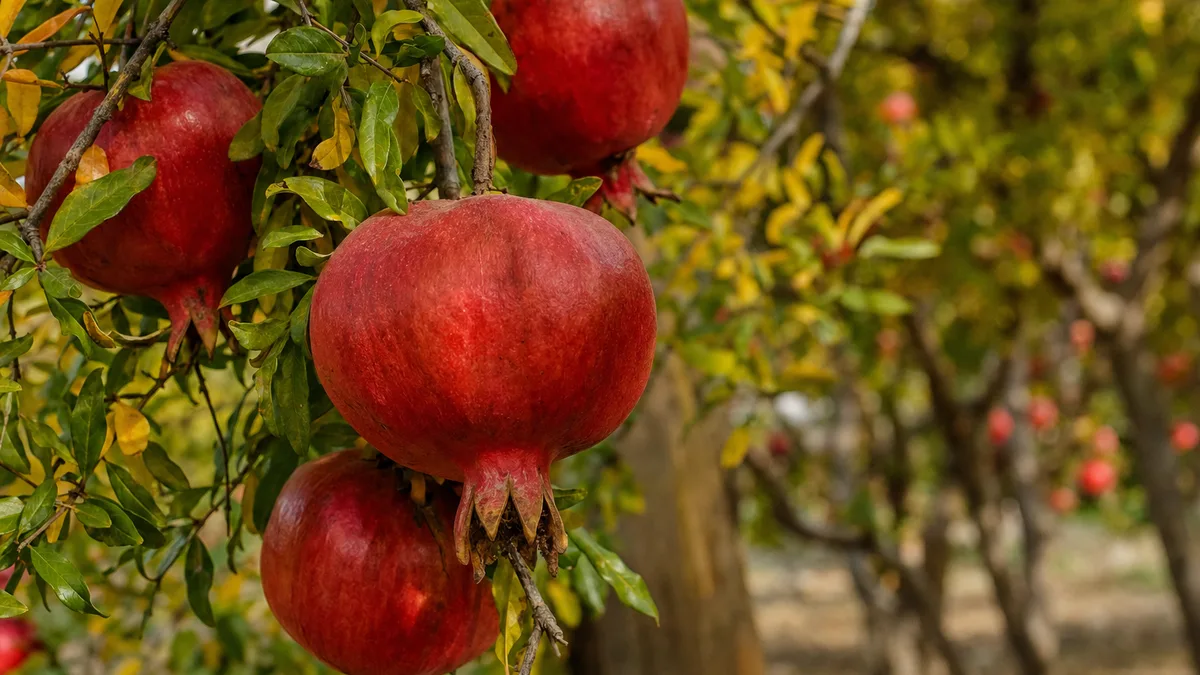
Pomegranate Ripeness at a Glance
Most advice online is about the tree, but a lot of searches come from people standing in a produce aisle. The signs are not identical, so here they are side by side.
| Sign | On the tree | At the store |
|---|---|---|
| Color | Varies by variety, from golden or pink to deep red (UF/IFAS, Utah State) | Do not rely on it alone, since variety changes the color |
| Shape | Round sides turn slightly square (UC Master Gardeners) | Plump and round (USDA SNAP-Ed) |
| Weight | Not described in the extension guides reviewed | Firm and heavy for its size (Illinois Extension, USDA SNAP-Ed) |
| Skin | Fingernail leaves a mark with gentle pressure (UC Master Gardeners) | No cracks, cuts or bruises (UC Davis Postharvest) |
| Sound | Metallic ring when tapped (Texas AgriLife, UGA, UC Master Gardeners) | Not a store test; use weight and condition |
| Crown | Petals at the top curl slightly inward (UC Master Gardeners) | Dry and intact, not mouldy |
The store column on weight and condition comes from Illinois Extension, USDA SNAP-Ed and UC Davis. The crown note for the store is a plain-sense check, not an extension finding.
How to Tell When a Pomegranate Is Ripe on the Tree
There is no single switch that flips when a pomegranate is ready, so use several cues together. The most complete list comes from the UC Master Gardeners of Placer County, and the other extension sources agree with parts of it.
Color is a clue, not a verdict
Rind color depends on the variety. Clemson Extension says fruit goes from green to several shades of red, and the University of Florida’s Manatee County Extension describes colors from golden to deep red. Utah State Extension says the skin of its example fruit turns from green to pink and becomes deep red in some varieties. If you do not know which variety you have, color alone will mislead you. UGA Extension adds that color changes with the season, so growers use it alongside other checks.
Slightly squared sides
An unripe fruit is a near-perfect sphere. According to the UC Master Gardeners, as the seed sacs inside fill with juice the sides become slightly square, so a fruit with faintly angular shoulders is further along than a perfectly round one. This is the easiest cue to spot from a few feet away.
The calyx, or crown
The spiky crown on top is the dried remains of the flower. The UC Master Gardeners say the petals that form a rose-like shape there turn slightly inward on a ripe fruit.
Skin texture
Rub the skin with a fingernail. The same source says that if gentle pressure leaves a scratch, the fruit is ripe, while unripe skin is hard and resists marking. Be gentle, since a scratched rind is one more way in for rot.
The tap test
Tap the fruit lightly with a knuckle. Texas AgriLife’s pomegranate production guide says fruit that is ready may give a metallic sound, and UGA Extension says experienced growers listen for a metallic ting. Think of it as a tiebreaker. It is hard to judge on your first tree, so compare a few fruits on the same plant.
What commercial growers measure
Packers do not rely on squinting at color. For the Wonderful variety, UGA Extension gives juice acid below 1.85 percent and soluble sugar above 16 to 17 percent, and UC Davis Postharvest lists soluble solids above 17 percent and acidity below 1.85 percent. UGA also notes these figures are for Wonderful, and other cultivars will differ. A refractometer is overkill for a backyard tree, but it explains why sweet fruit is not always the reddest one.
When to Pick Pomegranates: Harvest Months
Pomegranates take a long time to mature. Texas AgriLife says fruit ripens about 6 months after bloom, and the UC Master Gardeners say 6 to 7 months depending on variety, bloom date and summer weather. Harvest months therefore vary by region and variety, and the sources give different windows.
| Source | Harvest window it gives |
|---|---|
| UC Master Gardeners (California) | October and November |
| Clemson Extension (South Carolina) | Roughly August through October |
| University of Georgia Extension | End of August for early types, through October or early November for late types |
| Texas AgriLife | September for early varieties, through October for later ones |
| UF/IFAS Manatee County | July to November |
Read that as a range, not a rule: the best time to pick pomegranates is when the fruit shows the cues above, not on a calendar date. Variety shifts the timing too. Utah State Extension says Early Wonderful ripens about 2 weeks ahead of Wonderful, and Granada about a month earlier. UGA Extension suggests planning two to four harvest passes per season, because fruit on one plant does not ripen all at once.
The one rule that should change how you behave is this: pomegranates do not ripen after they come off the plant. UC Davis Postharvest says they must be picked fully ripe for the best eating quality, and the UC Master Gardeners say the fruit does not ripen any further after harvest. Texas AgriLife calls the fruit non-climacteric and says to pick only at full maturity. A pale, hard pomegranate left on the counter will stay pale and hard. Green tomatoes are the opposite case, and our guide to ripening green tomatoes indoors covers how they finish off the vine. Dragon fruit is another fruit judged at harvest, as covered in how to tell if a dragon fruit is ripe.
How to Pick Pomegranates From the Tree
Do not yank the fruit. Both Texas AgriLife and the UC Master Gardeners say to cut the stem rather than pull, and to cut close to the fruit so the leftover stub does not scratch its neighbors. For harvest passes, rain timing and storage after picking, see our guide to how to pick pomegranate fruit.
- Check several cues. Look for squared sides, an inward-curling crown, and a skin that gives a faint fingernail mark. Add a light tap.
- Check for cracks first. Split fruit can spoil on the tree in rain, as covered below, so pick those soonest.
- Hold the fruit and clip. Use clean pruners and cut the short stem right at the fruit.
- Handle gently. UGA Extension notes a strong bump during handling can split a fruit open.
- Keep unsplit fruit for storage. The UC Master Gardeners say unsplit fruit is the kind to keep, so eat the cracked ones first.
- Return in a week or two. Fruit ripens unevenly, so plan on several visits.
Splitting, Cracking and Rain
A split pomegranate is not always a ripe one. Utah State Extension says a plant that takes up water quickly after a dry spell can split its rind, that late summer and early fall rain encourages cracking, and that the closer the rain is to harvest the worse it can get. Cracks let in fungal spores and insects. Texas AgriLife also names a fungal disease that causes fruit splitting as the fruit begins to mature, and UGA Extension adds that excess fall soil moisture, sunburn and rough handling can all contribute.
The UC Master Gardeners offer a practical read on the problem: some growers let the first fruit crack, taste a few, then harvest the rest, and ideally you pick just before splitting because rain can spoil split fruit on the tree. Utah State and the University of Florida both point to regular watering as the best prevention. Utah State suggests a deep soak every 7 to 10 days in dry weather, and the UF/IFAS Manatee County article gives the same 7 to 10 days when there is no rain. Clemson says even soil moisture reduces splitting and fruit drop.
How to Choose a Good Pomegranate at the Store
The tree tests do not transfer well to a bin of fruit, and most of the extension guidance for shoppers is about weight and condition. Illinois Extension says to choose whole pomegranates that are firm and heavy, and warns that fruit that is soft or light for its size may have burst arils or decay inside. USDA SNAP-Ed says plump, round and heavy for their size. UC Davis Postharvest lists skin color and smoothness, and the absence of growth cracks, cuts and bruises, as quality marks.
A simple routine works in the produce aisle:
- Pick up two or three. Keep the one that feels heaviest for its size.
- Squeeze gently. It should feel firm all over, with no soft or sunken patches.
- Inspect the skin. Skip any with cuts, bruises, mould or wet spots.
- Accept some shape variety. Slightly flattened sides can be a ripeness sign on the tree, so do not penalise them.
Because the fruit will not ripen at home, a hard pale pomegranate is not a bargain waiting to improve. The sources do not say how ripe shop fruit was when picked, so lean on weight and condition.
How Big Is a Pomegranate?
Size varies a lot, and the sources give overlapping ranges rather than one answer. Clemson Extension says fruit is usually about 2 to 3 inches across and occasionally up to 5. Utah State Extension gives 2 1/2 to 5 inches, with Balegal and Fleshman about 3 inches and Phoenicia 4 to 5 inches. Texas AgriLife says up to about 4 inches and names Wonderful as a large-fruited variety. USDA SNAP-Ed uses a 4-inch fruit as its reference serving. Since size depends so much on variety, a small fruit is not automatically unripe. UGA Extension adds that the largest fruit come from the blooms that open early in spring, and fruit from young trees tends to be small.
How to Tell if a Pomegranate Is Bad
Spoilage shows up both outside and inside. Work through these in order.
- Soft, light or sunken fruit. Illinois Extension says fruit that is soft or light for its size may have burst arils or decay inside.
- Off-color rind and black spots in cracks. New Mexico State University describes a fruit rot where the rind looks slightly off-color, such as pale red, and black spore growth can form in cracks.
- Brown or black arils. The same NMSU guide says affected fruit cut open shows brown to black rotted arils with black powdery spores. It is also called black heart.
- Dull, red-brown or shriveled arils. Illinois Extension says to keep shiny, bright to deep red arils with intact juice sacs and discard ones that are dull, red-brown or shriveled.
- Browned membranes after long cold storage. UGA Extension says storage beyond three weeks at low temperatures can cause chilling injury, which browns and softens the membranes and arils.
When in doubt, throw it out. This is general kitchen caution rather than a sourced rule, and the sources reviewed give no figure for how many days a cut fruit lasts at room temperature.
How to Cut, Open and Store a Pomegranate
Illinois Extension and Utah State Extension both describe approaches that avoid the usual juice spray. Wear an apron, since Utah State warns that the juice stains and the fruit tends to spurt.
- Wash your hands and the fruit. Illinois Extension starts here.
- Cut off one end. Illinois Extension removes one end with a knife, and Utah State removes the crown and scores the fruit lengthwise in three or four places.
- Break it into sections. Cut around the fruit and gently pull the sections apart.
- Release the arils. Work them out by hand or tap the back of each section with a spoon. Utah State also describes doing this under water, where the seeds sink and the membranes float.
- Use plastic or glass. Utah State says metal utensils can darken the juice.
Storing whole fruit and arils
Storage guidance differs by source, so here are the figures with their origins:
- Whole fruit, refrigerated: up to two months (USDA SNAP-Ed); several months for unsplit fruit (UC Master Gardeners); UC Davis Postharvest says 41°F for up to 2 months at 90 to 95 percent humidity, with 45°F for longer storage to avoid chilling injury. Texas AgriLife gives about 40 to 45°F and up to three months. Utah State says 6 to 7 months at 32 to 41°F.
- Loose arils in the fridge: within 7 days (Illinois Extension) or up to 5 days (Utah State).
- Frozen: use within 1 year (Utah State). Spread arils on a tray to freeze in a single layer, then bag them.
The wide spread between 2 months and 7 months reflects different fruit quality, handling and storage conditions. For a home fridge, the more cautious end is the safer planning figure.
Planning Your Own Pomegranate Harvest
If you are thinking about growing your own, set expectations early. Clemson Extension says a young plant may flower and set a fruit or two in its first year, and most plants bear well about three years after planting. Texas AgriLife puts the first economical harvest at about year 4, at 20 to 25 fruits (10 pounds) per tree, rising to 100 to 150 fruits (50 pounds) at year 10. Clemson adds that vigour declines after roughly 15 years. If you are comparing fruit trees by how long they take to bear, see our guide to planting mangoes from seeds.
If you inherited a pomegranate and want to know where it sits on that timeline, you can estimate its age from the trunk. See also our guide on how to tell the age of a tree.
Your winters decide whether a plant will survive, and in colder areas a winter checklist helps; ours is in the winterize your garden guide.
Other growing zone pages are at growing zones, and more on woody plants is in the trees and shrubs hub.
For the fruit itself, Texas AgriLife says a well-managed orchard can reach 200 to 250 fruits, about 75 pounds, per tree.
Free book · 23 pages, PDF
How to Tell if a Pomegranate Is Ripe FAQ
Do pomegranates ripen after they are picked?
No. UC Davis Postharvest says pomegranates do not ripen after harvest and must be picked fully ripe for the best eating quality, and the UC Master Gardeners say the same. Texas AgriLife calls the fruit non-climacteric. A hard, pale fruit will not improve on the counter.
How do you know when a pomegranate is ripe if it is not red?
Use the other cues. Clemson Extension says color runs from green to several shades of red, UF/IFAS describes golden to deep red fruit, and Utah State describes pink skin on its example. Check for slightly squared sides, a crown that curls inward, a skin that marks under a fingernail, and a metallic sound when tapped.
What month are pomegranates ripe?
It depends on region and variety. The UC Master Gardeners give October and November, Clemson says roughly August through October, UGA Extension says late August to early November, and UF/IFAS Manatee County gives July to November. Go by the ripeness cues, not the date.
Is a pomegranate that has split open still good?
Often yes, if you act quickly. The UC Master Gardeners say some growers wait for the first fruit to crack and then taste a few, but rain can spoil split fruit on the tree. Utah State Extension warns cracks let in fungal spores and insects, so eat split fruit soon and do not store it. Discard any with black spores or rotted arils.
How do you tell if a pomegranate is bad inside?
Illinois Extension says to keep shiny, bright to deep red arils and discard ones that are dull, red-brown or shriveled. New Mexico State University describes rotted fruit with brown to black arils and black powdery spores.
How long does a whole pomegranate last?
USDA SNAP-Ed says up to two months in the refrigerator, and UC Davis Postharvest gives up to 2 months at 41°F. Other sources give longer, Texas AgriLife up to three months and Utah State 6 to 7 months in ideal conditions, so use the shorter figure at home.
Sources & further reading
Ripeness cues, harvest months and splitting advice come from the UC Master Gardeners of Placer County, Clemson Home and Garden Information Center, UF/IFAS Extension Manatee County, University of Georgia Extension’s Pomegranate Production, Utah State University Extension’s Pomegranate, Fruit of the Desert and a copy of the Texas fruit and nut production guide on pomegranates hosted by UF/IFAS. Maturity, quality and storage data come from UC Davis Postharvest Technology, whose fact sheet was last updated in 1996. Store selection and opening advice come from University of Illinois Extension, USDA SNAP-Ed Connection and Utah State’s How to Preserve Pomegranates. Rot symptoms are from New Mexico State University’s Guide H-150. For how we source the facts on this site, see our methodology page.
Free book · 23 pages, PDF
The Spacing & Planting Cheat Sheet
Sent