How to Use This Calculator
- Pick a spacing preset for your use, or choose Custom spacing and type your own.
- Choose a layout: rectangular grid, triangular, or rows by length.
- Enter the length and width of the area (or the row length and number of rows).
- Read how many trees fit and the trees per acre at that spacing.
- Switch to Hole, mulch and water, enter the root ball size, trunk diameter, and mulch ring, and read the numbers for each tree and for all of them together.
How Many Trees Can I Plant?
The number is set by spacing: trees per acre = 43,560 ÷ (spacing × row spacing), with both spacings in feet (University of Georgia, Warnell School of Forestry). For a specific plot, the calculator counts whole spacing cells instead of rounding a density, so a 100 × 100 ft plot at 30 × 30 ft holds 9 trees (3 × 3), while dividing the area by 900 sq ft per tree would suggest 11.
The three layouts count differently:
- Rectangular grid. Trees = floor(length ÷ spacing) × floor(width ÷ row spacing). Best for orchards and blocks of shade trees.
- Triangular. Rows sit 0.866 × the spacing apart and every other row is staggered half a spacing, so trees = floor(length ÷ spacing) × floor(width ÷ (0.866 × spacing)). It fits about 15% more trees per acre than a square layout (New Mexico State University Extension). Leave half a spacing of extra room at one end for the staggered rows.
- Rows by length. For a hedgerow or windbreak you stake a line, so there is a tree at both ends: trees per row = floor(length ÷ spacing) + 1, times the number of rows.
Spacing is the one input that changes the answer most, and it depends on the kind of tree. The presets use figures published by university extension, shown in the table above with their sources, and the preset note under the dropdown shows the full published range. The spacing inputs start at the middle of a range, so push toward the low end for dwarf or compact varieties and the high end for vigorous ones. The Maine orchard figures are for regions with cold winters and short growing seasons, and trees in warmer climates with longer growing seasons need more room than those numbers (University of Maine Cooperative Extension).
Windbreaks have one extra rule. University of Nebraska Extension advises making the between-row spacing 4 ft wider than the widest piece of equipment that will maintain the planting or provide access.
Spacing by Use
The table near the top of this page lists the published spacing for each preset: windbreak rows (University of Nebraska Extension), shrub hedges and landscape trees (Washington State University Extension), and fruit trees (University of Maine Cooperative Extension). Where a source gives one number rather than a range, the table shows that number. Where it gives a single spacing for both directions, the calculator uses it for the row and between rows.
Planting Hole, Mulch and Water for Each Tree
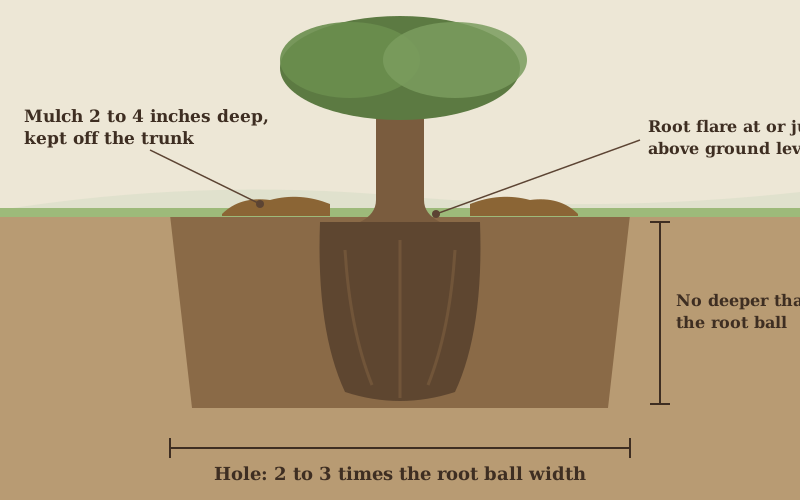
The second tab turns the tree count into a shopping and digging list. It uses four published rules:
- Hole width: 2 to 3 times the width of the root ball, container, or root mass (Iowa State University Extension and Outreach; Arbor Day Foundation).
- Hole depth: deep enough that the trunk flare sits level with or slightly above the surrounding soil. In well-drained soil that is 2 to 3 inches less than the root ball height, and in poorly drained soil about two-thirds of it (Iowa State).
- Mulch: 2 to 4 inches deep, kept off the trunk, with at least 4 to 6 inches of bare space around it (Iowa State; Arbor Day Foundation). Each tree’s mulch is a flat ring: π × (outer radius² − bare radius²) × depth, where the bare radius is half the trunk diameter plus the bare space.
- Water: 1 to 2 gallons per inch of trunk diameter at each watering, at least once a week (University of Illinois Extension). The calculator gives the amount per watering, not per week, because the number of waterings depends on weather and soil.
Totals multiply the per-tree numbers by the number of trees: the first tab’s count by default, or whatever you type into Number of trees. Mulch totals are shown in cubic yards (cubic meters in metric), the unit bulk suppliers sell by. To compare bagged and bulk mulch for a big planting, put that volume into the Mulch Calculator.
Worked Examples
A small orchard block
You have a 90 × 60 ft area for semi-dwarf apples. The University of Maine figure is about 15 ft apart, so the preset fills in 15 ft in the row and 15 ft between rows.
- Trees along the length: 90 ÷ 15 = 6.
- Rows across the width: 60 ÷ 15 = 4.
- Total: 6 × 4 = 24 trees.
- Density: 43,560 ÷ (15 × 15) = 194 trees per acre.
Now the planting numbers for those 24 trees, each with an 18 inch wide, 16 inch tall root ball and a 1.5 inch trunk, in well-drained soil, with a 4 ft mulch ring 3 inches deep and 6 inches left bare around the trunk:
- Hole width: 2 × 18 = 36 to 3 × 18 = 54, so 36–54 inches.
- Hole depth: 16 − 3 = 13 to 16 − 2 = 14, so 13–14 inches.
- Mulch per tree: bare radius = 0.75 + 6 = 6.75 in = 0.5625 ft; ring radius = 2 ft; π × (2² − 0.5625²) × (3 ÷ 12) = 2.9 cubic feet.
- Mulch for all 24: 2.9 × 24 = 69.4 cubic feet ÷ 27 = 2.6 cubic yards.
- Water per watering: 1.5 × 1 = 1.5 to 1.5 × 2 = 3 gallons per tree, so 36–72 gallons for all 24.
A two-row windbreak
A 200 ft long windbreak of dense conifers, using the University of Nebraska mid-range figures of 9 ft in the row and 16 ft between two rows:
- Trees per row: 200 ÷ 9 = 22.2, so 22 spaces and 23 trees (one at each end of the line).
- Total: 23 × 2 rows = 46 trees.
- Strip width: 16 ft between the rows, so the planting covers 200 × 16 = 3,200 sq ft.
Common Tree Planting Mistakes
- Digging deeper than the root ball. Iowa State’s guidance is that the hole depth should let the trunk flare sit level with or slightly above the surrounding soil, which is why the calculator caps depth at the root ball height.
- Piling mulch against the trunk. Iowa State says not to place mulch against the trunk and to feather it up to, but not over, the flare. Keep the bare ring around the trunk.
- Using the nursery tag spacing in the wrong climate. The Maine orchard figures assume a cold-winter, short-season region, and trees in warmer, longer seasons need more space (University of Maine Cooperative Extension). Check with your local extension office.
- Forgetting the equipment. Windbreak row spacing should be 4 ft wider than the widest equipment you will use to maintain or reach the rows (University of Nebraska Extension).
- Watering once and walking away. University of Illinois Extension advises supplemental watering at least once a week after planting, and Iowa State notes several waterings a week may be needed in the first few months.
Tree Planting Calculator FAQ
How many trees per acre can I plant?
Divide 43,560 square feet by the area each tree gets: spacing times row spacing. Trees 10 ft apart in rows 10 ft apart fit about 436 per acre, 12 by 12 ft fits about 303, and 20 by 20 ft fits about 109 (University of Georgia, Warnell School of Forestry). The calculator shows this density for whatever spacing you enter.
Can I use this as a tree plant calculator for a whole property?
Yes, as long as each block has one spacing. Run the calculator once per block (an orchard here, a windbreak there, a row of shade trees along the drive), then add the tree counts.
How far apart should I plant trees for a windbreak?
University of Nebraska Extension lists 6–12 ft between dense conifers in a row with 12–20 ft between rows, 10–18 ft between medium-height trees with 14–20 ft between rows, 12–20 ft between tall trees with 20–25 ft between rows, and 4–6 ft between shrubs with 8–10 ft between rows. It also advises making row spacing 4 ft wider than the widest equipment you will use to maintain the planting.
What is the difference between a rectangular and a triangular layout?
In a triangular (staggered) layout every other row is shifted half a spacing, so each tree is the same distance from its neighbors and rows sit 0.866 times the spacing apart. That fits about 15% more trees per acre than a square layout at the same spacing (New Mexico State University Extension), though New Mexico State notes the layout is harder to set out and less adaptable to thinning.
How wide and deep should a tree planting hole be?
Iowa State University Extension says to dig the hole 2 to 3 times the width of the root ball, with the trunk flare level with or slightly above the surrounding soil. For depth it recommends 2 to 3 inches less than the root ball height in well-drained soil and about two-thirds of the root ball height in poorly drained soil. Some guides, such as the Arbor Day Foundation’s, say “as deep as the root ball,” so this calculator never goes deeper than the root ball is tall.
How much mulch does each tree need?
Spread mulch 2 to 4 inches deep and keep it off the trunk: Arbor Day Foundation says 4 inches of clearance, Iowa State says at least 6. A 4 ft ring at 3 inches deep with 6 inches left bare around a 1.5 inch trunk takes about 2.9 cubic feet per tree. For a flower or vegetable bed instead of a tree ring, use the Mulch Calculator.
How much water does a newly planted tree need?
University of Illinois Extension recommends 1 to 2 gallons per inch of trunk diameter at each watering, and at least once a week. A tree with a 1.5 inch trunk gets 1.5 to 3 gallons per watering. Iowa State adds that several waterings a week may be needed in the first few months, so treat the calculator’s figure as the amount per watering, not per week.
How much does tree planting cost?
It depends on the size and kind of tree (bare-root, container, or balled and burlapped), your soil and access, how many trees you are planting, and whether you hire the work. This page does not quote prices because they vary by region and supplier. Use the tree count and mulch volume here as the quantities to ask for, and get several local quotes from nurseries, landscapers, or arborists.
Sources & further reading
- “Number of Trees per Acre by Spacing Distance”, University of Georgia Warnell School of Forestry and Natural Resources (Kim D. Coder): the 43,560 formula and table values.
- “Windbreak Design” (G1304), University of Nebraska-Lincoln Extension: Table 1 windbreak spacing and the equipment-width rule.
- “Spacing of Landscape Plants” (C132), Washington State University Extension: hedge and landscape tree spacing.
- “Spacing Trees in an Orchard”, University of Maine Cooperative Extension: fruit tree spacing.
- “Designing A Pecan Orchard”, New Mexico State University Extension: triangular layout fits about 15% more trees per acre.
- “Tree Planting Basics” and “How large of a hole should be dug when planting a tree?”, Iowa State University Extension and Outreach: hole width and depth, trunk flare, and mulch.
- “How to Plant Balled & Burlapped Trees”, Arbor Day Foundation: hole width and mulch.
- “Care of Newly Planted Trees”, University of Illinois Extension: watering per inch of trunk diameter.
For how we source and review the formulas behind every calculator, see our methodology page. Spacing and planting depth vary by species and region, so check with your local extension office before you order trees. For the full picture of caring for trees after they are in the ground, see our guide to trees and shrubs.