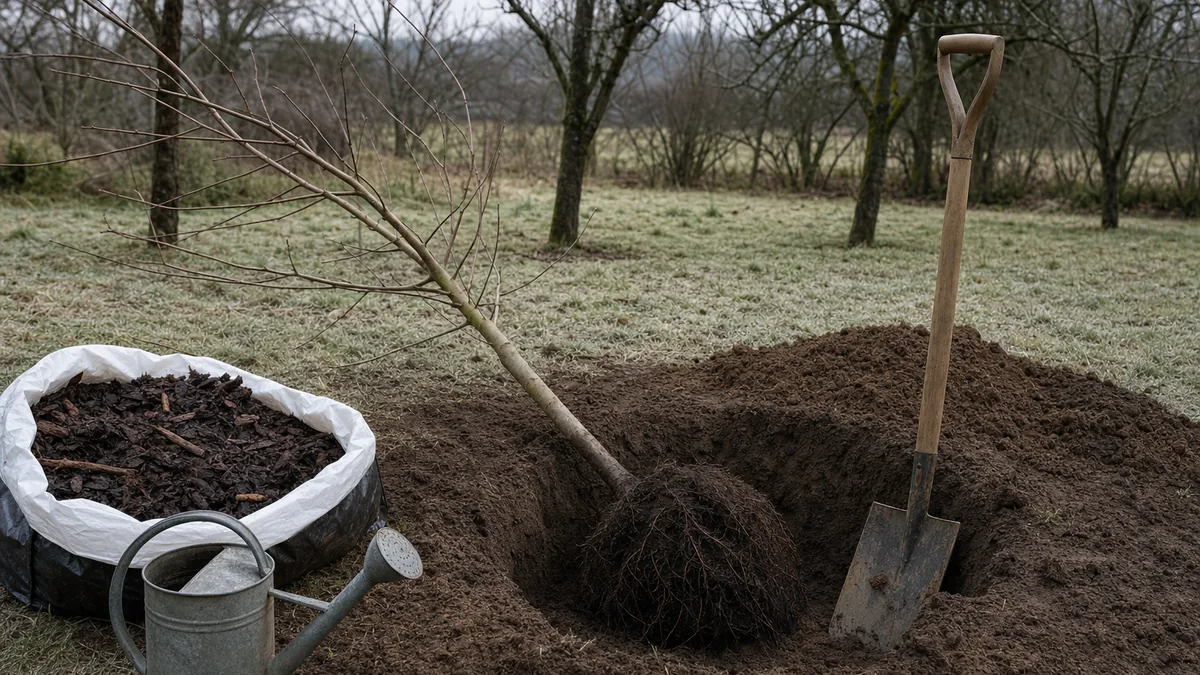
Yes, you can plant trees in the winter as long as the tree is dormant and the soil is not frozen, according to University of Maryland Extension, which lists fall, winter (soil should not be frozen) and early spring as the best times to plant trees and shrubs. Bare-root trees belong in the ground in late winter or early spring, says Purdue Extension, and a few species do better if they wait. Our trees and shrubs hub has guides for specific trees.
Planting Trees in Winter at a Glance
The answer depends on the soil, the tree and how it was grown. This table sums up what the extension services below say, and your USDA hardiness zone tells you how long your winter ground stays workable. What lies under the topsoil matters for roots too, and soil profile horizons explains each layer.
| Tree type or situation | Winter planting OK? | What to do | Source |
|---|---|---|---|
| Dormant tree, soil thawed and workable | Yes | Plant, water in and mulch | University of Maryland Extension |
| Any tree, soil frozen | No | Postpone; pot bare-root stock in a frost-free place | University of Maryland Extension |
| Bare-root tree | Yes, late winter to early spring | Plant while still dormant, before growth starts | Purdue Extension, Iowa State Extension |
| Balled-and-burlapped and container trees, milder climates | Yes | Plant in the cooler months after leaf drop | Clemson Extension |
| Bare-root fruit trees | Yes, February or March in Oregon | Early spring where winters are cold | Oregon State Extension |
| Oaks, birches, magnolias, dogwoods, tuliptree, sweetgum | Better to wait | Plant in spring | Purdue Extension, University of Maryland Extension |
| Pine and spruce | Not in winter | Plant in early fall or early spring | UMass Extension, North Dakota State Extension |
| Broadleaf evergreens (rhododendron, boxwood, holly) | No | Plant in spring | University of Maryland Extension |
Can You Plant a Tree in Winter When the Ground Is Frozen?
No. University of Maryland Extension says to postpone planting if the ground is frozen, and not to water while it is frozen. The roots cannot spread into frozen soil, and you cannot dig a hole wide enough to hold them. For a bare-root tree that arrives during a freeze, the same page says to pot it temporarily in a frost-free location until the ground thaws. Vegetables follow the same rule, and can you plant potatoes in the winter shows where an early planting works and where seed pieces rot.
Planting in a thaw has its own risk. An Illinois Extension specialist, answering a reader about planting in early winter, said fall-planted trees often show winter kill and frost heaving, and advised holding off until late winter or early spring if the trees can be stored properly. Winter ground can also be soggy. Roots sitting in saturated soil are how root rot starts, and a University of California Master Gardener program says a planting site that takes longer than 3 or 4 hours to drain after you fill the hole with water is not adequate. On poorly drained soil it suggests planting on a mound.
Which Trees Do Poorly When Planted in Winter?
Extension lists agree on the general idea but not on every species. Purdue Extension says to plant magnolia, dogwood, tuliptree, sweet gum, red maple, birch, hawthorn, poplars, cherries, plum and many of the oaks in spring. The University of Wisconsin Extension horticulture program has a similar spring list that adds ginkgo and beech, and puts dogwood, rhododendron and azalea on a list of shrubs not suggested for fall planting. University of Maryland Extension says trees with fleshy roots, such as dogwoods, magnolias, willow oaks, tulip poplar and yellowwood, should be planted or transplanted in spring.
Those pages are about fall planting more than deep winter, but the logic carries over: a slow-rooting species set in cold soil has less time to establish before it has to cope with a full season of leaves and heat. Sources disagree on a few trees. Wisconsin puts hawthorn and redbud on both its fall and spring lists, and Illinois Extension, quoting the Morton Arboretum, lists maples as a fall choice while Purdue and Wisconsin flag red maple for spring. Hardy shrubs are easier: Wisconsin suggests lilac, forsythia and witch hazel for fall planting.
Can I Plant Bare-Root Trees in Winter?
Yes, in the right window. Purdue Extension says bare-root plants should only be planted in late winter or early spring while the plants are still dormant. Iowa State Extension says bare-root trees must be planted in spring before growth begins, and that if planting has to wait you should keep them cool, around 40°F, and damp. University of Minnesota Extension and North Dakota State Extension also say early spring. A bare-root tree has no soil around its roots, so it dries out fast, and Iowa State says to plant as soon as you can.
Balled-and-burlapped (B&B) and container trees are more forgiving. University of Maryland Extension says B&B plants can be planted almost any time the ground can be worked, and Clemson Extension says container-grown and B&B plants with well-developed root systems can be planted throughout the year in the Southeast, where most B&B trees are dug in the cooler months after leaf drop. The University of Minnesota gives a different answer for a colder state, saying to plant B&B stock in spring, summer and fall. So the further north you live, the narrower the winter window gets. Our growing zones pages show how cold your state runs.
Can I Plant Fruit Trees in Winter?
Yes, bare-root fruit trees are sold in winter for exactly this reason. A University of California Master Gardener program says planting young, leafless trees in winter has several advantages, and says to soak the roots for at least 1 hour or up to 24 hours first. Oregon State Extension says nurseries dig bare-root trees only once they are dormant, which can be as late as January, and that early spring, February or March for example, is an ideal time to plant them. It prefers early spring in the colder parts of Oregon.
For an apple, the wait to fruit is long enough that a good start matters; our guide on how long an apple tree takes to grow gives the timeline by rootstock. Wisconsin Extension lists apple among the trees suggested for fall planting. Cherry and plum are on the spring list at Purdue and Wisconsin, and for another stone fruit the guide to growing a peach tree from a pit covers the chill and fruiting timeline from seed. In warm regions, fruit trees such as pomegranate are planted in early spring after the worst frost, as our pomegranate planting guide explains, while a frost-tender tropical like the mango, covered in our mango guide for zones 10 and 11, is not a tree to risk in a freeze.
Can You Plant Evergreen Trees in the Winter?
Mostly no. University of Maryland Extension says broadleaf evergreens are generally best planted in spring, and that mountain laurel, boxwood and hollies can be moved in early fall if they are watered deeply and mulched. UMass Extension says rhododendron and yew should wait until spring, and Purdue Extension says evergreens, particularly broad-leaved ones, are more susceptible to winter desiccation because their leaves lose water all winter while the roots cannot take it up from cold soil. University of Minnesota Extension is blunt: do not plant evergreens later than October so the roots have a chance to become established.
Nebraska Extension adds that evergreens lose water faster than deciduous trees, that browning often does not show until early spring, and that winter watering helps. If a cold snap catches a young evergreen anyway, our guide on how to protect plants in winter covers what to put over it and when.
Can I Plant a Pine Tree in the Winter?
Not in the depths of winter, and the safe windows are on either side of it. UMass Extension says pine and spruce will do well if planted before the end of September while the soil is warm. The University of Wisconsin Extension horticulture program is earlier still, saying to plant them by mid August to September with proper watering. North Dakota State Extension says evergreens such as spruces and pines should also be moved in early spring while dormant, and that late August through September is a good time too. The Morton Arboretum, quoted by Illinois Extension, lists pines and spruces among the trees to plant in fall.
So the sources give you two windows: early fall, which fits on the same autumn to-do list as our winterize garden steps, and early spring as the ground thaws. The frozen-ground rule still applies in between. If you missed the fall window, buy the tree in a container and plant it when the soil can be worked, or heel it in until then.
How to Plant a Tree in Winter, Step by Step
These steps combine the planting advice from Clemson, Iowa State, Minnesota and Maryland Extension, for a dormant tree on a day when the soil is workable.
- Check the soil and the forecast. Push a spade in. If it will not go in, wait. Maryland says to postpone if the ground is frozen.
- Keep the roots moist until planting. Iowa State says to soak bare roots for one to two hours after pruning off damaged ones, and again for several hours just before planting. Keep B&B root balls from drying out, as Maryland advises.
- Dig a wide, shallow hole. Clemson says the hole should be at least twice and preferably five times wider than the root ball, and not deeper than the root ball is tall. For bare root, Iowa State says two to two and a half times the spread of the roots.
- Set the trunk flare at the surface. Clemson says the top roots should sit level with the soil surface in well-drained soil, and 2 to 4 inches higher in poorly drained or compacted soil. Iowa State says the trunk flare should be even with the surrounding soil.
- Backfill and water as you go. Iowa State says to water the backfill when the hole is three-quarters full and again at grade, which settles air pockets.
- Stake only if needed. Maryland says large bare-root trees, top-heavy trees and trees on windy sites may need two stakes 5 to 6 feet long, with ties loose enough to let the trunk sway.
- Mulch and water. Spread organic mulch (our organic vs. inorganic mulch comparison covers the difference), keep it off the trunk, and follow the watering schedule below.
If you are planting several trees, the spacing and hole sizes add up quickly, so it helps to plan the layout before the ground thaws.
How Should You Water and Mulch a Tree Planted in Winter?
Water on a schedule while the soil is unfrozen, then let the soil guide you. Penn State Extension and University of Minnesota Extension both say at least 1 to 1.5 gallons per inch of trunk diameter each time you water, and give the same schedule: daily for the first 2 weeks, every 2 to 3 days through week 12, then weekly. Alabama Extension is more generous, suggesting 2 gallons per inch of trunk diameter at planting. North Dakota State Extension is gentler, saying twice a week for the first month, once a week for the second, then every 10 to 14 days, and that a tree in moist soil does not need extra water.
Once the weather turns cold, you water less. Colorado State Extension says to water monthly on sunny days when it is above 40°F and the ground is not frozen, and Nebraska Extension says 1 to 2 times a month around midday at 40 to 45°F. Purdue Extension says to keep watering until the ground freezes, even after the leaves have fallen. Penn State says establishment in USDA zones 2 to 6 takes roughly one year per inch of trunk diameter, so a 2-inch tree needs about two growing seasons of care. Years later, how to tell the age of a tree explains how to estimate how old it is.
Mulch depth varies by source. Clemson Extension says 2 to 4 inches of organic mulch, University of Minnesota Extension and Texas A&M Forest Service say 2 to 3 inches, North Dakota State Extension says 3 to 4 inches, and Colorado State Extension gives 4 to 5 inches of wood or bark chips. A safe middle is 2 to 4 inches. Every source agrees on the trunk: Clemson says do not let mulch touch it, and Minnesota says keep it at least 4 inches away. Piling it up is one of the mulch mistakes that hurt trees.
Care for a new tree runs for years, and the Tree & Shrub Care Planner app works out how much to water a newly planted tree and when, from planting day until it is established, if you would rather not track it on paper.
Is Fall or Early Spring Better Than Winter for Planting Trees?
For most trees, yes. Illinois Extension says the ideal time to plant a tree is when you get regular rainfall, which in the Midwest means spring and fall. UMass Extension says plants need at least six weeks to establish before the ground freezes, and Purdue Extension asks for soil above 55°F at 6 inches deep when you plant in fall, which usually lasts into October or later depending on location. Clemson Extension says the roots of ornamental plants in the Southeast keep growing through warm fall and winter months, and early spring planting gets a tree into the ground before growth starts.
Winter planting makes the most sense as a fallback: the nursery order arrived in January, the soil is thawed and the tree is dormant. If the ground is locked up, hold the tree and wait. Your average first fall frost and last spring frost mark both windows, and our frost dates pages list them by place.
If you would rather plant something that grows now, see what to plant in winter by climate. The same cold-soil logic applies to lawns, covered in can you plant grass seed in the winter. To see what to plant this month where you live, enter your ZIP code in the planting calendar by ZIP code.
Free book · 23 pages, PDF
Can You Plant Trees in Winter FAQ
Can you plant trees in winter?
Yes, while the tree is dormant and the soil is not frozen. University of Maryland Extension lists fall, winter (soil should not be frozen) and early spring as the best times, and says to postpone planting if the ground is frozen. Some species, including magnolia, dogwood and many oaks, do better planted in spring, according to Purdue Extension.
Can you plant a tree in the winter if the ground is frozen?
No. University of Maryland Extension says to postpone planting when the ground is frozen and not to water it while frozen. A bare-root tree can be potted temporarily in a frost-free place until the soil thaws.
Can I plant bare-root trees in winter?
Yes, in late winter or early spring while the trees are still dormant. Purdue Extension says bare-root plants should only be planted then, and Iowa State Extension says to plant before growth begins and to keep trees cool, around 40 degrees F, and damp if planting must wait.
Can I plant fruit trees in winter?
Yes, bare-root fruit trees are planted in winter and early spring. Oregon State Extension says February or March is an ideal time to plant bare-root trees and prefers early spring where winters are cold. A University of California Master Gardener program says to soak the roots for at least 1 hour first.
Can you plant evergreen trees in the winter?
Generally not. University of Minnesota Extension says not to plant evergreens later than October so the roots can establish, and University of Maryland Extension says broadleaf evergreens are best planted in spring. Purdue Extension notes that broadleaf evergreens are especially prone to winter desiccation.
Can I plant a pine tree in the winter?
Not in deep winter. UMass Extension says pine and spruce do well if planted before the end of September while the soil is warm, and North Dakota State Extension says early spring while dormant also works. Wait for a thaw or for fall.
How deep should the mulch be on a tree planted in winter?
Between 2 and 4 inches, kept off the trunk. Clemson Extension says 2 to 4 inches of organic mulch, University of Minnesota Extension says 2 to 3 inches at least 4 inches from the trunk, and Colorado State Extension gives 4 to 5 inches of wood chips, so sources range from 2 to 5 inches.
Sources & further reading
Planting seasons, frozen ground, B&B timing and trees that need spring planting come from University of Maryland Extension’s Planting a Tree or Shrub, Purdue Extension’s Fall Ideal for Planting Trees, University of Wisconsin Extension’s Tree Species Recommended for Fall Planting, Illinois Extension’s When is the Best Time of Year to Plant Trees and an Illinois Extension Ask Extension answer on early winter planting. Evergreen and pine timing is from UMass Extension’s Fall Planting for Trees and Shrubs, University of Minnesota Extension’s Planting and Transplanting Trees and Shrubs and North Dakota State Extension’s Tree Planting in North Dakota. Bare-root and fruit tree details are from Iowa State Extension’s How to Plant Bare Root Trees, Oregon State Extension’s Should I plant fruit trees in fall or spring and the UC Master Gardeners of Sonoma County’s Planting Bare-Root Fruit Trees. Hole size, depth, mulch and watering come from Clemson HGIC’s Planting Trees Correctly, Penn State Extension’s Meeting the Watering Needs of a Newly Planted Tree, Colorado State Extension’s Care of Recently Planted Trees, University of Nebraska-Lincoln’s Tree Care During the Winter, Alabama Extension’s Proper Tree Planting and Texas A&M Forest Service’s Planting page. For how we source the facts on this site, see our methodology page.
Free book · 23 pages, PDF
The Tree Care Cheat Sheet
Sent