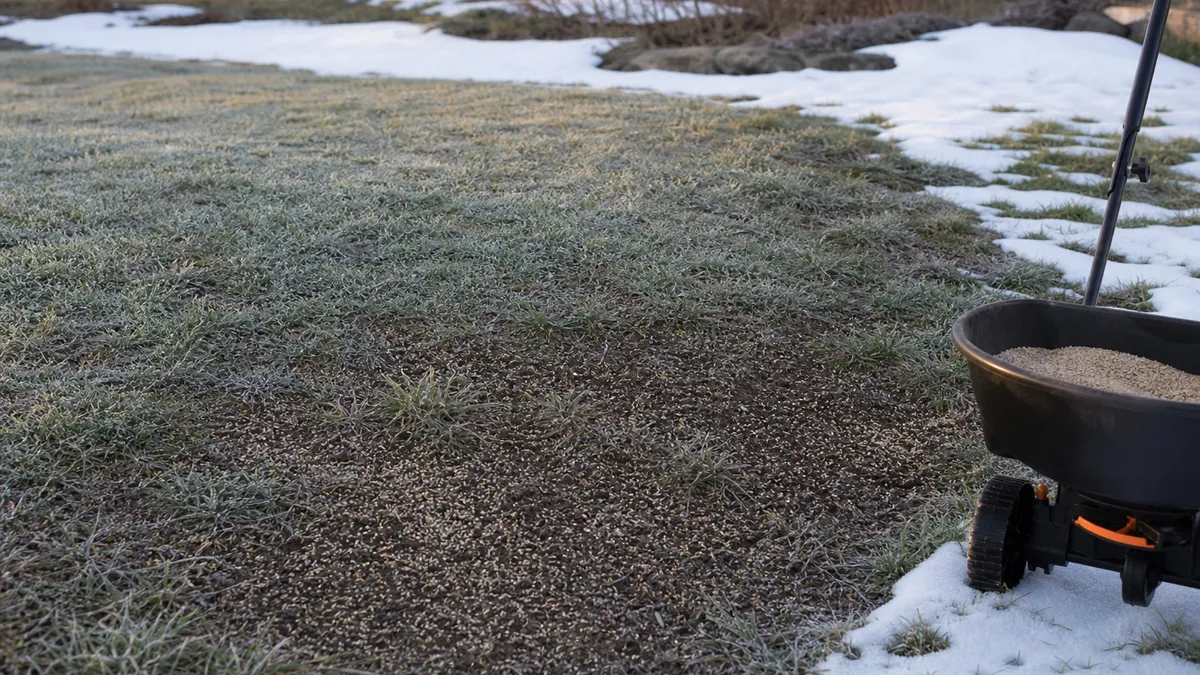
Yes, you can plant grass seed in the winter if you have a cool-season lawn, according to University of Minnesota Extension, which says dormant seeding can be done whenever soil is below 40°F, from early November to mid-March in most of Minnesota. The seed sits dormant until spring. Warm-season grass such as bermudagrass is different: Oklahoma State Extension says to avoid seeding it before May 1.
Planting Grass Seed in Winter at a Glance
The answer depends on your grass type and how cold your winter really is. This table sums up what the extension services below say for each situation.
| Situation | Winter seeding? | What to do | Source |
|---|---|---|---|
| Cool-season lawn, cold winters (Minnesota) | Yes | Dormant seed when soil is below 40°F, early November to mid-March | University of Minnesota Extension |
| Cool-season lawn, Indiana and Illinois | Yes, best in the northern halves | Seed from Thanksgiving through March | Purdue Extension |
| Cool-season lawn, Nebraska | Yes | Spread seed from mid to late November through March | University of Nebraska-Lincoln (archived page) |
| Cool-season lawn, Missouri | Yes, late winter suits best | Seed in February or March so the seed is not exposed for long | University of Missouri IPM |
| Warm-season lawn (bermudagrass, zoysiagrass), most states | No | Wait for upper soil with daily means of 68 to 95°F; not before May 1 | Oklahoma State Extension |
| Bermudagrass, Arkansas trials | Late winter worked | Seeded February 15 and March 15, germinated around mid-April | University of Arkansas |
| Dormant bermudagrass, want a green winter lawn | Overseed in fall, not winter | Perennial ryegrass in October (Arizona low desert) | University of Arizona Extension |
Can You Plant Grass in the Winter? How Dormant Seeding Works
Dormant seeding means spreading seed after the soil has gotten too cold for it to sprout, the opposite of the warm-soil timing in how to reseed a lawn. University of Minnesota Extension says the seed stays dormant until temperatures warm, and that the natural freeze and thaw cycle over winter works it into good contact with the soil. Purdue Extension adds that freeze-thaw cracks in the soil make good germination sites, and that the seed waits until the soil warms in April or May.
The payoff is a head start. The University of Missouri says seed sown dormant germinates at the first suitable spring temperatures, so it competes with weeds for the open space, and seedlings that start early get more time to mature and resist disease before late spring and early summer. Purdue calls ordinary spring seeding difficult and often unsuccessful, which is why dormant seeding is worth considering. Minnesota Extension describes it as an excellent strategy for establishing new areas or improving turf density, while noting two drawbacks covered below.
It only suits cool-season species. Minnesota lists Kentucky bluegrass, the fine fescues and tall fescue, and recommends a mix of species suited to your site. Purdue names Kentucky bluegrass, tall fescue and perennial ryegrass.
When Can You Plant Grass Seed in Winter? Dates and Soil Temperature
The cue is cold soil, not a calendar date. Minnesota Extension says to seed any time soil is below 40°F, and that seedlings can begin to germinate once air and soil rise above 40°F. A cheap soil thermometer settles the question, and our guide to soil temperature for planting shows how to take a reading. Published windows from extension services:
- Minnesota: early November to mid-March in most of the state (University of Minnesota Extension).
- Indiana and Illinois: as early as Thanksgiving and as late as March (Purdue Extension). A Purdue turf page says to wait until after Thanksgiving for Kentucky bluegrass, tall fescue or perennial ryegrass, and allows seeding into March or April if the soil is dry enough to prepare a seedbed.
- Nebraska: mid to late November through March, according to a University of Nebraska-Lincoln page marked as archived, so check current guidance for your area.
- Missouri: late winter may suit best because of the state’s wide temperature swings, says University of Missouri IPM. It cites Purdue trials where November, December or March dormant seeding was effective.
Starting too early is the main danger. Purdue says seeding in early November may still allow germination, but the seedlings are likely to die from winterkill. It also says dormant seeding works better in the northern halves of Indiana and Illinois, because warm spells in the south can trigger germination and the seedlings may die when cold returns. If your winters swing, follow the soil thermometer and the forecast rather than the date, and lean toward late winter. The USDA hardiness zones are built on average winter lows, so they give a rough sense of how cold your winters run, and our growing zones pages list the zones by state.
How to Plant Grass in the Winter, Step by Step
The steps below follow University of Minnesota Extension’s dormant seeding guidance, with Purdue and Missouri details where they add something.
- Wait for cold soil. Soil below 40°F means the seed will not sprout in the next warm afternoon. Late winter is the safer end of the window if you are worried about early germination.
- Clear the surface. Minnesota says to bag heavy tree leaf litter so seed reaches the soil. On thin turf no soil disturbance is needed, and where crabgrass has died you can seed straight into the dead stand, since the residue acts as mulch. For bare ground, Missouri says seed and soil contact is a necessity, so remove existing vegetation with a strong hoe or rake.
- Buy extra seed. Minnesota advises buying 10 to 20 percent more than you need, to patch spots that fail to come up in spring. Neither the Minnesota nor Purdue dormant seeding pages give a separate winter rate. Purdue’s general seeding table for cool-season lawns lists 1.5 to 2.0 lb per 1,000 sq ft for 100 percent Kentucky bluegrass and 6.0 to 9.0 lb for 100 percent tall fescue.
- Spread on dry ground. Minnesota says to use a drop spreader on larger areas or hand-spread small ones, applying half the seed in each of two opposite directions. Do not rake it in afterward. You can spread on melting snow, but Minnesota notes it is easier to see where seed is needed once the ground is bare.
- Protect slopes. On bare soil, especially slopes, Minnesota recommends a germination or erosion control blanket. Purdue suggests straw with a tackifier or commercial netting on moderate slopes and says to avoid steep slopes prone to erosion.
- Water and feed in spring. Once seedlings appear, Minnesota says to water if spring turns dry, mow when most seedlings are above your normal height (ideally at least 3 inches) and apply a starter fertilizer containing nitrogen and phosphate around the first mowing.
Starter fertilizer is easy to overdo on a young lawn, so read our list of fertilizing mistakes before you spread any.
Why Winter Grass Seed Fails
Dormant seeding is not foolproof. The extension pages name these problems:
- Germinating too soon. A warm spell can wake the seed before winter is really over, and Purdue says the seedlings may die when the cold returns.
- Poor contact with the soil. Thick leaf litter keeps seed off the ground, per Minnesota, and Missouri stresses contact.
- Erosion. Purdue names erosion on slopes as the main risk, and Minnesota advises blankets on bare, sloped sites. That is the practical answer to the worry about heavy rain or snowmelt washing seed away.
- No crabgrass preventer. Minnesota and Missouri both say most crabgrass preemergent herbicides also harm turfgrass seed, so you cannot use them on the area. Minnesota says to treat crabgrass that appears with a post-emergent product in early summer, after the second or third mowing, following the label.
- A dry spring. If the seed germinates and spring turns warm and dry, Minnesota says unwatered seedlings can dry out.
- Birds and animals. Minnesota says seed predation has not been observed, but suggests seeding in late winter or early spring, or using a blanket on thin or bare areas, if you are concerned.
- Disease. Missouri says disease can wipe out seedlings in late spring or early summer.
Spring watering is where many winter-seeded lawns are won or lost, and the sprinkler run times depend on your output.
Can You Plant Warm-Season Grass Seed in Winter?
Mostly no. Warm-season grasses need heat to sprout. Oklahoma State Extension says to seed bermudagrass, zoysiagrass and buffalograss when the upper soil has daily mean temperatures of 68 to 95°F, not before May 1, and to seed most bermudagrasses by July 1. Clemson Extension gives a target of May 1 to 14 for all of South Carolina and says planting earlier raises the risk of below-optimal soil temperatures, which slows seedlings and invites seed rot disease. Minnesota Extension notes that buffalograss can be dormant seeded, but that crabgrass is likely to outcompete it.
Sources differ at the edge of the range. University of Arkansas turf researchers found that bermudagrass dormant seeded on February 15 and March 15 germinated around mid-April and established faster than seed sown in April or May. In dormant plots germination occurred as low as 59°F at a 1-inch depth, and emergence took about 14 days against 7 to 10 days for warm-soil seeding. That was a late-winter trial in a state with milder winters than Minnesota, on lawn, golf course and athletic field turf, not a license to scatter seed in December. Oklahoma State and Clemson both point to late spring. Soil temperature rules decide vegetable planting too, and can you plant potatoes in the winter applies the 45 to 50°F floor to a cool-season crop.
If you are not sure which type you have, check the cool-season vs warm-season grass comparison, because the answer decides your seeding season.
Winter Lawns in Warm Climates: Overseeding Bermudagrass With Ryegrass
Warm-climate states do plant grass seed in the winter months, but it is a different job. A bermudagrass lawn turns brown when it goes dormant, and many homeowners in Arizona and Texas overseed it with ryegrass for a green winter lawn. It is a temporary cover, planted in fall, not a way to thicken the permanent grass.
- Arizona: University of Arizona Extension says the ideal time is when daytime highs are 80 to 85°F and nighttime lows are about 55°F, which in the low desert falls in October to November. Seeding earlier favors the bermudagrass, and seeding later risks frost damage to young seedlings. It recommends perennial ryegrass at 12 to 15 lb per 1,000 sq ft, applied in two passes at right angles, with irrigation 3 to 4 times a day for the first 7 to 10 days.
- Texas: a Texas A&M AgriLife Extension column puts the best time for the home lawn at mid to late October and early November, at about 10 to 12 lb of annual ryegrass per 1,000 sq ft. It says overseeding is mainly worth it for lawns with heavy winter traffic.
- Georgia: University of Georgia Extension advises 5 to 10 lb of ryegrass per 1,000 sq ft for lawns, starting when soil at 4 inches approaches 75°F (a thermometer reading, as our soil temperature guide explains) or nights stay in the 50s, 2 to 4 weeks before the average first killing frost.
The cost comes in spring. Arizona says perennial ryegrass persists and competes with greening bermudagrass, so the transition takes extra work, and Texas A&M warns that in a cool, wet spring ryegrass can linger at the bermudagrass’s expense. Arizona also notes that skipping overseeding saves water, and that turf colorants can keep a dormant lawn green. Arizona says St. Augustinegrass and zoysiagrass are generally not suited to overseeding. The Overseeding Calculator gives you the pounds for your lawn size and the rate you pick.
Is Fall Better Than Winter for Grass Seed?
Yes, for cool-season lawns. Purdue gives August 15 to September 15 for the northern half of Indiana and Illinois and September 1 to 30 for the southern half, and says that waiting one week can add 2 to 4 weeks to stand maturity. The University of Nebraska-Lincoln gives the same 2 to 4 week penalty and says tall fescue should be seeded no later than mid-September. University of Maryland Extension recommends mid-August to mid-October, with late February through early April as the second-best window, and warns that seed planted at other times tends to fail, usually because of weed competition and weather. Oklahoma State names late September and October for tall fescue and March as second best.
So dormant seeding is the fallback for when fall slipped by, not the plan. Our guide on when to overseed a lawn has the fall dates and soil temperatures by grass type, and how to reseed a lawn covers seedbed prep, seed rates and watering in detail. Your first fall frost date tells you how late fall seeding can still work, and the calculator below finds it from your ZIP code.
The Rest of Winter for Your Lawn
If you seed in winter, keep a note of the date, the grass mix and the area, because the real work happens in spring. The 12-Month Lawn Program app lays out when to seed, feed, mow and water through the year, with amounts for your lawn, and you can try the free demo first. On paper, the spring checklist is short: water seedlings if the weather turns dry, mow once most are above your normal height, feed lightly, and deal with crabgrass after the second or third mowing.
Winter seeding is one job on a longer list, and our winterize garden checklist covers the rest of the yard. If you want something that actually grows in cold weather, see what to plant in winter. For more on seeding, feeding and mowing, browse the lawn and landscaping hub, or check what to plant now for your ZIP code.

Free book · 23 pages, PDF
Can You Plant Grass Seed in Winter FAQ
Can you plant grass seed in the winter?
Yes, if it is a cool-season grass. University of Minnesota Extension says dormant seeding can be done any time soil is below 40 degrees F, typically early November to mid-March, and that the seed germinates when spring warms. Warm-season grass such as bermudagrass should wait until late spring, according to Oklahoma State Extension.
Can you plant grass seed on snow?
Yes. University of Minnesota Extension says seed can be spread on melting snow, but it suggests it may be more useful to seed after the snow is gone so you can see where seed is needed. Spread on dry ground and do not rake it in.
When is the best time to plant grass seed in winter?
Late fall to late winter, once soil is cold. Minnesota Extension gives early November to mid-March, Purdue Extension says Thanksgiving through March, and the University of Missouri says late winter may suit best where temperatures swing. Seeding too early risks seedlings that start and then die in the cold.
Will grass seed die if I plant it in winter?
Not if the soil stays cold. The seed lies dormant until spring. Purdue Extension warns that seed sown in early November may germinate and then winterkill, and that warm spells in southern areas can trigger early germination, so late winter is the safer choice.
Can you plant grass seed in winter in the South?
Not for permanent warm-season grass. Oklahoma State Extension says not to seed bermudagrass before May 1. You can overseed a dormant bermudagrass lawn with ryegrass in fall for winter color: University of Arizona Extension gives October in the low desert, at 12 to 15 lb of perennial ryegrass per 1,000 sq ft.
Can I use crabgrass preventer on a lawn I seeded in winter?
No. University of Minnesota Extension says most crabgrass preemergent herbicides cannot be used because they also harm turfgrass seed. It suggests treating crabgrass with a post-emergent product in early summer, after the second or third mowing, and following the label.
Sources & further reading
Dormant seeding dates, soil temperature, steps, risks and spring care come from University of Minnesota Extension’s dormant seeding page, Purdue Extension’s AY-3-W, Purdue Turfgrass Science’s Options for Seeding Late in the Year, University of Missouri IPM’s Dormant Seeding of Turfgrass in Late Winter and University of Nebraska-Lincoln’s fall lawn seeding article. Fall timing alternatives are from University of Maryland Extension’s Seeding or Sodding Lawns and Oklahoma State Extension’s Establishing a Lawn in Oklahoma, which also supplies the warm-season seeding dates. Warm-season details are from Clemson HGIC’s Lawn Establishment and the University of Arkansas publication on establishing seeded bermudagrass. Winter overseeding comes from University of Arizona Extension’s Overseeding Winter Grasses into Bermudagrass Turf, the University of Arizona IPM newsletter on whether to overseed, Texas A&M AgriLife Extension’s PLANTanswers overseeding column and University of Georgia Extension’s Managing Overseeded Grasses in Georgia. For how we source the facts on this site, see our methodology page.
Free book · 23 pages, PDF
The Lawn Cheat Sheet
Sent