How to Use This Calculator
- Choose a weekly water target for your grass and season, and enter any rain so far this week.
- For each zone, enter its area and pick the sprinkler type, or choose the catch-can option and enter what you measured.
- Read the minutes per watering day, minutes per week and gallons per week and month. Turn on cycle and soak if water runs off your soil.
The Imperial and Metric buttons convert every field and result between inches, sq ft, GPM and gallons on one side and millimetres, m², L/min and litres on the other.
How to Calculate Sprinkler Run Time
Run time is the water you need divided by how fast your sprinklers apply it. The speed is the precipitation rate, in inches per hour (or millimetres per hour). Multiply by 60 to get minutes:
The same rate turns into very different times by head type. Colorado State Extension’s lawn irrigation guide estimates that pop-up spray heads apply about 1¾ inches per hour and rotors about ½ inch per hour, and its own range is 1–2½ in/hr for sprays and ¼–¾ in/hr for rotors. Multi-stream rotary nozzles, which a California water-efficiency report measured at 0.4–0.6 in/hr, sit near the rotor figure. Those are starting points. Your own catch-can reading is better.
Watering days only divide the weekly time. Colorado State Extension recommends one irrigation a week for most soils in spring and fall and two a week in summer, which is why the calculator starts at two days.
How Much Water Does a Lawn Need?
Extension guidance for cool-season grasses clusters around 1 to 1.5 inches a week, counting rain. Illinois Extension says about 1 to 1.5 inches a week keeps a lawn green and growing, and K-State gives 1 to 1½ inches for bluegrass, ryegrass, fescue and bentgrass. North Carolina State Extension says 1 inch a week is usually adequate. Colorado State Extension varies the number across the season, which the calculator’s menu follows:
| Period (cool-season turf) | Inches per week, rain included |
|---|---|
| Late April | 0.75 |
| May and June | 1 |
| July and August | 1.5 |
| September | 1 |
| Early October | 0.75 |
Warm-season grasses and other climates differ, so check your own state extension office and type a custom amount if it differs. The calculator subtracts the rain you enter, because the targets above count rain and irrigation together.
How to Run a Catch-Can Test
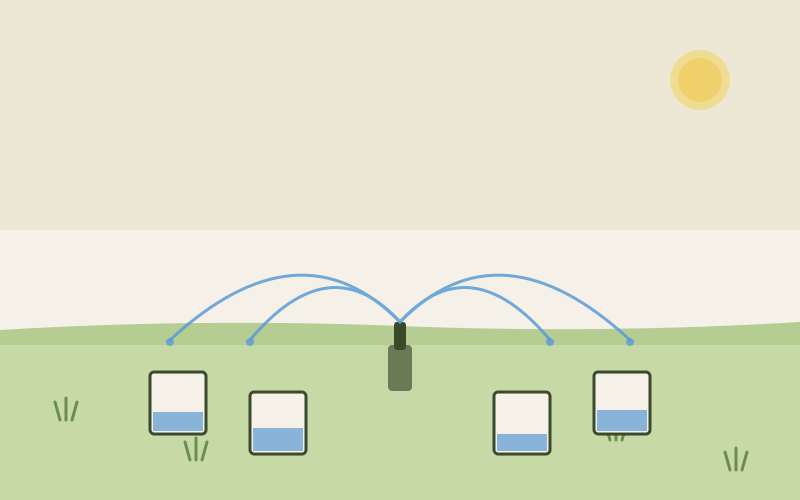
- Set out six or more identical straight-sided cans across the zone, at different distances from the heads (Colorado State Extension uses six).
- Run the zone for a timed period. Colorado State uses exactly ten minutes, University of Florida IFAS uses 15.
- Measure the depth in each can with a ruler and average them.
- Choose “Catch-can test” for that zone and enter the average depth and the minutes. The calculator scales it to an hour: a quarter inch in ten minutes is 1.5 in/hr.
Uneven cans mean uneven coverage, which is a sign to fix the heads before you add minutes. Repeat the test after you change nozzles or pressure.
Worked Example
A yard has two zones and a 1.5 inch weekly target for midsummer, watered on 2 days with no rain so far.
- Front lawn, 1,200 sq ft, spray heads at 1.75 in/hr. 1.5 ÷ 1.75 × 60 = 51.4 minutes a week, or 25.7 per day, so about 26 minutes each watering day. Water: 1.5 in × 1,200 sq ft × 0.6234 = about 1,122 gallons a week (1,135 once the minutes are rounded to 26).
- Back lawn, 2,000 sq ft, rotors at 0.5 in/hr. 1.5 ÷ 0.5 × 60 = 180 minutes a week, or 90 minutes a day. Water: 1.5 × 2,000 × 0.6234 = about 1,870 gallons a week.
- Whole yard. 26 + 90 = 116 minutes of sprinkler time per watering day, about 3,005 gallons a week and about 13,020 gallons in a month of 4.33 weeks.
Colorado State Extension’s own table for these two heads at 1.5 inches a week lists 52 minutes for the sprays and 180 for the rotors, which agrees with steps 1 and 2 (the calculator’s 26 minutes on 2 days is 52).
Cycle and Soak for Clay and Slopes
When sprinklers apply water faster than the soil takes it in, the surplus runs to the street. Colorado State Extension notes this happens on slopes and compacted, clayey soils. The fix is to split each day’s run into cycles with a pause between them. Texas A&M AgriLife Extension says the minimum time between cycles varies from 30 to 60 minutes, and North Carolina State Extension suggests waiting 30 minutes on clay before applying more.
The calculator’s Cycle and soak setting follows Colorado State Extension’s cycle counts: sprays take 1 cycle up to 16 minutes, 2 cycles up to 24 and 3 above that, and rotors take 1 cycle up to 48 minutes, 2 up to 72 and 3 above that. In the worked example, the 90-minute rotor day becomes 3 cycles of 30 minutes. If you know your soil, use Custom limit and enter the longest run before water pools, taken from the Texas A&M table below.
Reference Tables
The tables follow the Imperial and Metric buttons, so they show millimetres and litres when Metric is chosen.
Common Mistakes
- Using a preset instead of measuring. Presets are typical values. Mixed heads, worn nozzles and pressure all move the real rate, and a catch-can test takes about 15 minutes.
- Watering a little every day. Illinois Extension advises watering infrequently and thoroughly so moisture reaches the roots, and K-State says to supply enough in one irrigation to wet the root zone, usually about 1 inch. Fewer, longer watering days beat daily sprinkles.
- Ignoring rain. The weekly targets include rain. Enter what fell, or you will water on top of it.
- Running one program for every zone. Sprays and rotors differ by a factor of three or four in rate, so give each zone its own minutes.
- Skipping cycle and soak where water runs off. If you see pooling or runoff, the minutes are right but the delivery is wrong. Split the run.
Lawn Irrigation Calculator FAQ
How long should I run my sprinklers?
Divide the water your lawn needs each week by your sprinklers’ precipitation rate, multiply by 60, then split the result across your watering days. Pop-up sprays apply roughly 1 to 2.5 inches per hour, so they need far less time than rotors at roughly ¼ to ¾ inch per hour (Colorado State Extension). For 1 inch a week, that is about 34 minutes a week from sprays rated at 1.75 in/hr, or about 120 minutes a week from rotors rated at 0.5 in/hr.
How much water does a lawn need per week?
Most cool-season lawns need about 1 to 1.5 inches a week, rain included, during active growth (Illinois Extension and K-State both give that range). Colorado State Extension scales it with the season for cool-season turf: 0.75 inch in late April and early October, 1 inch in May, June and September, and 1.5 inches in July and August. North Carolina State Extension says 1 inch a week is usually adequate. The calculator’s target menu uses those figures, and you can type your own.
How do I find my sprinkler’s precipitation rate?
Run a catch-can test. Set out several identical straight-sided cans across the zone, run the sprinklers for a set time, and measure the water in each can. Colorado State Extension uses six cans and exactly ten minutes, so the depth in inches is the rate in inches per hour. Illinois Extension and K-State both suggest coffee cans or similar straight-sided containers. The calculator’s catch-can option takes the average depth and the minutes you ran, so a 15-minute test works too.
Can I use this as an irrigation system calculator for several zones?
Yes, up to eight zones. Each zone gets its own area, sprinkler type or measured rate, and optional flow in GPM, and the calculator adds up the minutes per watering day and the gallons per week and per month across all of them. It does not design a system: it will not size pipe, check pressure loss, choose a pump or lay out heads. It also does not replace a controller, so you still enter the minutes it gives you.
What is cycle and soak, and when do I need it?
Cycle and soak splits one long run into shorter runs with a pause between them, so water can soak in instead of running off. Texas A&M AgriLife Extension notes that runoff is most common on compacted and clay soils and on slopes, and that the minimum time between cycles varies from 30 to 60 minutes. The calculator’s Cycle and soak setting uses Colorado State Extension’s cycle counts for your sprinkler type, and the custom limit lets you enter the longest run your soil takes before water pools.
How many gallons does my lawn use?
One inch of water over one square foot is 0.6234 gallons (144 cubic inches divided by 231 cubic inches per US gallon), so 1,000 sq ft takes about 623 gallons for each inch applied. The calculator multiplies the inches your programmed minutes actually apply by the area. If you enter a zone’s flow in GPM, it uses flow times minutes instead, which is the better figure when you know it.
How do I account for rain?
Enter the rain that has fallen so far this week in the rain box. The calculator subtracts it from the weekly target and shortens every zone’s run time. University of Florida IFAS Extension advises suspending irrigation after a rain of about ½ to ¾ inch or more, and a rain gauge or a can left on the lawn gives you the number. When rain meets the whole target, the calculator shows zero minutes.
How is this different from the Drip Irrigation Calculator?
This one is for sprinklers watering a lawn by area, where run time depends on precipitation rate in inches per hour. The Drip Irrigation Calculator is for emitters on beds, shrubs and trees, where run time depends on emitter count and gallons per hour. Use the drip tool for the garden and this one for the grass.
Sources & further reading
Sprinkler rates, seasonal weekly amounts, the catch-can method and the cycle counts come from Colorado State Extension’s “Methods to Schedule Home Lawn Irrigation” (CMG GardenNotes #265). The 1 to 1.5 inch weekly range is from Illinois Extension’s “Watering Your Lawn” and K-State’s “Irrigating”, with the 1 inch figure and clay-soil pause from NC State’s “Lawns” chapter. Cycle length and maximum run times are from Texas A&M AgriLife Extension’s “Preventing Runoff with Cycle and Soak Irrigation”. The 15-minute can test and the rainfall adjustment are from UF/IFAS’s “Watering Your Florida Lawn”. The rotary nozzle range is from the California Water Efficiency Partnership’s “Evaluation of Potential Best Management Practices: Rotating Nozzles”. The 231 cubic inch gallon is from NIST Handbook 44, Appendix C. For more on how we build and verify the formulas behind every calculator on this site, see our methodology page.