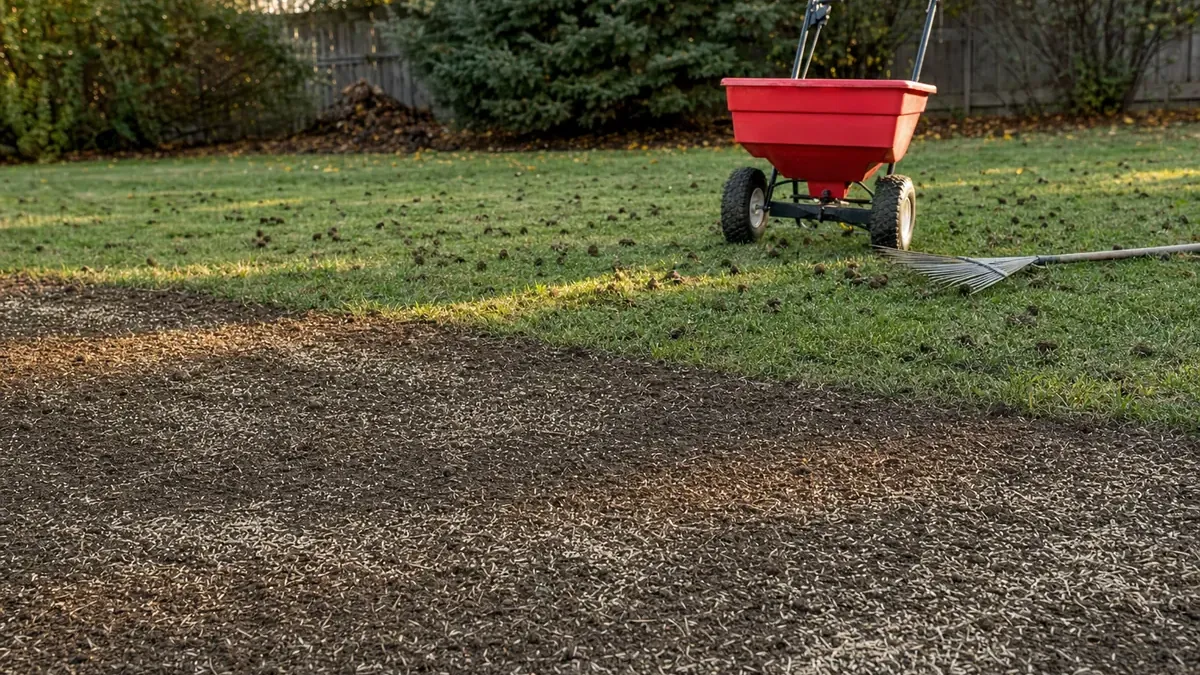
To reseed a lawn, seed in late summer to early fall for cool-season grass (late spring to early summer for warm-season grass), mow short, open the soil by dethatching, aerating or slit-seeding, spread seed at your grass type’s rate, add starter fertilizer at 0.5 to 1 lb of nitrogen per 1,000 sq ft, rake lightly so seed touches soil, and keep the top inch or so moist with light watering two or three times a day until seedlings are up. Mow once the new grass is about a third taller than your target height.
The Short Version
Reseeding vs. Overseeding: Which One You Need
Reseeding means starting grass again where the old lawn is dead, mostly weeds, or bare soil. You are establishing a stand from scratch, so you seed at the full new-lawn rate. Penn State Extension’s renovation method for a poor lawn goes further: fix whatever killed it first (shade, compaction, acid soil, insects, bad mowing), kill the remaining vegetation if it is mostly weeds, remove the thatch, aerate in several passes, then seed.
Overseeding means spreading seed into a lawn that is still mostly alive but thin. The existing grass stays, and the new seed fills the gaps. That is why the rate is lower. Kansas State’s tall fescue guide puts it plainly: use 6 to 8 lb per 1,000 sq ft when repairing large dead areas, and a half rate of 3 to 5 lb when you are trying to thicken a thin lawn. If you are wondering how to overseed a lawn rather than rebuild one, the steps below are the same (see when to overseed a lawn for timing); you just use the lower rate and skip killing anything.
A quick way to decide: if most of what you see is bare soil or weeds, treat it as reseeding. If you mostly see grass, just not enough of it, it is overseeding.
Step by Step: How to Reseed a Lawn
1. Pick the right time
Seeding lawns in fall is the standard advice for cool-season grass (Kentucky bluegrass, tall fescue, perennial ryegrass, fine fescue) for good reasons. Penn State Extension calls late summer the optimum time to seed in most of Pennsylvania, because late August and early September soils are warm and workable, and seedlings get two cool growing seasons (fall and the following spring) before facing summer heat. Illinois Extension gives August 15 to September 15 for central Illinois, earlier further north and later further south, and Clemson’s guide puts it at mid to late September in South Carolina.
Warm-season grasses (bermudagrass, zoysiagrass, centipedegrass) flip the calendar. They need warm soil to germinate, so they are seeded in late spring to early summer: NC State Extension gives March 1 to July 1 depending on species and location, and Clemson targets May 1 to 14.
Planting grass seed in fall too late is the most common timing mistake for cool-season lawns, because seedlings need several weeks to toughen up before hard frost.
2. Mow low and clear the surface
Seed has to reach soil to grow, and a tall canopy catches it. Kansas State recommends mowing the lawn down to about 1.5 inches before overseeding, then removing the clippings and debris with a rake or a bagging mower. UMass Extension goes lower still for overseeding, about 1/2 to 3/4 inch, if your mower can go that low without gouging soil. The point is to expose the ground and let light reach the seedlings.
3. Remove thatch, aerate, or slit-seed
Seed sitting on top of a mat of thatch dries out and dies. You have three options for getting it into soil, and they can be combined:
- Dethatch (power rake) if there is a thick spongy layer between the grass and the soil. Kansas State suggests a power rake with spring tines or thin blades, then raking the debris off.
- Core aerate if the soil is compacted. Penn State’s renovation method calls for several passes with a core aerator. The holes catch seed and the pulled cores break down into a light soil cover. University of Missouri Extension notes that if you aerate in fall, seeding cool-season grass the same day gives the best results.
- Slit-seed with a rented slit seeder (also called a slicer seeder), which cuts shallow grooves and drops seed into them in one pass. Penn State notes slicer blades should only go about 1/4 to 1/2 inch into the soil.
For a fully bare area, loosen the top inch or two of soil with a rake or tiller and smooth it before seeding.
4. Seed at the right rate
Use the table below for the rate, then split the seed in half and spread each half in a different direction, at right angles. University of Minnesota Extension recommends this half-rate, two-direction pass to avoid stripes and bare skips. More seed is not better: NC State warns that rates above the recommendation can produce weak, thin stands more prone to disease.
5. Apply starter fertilizer
Penn State Extension recommends a starter fertilizer at 0.5 to 1 lb of nitrogen per 1,000 sq ft, applied just before or just after seeding, and warns that more than 1.5 lb of nitrogen per 1,000 sq ft can burn young turf (our guide to 8 fertilizing mistakes covers more ways feeding goes wrong). To turn that into pounds of product, divide the nitrogen you want by the first number on the bag as a decimal. A 10-10-10 starter at 1 lb of nitrogen is 1 / 0.10 = 10 lb of product per 1,000 sq ft. A soil test is still the only way to know how much phosphorus, potassium and lime the soil needs; Penn State is clear that starter fertilizer is not a substitute for it.
6. Rake lightly for seed-to-soil contact
After seeding and fertilizing, drag a leaf rake across the area in straight lines. Penn State’s target is most of the seed covered by about 1/4 inch of soil, followed by a pass with a light roller to press it in. On bare soil, a thin straw mulch helps hold moisture and keeps seed from washing: Penn State suggests 80 to 100 lb of straw per 1,000 sq ft on level ground, and Clemson says one 60 to 80 lb bale covers about 1,000 sq ft.
7. Water until it is established
This is the step that decides whether lawn seeding works: the seedbed should never dry out, but never puddle either.
- Until germination: NC State Extension says to keep the top 1.5 inches of soil moist, which may take light watering two or three times a day for 7 to 21 days. Clemson gives the same pattern, two or three light waterings a day for about two to three weeks.
- Kentucky bluegrass is slow: it takes 7 to 14 days longer to germinate than other cool-season grasses, per NC State. In a bluegrass mix, keep up the frequent watering until the bluegrass is up, not just the fast ryegrass.
- After seedlings emerge: water less often but for longer, so roots follow the water down. The Lawn Irrigation Calculator turns that into sprinkler run time per zone.
- Once established: NC State suggests that after the third mowing you water to a depth of 6 to 8 inches about once a week, or when needed.
8. The first mow
Penn State says to start mowing new turf when it is no more than one-third taller than the height you plan to keep it: if you want a 3-inch lawn, mow just before it reaches 4 inches. Use a sharp blade and a light mower. Penn State’s readiness test: walk on the new grass, and if the blades spring back up, you can mow.
Hold off on weed killers. Kansas State advises no crabgrass preventers other than siduron or mesotrione until the new grass is well established, and no broadleaf weed killers until the new grass has been mowed three times.
Seed Rates by Grass Type
New-lawn rates below are from Penn State Extension’s lawn establishment guide for cool-season grasses and NC State Extension for warm-season grasses. The overseeding column uses the range in our Overseeding Calculator, from a thin lawn to a very thin one with bare spots; for bermudagrass and zoysiagrass it uses the Grass Seed Calculator’s overseeding setting. The Grass Seed Calculator column is the new-lawn rate that calculator uses by default.
| Grass type | Reseeding / new lawn (extension) | Grass Seed Calculator default | Overseeding a thin lawn |
|---|---|---|---|
| Kentucky bluegrass | 2-3 lb (Penn State) | 2 lb | 1-2 lb |
| Perennial ryegrass | 4-5 lb (Penn State) | 8 lb | 4-6 lb |
| Tall fescue (turf-type) | 6-8 lb (Penn State) | 7 lb | 3-5 lb |
| Fine fescue | 4-5 lb (Penn State) | 5 lb | 3-4 lb |
| Bermudagrass (hulled) | 1-2 lb (NC State) | 2 lb | 1 lb (half rate) |
| Zoysiagrass (seeded types) | 1-2 lb (NC State) | 1.5 lb | 0.75 lb (half rate) |
All rates are pounds of seed per 1,000 sq ft. Perennial ryegrass is where sources differ most: Penn State lists 4 to 5 lb for a new lawn and 4 to 6 lb for overseeding or renovation, while Oklahoma State gives 4 to 8 lb. Our Grass Seed Calculator uses the top of that range for a new lawn, so drop it if your bag label says less. Coated bermudagrass seed may need about double the rate, per NC State. Always check the label on your bag too, since blends vary.
Overseeding runs at roughly half the new-lawn rate because the existing grass already covers much of the ground, which matches Kansas State’s 3 to 5 lb half rate for tall fescue against 6 to 8 lb for dead areas. The thinner the lawn, the closer you move toward the full rate.
Worked Example: Reseeding a 2,000 Sq Ft Lawn
Say you have a 2,000 sq ft tall fescue lawn. Here is what each version of the job takes.
If it is mostly dead (reseeding): 2,000 sq ft is 2 units of 1,000 sq ft. At Penn State’s 6 to 8 lb rate, that is 12 to 16 lb of seed. Our Grass Seed Calculator’s 7 lb default lands in the middle at 14 lb.
If it is thin but alive (overseeding): At the Overseeding Calculator’s patchy rate of 4 lb per 1,000 sq ft, you need 8 lb. If it is only thin, 3 lb gives 6 lb; very thin with bare spots, 5 lb gives 10 lb.
Starter fertilizer: 0.5 to 1 lb of nitrogen per 1,000 sq ft is 1 to 2 lb of nitrogen for the whole lawn. With a 10-10-10 starter, that is 10 to 20 lb of product. The 1.5 lb ceiling works out to 3 lb of nitrogen, or 30 lb of 10-10-10, so stay under that.
Straw for bare areas: At 80 to 100 lb per 1,000 sq ft, a fully reseeded 2,000 sq ft lawn takes 160 to 200 lb of straw, or roughly two to three bales depending on bale weight.
Water: Two or three short waterings a day for the first one to three weeks, then switching to deeper, less frequent watering once seedlings are up. With tall fescue, Kansas State says seed germinates in four to seven days under good conditions, so you should see green within the first week or so.
Common Mistakes
- Seeding on top of thatch or hard soil. Seed that never touches soil rarely survives.
- Using too much seed. Crowded seedlings compete and get more disease.
- Letting the seedbed dry out. One dry afternoon after germination starts can kill seedlings.
- Applying crabgrass preventer at the same time. Most pre-emergents stop grass seed too.
- Seeding too late. Cool-season seedlings that come up just before hard frost often do not survive winter.

Free book · 23 pages, PDF
How to Reseed a Lawn FAQ
Can I just throw grass seed on my existing lawn?
You can, but much of it will not grow. Seed that lands on thatch or grass blades dries out before it roots. Mow short, rake or aerate to expose soil, and rake lightly after seeding so most of the seed ends up under about 1/4 inch of soil.
How much grass seed do I need to reseed a lawn?
For bare or dead ground, use the full new-lawn rate: about 2 to 3 lb per 1,000 sq ft for Kentucky bluegrass and 6 to 8 lb for tall fescue, per Penn State Extension. For a thin lawn, about half that. The Grass Seed Calculator works it out for your lawn size.
Should I use starter fertilizer when overseeding?
Yes. Penn State Extension recommends a starter fertilizer at 0.5 to 1 lb of nitrogen per 1,000 sq ft just before or after seeding, and warns that more than 1.5 lb of nitrogen per 1,000 sq ft can burn young turf. A soil test tells you whether you also need phosphorus, potassium or lime.
How often should I water new grass seed?
Lightly, two or three times a day, enough to keep the top 1.5 inches of soil moist, for about 7 to 21 days until the seedlings are up, per NC State Extension. Then water less often but more deeply. Kentucky bluegrass needs the frequent watering longer because it germinates 7 to 14 days later than other cool-season grasses.
When can I mow after reseeding?
Once the new grass is about one-third taller than the height you want to keep it at, per Penn State Extension. For a 3-inch lawn, mow just before it reaches 4 inches. Use a sharp blade and wait until the soil is firm enough that the grass springs back after you walk on it.
Sources & further reading
Seed rates, starter fertilizer limits, renovation steps, seed coverage, straw rates and first-mowing guidance come from Penn State Extension’s Lawn Establishment guide. Watering frequency, the bluegrass germination delay, warm-season seed rates and seeding dates come from NC State Extension’s Gardener Handbook chapter on lawns. The full-rate versus half-rate overseeding split, mowing height before overseeding, tall fescue germination time and herbicide cautions follow Kansas State Research and Extension’s Tall Fescue Lawns (MF736). Seeding dates and straw rates for the South come from Clemson Cooperative Extension’s Lawn Establishment factsheet, and Midwest dates from Illinois Extension’s Planting a New Lawn. The low mowing height for overseeding is from UMass Extension’s establishment, renovation and repair guidelines; the two-direction seeding pass is from University of Minnesota Extension; same-day aerating and seeding is from University of Missouri Extension; and the wider perennial ryegrass range is from Oklahoma State University Extension. For how we source the numbers behind our guides and calculators, see our methodology page, and for more on lawns, see our lawn & landscaping guide.
Free book · 23 pages, PDF
The Lawn Cheat Sheet
Sent