Whether you have cool-season or warm-season grass comes down to one thing: when your lawn actually grows, and when it goes dormant. Cool-season grasses (Kentucky bluegrass, tall fescue, ryegrass) grow fastest in spring and fall and can fade in summer heat; warm-season grasses (bermuda, zoysia, St. Augustine) do the opposite, thriving in summer heat and turning brown once temperatures drop. The reason isn’t just climate preference. It’s a real difference in how each type photosynthesizes, and that single mechanism explains almost everything else below: growth timing, cold tolerance, water needs, and which grass actually belongs in your yard.
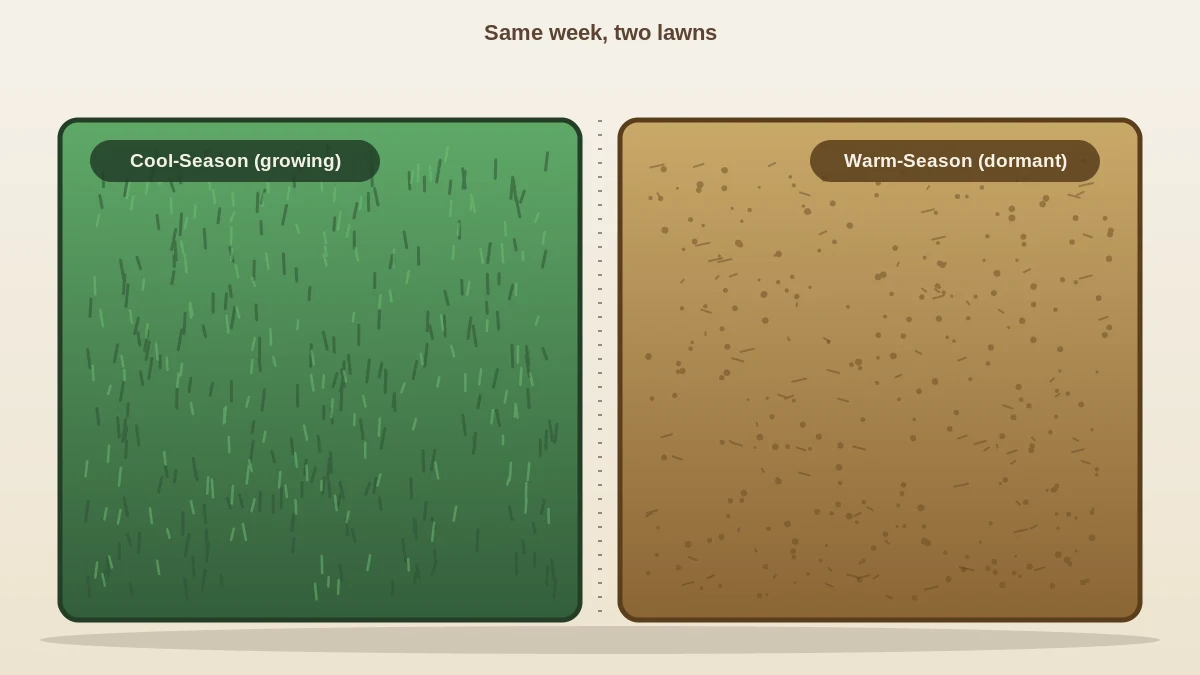
This is a diagram, not a photo, but it illustrates the real, visible diagnostic covered below.
Cool-Season vs. Warm-Season Grass at a Glance
| Cool-Season | Warm-Season | |
|---|---|---|
| Growth Season | Spring and fall, while temperatures are moderate | Late spring through summer, while temperatures are hot |
| Dormant Season | Summer heat stress (semi-dormant, tan) and, in cold climates, mid-winter | Winter, once soil temperature drops below roughly 55°F |
| Photosynthesis Type | C3 | C4 |
| Cold Tolerance | High: stays green through most winters, survives hard freezes | Low to moderate: goes fully brown with frost; can suffer winterkill in a harsh winter |
| Water Needs | Higher overall, especially during summer heat stress | Lower per unit of growth: the C4 pathway is more water-efficient |
| Common Species | Kentucky bluegrass, tall fescue, perennial ryegrass, fine fescue | Bermudagrass, zoysiagrass, St. Augustinegrass, centipedegrass |
Once you know which side of this table your lawn falls on, our Grass Seed Calculator converts the actual per-species seeding rate into pounds and bags for your lawn’s size. The rates genuinely differ by species, not just by cool-season versus warm-season. The same split shows up again if you’re laying sod instead of seeding: warm-season sod is cut as thicker slabs and covers less area per pallet (roughly 400–450 sq ft), while cool-season sod is cut thinner and sold as rolls that cover more (roughly 500–600 sq ft). Our Sod Calculator accounts for the difference by grass type.
Why the Difference? (C3 vs. C4 Photosynthesis)
The growth-timing difference above isn’t just a preference. It comes from two different photosynthesis pathways, and this is the part most lawn-care content skips entirely.
Cool-season grasses use C3 photosynthesis, the more common pathway in plants generally. A C3 plant fixes carbon dioxide directly using an enzyme called RuBisCO, in a single step. That enzyme works well at moderate temperatures, but it has a real weakness: as temperatures climb past roughly 75–85°F, RuBisCO increasingly grabs oxygen instead of CO2 in a wasteful side reaction called photorespiration. The plant spends energy without gaining carbon for it. That’s the biochemical reason cool-season grass slows down, thins out, or goes tan-brown in summer heat. It’s not simply “wilting,” it’s losing photosynthetic efficiency at the enzyme level.
Warm-season grasses use C4 photosynthesis, a more complex two-step pathway that evolved specifically to get around the photorespiration problem. A C4 plant first fixes CO2 in outer mesophyll cells using a different enzyme (PEP carboxylase, which doesn’t bind oxygen), then shuttles the resulting compound into specialized bundle-sheath cells deeper in the leaf, where it’s released and concentrated around RuBisCO for the actual Calvin cycle. That concentration step keeps RuBisCO surrounded by CO2 instead of oxygen, largely eliminating photorespiration, which is exactly why C4 grasses keep growing efficiently in heat that stalls a C3 lawn. It also means C4 grasses can run with their stomata (leaf pores) more closed, losing less water for the same amount of growth, which is the real reason warm-season grasses are generally more drought-tolerant.
The tradeoff cuts the other way in cold weather. The extra enzymatic machinery C4 grasses rely on becomes inefficient and eventually shuts down as temperatures drop, typically once soil temperature falls below roughly 55°F. That’s dormancy, not death: the same mechanism that makes warm-season grass thrive in July makes it turn brown in December.
How to Tell What You Have
If you don’t know your species, the fastest real-world diagnostic is timing, not texture:
- Green in winter, tan or thinning in summer heat → cool-season. If your lawn stays green through cold months (including light frost) and looks its worst in the hottest weeks of summer, you have a cool-season grass.
- Brown in winter, green and thriving in summer → warm-season. If your lawn goes fully brown with the first hard frost and doesn’t green back up until late spring, you have a warm-season grass. This is dormancy, not a dead lawn.
- Green-up timing is a strong secondary clue. Cool-season lawns green up early, often in March. Warm-season lawns green up late, frequently not until May, once soil has warmed.
Texture and growth habit back up the color diagnostic, but don’t rely on them alone: cool-season species like tall fescue and ryegrass tend to be coarser-bladed and grow in distinct bunches, while many warm-season species like bermuda and zoysia spread by above- or below-ground runners (stolons and rhizomes) into a denser, finer-textured turf. Species within each group vary enough on texture that color and seasonal timing remain the more reliable test.
The Transition Zone: What to Plant If You’re Stuck in the Middle
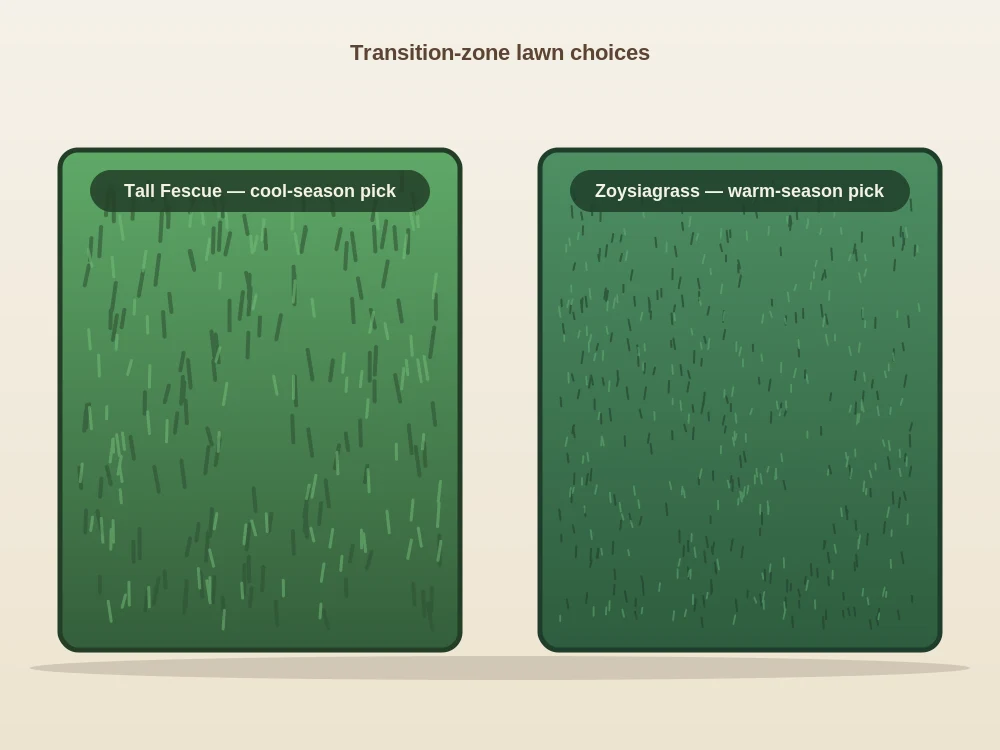
The transition zone is the band of the U.S. (roughly Virginia down through the Carolinas, Tennessee, and Oklahoma) where summers get hot enough to stress cool-season grass, but winters get cold enough to damage warm-season grass. Neither type is fully comfortable there, which is exactly why homeowners in Knoxville, Nashville, Charlotte, and across Oklahoma end up asking this question more than almost anywhere else. There’s no single correct answer; it’s a real tradeoff between winter color and summer toughness.
| Region / Zone | Recommended Grass | Why |
|---|---|---|
| Upper transition zone (Virginia, eastern Tennessee incl. Knoxville) | Tall fescue | Best cold tolerance of the heat-adapted cool-season grasses; stays green through winter and handles moderate summer heat with irrigation |
| Central transition zone (Charlotte NC, Nashville TN) | Zoysiagrass (or tall fescue where winter color matters more) | Hot, humid summers favor zoysia’s heat and drought tolerance; better cold tolerance than bermudagrass for occasional hard freezes |
| Lower / western transition zone (Oklahoma) | Bermudagrass or zoysiagrass | Long, hot, often drought-prone summers favor warm-season grass; occasional winterkill risk in a hard winter is the real tradeoff |
| Shaded lawns, anywhere in the transition zone | Tall fescue | Warm-season grasses need full sun to perform; tall fescue tolerates partial shade far better than bermuda or zoysia |
Tall fescue is the transition zone’s default cool-season pick because it’s the most heat-tolerant cool-season species available: its deeper root system helps it ride out summer better than Kentucky bluegrass. Zoysiagrass is the default warm-season pick because it holds color longer into fall and tolerates cold better than bermudagrass, at the cost of a slower green-up in spring. Most transition-zone lawns are a genuine compromise between the two, not a clean win either way.
Overseeding Across Types
One place cool-season and warm-season grass genuinely work together, on purpose, is overseeding. A dormant warm-season lawn (bermuda or zoysia gone brown for the winter) can be overseeded in early fall with annual or perennial ryegrass, a cool-season species that germinates quickly in cool soil and stays green all winter while the base grass sleeps. Come late spring, as soil temperatures rise, the warm-season grass resumes growth and gradually crowds out or is mowed out along with the fading ryegrass, and the lawn returns to its usual base species for summer.
This is standard practice on golf courses and in warm-season lawns throughout the South specifically for winter color, not a workaround or a mistake. If you’re planning it, our Overseeding Calculator handles the seed and topdressing amounts for overseeding an existing lawn by grass type and condition, which is a genuinely different calculation from seeding a new lawn from bare soil.
Free book · 23 pages, PDF
FAQ
What's the difference between cool-season and warm-season grass?
Cool-season grasses grow fastest in spring and fall using C3 photosynthesis; warm-season grasses grow fastest in summer using C4 photosynthesis. That single biochemical difference drives everything else: when each type is green, when it goes dormant, and how much cold or heat it tolerates.
How do I know if I'm in the transition zone?
You're in the transition zone if your summers get hot enough to stress cool-season grass but your winters get cold enough to damage warm-season grass, roughly the band from Virginia through the Carolinas, Tennessee, and Oklahoma. Neither grass type thrives there without some compromise, which is why the region has its own grass recommendations.
Can I have both cool-season and warm-season grass in one lawn?
Yes, though usually not as a permanent mix. The common version is overseeding a dormant warm-season lawn with cool-season ryegrass for winter color, then letting the warm-season grass resume in spring. A permanent blend of both types is uncommon because their growth cycles compete rather than complement each other.
Why does my grass turn brown in winter (or summer)?
Warm-season grass turns brown in winter because its C4 photosynthesis pathway shuts down once soil temperatures drop. It's dormant, not dying. Cool-season grass can turn tan or thin in summer heat for the reverse reason: heat stress slows C3 photosynthesis and the plant conserves resources instead of growing.
What grass should I plant if I'm in the transition zone?
Tall fescue is the most common cool-season pick for the transition zone because it tolerates heat better than other cool-season species; zoysiagrass is the most common warm-season pick because it tolerates cold better than other warm-season species. Which one's right for you depends on whether you'd rather have a lawn that's green in winter or green in summer.
Sources & further reading
The photosynthesis and growth-timing facts in this article follow the University of Illinois Extension’s Warm Season vs Cool Season Grasses. For more on how we source and review the facts and formulas behind every calculator and guide on this site, see our methodology page. And for the full picture on seeding, overseeding, and lawn care timing beyond just species selection, see our complete guide to lawn & landscaping.