When to fertilize lawn grass depends on the grass. For a cool-season lawn (Kentucky bluegrass, tall fescue, ryegrass), fall lawn fertilizer matters most: feed in early fall and again in late fall, because Purdue Extension says these lawns benefit most when the majority of the year’s nitrogen goes on from late summer through autumn. Warm-season lawns are the opposite. NC State and Clemson feed them in late spring and summer and give them little or no nitrogen in fall. Not sure which type you have? Start with cool-season vs warm-season grass.
Quick Answer: Best Time to Fertilize Lawn by Grass Type
Amounts below are pounds of actual nitrogen (N) per 1,000 sq ft, the number extension services use. How to turn that into pounds of product is in the “How Much to Put Down” section further down.
| Lawn type | Main feedings | Nitrogen per feeding | Last nitrogen of the year |
|---|---|---|---|
| Cool-season, northern Midwest (Iowa State) | Mid-September and late October to early November | 1 lb | Late October or early November, timed to the last mowing |
| Cool-season, Indiana (Purdue) | September (once highs leave the 90s) and the first weeks of November | About 1 lb in September, 0.5 to 1 lb in November | November, while the grass is still green |
| Tall fescue, North Carolina (NC State) | Mid-September and November for a basic program | 1 lb | November |
| Bermudagrass (NC State) | After spring green-up, then every 4 to 6 weeks in summer | 1/2 to 1 lb in spring, 1 lb in summer | September at the latest, 1/2 lb at most, or four weeks before the first expected frost |
| Zoysiagrass (NC State) | About three weeks after green-up, late June or early July, and mid-August | 1/2 lb, then 1/2 to 1 lb | Mid-August; none from September on |
| Centipedegrass (NC State) | Not before mid-May; mid-August only if needed | 1 lb | Mid-August |
The dates move with your climate, so these are anchors, not a calendar for every yard. Extension services in colder states land earlier in the fall window and warmer ones later. If you are not sure of your zone, the Hardiness Zone Finder gives it from your ZIP code.
Lawn Fertilizer Schedule by Month
The same extension sources, laid out by month. Timing is the most common slip, so 8 fertilizing mistakes hurting your garden and lawn is worth a read too. Amounts are pounds of nitrogen per 1,000 sq ft, and dates shift a few weeks with your climate.
| Month | Cool-season (bluegrass, fescue, ryegrass) | Warm-season (bermuda, zoysia, centipede, St. Augustine) |
|---|---|---|
| March to April | Light only: 0 to 0.5 lb for low-maintenance lawns (Purdue) | Wait for green-up. Texas A&M says after the second mowing; NC State says not before mid-May for centipedegrass |
| May to June | Early to mid-May in central Illinois (Illinois Extension); Minnesota’s window runs through late June | Main spring feeding: 1/2 to 1 lb on bermudagrass (NC State) |
| July to August | Little to none in the heat; the early-fall window opens around August 15 in central Illinois | Bermudagrass 1 lb every 4 to 6 weeks (NC State); zoysiagrass and centipedegrass get a last feeding in mid-August |
| September | The main feeding of the year, about 1 lb (Iowa State, Purdue) | Bermudagrass 1/2 lb at most; none on zoysiagrass or centipedegrass (NC State) |
| October to November | Late-fall feeding near the last mowing, 0.5 to 1 lb | None in the Southeast; Texas cutoffs run from October 1 to November 1 by city (Texas A&M) |
| December to February | None; do not fertilize frozen ground (Purdue) | None (NC State) |
Seeding, sod and watering sit on the same calendar, and the lawn and landscaping guides cover them.
Fall Lawn Fertilizer: Why It Matters Most for Cool-Season Grass
Purdue’s turf specialists say fall nitrogen promotes good root development and stores energy reserves, and that most of the benefit shows up the following spring and summer as earlier green-up, denser turf and better resistance to spring diseases such as red thread and pink patch. Kansas State Extension explains the timing: cool-season grasses thicken in fall as days shorten and temperatures cool, forming new shoots at the base of the plant, so it calls September the most important time to fertilize tall fescue and Kentucky bluegrass.
That is why most extension programs front-load the year. Purdue’s lawn publication AY-22 recommends putting the majority of nitrogen on from late summer through autumn, with little in spring and almost none in summer. Here is how the early-fall window is stated in different states (find your own on the growing zones by state pages):
- Illinois: August 15 to September 15 in central Illinois is the optimal late-summer to early-fall window, earlier in the north and later in the south (Illinois Extension).
- Indiana: September, any time after daytime highs are no longer in the 90s (Purdue).
- Iowa: mid-September, then again in late October or early November (Iowa State Extension).
- Kansas: September, at 1 to 1.5 lb of quick-release nitrogen (Kansas State).
- Minnesota: early August through mid-October is the best window listed in the University of Minnesota’s lawn care calendar.
- North Carolina: mid-September for tall fescue (NC State).
Iowa State describes the two fall feedings as having different jobs: the mid-September one promotes a moderate rate of shoot growth and helps thicken the turf, while the late October or early November one promotes root growth and early green-up next spring.
How much nitrogen a lawn gets over the year depends on how much you want from it. Illinois Extension suggests about 3 lb of nitrogen per 1,000 sq ft per growing season for most full-sun lawns, split evenly across the feedings, with shaded lawns needing roughly half. Purdue gives a wider range for mature cool-season lawns, 1 to 5 lb a year, and Virginia Tech says fall totals of 2 to 3 lb might be applied depending on the grass, with fine-leaf fescue needing only about 1 lb because it is a low-maintenance turf. Kentucky bluegrass is described there as a heavy nitrogen feeder. If the three numbers on a bag are new to you, the fertilizer and nutrients guides explain what N-P-K means.
If your lawn is thin because it was stressed this summer, fall is also the time to patch it. The same early-fall window suits seeding, so read when to overseed lawn before you buy bags.
The Late-Fall Feeding: After the Last Mow
The second fall feeding is the one most people skip, and extension services keep recommending it. Purdue says to apply it in late fall, near or after the last mowing of the year, while the lawn is still green. Its turf team puts the Indiana timing at generally the first few weeks of November, at 0.5 to 1.0 lb of nitrogen per 1,000 sq ft. Illinois Extension times it about one week after the final mowing, which falls in November in central Illinois.
Purdue’s reasoning is that the nitrogen must be taken up by the plant before winter to work well, which is why it recommends a soluble source such as urea, ammonium nitrate or ammonium sulfate for this one. Purdue’s AY-22 describes a late-fall program of water-soluble nitrogen at 0.5 to 0.75 lb per 1,000 sq ft about every three weeks from October until early December or until the ground freezes. Both are fine; the single early-November feeding is the simple version.
The firm rule is the end date. AY-22 says not to apply fertilizer during the winter or when the soil is frozen, for any lawn. Lawns that were damaged in summer, or seeded this fall, get the most from this feeding, according to Purdue.
When to Fertilize a New or Newly Seeded Lawn
A new lawn follows a different clock, and extension offices do not all agree. UC Integrated Pest Management says to apply nitrogen to a seeded lawn about 4 to 6 weeks after germination, and to sod, sprigs, stolons or plugs about 6 weeks after planting. UF/IFAS says to wait 30 to 60 days after planting new turf. West Virginia University Extension goes furthest: it says a newly seeded lawn will not require additional fertilizer for one year.
What they share is that the first weeks are about water and a few feedings later, not heavy nitrogen. Starter fertilizer, which is higher in phosphorus, is meant for new seedings and sod (Illinois Extension), and a soil test tells you whether your soil needs it. Lawns seeded this fall get the most out of the late-fall feeding, according to Purdue, and seed only germinates once the soil is warm enough, which soil temperature for planting explains. The seeding steps and starter fertilizer are covered in how to reseed a lawn.
How Much Fertilizer to Put Down: The Bag Math
The first number on a fertilizer bag is the percent nitrogen. Rutgers Cooperative Extension gives the formula: pounds of product equals 100 divided by the percent N, times the pounds of N you want per 1,000 sq ft, times your lawn area divided by 1,000. Count only turf, not the driveway or walks.
Here it is for a 5,000 sq ft lawn getting the 1 lb of nitrogen per 1,000 sq ft that Iowa State recommends for the September feeding. The three fertilizer analyses are examples of what is commonly sold; use the first number on your own bag.
| Bag analysis | Product per 1,000 sq ft for 1 lb N | Product for 5,000 sq ft |
|---|---|---|
| 29-0-4 | 3.4 lb | 17 lb |
| 21-0-0 | 4.8 lb | 24 lb |
| 10-10-10 | 10 lb | 50 lb |
Three limits keep the math safe. Purdue, Illinois Extension and Virginia Tech all cap a single application of quick-release nitrogen at 1 lb per 1,000 sq ft. Purdue allows up to 2 lb per application only for products with more than half of their nitrogen in slow-release form. And on phosphorus, Illinois Extension says its soils often have enough, recommends focusing on nitrogen unless a soil test shows otherwise, and notes that high-phosphorus starter fertilizers are meant for new seedings and sod. A soil test tells you which applies; how to read soil test results explains the report.
Do This in the Lawn Program Instead of by Hand
Everything above works on paper: pick your grass, find your window, do the bag math, write the dates on a calendar. If you would rather have it worked out once, the 12-Month Lawn Program does exactly this example. You can try it free; the demo plans one lawn and one sprinkler zone.
Here is the 5,000 sq ft tall fescue lawn from the bag math, set up in the program:
- Add the lawn: name it, pick tall fescue from the nine grasses (four cool-season, five warm-season), and enter 5,000 sq ft.
- Set your climate. Enter a ZIP code or tap your zone group, and the program moves fall jobs earlier in zones 3 to 5 and later in zones 8 to 11.
- Choose the fertilizer closest to your bag: 29-0-4, 21-0-0 or 10-10-10.
- Open the feeding card. It shows the window, the pounds of that fertilizer for your square footage, the nitrogen behind it, and a link to the extension source. Tick it off when done.
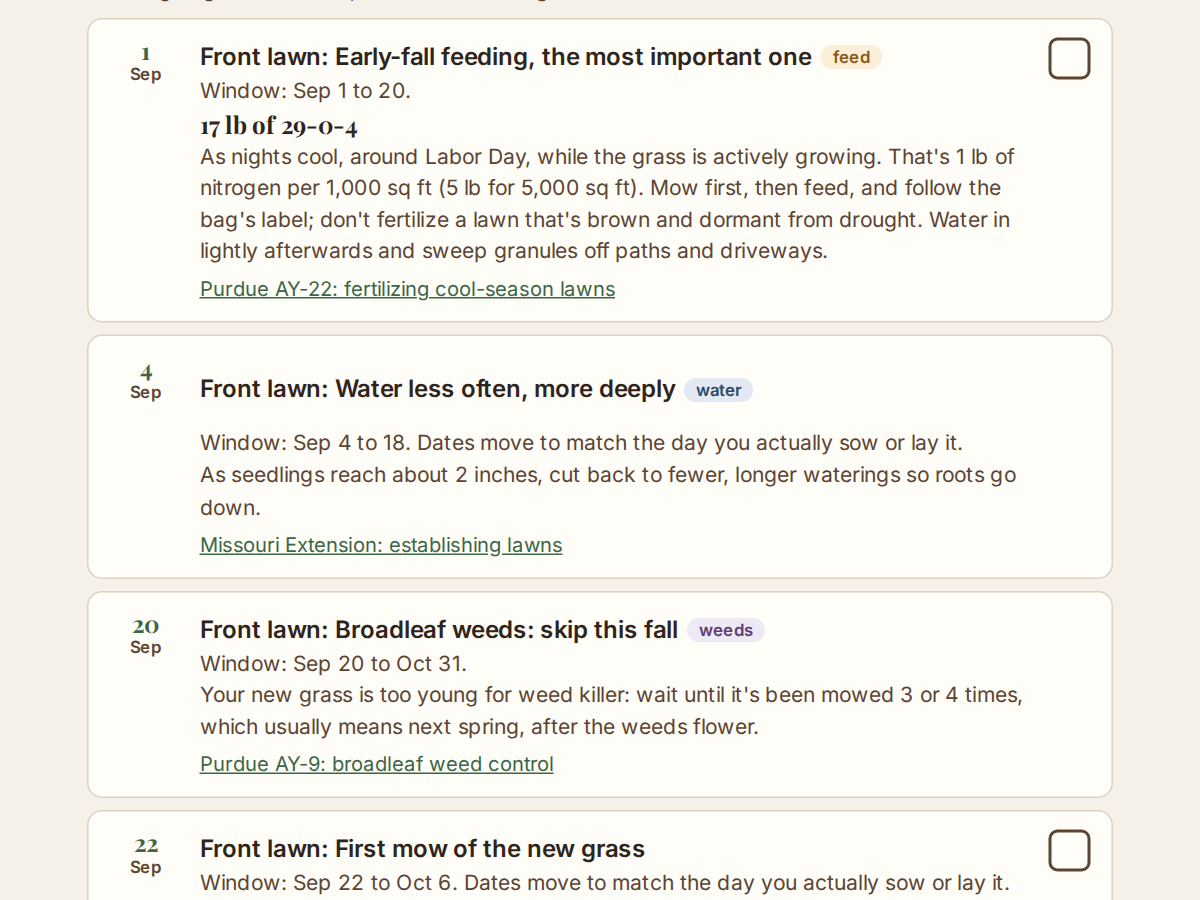
That card is the same 17 lb of 29-0-4 in the table above, with the date window attached. The program also puts the late-fall feeding on your list (October 20 to November 15 in the middle zones) and the watering and mowing jobs around it, and it can export every job to your calendar. It builds each grass’s schedule from Purdue’s and NC State’s extension programs, so if your own state’s extension office gives a different date, follow your state.
Paper versus app, honestly: for one lawn and one bag, ten minutes and a calendar are enough. The program saves time when you have more than one lawn or more than one fertilizer, when you would like the dates shifted to your zone automatically, or when you want feeding, seeding, mowing and watering in one yearly plan. If that sounds useful, see the 12-Month Lawn Program.
Warm-Season Lawns: Stop Nitrogen Before Frost
If your lawn is bermudagrass, zoysiagrass, centipedegrass or St. Augustinegrass, the fall advice above reverses. Clemson Extension warns that nitrogen applied too late and too heavily to warm-season turf promotes shoot growth just as the plant is slowing down, and that those new shoots are less tolerant of cold. It recommends late-season nitrogen at least two months before the first average frost, with stated dates of August 15 for South Carolina’s Upstate and September 1 for the coast.
NC State’s maintenance calendars say the same thing grass by grass. For bermudagrass, apply no more than 1/2 lb of nitrogen per 1,000 sq ft in September, or four weeks before the first expected frost, to minimize spring dead spot, and fertilize with 1 lb every four to six weeks in summer. Its zoysiagrass calendar says not to apply nitrogen from September through November, and its centipedegrass calendar says not to apply nitrogen before mid-May and not to fertilize from December through February. In fall both recommend potassium instead, about 1 lb of K2O per 1,000 sq ft, four to six weeks before the first expected frost for centipedegrass. A soil test shows whether yours needs it.
Warm-season grass also follows different seeding rules in fall, which can you plant grass seed in winter explains. In the Lawn Program, the warm-season grasses follow these same stop dates, and the free demo shows the schedule for whichever grass you pick.
When to Fertilize Bermuda and St. Augustine Lawns in Texas and Florida
The South has its own rules, because the growing season is long. Texas A&M’s publication E-436 says to make the first application after the second mowing of the lawn, roughly six weeks after the average last spring frost, once the grass rather than the weeds is growing. It caps each application at 1 lb of nitrogen per 1,000 sq ft and keeps supplemental feedings 45 to 60 days apart. A low-input program uses spring and fall feedings only, a moderate one adds a summer feeding, and a high one adds two or three. Yearly totals per 1,000 sq ft run from 2 to 5 lb for common bermudagrass, 2 to 6 lb for hybrid bermudagrass, and 2 to 4 lb for St. Augustinegrass in sun (1 to 2 lb in shade).
Unlike the Southeast, Texas A&M allows a fall feeding of up to 1 lb to build density and help spring recovery, as long as it goes on early enough for the grass to take it up. Its last-application dates, which it says should fall no later than six weeks before the expected first frost:
| Texas area | Last fall nitrogen |
|---|---|
| Amarillo | September 15 |
| Dallas, Abilene, Lubbock, El Paso | October 1 |
| Austin, Houston, San Antonio, Waco | October 15 |
| College Station, Corpus Christi, Laredo, McAllen | November 1 |
In Florida, UF/IFAS says to fertilize North and Central Florida lawns during the growing season, roughly April through September, while South Florida turf grows year-round. It also caps a single application at 1 lb of nitrogen per 1,000 sq ft, calls mid-summer nitrogen not always desirable because it can encourage disease and insects, and points out that local ordinances can ban it, so check your county’s rules before you spread. Fall and winter feedings are not part of its North and Central Florida advice. For St. Augustinegrass or bermudagrass in any state, use the cutoff for your area, not a national date; the frost dates by zone pages show when your first frost usually arrives, and Farmers’ Almanac frost dates vs NOAA explains why sources differ by a week or two.
When to Fertilize Lawn in Spring and Summer (Cool-Season Grass)
Purdue’s AY-22 recommends 0 to 0.5 lb of nitrogen in early spring (mid-March through April) for low-maintenance lawns and up to 0.75 lb for moderate programs, using slow-release sources, and less nitrogen during the May and early June growth flush. From mid-June through August it recommends little to none, except where turf is irrigated often or clippings are removed. Illinois Extension times a spring feeding for early to mid-May in central Illinois, and NC State says tall fescue fertilized in spring or summer should get only 1/5 to 1/2 lb at a time, and only if needed for color and recovery.
The University of Minnesota’s calendar lists May through late June as the spring window and early August through mid-October as the fall window, and is blunter about the rest: do not fertilize in hot mid-summer months, and do not add fertilizer too early in spring. Forcing growth in the heat feeds stress, not roots. If you can only fertilize once a year, make it the early-fall feeding.
How many feedings you need depends on the lawn. Illinois Extension matches the number to density: one in late summer to early fall for a low-density lawn, two (spring plus late summer to early fall) for low to moderate, three with a late-season feeding for moderate to high, and four, adding an early-summer feeding on irrigated lawns, for the densest turf. Purdue says the greenest year-round lawns often take four to six applications. For a closer look at the most common timing errors, see 8 fertilizing mistakes hurting your garden and lawn.
When Not to Fertilize
- On frozen ground or in winter. Purdue’s AY-22 says not to apply fertilizer during the winter or when the soil is frozen, and NC State lists December through February as no-fertilizer months for bermudagrass, zoysiagrass and centipedegrass. The rest of your fall to-do list is in winterize garden.
- Warm-season grass in fall. Late nitrogen raises the risk of cold injury (Clemson). Potassium, not nitrogen, is what NC State recommends.
- In hot mid-summer on cool-season grass. Minnesota Extension says not to, and Purdue allows little to none (Purdue AY-22).
- More than 1 lb of quick-release nitrogen at once. Purdue, Illinois Extension and Virginia Tech all set that cap.
- Without checking phosphorus. Illinois Extension recommends focusing on nitrogen unless a soil test shows other needs.
For more on the lawn side of the calendar, the lawn and landscaping guides cover seeding, sod and watering, and the frost dates by zone pages give the first-frost dates the warm-season rules depend on. Once the last feeding is down, the sprinklers are next, and how to winterize a sprinkler system covers shutting them down before the first hard freeze.
Free book · 23 pages, PDF
When to Fertilize Lawn FAQ
What is the best time of year to fertilize a lawn?
For cool-season grass, fall. Purdue Extension says these lawns benefit most when the majority of their nitrogen goes on from late summer through autumn, and Kansas State calls September the most important month. For warm-season grass, late spring and summer, with the last nitrogen about four weeks to two months before the first frost, per NC State and Clemson.
Is it too late to fertilize my lawn in October or November?
Not for a cool-season lawn. Iowa State Extension recommends a feeding in late October or early November, and Purdue's turf team puts the Indiana window at the first few weeks of November, while the grass is still green. It is too late for most warm-season grass, and too late for any lawn once the soil is frozen.
What does fall lawn fertilizer do?
It feeds roots and stored energy rather than top growth. Purdue says fall nitrogen promotes root development and energy reserves, with the payoff next spring as earlier green-up and denser turf. Use the first number on the bag to work out pounds of nitrogen, not the brand name or season on the label.
When should I fertilize a new or newly seeded lawn?
About 4 to 6 weeks after germination for seed, and about 6 weeks after planting for sod, according to UC Integrated Pest Management. UF/IFAS says to wait 30 to 60 days after planting new turf, and West Virginia University Extension says a newly seeded lawn needs no more fertilizer for a year. A starter fertilizer at seeding is the exception, and a soil test shows whether you need one.
When should I fertilize my lawn in Texas or Florida, and what about St. Augustine?
In Texas, Texas A&M says to make the first application after the second mowing in spring, keep each application to 1 lb of nitrogen per 1,000 sq ft, and make the last one by a cutoff that runs from September 15 in Amarillo to November 1 on the Gulf Coast. In North and Central Florida, UF/IFAS puts fertilizing in the growing season, roughly April through September, and notes that local ordinances may restrict summer nitrogen. The same dates apply to St. Augustinegrass and bermudagrass in those areas.
How often should I fertilize my lawn, and can I do it every 2 weeks?
Not as a rule. Cool-season lawns get one to four feedings a year (Illinois Extension), quick-release nitrogen is capped at 1 lb per 1,000 sq ft per application, and Texas A&M keeps summer feedings on warm-season grass 45 to 60 days apart. The exception is Purdue's late-fall program, which uses 0.5 to 0.75 lb of soluble nitrogen about every three weeks from October until the ground freezes.
Should I fertilize before or after rain?
Iowa State Extension says fertilize just before a light rain, or water the lawn right after so the fertilizer soaks in. It says to skip the job if moderate to heavy rain is likely within 24 hours, because runoff washes it away, and that the safest default is about 24 hours after a soaking rain or irrigation. UF/IFAS gives the same 24-hour rule.
Sources & further reading
Cool-season timing and rates come from Purdue Extension’s Fertilizing Established Cool-Season Lawns (AY-22), Purdue’s turfgrass team on fall fertilization and late-fall fertilization, Iowa State Extension, Illinois Extension, Kansas State Extension, Virginia Tech Extension and the University of Minnesota lawn care calendar. Warm-season guidance comes from NC State’s tall fescue, bermudagrass, zoysiagrass and centipedegrass maintenance calendars and Clemson’s Winterizing Lawns. Southern and new-lawn guidance comes from Texas A&M’s Fertilizing Texas Lawns (E-436), UF/IFAS’s Fertilizing Your Florida Lawn, UC IPM’s lawn establishment guide and WVU Extension’s new lawn maintenance page; the rain advice is from Iowa State Extension. The bag formula is from Rutgers Cooperative Extension’s FS839.
Recommendations differ by state and by how dense you want the lawn, so treat the numbers here as ranges and follow your own state’s extension office and the label on your fertilizer.
Free book · 23 pages, PDF
The Lawn Cheat Sheet
Sent