How to Use This Calculator
- Enter your lawn area.
- Choose your grass type and lawn condition.
- Optionally add a topdressing material and depth.
- Read your seed amount (and topdressing volume).
How Much Seed Do You Need to Overseed?
Overseeding rates run roughly half of new-lawn seeding rates for the same grass type. A new lawn starts from bare soil, so every seed has to survive and establish across the whole area. Overseeding works on turf that already covers most of the ground. You’re filling gaps and thickening the stand, not starting over, so far less seed gets you there.
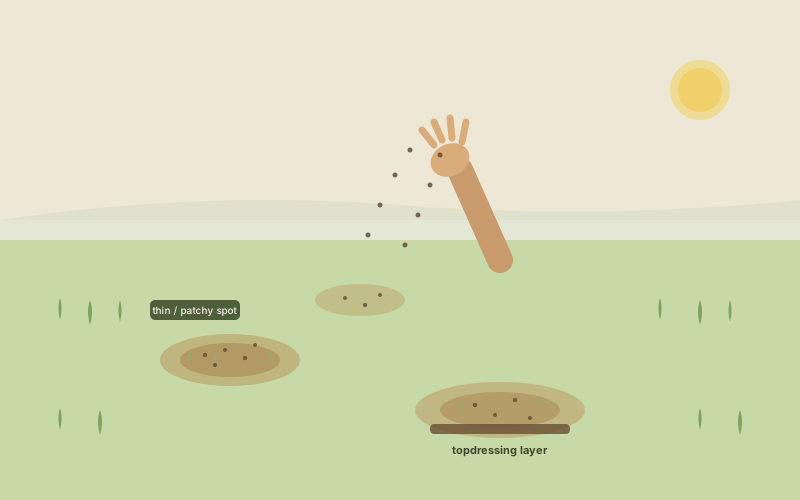
Within that overseeding range, your lawn’s condition sets where you land. A lawn that’s still mostly green with just a few thin spots needs the low end of the range. A patchy lawn with visible gaps sits in the middle. A lawn with real bare soil showing through needs the high end, closer to what a partial new-lawn seeding would use, since those bare patches are effectively starting from scratch.
That’s why the calculator above asks for grass type and lawn condition separately: the grass type sets the overall rate range, and the condition dropdown picks the right point within it.
Overseeding Rates by Grass Type
Reference overseeding rates in pounds per 1,000 sq ft, by grass type and lawn condition.
| Grass type | Thin but mostly green | Patchy | Very thin / bare spots |
|---|---|---|---|
| Kentucky bluegrass | 1 lb | 1.5 lb | 2 lb |
| Tall fescue | 3 lb | 4 lb | 5 lb |
| Perennial ryegrass | 4 lb | 5 lb | 6 lb |
| Bermuda (winter overseed) | 5 lb | 7 lb | 10 lb |
| Fine fescue | 3 lb | 3.5 lb | 4 lb |
Worked Example
Let’s overseed a 5,000 sq ft lawn of tall fescue that’s patchy, with a ¼-inch compost topdressing on top:
- Rate: tall fescue, patchy condition = 4 lb per 1,000 sq ft.
- Area factor: 5,000 sq ft ÷ 1,000 = 5.
- Seed needed: 5 × 4 lb = 20 lb of seed.
- 50 lb bags: 20 ÷ 50 = 0.4 → round up to 1 bag (you’ll have 30 lb left for next season or spot repairs).
- Topdressing volume: 5,000 sq ft × (0.25 in ÷ 12) = 104.2 cu ft.
- Cubic yards: 104.2 ÷ 27 = ~3.86 cu yd of compost.
So this lawn needs about 20 lb of tall fescue seed (one 50 lb bag) and roughly 3.86 cubic yards of compost for a ¼-inch topdressing layer. If the lawn were only thin rather than patchy, the seed rate would drop to 3 lb per 1,000 sq ft: 15 lb total, still under a full bag.
Common Mistakes
- Using new-lawn rates instead of overseeding rates. A new-lawn rate is roughly double what overseeding needs for the same grass type. Applying it to existing turf wastes seed and can crowd and weaken the seedlings that do germinate, rather than thickening the lawn.
- Overseeding into a lawn recently treated with pre-emergent herbicide. Pre-emergent herbicides block seed germination indiscriminately (new grass seed included) for up to 8 weeks after application. Check your treatment history before you buy seed, or you’ll be watering a lawn that was never going to germinate.
- Skipping soil prep. Mow low and bag the clippings first, then dethatch or core aerate so seed reaches soil instead of sitting on top of thatch or clippings. Seed-to-soil contact is what determines whether overseeding actually thickens a lawn or just feeds the birds.
- Not pairing with a starter fertilizer. New seedlings need available phosphorus for root development, which established turf has often depleted from the topsoil. A starter fertilizer applied at seeding gives new grass the nutrients to establish alongside the lawn it’s filling in.
Overseeding Calculator FAQ
How do I calculate how much grass seed I need to overseed?
Divide your lawn area in square feet by 1,000, then multiply by your grass type’s overseeding rate (roughly 1–10 lb per 1,000 sq ft depending on species and how thin the lawn is). The calculator above does this instantly and also gives you a topdressing amount if you want one.
How do I spread grass seed by hand?
Split your total seed in half, walk the lawn in parallel rows spreading one half, then walk it again in perpendicular rows with the second half. This cross-hatch pattern evens out the inconsistency of hand spreading far better than trying to get full coverage in one pass.
When is the best time to overseed a lawn?
For cool-season grasses (Kentucky bluegrass, tall fescue, perennial ryegrass, fine fescue), late summer to early fall is ideal. Warm soil and cooling air give fast germination without summer heat stress. For Bermuda, overseed in fall as it goes dormant, using a cool-season ryegrass to keep color through winter.
Can you put too much grass seed on your lawn?
Yes. Past the recommended rate, seedlings crowd each other and compete for light, water, and nutrients, producing thinner and weaker turf rather than a fuller lawn. Stick to the rate for your grass type and lawn condition rather than assuming more is better.
How do I plant grass seed on top of an existing lawn?
Mow low and bag the clippings, then dethatch or core aerate so seed makes contact with soil instead of sitting on top of thatch. Spread seed at the overseeding rate, then a thin topdressing layer, and keep the top half-inch of soil consistently moist until germination.
Sources & further reading
Overseeding rate guidance in this article follows Cooperative Extension seeding-rate guidance, including Kansas State University’s Tall Fescue Lawns (MF736), which puts tall fescue at 6–8 lb per 1,000 sq ft for bare areas and about half that to thicken a thin lawn, consistent with the ratio used throughout this calculator. For more on how we source and review the formulas behind every calculator, see our methodology page. For grass type selection, starting a new lawn, and lawn care timing, see our complete guide to lawn care.