To winterize a sprinkler system, shut off the water supply, get the water out of the pipes, and protect the backflow preventer before the first hard freeze. The National Weather Service office in Charleston, West Virginia, issues a hard freeze warning at 28°F or lower for more than an hour. Colorado State Extension calls a compressed-air blowout the only positive way to confirm the water is out, at no more than 80 psi for PVC pipe and 50 psi for polyethylene. More watering guides are in our watering and irrigation hub.
Quick Answer: How to Winterize a Sprinkler System
Here is the whole job in one table, with the extension or government source behind each line. The sections below explain each one.
| Question | Answer | Source |
|---|---|---|
| Why does it matter? | Water expands by about one-eleventh when it freezes and can crack pipes, fittings, valves, sprinklers and pumps | Colorado State Extension |
| When? | Before the first hard freeze, 28°F or lower for more than an hour in the NWS Charleston definition | NWS Charleston |
| How do I clear the lines? | Open the drain valves, or blow them out with compressed air, which is the only positive check | Oklahoma State, Colorado State |
| How much air pressure? | 80 psi at most for rigid PVC, 50 psi at most for polyethylene pipe | Colorado State Extension |
| Backflow preventer? | Drain it, leave the ball valves part open, insulate it. Never blow out a pressure vacuum breaker or reduced pressure device with air | University of Minnesota, Colorado State |
| Controller and water valve? | Controller off or on rain mode, water supply valve left off all winter | University of Minnesota, University of Nevada |
Do it yourself or hire it out? Oklahoma State Extension says a compressed-air blowout is not something a homeowner should do alone, because improper pressure can damage the system. The University of Minnesota calls a certified irrigation professional the best and safest route. Colorado State’s fact sheet is written for homeowners who have the right compressor and regulator. This page covers every step so you can do the parts you are comfortable with, and know what to ask a contractor. How soon winter arrives depends on where you live, and the growing zones by state pages show it for yours.
When to Winterize a Sprinkler System
Colorado State Extension says water expands by about one-eleventh in volume as it freezes, so 11 cubic feet of water becomes roughly 12 cubic feet of ice. That is why a pipe that holds water through a hard freeze splits. NWS Charleston says a hard freeze brings the potential of damage to unprotected outdoor plumbing and un-drained sprinkler systems, and it defines a hard freeze warning as minimum temperatures of 28°F or less for more than one hour. Other forecast offices use slightly different numbers, which what temperature does frost form compares.
The extension guides used here give no single calendar date, because fall weather swings too much. Colorado State’s PlantTalk page notes that fall in Colorado can have extreme fluctuating day and night temperatures within a short period, and frames the choice as damage risk against the need to keep watering dry landscapes. Oklahoma State Extension treats snow as the sign that it is time, if you have not already done it. The University of Minnesota says fall is when to start preparing. The practical rule: plan to be finished before your average first freeze, and let the forecast pick the day. Your average date is on the frost dates by zone pages.
Milder climates still need a plan. Kerry Harrison, an irrigation specialist with University of Georgia Extension, said only the top 2 inches of ground freeze in most of Georgia, so buried sprinkler pipe is generally fine, but backflow-prevention valves and other parts at ground level are at risk and should be wrapped. Oklahoma State likewise says most irrigation systems are installed below the freeze line, which makes the exposed parts and any trapped water the real targets.
Keep watering until you are ready to shut down, then stop. Illinois Extension says to stop supplemental watering after the ground freezes, because trees cannot absorb water through frozen soil, which how often to water plants in winter covers. If you seeded or fed the lawn this fall, check when to overseed lawn and when to fertilize lawn before you pick the shutdown day, since both jobs fall in the same weeks.
Drain or Blow Out: Which Method Does Your System Need?
Three methods are in use. Which one your system allows depends on how it was installed, so look for drain valves in the valve box or at the low point of each zone before you do anything else.
| Method | How it works | What extension says |
|---|---|---|
| Manual drain valves | You open a valve at the low point of each zone and the pipe empties by gravity | Oklahoma State says many systems have them at each zone’s lowest point and says to open each one. Colorado State does not recommend relying on gravity drains because buried pipe shifts over time |
| Automatic drain valves | They open on their own when line pressure drops | University of Georgia says some systems have them. Colorado State’s PlantTalk page says lines can settle and leave low spots that still need blowing out even with inline drains |
| Compressed-air blowout | Air pushed through each zone forces the water out of the heads | Colorado State calls it the only positive way to be sure enough water is out. Oklahoma State and Minnesota advise a professional |
The sources do not fully agree, so use the most cautious reading. If your system has working drains and a gentle slope toward them, draining may be enough in a mild climate. Where winters are hard, or you cannot be sure the pipe slopes cleanly to a drain, a blowout is the safer check. Not sure how cold your zone gets? USDA hardiness zones explained shows how to find it.
How to Winterize a Sprinkler System: The Steps in Order
This sequence draws on Colorado State, Oklahoma State, Minnesota, Nevada and Georgia guidance. The blowout itself is explained in its own section after the app walkthrough.
- Run every zone and look for damage. The University of Minnesota says to inspect each zone for leaks and broken heads or nozzles and repair them now, before you shut the system down.
- Find and turn off the water supply. The shutoff sits between the water supply and the backflow preventer, in a basement or crawlspace or in an outdoor valve box (Minnesota). Colorado State says the stop-and-waste valve can be deep underground and not to force it. Know where your main water cutoff is too, as the University of Georgia advises.
- Release the pressure. With the water off, University of Nevada Cooperative Extension says to run the controller through a normal cycle so the valves open, which relieves pressure and helps drain the lines. Minnesota says you can open the irrigation valves by hand instead.
- Open the drains. Open the drain valves in the valve box (Minnesota) and the manual drain at each zone’s lowest point (Oklahoma State). Minnesota says to leave the drain valve open through winter, with the water valve left off.
- Blow out the zones if you are using air. See the section on pressure and air volume below.
- Drain and protect the backflow preventer. It is the part most likely to freeze, and the backflow section below covers it.
- Insulate everything above ground. Oklahoma State says to insulate the main shutoff valve, exposed pipes and backflow preventers. Minnesota suggests foam or a backflow blanket. Nevada says to leave the sprinkler heads uninsulated. Outdoor faucets get the same treatment in winterize garden.
- Turn the controller off or to rain mode. Nevada says rain mode stops the signals to the valves while keeping your programs and clock, and cutting power means reprogramming next spring. If you keep your zone minutes in the free Watering Schedule Builder demo, you can end each zone’s season the same month, as the next section shows.
- Drain the pump if you have one. Colorado State says pumps should be drained and stored indoors, or drained and wrapped if they cannot be moved.
Do This in the Watering Schedule Builder Instead of by Hand
No app drains a pipe, so the hands-on steps above stay with you. What the Watering Schedule Builder takes over is the record keeping around them: which zones you have, the month each one stops, and the calendar reminders that would otherwise keep going off after the system is shut down. You can try it free; the demo handles two zones.
Here is the yard from the app’s own screenshot: a 50 sq ft vegetable bed on drip, a 1,200 sq ft front lawn on spray heads in clay soil, and patio pots.
- On the Zones tab, add each thing you water: what it waters, how big it is, and how it is watered (drip, spray heads, rotors, soaker hose, hose or can). That list doubles as your blowout map, because it shows which zones are drip and which are spray.
- Open the lawn zone and change “Watering season” so it ends in the month you plan to blow out the lines. The lawn starts as Jan to Dec and the vegetable bed shows Apr to Oct, as in the screenshot. The app works in whole months, so pick the month your shutdown falls in.
- Open This week. A zone outside its season reads “Skip”, with the months of its season beside it. When every zone is out of season, the top of the page says none of your zones is in its watering season and to water only in a long dry spell, never into frozen ground, the same rule covered in how often to water plants in winter.
- Download the calendar file from the More tab. It builds weekly repeating sessions for every zone with a reminder 10 minutes before, and each series stops at the end of that zone’s season, so your phone stops reminding you to water a system you have drained.
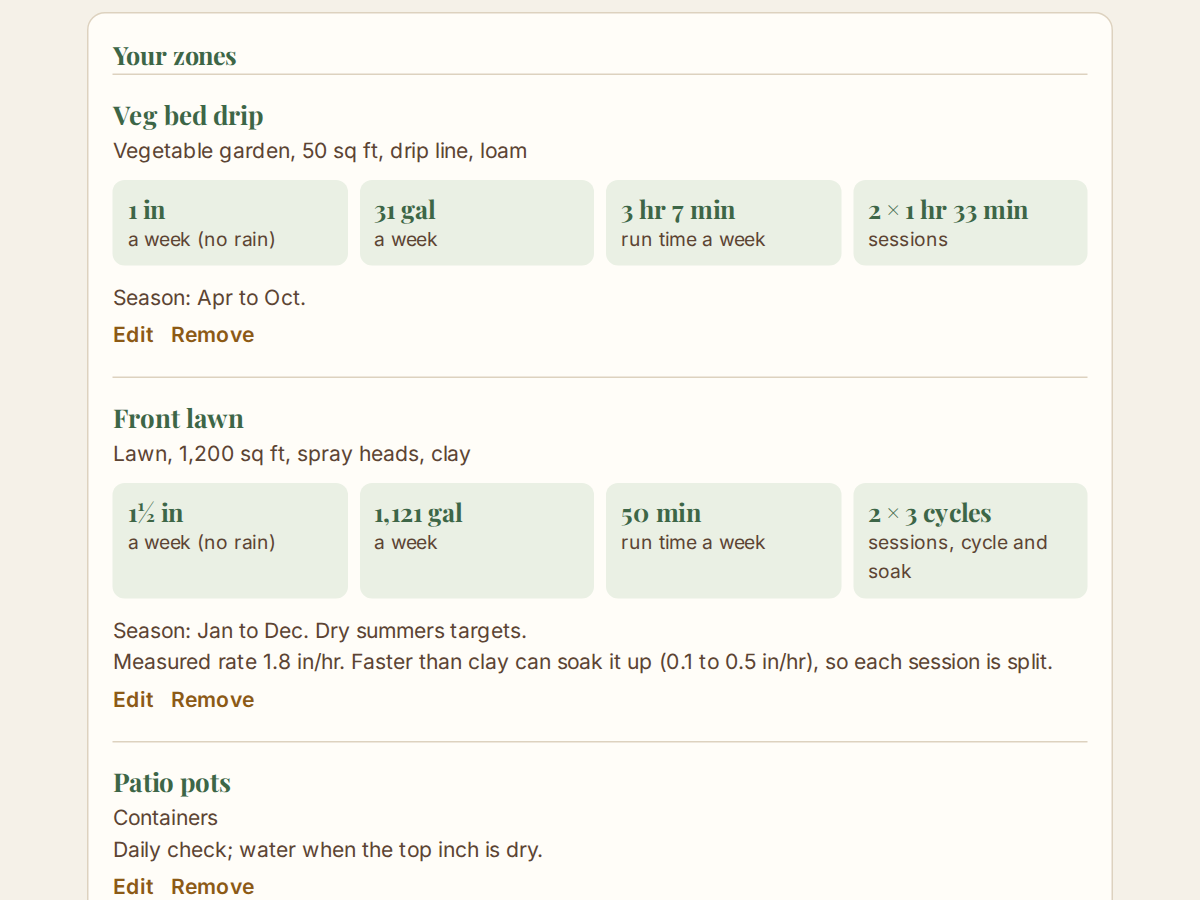
The app keeps the measured rates and minutes for each zone on your device, so next spring the zones are still there and you only move the season start. It does not remind you to blow out your lines and it does not control your sprinkler timer. It works out what to set, and you set the timer.
Paper versus app, in plain terms: for one controller and one lawn, a note taped inside the controller door with the shutdown date, plus one calendar reminder, is enough. The app saves time when you have mixed zones with different end dates, such as a vegetable bed that stops in October and a lawn that runs later, and you want the reminders to stop on their own. If that sounds useful, see the Watering Schedule Builder.
Sprinkler Blowout: Compressed-Air Pressure and Air Volume
Two numbers matter, pressure and volume. Pressure is set on the compressor’s regulator. Colorado State’s fact sheet says to keep it between 40 and 80 psi, and to treat the pipe as the limit:
| Pipe in your system | Maximum air pressure (Colorado State) |
|---|---|
| Rigid PVC pipe | 80 psi |
| Polyethylene pipe (flexible black pipe) | 50 psi |
Volume is the part home compressors lack. The University of Minnesota says consumer compressors can reach the needed psi but deliver less air volume, measured in cfm, while commercial compressors move more air and empty the system faster and more thoroughly. Colorado State gives the sizing rule, quoted as “GPM divided by 7.5 gallons = CFM needed.” A zone that flows 12 gallons per minute needs about 1.6 cfm by that math (12 divided by 7.5). Your zone flow comes from the irrigation plan or the ratings of its nozzles.
The technique is short bursts, not one long run. Colorado State says to blow each zone out twice, and that two short cycles per zone are better than one long cycle. It also says to wear eye protection. Both Oklahoma State and Colorado State’s PlantTalk page warn that mishandled air pressure can damage a system, as can leaving water in it, which is why so many sources hand this step to a professional.
Backflow Preventer: The Part That Freezes First
Colorado State says a backflow device is required if the system connects to the household water supply, and to check your water district or county health department for local rules. The device sits above ground, which is why it freezes before buried pipe does. The type decides how you drain it:
- Atmospheric vacuum breaker: Colorado State says it is winterized with air as each zone is blown out.
- Pressure vacuum breaker or reduced pressure device: Colorado State says these must never be blown out with compressed air. Drain the risers, then set the ball valves and test cocks part open for the winter.
The University of Minnesota puts the ball valve position at a 45 degree angle to the pipe, and says to loosen the test-cock screws a quarter turn so trapped water can drain and freezing does not crack the housing. Then wrap it. Colorado State’s PlantTalk page says to use insulation covered with plastic and to include the pipes down to ground level. Nevada’s JoAnne Skelly says taking the device off, draining it and storing it somewhere warm sounds more reliable against deep freezes, and that if it stays on, it should be insulated.
If your system also feeds a rain barrel, drain that too. The steps are in the winterizing section of our rainwater collection system guide.
Drip Lines, Soaker Hoses and Garden Hoses
Drip zones hold water in thin tubing, so they freeze as easily as pipe. Skelly’s drip steps for University of Nevada Cooperative Extension are: turn off the main water to the drip system, disconnect the hose from the filter, wrap the filter connection in a plastic bag to keep dirt out of the tubing, open the ends of all drip tubing to drain it, lift the tubing so water runs out or blow it out with a compressor, then close the ends.
The University of Georgia’s drip winterization checklist says it is best done before the first freeze, that screen and sand filters should be drained, inspected and cleaned, and that valves should be left open, because closed gate and ball valves trap water and can crack through repeated freeze and thaw cycles. Oklahoma State says to drain drip tape and soaker hoses and store them out of the sun, and that a hose frozen outdoors should be left alone until it thaws, since moving it can damage it. Georgia’s Harrison says the same of frozen hoses, which are fragile.
When the drip bed goes back into service next season, how often to water tomatoes covers the run times to set.
Spring Start-Up: Turning the System Back On
Oklahoma State says to close any manual drain valves in spring before you turn the system on. For a pressure vacuum breaker, Colorado State says to close the test cocks, then open the ball valves slowly to avoid water hammer. Then run each zone and look for leaks, the same check the University of Minnesota suggests in fall.
Spring is also when you reset how long each zone runs. The free demo keeps your zones and rates, so you only move each season’s start. If you would rather work it out on paper, the Lawn Irrigation Calculator below turns a weekly water target into minutes per zone.
Mistakes to Avoid
- Skipping it. The University of Minnesota says failing to winterize could result in significant and costly damage.
- Turning the water back on. Minnesota says the water valve should remain off all winter, with the drain valve left open.
- Blowing out a pressure vacuum breaker or reduced pressure device. Colorado State says never to do it.
- Going over the pipe’s pressure limit. 80 psi for PVC and 50 psi for polyethylene, per Colorado State.
- Using a small compressor and calling it done. Minnesota warns that a consumer compressor may not clear the system fully because of its lower air volume.
- Closing the backflow ball valves fully. Both Colorado State and Minnesota leave them part open so trapped water can drain.
- Leaving above-ground parts bare. Oklahoma State says to insulate them, and Colorado State’s PlantTalk page says to wrap down to ground level.
For more on the garden side of the fall list, our watering and irrigation guides cover the rest of the system, and the growing zones by state pages show how early your winter arrives.

Free book · 23 pages, PDF
Winterize Sprinkler System FAQ
When should I winterize my sprinkler system?
Before the first hard freeze. NWS Charleston issues a hard freeze warning at 28°F or lower for more than an hour and says a hard freeze can damage un-drained sprinkler systems. Extension sources give no single date: Oklahoma State treats snow as the sign it is time, and the University of Minnesota says to start preparing in fall. Plan to finish before your average first frost and let the forecast pick the day.
How do I turn off and winterize a sprinkler system for winter myself?
Turn off the water supply, release the pressure, open the drain valves, drain and insulate the backflow preventer, and set the controller to off or rain mode. If your system has no working drains, a compressed-air blowout is needed, and Oklahoma State and the University of Minnesota advise having a professional do it. Colorado State's fact sheet explains how to do it yourself with the right compressor and regulator.
Do I really need to blow out my sprinkler lines?
Colorado State Extension calls compressed air the only positive way to be sure enough water has been expelled, and says gravity drains are not recommended because buried pipe shifts over time. Oklahoma State, though, describes opening manual drain valves as a working method, and Colorado State's PlantTalk page says lines can settle and leave low spots even with inline drains. If you are unsure your pipe slopes cleanly to a drain, blow it out.
What PSI should I use to blow out sprinklers?
Colorado State Extension says to set the compressor regulator between 40 and 80 psi, with 80 psi the maximum for rigid PVC pipe and 50 psi the maximum for polyethylene pipe. It also says to blow each zone out twice in short cycles rather than one long run.
Can I use a small home air compressor?
It may reach the pressure but not the air volume. The University of Minnesota says consumer compressors can reach the needed psi but deliver less cfm, so they may not clear the system fully, while commercial compressors drain it faster and more thoroughly. Colorado State's sizing rule is gallons per minute divided by 7.5 to get the cfm a zone needs.
What happens if I do not winterize my sprinkler system?
Water left in the system can freeze and crack pipes, fittings, valves, sprinklers and pumps, according to Colorado State Extension, which says water expands by about one-eleventh in volume when it freezes. The University of Minnesota says failing to winterize could result in significant and costly damage.
Will my sprinkler system freeze at 32 degrees?
Water freezes at 32°F, but a night that touches 32°F is a signal to finish the job, not the point where buried pipe splits. NWS Charleston's hard freeze warning starts at 28°F or lower for more than an hour, and Oklahoma State says most systems are installed below the freeze line. That makes the exposed parts the first at risk: the backflow preventer, the main shutoff valve and any pipe above ground. Colorado State says the damage comes from water left in the lines, which expands by about one-eleventh as it freezes.
How much does a sprinkler blowout or winterization cost?
None of the extension and weather service sources used in this guide publish a price, so there is no sourced figure to quote here. Cost depends on how many zones you have, how long the lines are and what local companies charge. Ask for a per-zone or flat price in writing, and ask whether it includes draining the backflow preventer and shutting the system down at the controller, not only the blowout itself. Colorado State's 40 to 80 psi limits (80 for PVC, 50 for polyethylene) are a fair question to put to any contractor.
Is it too late to winterize my sprinkler system?
Not if the lines have not frozen with water in them. Oklahoma State treats snow as the sign it is time, and NWS Charleston warns that a hard freeze can damage un-drained systems, so the goal is to finish before the next hard freeze in your forecast. If a hard freeze has already passed with water still in the system, winterizing now will not undo damage, but it protects against the next one. Turn the system on in spring and check for leaks before you rely on it.
Is winterizing an irrigation system the same as winterizing a sprinkler system?
For in-ground sprinklers, yes: shut off the water, get the water out of the pipes and protect the backflow preventer. Drip irrigation is handled a little differently because the tubing is thin and holds water. University of Nevada Extension says to open the tubing ends to drain it, then lift the tubing or blow it out with a compressor, and the drip section above has the full steps.
Do I need to winterize sprinklers in a warm climate?
A shortened version. A University of Georgia irrigation specialist said only the top 2 inches of ground freeze in most of Georgia, so buried pipe is generally fine, but backflow-prevention valves and other above-ground parts should be wrapped and the system drained, since undrained lines can burst. Oklahoma State likewise says most systems sit below the freeze line, so the exposed parts are what matter.
Sources & further reading
Blowout pressure, sizing, backflow device and pump guidance comes from Colorado State Extension’s Home Sprinkler Systems: Preparing Your Sprinkler System for Winter (fact sheet 4.719) and Colorado State’s PlantTalk page on winterizing sprinkler systems. Drain valves, timer shutdown, insulation and drip tape come from Oklahoma State Extension’s tips for winterizing an irrigation system. The homeowner steps and backflow angles come from the University of Minnesota Turfgrass Science program’s Properly preparing irrigation systems for winter (October 2018). Mild-climate and hose advice comes from the University of Georgia’s Winterize pipes soon, avoid springtime troubles (2004), and drip checklist guidance from University of Georgia Extension Circular 1094. Controller and drip-line steps come from JoAnne Skelly of University of Nevada Cooperative Extension (2012 column). The hard freeze definition and the plumbing warning are from NWS Charleston’s frost and freeze information.
Systems, pipe and local rules differ, so treat these numbers as limits to stay under and follow your installer’s instructions and your water district’s backflow rules. Have a certified irrigation professional do the blowout if you are not sure.
Free book · 23 pages, PDF
The Watering & Irrigation Cheat Sheet
Sent