How to Use This Calculator
- Enter your roof area and rainfall amount.
- Read your total gallons collected and recommended barrel count.
- Enter your barrel height in the water pressure section.
- Read your spigot water pressure in PSI.
How Much Rainwater Can You Collect?
Collection comes down to three numbers: your roof area, the rainfall amount, and a collection efficiency that accounts for real-world losses. The conversion itself is simple — 1 inch of rain over 1 sq ft of roof yields 0.623 gallons — but not every drop that hits your roof ends up in the barrel.
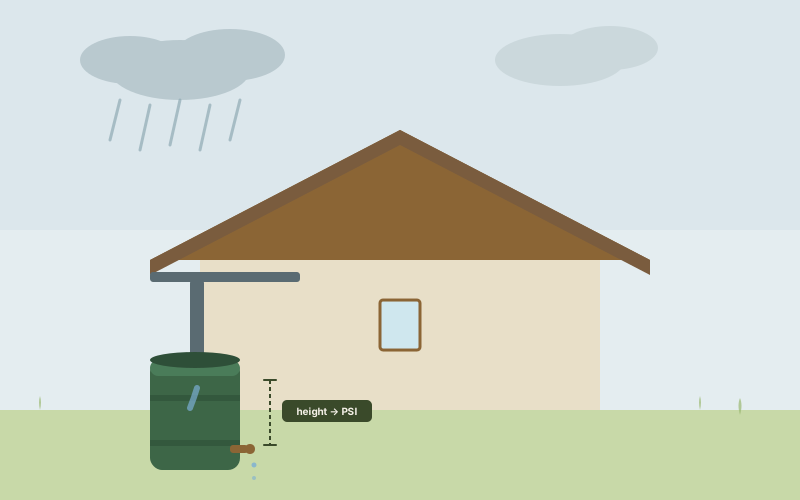
Collection efficiency (85% by default in the calculator above) accounts for evaporation off the roof surface, water lost to gutter overflow during heavy rain, splash-out at downspout junctions, and any first-flush diverter that intentionally routes the first bit of runoff away from the barrel. Steeper roofs and well-maintained gutters trend toward the higher end of realistic efficiency; roofs with debris or undersized gutters trend lower. 85% is a reasonable planning default, not a guarantee.
How Much Water Pressure Will You Get?
A rain barrel has no pump — whatever pressure comes out of the spigot is purely hydrostatic pressure, generated by the weight of the water above the outlet. The relationship is direct: every foot of water height above the spigot adds 0.433 PSI. There’s no way around this without adding a pump; a bigger barrel doesn’t give you more pressure unless it’s also taller or elevated higher.
In practice, this means most rain barrel setups produce very low pressure — a barrel on a 2–3 ft stand yields roughly 1–1.5 PSI. That’s workable for gravity-fed drip irrigation and soaker hoses, which need very little pressure to function. It is not enough for a standard sprinkler, which typically needs 15–30 PSI to spray properly — getting there from a barrel alone means adding an inline booster pump. Not sure whether your setup needs one? See Do You Need a Pump? in our full rainwater collection guide.
Is Collecting Rainwater Legal in Your Area?
Rainwater collection is legal in all 50 U.S. states — no state bans it outright. A small number of states have specific rules worth knowing before you set up a system:
- Colorado: households may use up to two rain barrels with a combined capacity of 110 gallons, for outdoor, non-potable use only (lawn, garden, and similar irrigation on the same property where the water was collected), and the barrels must have a sealable lid. This is current as of House Bill 16-1005 (2016). Residents with an exempt well permit may qualify to collect more under a separate permit — see the Colorado sources below.
- Utah: properties may store up to 2,500 gallons of collected rainwater. Free registration with the Utah Division of Water Rights is required once storage exceeds a small threshold (two 100-gallon containers or less needs no registration).
- Everywhere else: most states and localities have no specific rainwater collection restrictions beyond general property and building codes, but rules can change and vary by city or HOA. Check your local and state regulations before installing a large system — this page isn’t a substitute for that check.
Worked Examples
Collection: a 1,200 sq ft roof gets 1 inch of rain, at the default 85% collection efficiency.
- Base conversion: 1,200 sq ft × 1 in × 0.623 = 747.6 gallons (theoretical maximum).
- Apply efficiency: 747.6 × 0.85 = ~635.5 gallons actually collected.
- Barrels needed: 635.5 ÷ 50 = 12.7 → round up to 13 standard 50-gallon barrels.
Water pressure: a barrel elevated on a stand puts the water surface 3 ft above the spigot.
- PSI: 0.433 × 3 ft = ~1.3 PSI — enough for gravity-fed drip irrigation, not a sprinkler.
Common Mistakes
- Assuming 100% collection efficiency. Real-world losses from evaporation, gutter overflow, and splash-out are significant. Planning around the theoretical maximum instead of a realistic efficiency (80–90%) leads to underbuilt storage.
- Ignoring first-flush contamination. The first runoff off a roof carries accumulated dust, bird droppings, and roofing debris. Without a first-flush diverter, that contaminated water goes straight into your barrel — don’t use unfiltered rain barrel water on edible plants without accounting for this.
- Expecting sprinkler-level pressure from gravity alone. A barrel on a stand produces roughly 1–1.5 PSI, nowhere near the 15–30 PSI a standard sprinkler needs. A booster pump, not a taller stand, is the practical fix.
Rain Barrel Calculator FAQ
How many liters are in a rain barrel?
A standard rain barrel holds 50 gallons, which is about 189 liters. Sizes vary though — smaller barrels run 30–40 gallons (114–151 L), and larger cisterns can hold several hundred gallons. Check the specific product for its exact capacity.
How much does a barrel of water weigh?
Water weighs about 8.34 lb per gallon, so a full 50-gallon rain barrel weighs roughly 417 lb (about 189 kg) plus the weight of the barrel itself. This is why rain barrels need a sturdy, level base — a full barrel is not something you can casually reposition.
How many inches of rain does it take to fill a 5-gallon bucket?
From 1 sq ft of roof, 1 inch of rain yields about 0.623 gallons, so a 5-gallon bucket needs roughly 8 sq ft of roof area per inch of rain (5 ÷ 0.623). For a full-size roof, even a fraction of an inch fills a bucket almost instantly — collection scales with roof area, not just rainfall.
How do I calculate water pressure from a rain barrel?
Multiply the height of the water surface above your spigot (in feet) by 0.433 to get PSI. A barrel elevated 2–3 ft on a stand gives roughly 1–1.5 PSI — enough for gravity-fed drip irrigation, well short of the 15–30 PSI a standard sprinkler needs.
Sources & further reading
Legal information on this page draws on the Colorado Division of Water Resources’ “Rainwater, Storm Water & Graywater” page and Colorado State University Extension’s “Rainwater Collection in Colorado” fact sheet. For more on how we source and review the formulas behind every calculator, see our methodology page.