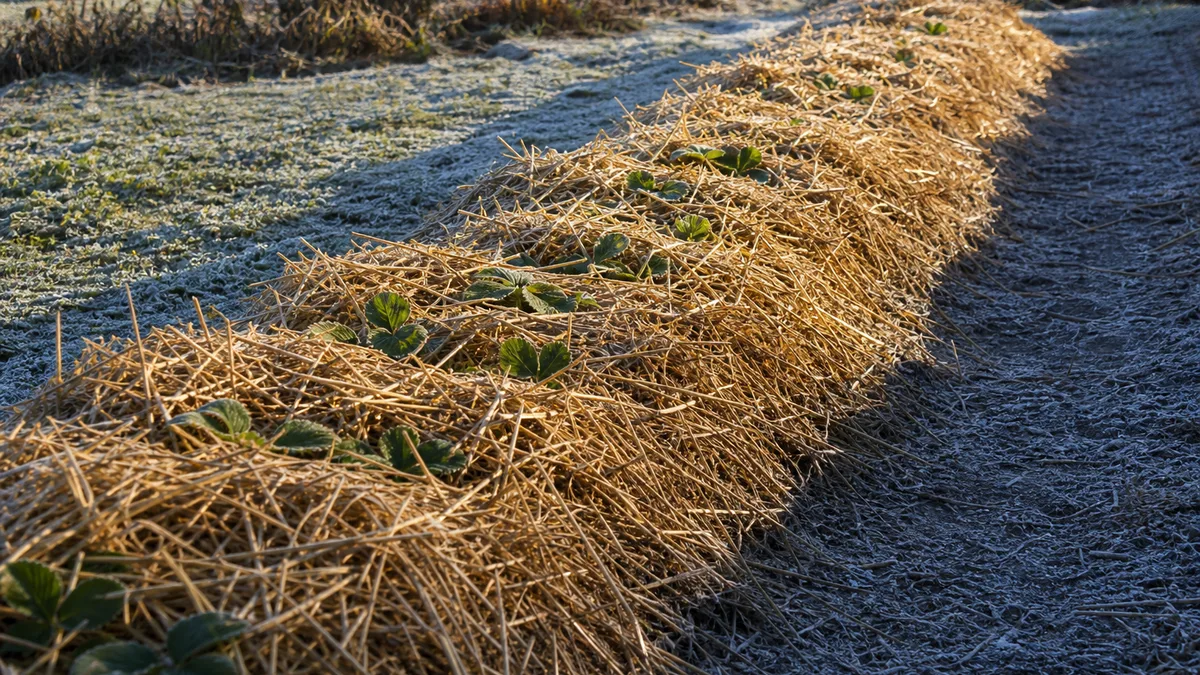
Yes, strawberry plants survive winter in USDA zones 3 to 9, according to University of Vermont Extension, but zone 4 and colder need protection. Purdue Extension says mulched plants can take -20°F with little damage, while Iowa State warns that below 20°F unmulched plants risk flower bud, root and crown injury. Check your hardiness zone, then mulch with straw once the plants are dormant.
Strawberry Winter Quick Reference
| Situation | Limit or timing | What to do | Source |
|---|---|---|---|
| Plants in the ground | Hardy in zones 3 to 9, depending on variety | Mulch in zone 4 and colder | University of Vermont |
| Unmulched crowns | Injury below 20°F (Iowa State), below 12°F (UMass), 10 to 20°F (Oregon State) | Mulch before the cold arrives, not before dormancy | Iowa State, UMass, Oregon State |
| Mulched bed | Survives -20°F with little damage | Loose straw, 3 to 6 inches in most sources | Purdue |
| Mulch date | Late November to mid-December in the Midwest and Northeast | Wait for several nights near 20°F and soil below 40°F | Iowa State, Purdue, West Virginia, UMass |
| Raised bed or pyramid | Colder than ground-level beds | 6 to 8 inches of straw | Iowa State |
| Potted plants | Roots exposed to air temperature | Unheated garage or shed, or replace each year | Iowa State, Nebraska |
| Spring uncovering | About 25 percent of plants show new growth | Rake straw into the aisles, keep it close | Iowa State, West Virginia |
Can Strawberry Plants Survive Winter?
Usually yes, because strawberries are perennials. Vermont Extension says they are hardy in zones 3 to 9 depending on variety and that mulching or other protection is advisable in zone 4 or colder. Oregon State Extension adds that you should choose cultivars adapted to your zone, and it warns that types suited to zones 5 to 7 may not do well in the warmer zone 8 Willamette Valley. Look up your own zone on our growing zones pages. Mulching strawberries is one of several approaches to carrying plants through the cold, and what overwintering means compares them with bringing plants in and storing tubers.
The exact cold limit depends on how hardened the plants are, so sources give a spread. Kansas State says a drop below 20°F before plants harden can cause severe damage and 15°F may kill them. UMass Extension says crowns can be damaged below 12°F without mulch, and Oregon State puts crown damage at 10 to 20°F depending on dormancy stage and recent weather. An older University of Minnesota freezing test, published in Minnesota Fruit Grower, found that well-hardened June-bearing plants took 21°F for 24 hours with little injury, 16°F caused much more, and 10°F came close to the killing point. Immature plants and heavily fruited everbearers were hurt first.
The same Minnesota article reported that in an average winter the temperature under mulch and snow generally stays above that danger point, which is the reason for mulching. Purdue’s figure for mulched plants, -20°F with little damage, shows how much the cover buys you. Cold damage shows up late: Oregon State says injured crowns blacken once the weather warms, and growth can be patchy. Frost does not need a 32°F reading to form, as what temperature frost forms explains.
How Do You Prepare Strawberry Plants for Winter?
Mostly by letting them harden and then covering them at the right moment. Iowa State and Purdue both say plants need time to adjust to cold, and mulching too early can injure them. Hardening shows in the plant: Iowa State describes leaves that turn grayish or reddish rather than bright green, and West Virginia Extension says the plant flattens out as leaves go light red and green. If it is still October where you garden, you are early, so use the weeks to tidy up.
The same hardening logic applies to the whole yard, and our guides to protecting plants in winter and to the full winterize your garden checklist show how to fit the strawberry bed into your fall jobs.
When Should You Mulch Strawberries for Winter?
After the plants go dormant and before the soil locks into deep cold. In practice that means late November to December across much of the Midwest and Northeast, and the sources give these windows:
So the calendar spans about a month, and the better clues are the weather ones that the sources share: several nights around 20°F, and soil that stays below 40°F for days. Treat your first fall frost as the point to start watching, not the day to mulch, because every source above waits for hard nights first. Mulching early is a real error: Purdue lists it among the common problems, since it can damage leaves that are still growing, while waiting too long invites cold injury.
For a quick look at typical dates by place, the frost dates pages list first and last frost by location. Do not treat them as a mulch date, only as the start of the watch.
How Do You Cover Strawberry Plants for Winter?
Use clean, dry, weed-free straw, laid loosely over the whole planting. Iowa State recommends oat, wheat or soybean straw, Purdue wants dry wheat straw and warns against moldy bales, and UMass lists wheat, rice, oat or Sudan grass straw, with the caution that anything coarser is not recommended. Kansas State accepts weed-free wheat straw or prairie hay.
How deep should the mulch be?
The sources differ, and the gap partly reflects climate. Iowa State says 3 to 5 inches at first, settling to 2 to 4. West Virginia says 4 to 6 inches. Purdue says at least 2 inches and ideally 4 to 6 inches of loose straw. Penn State says about 4 inches. UMass says 2 to 3 inches for a level row, with twice that on raised beds or windy sites, and Kentucky’s beginner guide says about 2 inches. A sensible reading is 2 to 3 inches where winters are moderate and 4 to 6 inches where they are hard. Iowa State says raised beds and pyramids are colder than ground-level beds and want 6 to 8 inches.
What not to use
Leaves are the one real disagreement. Iowa State and Purdue say not to use them, because they mat down, hold moisture and can rot crowns, while Kentucky’s guide says straw or leaves are fine at about 2 inches. Purdue also lists grass clippings as a poor choice. Oregon State adds a regional warning: in western Oregon, do not use straw for winter cold protection, because wet mulch promotes rot. Our organic vs. inorganic mulch comparison covers how different materials hold water, and the list of common mulch mistakes explains why piling it thick against stems backfires.
Steps to cover a strawberry bed
- Wait for dormancy. Look for gray or reddish leaves, several nights near 20°F and soil under 40°F, as above.
- Clear the bed. Pull weeds and remove any rotting leaves so you are not sealing problems under the straw.
- Break up the flakes. Kansas State and West Virginia both say to shake apart compressed slabs so the cover insulates evenly.
- Spread it loosely. Penn State warns against clumps, which can smother plants, and Oregon State says not to bury the crowns under organic mulch.
- Check the depth. Aim for the range above, remembering that rain and snow will compress it over the season, as Purdue notes.
- Secure it. On windy sites, hold the straw with fencing weighted by bricks, per Iowa State.
June-Bearing vs Everbearing: Does Winter Care Differ?
Barely, for plants in the ground. The extension pages reviewed give one mulch schedule for the whole planting and no separate dates for everbearing or day-neutral types, so use the timing above for both. The differences are elsewhere. Penn State says day-neutral plants are mulched right after planting because they dislike warm soil, are not renovated, and need replacing about every third year. Our planting calendar pages help you place those planting dates. Oregon State says only June-bearers should be renovated, since everbearing and day-neutral plants are still fruiting in late summer.
The old Minnesota freezing test found heavily fruited everbearers were among the plants injured at 21°F, which hints that these types go into winter with less in reserve. That is one older study, so treat it as a reason to mulch carefully, not as a rule. The other difference is containers: Iowa State says day-neutral and everbearing types suit pots better than June-bearers, and Oregon State names day-neutral cultivars as the best container choice, as the next section covers.
Can Strawberry Plants Survive Winter in Pots?
Sometimes, but sources are cautious. Iowa State’s container guide says it is not recommended to overwinter strawberries in containers and suggests composting the plants and buying new ones in spring. Its overwintering page is less strict: it says containers left outdoors will likely be seriously damaged or destroyed, and gives two options, moving the pot into an attached, unheated garage in November, or emptying the soil, storing the container indoors and replanting in spring. Nebraska Extension also says to move container plants to an unheated garage or shed and water them now and then so the roots do not dry out. The same shelter-or-replace choice applies to other tender container crops, as our guide to overwintering pepper plants shows.
The reason is the root zone. An Iowa State article on potted hardy fruit plants (it does not mention strawberries) found that during days of -15°F or colder, soil 4 inches deep never fell below 7°F and soil 12 inches deep stayed above 24°F. A pot has no such cushion, and the author says an exposed container’s root zone will likely approach air temperature. The article advises moving containers to an insulated but unheated space, or grouping them and insulating with straw or wood chips. It also warns that a garage or porch warmed by daytime sun can make plants break dormancy early. Tender plants that need a warm room instead are covered in when to bring plants inside for winter.
Options for potted strawberries
When you replant, Oregon State recommends containers 10 to 18 inches deep and 12 inches or larger across, and our guide to plant pot sizes helps you convert that to a real pot.
What Should You Do With Strawberry Plants in Winter?
Very little, which is the point of mulching well. Leave the straw in place through freeze and thaw cycles, because Iowa State, West Virginia and Kansas State all name repeated freezing and thawing as a cause of plants heaving out of the ground, which exposes roots and can kill them from water loss. Pots in a garage need an occasional light watering, per Nebraska. If a thaw leaves a patch of straw blown off the bed, put it back before the next cold snap, using the same secure-it habit as in fall. Otherwise, wait. For the rest of your cold-season jobs, see what to plant in winter.
When Do You Uncover Strawberries in Spring?
As late as you safely can, and gradually. Iowa State and West Virginia both say to remove the mulch when about 25 percent of the plants show new growth, which looks white or yellow under the straw. Both say removing it in March can trigger blooming before frost danger has passed, and Iowa State suggests leaving it until mid-April in central Iowa, where the average last 32°F date is late April. Penn State gives mid-March to early April, Purdue says when the 4 inch soil temperature reaches about 40°F, UMass says once new green growth appears, and Kentucky says when the plants begin to yellow.
Do not bag the straw. Iowa State says to rake it into the aisles and, if frost threatens during bloom, lightly rake it back over the plants. West Virginia and Iowa State both warn that 32°F or lower can severely damage or destroy open flowers. Penn State and Kansas State add that some straw can stay to keep berries off the soil and hold moisture. Cold-damaged plants can look fine for weeks, so recheck crowns for blackening as Oregon State describes.
If you track frost dates, planting dates and mulch weeks across several beds, the Season Planner keeps your frost dates and the next job in one place. For more fruit and vegetable planting guides, browse the spacing and planting topic hub.
Free book · 23 pages, PDF
Strawberry Winter Care FAQ
Can strawberry plants survive winter?
Yes, in USDA zones 3 to 9 depending on variety, per University of Vermont Extension, which advises mulching or other protection in zone 4 or colder. Purdue Extension says mulched plants can survive -20°F with little damage.
Will strawberry plants survive winter without mulch?
Possibly in mild winters, but it is a gamble. Iowa State Extension says temperatures below 20°F can kill flower buds and damage roots and crowns of unmulched plants, and UMass Extension says crowns can be damaged below 12°F.
When should I cover strawberries for winter?
After the plants go dormant, which is late November to mid-December in much of the Midwest and Northeast. West Virginia Extension says to wait for nights near 20°F and soil consistently below 40°F, and to mulch at once if a drop below 20°F is forecast.
How do you cover strawberry plants for winter?
Spread clean, weed-free straw loosely over the plants. Sources range from 2 to 3 inches (UMass) to 4 to 6 inches (West Virginia, Purdue), and Iowa State says raised beds need 6 to 8 inches. Shake apart compressed flakes and avoid clumps.
Can strawberry plants survive winter in pots?
Rarely if left outdoors. Iowa State Extension says containers left outside will likely be seriously damaged, and suggests an attached, unheated garage in November. Nebraska Extension agrees on an unheated garage or shed with occasional watering.
When do I take the mulch off strawberries in spring?
When about 25 percent of the plants show new white or yellow growth, per Iowa State and West Virginia Extension. Purdue says when the 4 inch soil reaches about 40°F. Rake the straw into the aisles and keep it handy in case a frost threatens open flowers.
Sources & further reading
Winter timing, mulch and thresholds: Iowa State Extension on overwintering strawberries, Purdue Extension, West Virginia University Extension, Kansas State Research and Extension, UMass Extension Berry Notes, Penn State Extension and University of Kentucky Extension.
Hardiness, varieties and cold injury: University of Vermont Extension, Oregon State Extension, Nebraska Extension and the University of Minnesota freezing test in Minnesota Fruit Grower. Containers and summer renovation: Iowa State on container strawberries, Iowa State on potted fruit plants and Iowa State on renovating June-bearing strawberries.
Free book · 23 pages, PDF
The Spacing & Planting Cheat Sheet
Sent