What to plant in winter depends on how hard your ground freezes. Where winters are mild, the University of Arizona Extension calendar for Maricopa County lists seeds of greens and roots from December to February. Where soil freezes, plant garlic in fall (see how to plant garlic), grow under covers, and start spring seeds indoors. Garlic planted now is ready the following summer, and when to harvest garlic covers the signs to watch for.
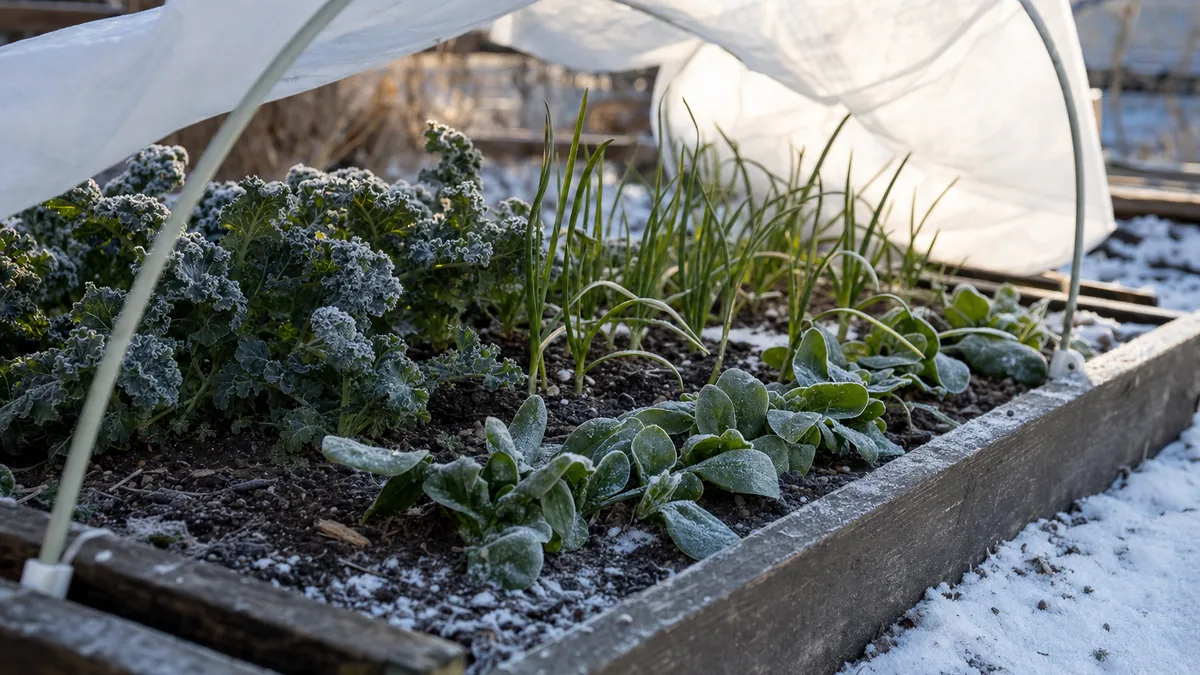
What Can I Plant in Winter? Quick Reference by Climate
Extension guides are written one region at a time, so each row below is that region’s own advice. Not sure which row is yours? Our explainer on USDA hardiness zones shows how to read the map. In cold climates, grass seed can also go down in winter, which can you plant grass seed in the winter explains.
| Climate | What to sow or plant outdoors in winter | Protection | Source |
|---|---|---|---|
| Low desert, mild winters (Maricopa County, Arizona) | Seeds of beets, carrots, lettuce, spinach, radishes, kale and peas from December to mid-February, depending on the crop | None listed in the calendar | University of Arizona Extension |
| Central Texas (Travis County) | In January, seeds of turnips, radishes, carrots, arugula, beets, kohlrabi and peas; transplants of broccoli, cabbage, lettuce and spinach; onion sets | Row cover or hot caps for cilantro, chives and parsley below freezing | Texas A&M AgriLife Extension |
| South Carolina (frost dates for zones 7b, 8b and 9b) | Leafy greens, cool-season herbs and root crops, planted mid-October to early November | Lightweight row cover (0.5 to 1 oz) for frost down to 28°F | Clemson Extension |
| Maritime Pacific Northwest (west of the Cascades) | Most winter crops go in from mid-July through August and are harvested through winter | Row covers, cold frames or cloches | WSU Master Gardeners, Oregon State Extension |
| Cold winters, soil freezes | Garlic about three weeks before the ground freezes; cold frame lettuce, spinach, kale and radishes in fall and early spring | 4 inches of mulch on garlic; cold frame or row cover for greens | Penn State Extension, UVM Extension |
Zones are the usual way to compare climates. The USDA says its map is based on the average annual extreme minimum winter temperature, shown in 10 degree F zones with 5 degree half zones. Oregon State Extension adds that heading brassicas such as cabbage and cauliflower are usually hardy to USDA zones 8 to 9, and Clemson ties its winter planting window to first fall frost dates in zones 7b, 8b and 9b. As my own reading of those guides, not an extension rule, zone 8 and warmer is where sowing outdoors in the middle of winter is realistic. Once you have picked a crop, the spacing and planting guides cover the rest.
What Grows in the Winter Where Winters Are Mild?
Cool-season vegetables do. The University of Georgia Extension in Madison County lists leafy greens (lettuce, spinach, kale, collards, arugula), cole crops (broccoli, cabbage, cauliflower) and root crops (carrots, radishes, turnips, beets) as the winter group, and says some can taste better after frost. Its timing is early: collards, kale and turnips in August and September, and lettuce, radishes and spinach into September and October, so plants establish before it turns consistently cold.
The farther south you go, the later the window. Clemson Extension puts winter crops in the ground from mid-October to early November in South Carolina, with harvest through December and sometimes into early spring. The University of Arizona calendar lists winter seeding of beets, carrots, spinach, radishes and turnips on December 1 to 15 and again from January 1 to February 15 in Maricopa County. Texas A&M says January is the month for sowing turnips, radishes, carrots, arugula, beets and peas in Central Texas. For lettuce, our guide to growing lettuce from seed covers depth, spacing and thinning. Potatoes use the same mild-winter window in the Gulf states, and can you plant potatoes in the winter gives the extension dates and the frost cautions.
Florida works differently: UF/IFAS Extension lists lettuce planting from September to February in central and south Florida, and from September to October and January to February in north Florida. For typical frost dates, try our pages for zone 9a and zone 8b, or enter your ZIP code in the planting calendar by ZIP code.
One caution for gardeners west of the Cascades: the Washington State University Clallam County guide says most winter crops are planted from mid-July through August there, so for the maritime Northwest, the planting for winter happens in summer. Sowing again every few weeks keeps greens coming, as our guide to succession planting explains.
What Veggies Can I Plant in Winter? A Crop Table
Windows and days to harvest are from the University of Arizona Extension calendar for Maricopa County, and temperature ratings are from the Purdue Extension cold tolerance chart. Windows differ by region, so read the table as the shape of a winter garden, not as your dates, and see our guide to growing carrots from seed for sowing and thinning. In Maricopa County, Arizona lists spinach, radish and carrot seeding on Oct 1 to Nov 15, Dec 1 to 15 and Jan 1 to Feb 15, and lettuce (seed or transplant) on Oct 1 to Nov 15, Dec 1 to 15 and Jan 1 to Feb 1.
| Crop | Winter window or method | Protect when | Days to harvest | Source |
|---|---|---|---|---|
| Leaf lettuce | Seed or transplant (Maricopa, above) | Semi-hardy: mid to upper 20s°F | 30 to 90 | Arizona, Purdue |
| Spinach | Seed (Maricopa, above) | Hardy: low 20s°F | 30 to 90 | Arizona, Purdue |
| Kale | Seed, Oct 1 to Nov 15 and Dec 1 to 15 (Maricopa) | Hardy: low 20s°F | 60 to 90 | Arizona, Purdue |
| Radishes | Seed (Maricopa, above) | No rating found | 30 to 60 | Arizona |
| Carrots | Seed (Maricopa, above) | Semi-hardy: mid to upper 20s°F | 60 to 100 | Arizona, Purdue |
| Garlic | Cloves, Oct 1 to 15 (Maricopa); elsewhere about 3 weeks before the ground freezes | 4 inches of straw or shredded leaves | 5 to 7 months | Arizona, Penn State |
| Onion sets | Sets, Dec 1 to 15 and Jan 1 to Feb 1 (Maricopa); mid to late January (Central Texas) | Hardy: low 20s°F | 4 to 5 months | Arizona, Texas A&M, Purdue |
Treat day counts as ranges: Oregon State says plants grow much faster at 70 to 90°F than at 32 to 50°F, so expect the long end of each range in a cold winter, though the sources give no formula for adjusting it. Harvest cut-and-come-again lettuce from the outside leaves; UGA Extension says to leave the growing point intact so the plant keeps producing, and our walkthrough on how to harvest lettuce shows the cuts.
Herbs fit too: Clemson lists chives, cilantro, parsley, dill and sage among its winter crops, and our guide to growing cilantro covers the cool-weather timing that keeps it from bolting.
What Can You Grow in the Winter Where the Ground Freezes?
Less outdoors, and more under cover. The extension guides I found describe protection, not sowing in frozen soil, and our guide to protecting plants in winter covers it in depth. Wisconsin, Clemson, Oregon State and UVM describe three tools, and the sources differ on how much warmth each gives:
- Floating row cover. UW-Madison Extension says covered plants stay five to ten degrees warmer and are protected down to 28°F. Oregon State says medium covers give up to about 4°F of protection with 85 percent light transmission and heavy covers 4 to 8°F with 30 to 50 percent. NC State Extension says about five degrees. Across sources, that is roughly 4 to 10 degrees.
- Hoops or low tunnels. Clemson says to support the fabric on wire or PVC hoops, because frost can still form where a cover rests on the leaves. Oregon State adds that covers can freeze to plants after rain.
- Cold frame. A south-facing box with a tilted clear lid. UVM Extension says to prop the lid open a couple of inches in the day and close it in the evening.
Venting is where sources disagree. Clemson says to vent on sunny days to stay below 60°F, Washington State University’s Clallam County guide says to vent above 45°F, and UW-Madison warns that frames can get extremely hot and wilt plants. The sources do not reconcile the two, so put a thermometer inside the frame, as Clemson suggests. UVM lists lettuce, spinach, kale, radishes and scallions for cold frames and says to sow two to four weeks before the usual planting time or, in fall, to extend harvest two weeks or more past the first frost. Fall prep is in our guide to winterizing your garden.
Gardeners in zone 7a or cooler can check typical first and last frost dates on our zone 7a frost dates page, and flower fans can see which blooms handle the cold in our guide to winter flowers.
What to Plant for Winter: Garlic and Onions
Garlic is the classic cold-climate crop, planted in fall and left in the ground through winter. Penn State Extension says to plant about three weeks before the ground freezes, so roots form but shoots do not poke through before winter. It asks for cloves root side down and at least two inches deep, four to eight inches apart, with about four inches of straw or shredded leaves on top. In Maricopa County, Arizona lists garlic cloves for October 1 to 15 and a harvest at 5 to 7 months. Our guide to timing, depth and spacing for garlic works through the same steps by region. Strawberry beds get a similar straw mulch over winter, covered in how to winterize strawberry plants.
Onions suit mild winters. Texas A&M says to plant onion sets in mid to late January, about an inch deep and two inches apart, and thin to about four inches. Oregon State notes that overwintering onions should go into winter small, about pencil-sized, to avoid early bolting. See our guide to planting onion sets for depth and dates. Grain is a winter-sown option too, and when to plant winter wheat dates the fall sowing by Hessian fly-free dates for several states.
What Plants Grow in Winter Indoors?
Microgreens are the quickest. Oregon State Extension’s Food Hero guide says to fill a clean tray 2 to 3 inches deep with at least 1 1/2 inches of moist potting soil, cover until sprouting at about 3 to 4 days, and cut many types in 10 to 14 days. It lists broccoli, cabbage, cilantro, chard, kale, peas, sunflower, arugula, mustard and radish, and says to avoid eggplant, peppers, tomatoes and tomatillos. It uses a lamp about 3 inches above the plants for roughly 15 hours a day, and warns that dim light makes them lean toward the light. That lean is the same fault our guide to preventing leggy seedlings explains, and our comparison of LED and fluorescent grow lights helps with the lamp.
Potted herbs are the other windowsill crop; for rosemary, see our guide to overwintering rosemary. Oregon State says to keep the soil just damp, because soggy trays are where damping off starts.
What Can I Grow in Winter for Spring? Start Seeds Indoors
Cornell Cooperative Extension says to start tomato, pepper and eggplant seeds about 6 weeks before your transplant date, and to plant them outside 2 to 3 weeks after the average last frost. As my own arithmetic from those two figures, that puts sowing roughly 3 to 4 weeks before the average last frost. Cornell gives germination soil temperatures of 75 to 90°F, daytime air of 65 to 70°F after sprouting, and grow lights 3 to 6 inches above seedlings for 12 to 16 hours a day. Texas A&M tells Central Texas gardeners to sow tomatoes indoors under grow lights in January. Our guides to growing tomatoes from seed and growing peppers from seed go through each crop.
The date that anchors all of this is your average last spring frost, and sources differ on it. Our comparison of Farmer’s Almanac frost dates and NOAA data explains why two lists can disagree by days.
The Season Planner works out every sowing and planting date for your own ZIP code in one plan.
How to Plant a Winter Garden, Step by Step
- Find your zone and frost dates. Use the USDA map zone and your average first fall frost. Clemson’s window is mid-October to early November.
- Choose crops by hardiness. Purdue rates spinach, kale and onions as hardy and lettuce and carrots as semi-hardy. Pick hardy crops if you will not cover.
- Sow in your window. Use Arizona’s calendar, Texas A&M’s January list or your own state’s extension calendar, and mulch garlic with about 4 inches of straw or leaves, per Penn State.
- Cover before the cold, not after. Lay fabric on hoops. Clemson says to leave headspace so frost does not form on leaves.
- Vent and water lightly. Open cold frames on sunny days. Clemson says growth is slower, so avoid overwatering.
Free book · 23 pages, PDF
What to Plant in Winter FAQ
What can I plant in winter?
In mild climates, cool-season greens, roots and brassicas. University of Arizona Extension lists seeds of beets, carrots, lettuce, spinach and radishes from December to mid-February in Maricopa County, and Texas A&M lists turnips, radishes, carrots, beets and peas for January. Where soil freezes, plant garlic in fall and start seeds indoors.
What veggies can I plant in winter?
Lettuce, spinach, kale, radishes, carrots, beets, peas, turnips and onion sets, depending on climate. Purdue Extension rates spinach, kale and onions as hardy to low 20s degrees F and lettuce and carrots as semi-hardy. Arizona lists 30 to 90 days for spinach and 60 to 100 for carrots.
What can you grow in the winter if the ground freezes?
Cold-frame greens, covered crops and indoor microgreens. UVM Extension names lettuce, spinach, kale, radishes and scallions for cold frames, and Oregon State Extension says many microgreens are ready in 10 to 14 days indoors. Garlic planted in fall about three weeks before the freeze overwinters in the ground, per Penn State.
What plants grow in winter without protection?
Hardy crops in mild climates. Texas A&M lists arugula, kale and mustards as the most frost-tolerant greens, and Purdue rates spinach, kale and onions as hardy. Purdue says to protect hardy crops if temperatures in the low 20s degrees F seem imminent.
How much does a row cover protect plants?
About 4 to 10 degrees, depending on the source. Oregon State Extension says medium fabric protects up to about 4 degrees F and heavy fabric 4 to 8 degrees F. UW-Madison says covered plants stay five to ten degrees warmer, down to 28 degrees F, and NC State says about five degrees.
What can I grow in winter for spring?
Tomatoes, peppers and eggplant started indoors late in winter. Cornell Cooperative Extension says to start them about 6 weeks before your transplant date, which falls 2 to 3 weeks after the average last frost, with grow lights 3 to 6 inches above seedlings for 12 to 16 hours a day.
Sources & further reading
Winter crop lists, windows and days to harvest come from the University of Arizona Extension vegetable planting calendar for Maricopa County, Texas A&M AgriLife Extension’s January vegetable garden page for Travis County, Clemson Extension’s guide to extending the growing season in South Carolina, University of Georgia Extension’s Madison County winter vegetable article, UF/IFAS Extension’s lettuce, endive and escarole publication and Purdue Extension’s cold temperature tolerance chart.
Covers and cold frames are from UW-Madison Extension’s article on extending the garden season, Oregon State Extension’s publication PNW 548 on winter vegetable production west of the Cascades, WSU Clallam County Master Gardener fall and winter gardening brochure, UVM Extension’s cold frame article and NC State Extension Carteret County’s winter garden crops page.
Garlic, indoor greens and seed starting are from Penn State Extension’s garlic planting article, Oregon State Extension’s Food Hero microgreens guide and Cornell Cooperative Extension’s indoor vegetable seed starting factsheet. Zone definitions are from the USDA Plant Hardiness Zone Map.
Free book · 23 pages, PDF
The Spacing & Planting Cheat Sheet
Sent