The flowers that grow well in winter include pansies, violas, hellebores, witch hazel, winter jasmine and snowdrops, with camellias added in zones 7 to 9. NC State Extension rates them from zone 3 (snowdrops) to zones 7 to 9 (camellias). See our spacing and planting guides for setting them out.
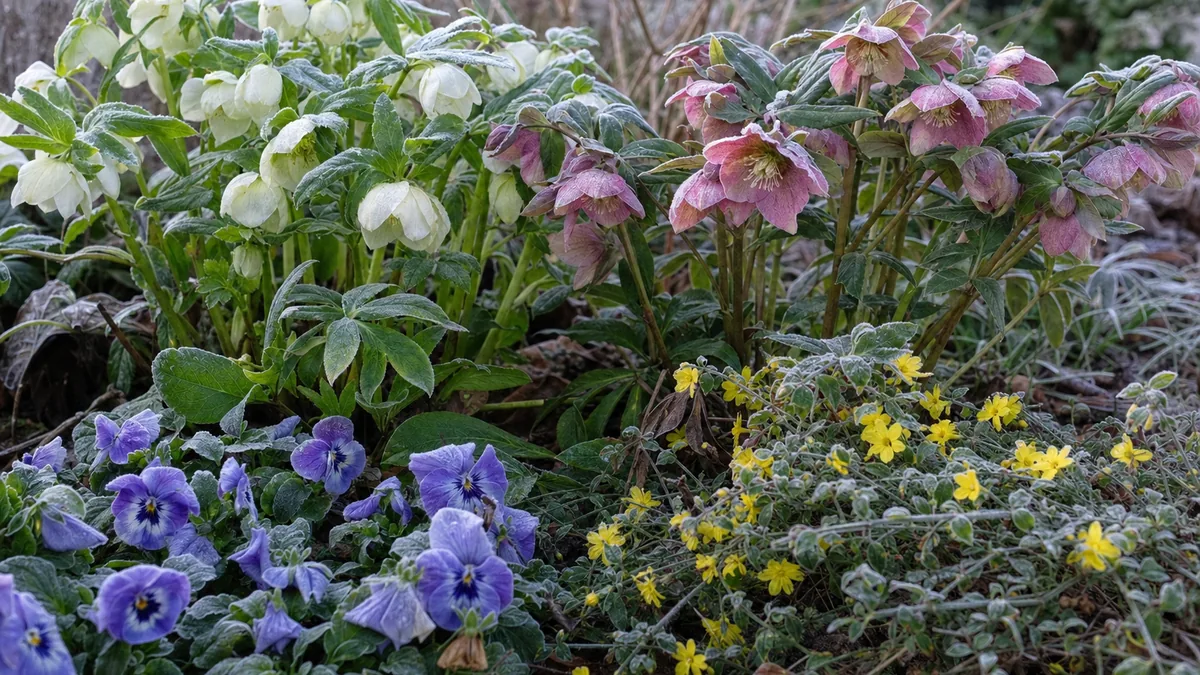
What Flowers Are Best for Winter Gardens? Quick Reference
Find your zone on our growing zones page, then compare it with the zone column below.
| Plant | USDA zone | Bloom time | Sun | Source |
|---|---|---|---|---|
| Pansies and violas | 6 to 10 (Oklahoma State lists 5) | Fall, winter and spring, up to 4 to 6 months | Full sun to partial shade | NC State, Oklahoma State |
| Hellebores | 4 to 9 | Late winter to early spring | Partial shade | UVM, NC State |
| Witch hazel (hybrid) | 5 to 9 (Iowa State: 5 to 8) | February to March | Part shade to full sun | NC State, Iowa State |
| Winter jasmine | 6 to 10 (Oklahoma State: 6) | As early as December, mostly January to February | Full sun to part shade | NC State, Oklahoma State |
| Camellias (sasanqua, japonica) | 7 to 9 | Sasanqua late fall to early winter; japonica usually February to April | Full sun to partial shade | NC State |
| Winter heath | 7 to 9 (UConn: 5) | January to March | Full sun or light shade | NC State, UConn |
| Snowdrops | 3 to 9 | Late winter to early spring | Full sun to part shade | NC State, UW-Madison |
| Winter aconite | 3 to 7 | February to March | Full sun to partial shade | NC State |
| Hardy cyclamen (C. coum) | 5 to 7 | Late winter to early spring | Shade or woodland | Penn State |
| Ornamental kale | Cool-season annual; UF/IFAS gives 7b to 11a for the Southeast | Fall color, best below 60°F | Full sun | UF/IFAS, UW-Madison |
| Florist cyclamen | 9 to 11 outdoors, frost tender | Early winter to spring | Bright indirect light or partial shade | NC State, UW-Madison |
Our guide to how USDA hardiness zones work explains the numbers, and sources disagree in places, which is why some cells show two zones. NC State lists winter heath for zones 7 to 9, for example, while UConn Extension says it is hardy in zone 5, so treat the colder zone as a tested limit and the warmer range as the safer bet.
What Are Winter Flowering Plants?
Winter flowers fall into three groups. True winter bloomers are shrubs, perennials and bulbs that flower between about December and March, such as witch hazel, hellebores and snowdrops. Cool-season annuals, mainly pansies, violas and ornamental kale, are replanted each fall and keep color through the cold. Tender container plants, such as florist cyclamen, only live outdoors in the mildest zones. Tropical hibiscus is another example, and how to overwinter hibiscus explains when it has to come inside.
So the answer to what flowers bloom in winter depends on where you garden: a plant rated only to zone 9 may not survive a northern winter. The zone column above is the quickest filter.
What Flowers Bloom in Winter? Shrubs and Perennials
Hellebores
University of Vermont Extension rates hellebores for USDA zones 4 to 9, with some hybrids surviving zone 3 under mulch and reliable snow cover. UVM says the flowers open in early spring, last more than four weeks and suit partial shade, with full direct sun avoided. NC State places the bloom in late winter. UVM recommends rich, well-draining soil and says to plant in spring or fall. Because that means avoiding soggy spots, our guide to fixing root rot shows what waterlogged roots look like.
Witch hazel
Witch hazel is the classic winter-blooming shrub. Iowa State Extension lists three groups: common witch hazel (Hamamelis virginiana) blooms mid-October to early December in zones 3 to 8, vernal witch hazel flowers from early February to late March in zones 4 to 8, and hybrids bloom the same weeks in zones 5 to 8. Iowa State says full sun gives more flowers and a more compact shape, and that established plants resent disturbance, so choose the spot carefully.
Winter jasmine
Winter jasmine (Jasminum nudiflorum) carries yellow flowers on bare green stems. NC State lists zones 6 to 10 and a January to February bloom, while Oklahoma State Extension says zone 6 and flowers as early as December. NC State adds that it blooms on last year’s growth, so prune right after flowering. The same logic applies to spring shrubs, as our guide to pruning a lilac bush explains.
Camellias
Camellias are for zones 7 to 9 only. NC State lists Camellia sasanqua for zones 7 to 9 with blooms from late fall to early winter, each flower lasting about four to six weeks. Camellia japonica is also rated for zones 7 to 9, and NC State says its season runs February through April, though some varieties start as early as October. Both want well-drained, acidic soil. Camellias bloom on old growth, so cut back only after flowering, as with old-wood types in our guide to cutting back hydrangeas. NC State lists stem cuttings or layering for propagation, and our guide to propagating roses from cuttings shows the cutting method.
Winter heath
Winter heath (Erica carnea) is a low evergreen mat, about 12 inches tall and 24 inches wide per UConn Extension, which says to plant it in early spring or fall in low-fertility, well-drained soil and to water the shallow roots until established. NC State lists a January to March bloom.
What Plants Bloom in Winter From Bulbs and Tubers?
Small bulbs and tubers give the earliest color and go in the ground in late summer or fall. University of Wisconsin Extension says to plant snowdrop bulbs in early fall, once the soil has cooled to nighttime temperatures of about 40 to 50°F, 3 inches deep and 3 inches apart, in groups of at least three or four. It rates the common snowdrop (Galanthus nivalis) hardy to zone 3, and NC State lists zones 3 to 9. Garlic is another crop planted in fall, and our guide to planting garlic covers its own timing and depth.
Winter aconite (Eranthis hyemalis) is a second early bloomer. NC State lists zones 3 to 7 with flowers in February and March on stalks 3 to 4 inches tall, and says to plant tubers 2 to 3 inches deep and about 3 inches apart in late summer to early fall. It adds that plants can be injured below 5°F.
Hardy cyclamen (Cyclamen coum) flowers in late winter to early spring. Penn State Extension rates both hardy species for zones 5 to 7 and says to plant tubers in late summer, one inch deep or less. Because the tubers sit near the surface, Penn State recommends a light mulch of leaves or evergreen boughs, and our comparison of organic and inorganic mulch helps you choose the material. Only the hardy species belongs in the ground. The florist cyclamen sold in pots is a different plant, covered below.
Pansies, Violas and Ornamental Kale: Cool-Season Winter Color
These are the easiest answer to what flowers grow in the winter, since garden centers sell them in fall. NC State rates pansies for zones 6 to 10 and says planting in fall gives winter and early spring bloom for up to 4 to 6 months, while Oklahoma State Extension lists zone 5. Clemson Extension adds that pansies and violas bloom best when the temperature is above 32°F, so expect flowers to pause in hard freezes and resume afterward. Mississippi State Extension says violas handle cold better than pansies.
Timing matters more than anything else. University of Kentucky trials recommended planting by mid-October, and by early October in Lexington, a zone 6b city, so the roots establish before winter. In those trials, overwintered pansies produced 30 to 50 flowers in early May, against 4 to 6 on spring-planted ones. University of Georgia horticulturists give zone-based windows: September 15 to October 1 for zones 6b and 7a, October 1 to 15 for 7b, and October 15 to November 1 for 8a and 8b. In zone 6b, see our zone 6b frost dates for the matching first frost.
Ornamental kale and cabbage add foliage color rather than flowers. UF/IFAS says leaf color is best below 60°F and that plants need full sun, and University of Wisconsin Extension says acclimated plants can survive temperatures as low as 5°F. UF/IFAS gives fall planting months of October in zone 7 and November to December in zone 8. A tender annual such as the marigold ends at the first frost, which our guide to growing marigolds explains, so pansies and kale replace it in the fall bed.
Which Winter Flowers Are Planted in Fall, and Which Are Container Plants for Mild Zones?
- Planted in fall in the ground: pansies and violas, ornamental kale, snowdrop bulbs, winter aconite tubers and hardy cyclamen tubers. Hellebores and winter heath can go in during fall or spring.
- Shrubs set out as early in the season as you can: witch hazel, winter jasmine and camellias. Iowa State Extension says to plant witch hazel as early in the season as possible.
- Container plants for mild zones: florist cyclamen (Cyclamen persicum), which NC State says is hardy only in zones 9 to 11, and pansies and ornamental kale, which Mississippi State Extension says grow well in containers in sun to partial shade.
UW-Madison Extension calls florist cyclamen a tender plant that will not tolerate frost, with ideal daytime highs of 60 to 65°F, so bring it in before the first frost outside the mildest zones. Our plant pot sizes chart converts nursery gallons to inches for choosing pots. Two other potted flowers are the poinsettia and the calla lily, covered in how often to water poinsettia and how to look after a calla lily.
What to Plant for Winter Flowers: Fall Planting Steps
- Find your zone and pick plants rated for it. Use the table above.
- Check your first frost date. University of Georgia gives September 15 to November 1 planting windows for pansies by zone, so count back from your first frost.
- Prepare drained soil. University of Georgia says to raise pansy beds 6 to 10 inches and work in decomposed organic matter, about 3 inches into the top 12 inches.
- Set out plants at the right depth and spacing. Snowdrops go 3 inches deep and 3 inches apart per UW-Madison, and kale 12 to 18 inches apart per UF/IFAS.
- Mulch lightly. Penn State recommends a light leaf mulch over hardy cyclamen tubers, and Iowa State suggests 2 to 4 inches around witch hazel.
- Feed carefully. University of Georgia says to skip granular fertilizer on pansies when soil is below 50°F and use a high-nitrate liquid feed every 14 days through March 15.
Our guide to what to plant in winter covers vegetables and other crops that share these fall planting weeks. If you would rather plan the whole bed at once, the Garden planner lays out your whole garden square by square with watering, planting dates and a shopping list, and a free demo is at the garden demo.
Cold Snap Care for Pansies and Other Winter Flowers
Pansies tolerate more than they look like they do. University of Georgia Extension says pansies can be frozen solid and still come back, because they move water out of their cells and use sugars as antifreeze. Georgia says gray-green wilting below 25°F is normal. The University of Kentucky found flowers undamaged until the temperature fell below 15°F, but says plants may be lost below 0°F without snow cover.
Here is what to do when a hard cold snap is forecast:
- Cover the bed with straw. University of Georgia says to apply 2 to 4 inches of pine straw when temperatures are expected to stay below 20°F for a long time, with dry cold wind, or when soil may freeze solid. Utah State Extension adds that pine boughs or white landscape fabric also work.
- Rake it off afterward. University of Georgia says to remove the straw once the cold passes.
- Bring pots to shelter. UGA Extension (Forsyth County) says to move containers into a house, garage or shed, or group them in a sheltered spot with mulch around them. An unheated garage can still drop below freezing, another UGA report notes.
- Be careful with plastic. UGA sources differ here. One article advises against plastic, which holds moisture that freezes. The Forsyth County guide says plastic holds heat well but must come off soon after daybreak, and that covers should reach the ground to trap soil heat.
- Trim only once the damage is clear. NC State’s Burke County office says to prune dead tissue and give plants time to recover, since they may bounce back.
Moisture advice differs too. University of Georgia says to keep pansy soil slightly on the dry side of moist before very cold weather, while the Forsyth County guide says drought-stressed plants are more vulnerable. For protecting shrubs, roses and pots in general, see our guide to protecting plants in winter, and for the rest of the yard, our checklist to winterize your garden.
5 free books · 120 pages, PDFs
Winter Flowers FAQ
What flowers are best for winter gardens?
Pansies, violas, hellebores, witch hazel, winter jasmine, snowdrops and, in zones 7 to 9, camellias are the most reliable. NC State Extension lists zones 3 to 9 for snowdrops and 6 to 10 for pansies and winter jasmine. Match the plant to your zone.
What flowers bloom in winter in cold climates?
Hellebores, snowdrops, winter aconite and hardy cyclamen. University of Vermont Extension rates hellebores for zones 4 to 9, NC State rates snowdrops for zones 3 to 9 and winter aconite for zones 3 to 7, and Penn State rates hardy cyclamen for zones 5 to 7.
What are winter flowering plants?
They are plants that flower between about December and March, such as witch hazel, winter jasmine, camellias, winter heath and hellebores. NC State lists winter jasmine for January to February and winter heath for January to March.
Can pansies survive a freeze?
Yes. University of Georgia Extension says pansies can be frozen solid and recover, and that gray-green wilting below 25 degrees F is normal. University of Kentucky found flowers undamaged until below 15 degrees F, though plants may be lost below 0 degrees F without snow cover.
What to plant for winter flowers in fall?
Plant pansies and violas, snowdrop bulbs, winter aconite and hardy cyclamen tubers. University of Kentucky recommends setting pansies out by mid-October, and University of Wisconsin Extension says to plant snowdrops 3 inches deep in early fall once soil cools to nighttime temperatures of about 40 to 50 degrees F.
What winter flowers grow well in pots?
Pansies, violas, ornamental kale and florist cyclamen. Mississippi State Extension says pansies and ornamental kale suit containers, while NC State says florist cyclamen is hardy only in zones 9 to 11, so it should be moved indoors before frost elsewhere.
Sources & further reading
Zones and bloom times come from the NC State Extension Plant Toolbox pages for pansy, hellebore, witch hazel, winter jasmine, Camellia sasanqua, Camellia japonica, winter heath, snowdrop, winter aconite and Cyclamen persicum.
Plant care comes from University of Vermont Extension on hellebores, Iowa State Extension on witch hazels, Oklahoma State on winter jasmine, Oklahoma State on pansies, UConn Extension on heath, UW-Madison on snowdrops, Penn State on hardy cyclamen, UW-Madison on florist cyclamen and UW-Madison on ornamental kale.
Pansy planting and cold care are from the University of Kentucky pansy trials, University of Georgia’s pansy guide, UGA’s winter pansy care, UGA on pansies and cold, UGA Forsyth County on freeze protection, Utah State on pansies, NC State Burke County on cold damage, Mississippi State on winter color, Clemson on seasonal containers and UF/IFAS on ornamental kale.
5 free books · 120 pages, PDFs
The Garden Starter Bundle
Sent