How to propagate roses comes down to one method for most home gardeners: stem cuttings. Iowa State Extension calls cuttings the most effective way to propagate roses in a home garden. Take a pencil-thick stem that has finished flowering, trim it to roughly 6 to 8 inches, dip the base in rooting hormone and keep it humid in loose mix. It is the same basic skill covered in our guide to growing succulents from cuttings, only with woody stems. For more shrub guides, see the trees and shrubs hub. Hibiscus cuttings follow a similar method, as how to overwinter hibiscus describes.
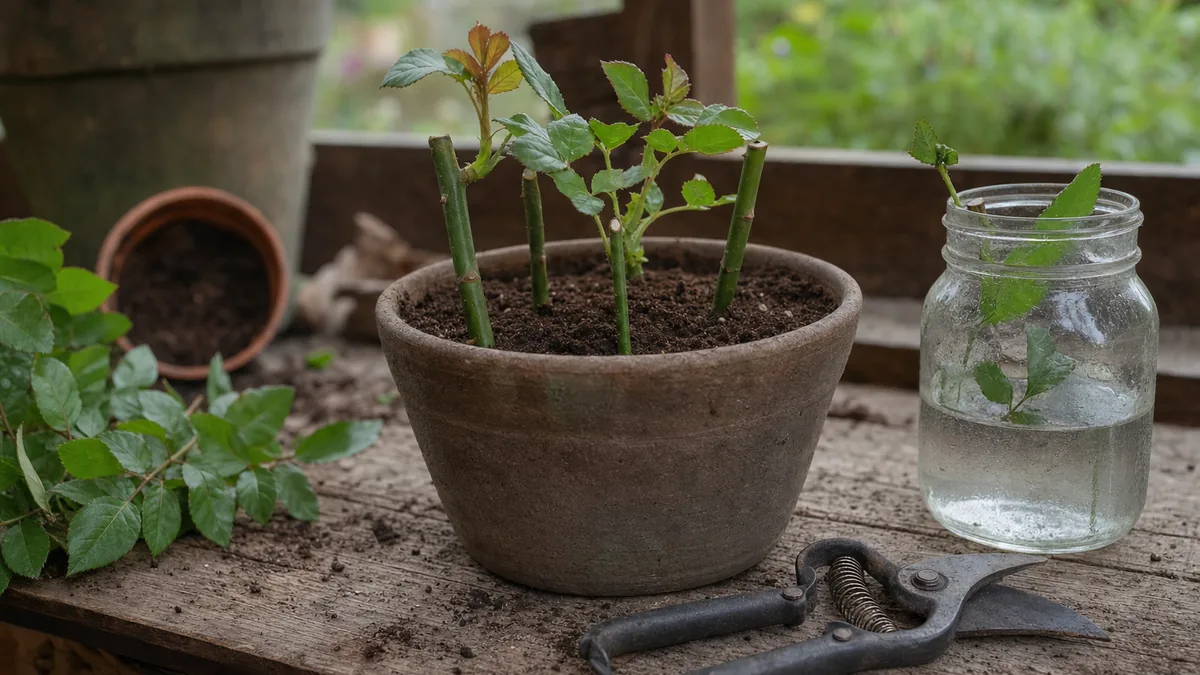
Rose Propagation Quick Facts
Extension sources agree on the method and differ a little on the numbers, so ranges are shown where they disagree.
| Question | Answer | Source |
|---|---|---|
| Best method for home gardeners | Stem cuttings | Iowa State Extension |
| Cutting length | 4 to 9 inches, depending on the source and the rose | UC ANR, NC State, University of Washington |
| Nodes on the cutting | At least 2, ideally 4 to 5 | University of Georgia, UC ANR |
| Rooting hormone | Recommended, not required | NC State, UC ANR |
| Time to root | About 3 to 8 weeks | University of Georgia, Ask Extension, UC ANR |
| Humidity | Clear bag or bottle cover, bright light, no direct sun | NC State, UC ANR |
| Patented roses | Do not propagate; plant patents last 20 years | UC ANR, University of Vermont Extension |
Ways to Propagate a Rose
There are four routes to a new rose. Iowa State Extension lists cuttings, layering, division and seed. Cuttings are the most effective for home gardens. Layering works best on roses with long flexible stems. Division suits only roses that sucker naturally on their own roots, not grafted modern roses, and Iowa State says to do it in March to early April while plants are dormant. Seed gives offspring similar to the parent but not identical. This guide focuses on cuttings and layering, the two methods a beginner can manage with a pair of pruners.
Check for a Plant Patent First
Before you cut anything from a named variety, check whether it is protected. UC Agriculture and Natural Resources (UC ANR) says to check whether the variety is patented, that labels and catalogs usually say so, sometimes with PPAF for a pending patent, and that plant patents last 20 years during which asexual propagation is illegal. University of Vermont Extension says the rights cover vegetative reproduction, including root cuttings, grafting and budding, and that a granted patent is marked PP followed by a number.
The University of Georgia is blunter. It says many plants are patented and it is unlawful to propagate them for any reason, including personal use, and that PPAF cultivars may not be propagated except by licensed growers. NC State Extension gives the same warning. Vermont adds that litigation against individuals is rare, but the safe move is to propagate unpatented varieties. The University of Georgia says to check the U.S. Patent and Trademark Office website if you are unsure.
When to Take Rose Cuttings
The sources split into three windows.
- Softwood, spring and early summer: The University of Georgia lists roses under softwood cuttings, taken in spring and summer. NC State Extension says new growth can be cut as soft cuttings in early summer. Purdue Extension describes softwood as soft new growth that snaps when bent, typically May through July.
- Semi-hardwood, mid to late summer: Iowa State Extension says cuttings from mature new growth in July and August are the easiest method. An Oregon Master Gardener answer on Ask Extension suggests half-ripe wood in late July, even if it has flowered. UC ANR says to use a current-year stem that has finished flowering.
- Hardwood, dormant season: Iowa State says hardwood cuttings come from the previous year’s growth, usually in late winter. NC State Extension says the best success is with cuttings taken November through February. A UC ANR writer takes cuttings at winter pruning time, from mid-January to mid-February.
Mississippi State Extension says roses can be rooted any time of year, with summer and fall perhaps easier. The practical reading is that summer is the easiest window if you can keep cuttings humid, and winter pruning leaves you with free material. If you prune anyway, our guides to pruning a lilac bush and cutting back hydrangeas show how timing works for other shrubs.
How to Take a Cutting From a Rose Bush
Extension sources give a consistent routine. Work in the morning, since NC State Extension says to take cuttings early, before the sun reaches the plant, and keep them from drying out. Mississippi State Extension says to carry cuttings in a cooler with a little ice if you are traveling, and never to leave them in sun or a hot car.
- Pick the right stem. Choose a healthy, vigorous, current-year stem. The Ask Extension answer says to take fresh tip cuttings about the diameter of a pencil, and UC ANR says old, woody stems are hard to root. The University of Washington suggests lateral shoots rather than leaders, and Mississippi State says the easiest part to root is the tip of a stem that recently bloomed.
- Cut to length. NC State and Mississippi State Extension both say 6 to 8 inches. UC ANR says about 8 inches for a hybrid tea and 4 to 5 inches for smaller landscape roses. The University of Washington suggests about 9 inches with 2 leaf joints in the top 3 inches. Keep at least two nodes, as the University of Georgia advises, with the lower node below the soil surface.
- Make a clean angled cut. NC State says to cut at a 45° angle with a sharp knife or pruners. The Ask Extension answer says to cut about 1/4 inch below a node.
- Remove the flower or hip. NC State and Mississippi State say to remove flower heads or hips down to the first set of leaves.
- Strip the lower leaves, keep the upper ones. The Ask Extension answer keeps the top 3 leaves. The University of Georgia says some leaves should stay because they are a source of internal hormones that help start roots, and that large leaves can be halved.
- Wound the base. NC State says to scrape the bottom inch to expose the cambium, and Mississippi State says to scrape the bark rather than cut into the wood. The University of Georgia lists roses as wounded softwood cuttings.
- Dip in rooting hormone. See the next section.
- Stick it and cover it. Poke a hole first, as the University of Washington suggests. UC ANR buries the bottom two nodes in a hole 3 to 4 inches deep, firms the soil and does not water again right away so the hormone is not washed off.
A UC ANR writer recommends at least three or four cuttings per desired variety, since not all will root, and Mississippi State notes some species and cultivars root more easily than others.
Rooting Medium, Hormone and Humidity
Medium
The University of Georgia says propagation medium should be sterile, fine-textured, weed-free and without fertilizer, with a pH of 5.0 to 6.5, and lists peat and perlite for roses. Purdue Extension says a 50/50 mix of vermiculite and perlite or any well-drained soilless potting mix works, and that if cuttings rot the mix is too wet. UC ANR uses a clean pot of moisture-retaining seed-starting compost with plenty of vermiculite or perlite. Mississippi State says to use loose, well-drained media and avoid soggy conditions. The University of Georgia and Purdue both avoid garden soil.
Containers matter less than drainage. Wet, airless mix is the usual way woody cuttings die, and the soggy conditions behind root rot are the usual enemy of a cutting that has not yet rooted.
Rooting hormone
NC State Extension says rooting hormone increases your chances of success and is sold at most garden or hardware stores. UC ANR says it is optional but produces better results. Tip the powder into a separate container, dip the moistened stem, tap off the excess and discard leftovers, as the University of Georgia and Purdue both advise. The University of Georgia gives 500 to 1,250 ppm of auxin for most softwood cuttings and 1,000 to 3,000 ppm for semi-hardwood. Follow the label on whatever you buy.
Humidity and light
The goal is to keep leaves from losing water, not to soak the cutting. The University of Georgia says to mist as needed until roots form, or to cover the pot with a clear zip-top bag or cloche. UC ANR covers the pot with a 2-liter soda bottle with the bottom cut out and the cap removed, or a closed plastic bag, in bright light but not direct sun. Purdue says to prop the bag away from the leaves with straws or sticks, check the mix every few days and discard any water that collects in the bag. Purdue also says to keep the rooting mix between 65°F and 75°F.
NC State Extension warns that during rooting cuttings must not dry out, which it says will spell sudden death. It suggests a light daily mist and keeping the soil moist. If you see a white powdery coating on leaves, our guide to powdery mildew explains what to do.
How Long Does It Take Rose Cuttings to Root?
Sources give a range of about 3 to 8 weeks for summer cuttings. The University of Georgia lists 3 to 4 weeks for roses under mist. The Oregon answer on Ask Extension says to wait about 6 weeks, depending on temperatures. UC ANR says roots may form in about 6 weeks but more often take about 8 weeks. Dormant-season cuttings follow a different clock. A UC ANR trial of November cuttings found root calluses after 25 days, with top growth not expected until the usual spring time. Purdue says deciduous hardwood cuttings in general may take two to four months.
To check progress, Purdue suggests looking for roots after two or three weeks for softwood cuttings and, if there are none, bagging them again and checking in one to two weeks. Purdue also says to check hardwood cuttings every two to three weeks.
Can You Propagate a Grafted or Climbing Rose?
Yes, with caveats. UC ANR says most roses sold today are grafted, often by budding, onto a hardier, more disease-resistant rootstock, and that cuttings can still be propagated. The most common local rootstock there, Dr. Huey, is vigorous but suckers heavily and can overtake the grafted rose. UC ANR adds that miniature roses usually root successfully, which makes them a good starting point.
University of Illinois Extension describes the trade-offs. Own-root roses come from softwood cuttings, start slowly and may be smaller at first, but soon develop into very durable plants and tend to live longer. Budded roses often send up suckers that produce completely different leaves and flowers. Because own-root roses keep their cultivar’s traits in every basal cane, Illinois says that matters most in harsh climates where winter can kill roses to the ground. The University of Washington agrees that rose cuttings may take longer to flower than budded plants but may live longer and will not sucker.
For climbing roses, the same method applies. The University of Washington says ramblers, Rosa rugosa, some climbers and large-flowered roses are easier to propagate from cuttings. Take the cutting from the current year’s flexible shoot, not from the thick old wood, which UC ANR says is hard to root.
Young plants need winter planning. Illinois says all but the old, very hardy varieties need some winter protection in Zone 5 and colder, and suggests mounding soil over plants in Zone 6. Check your zone, then see our explainer on USDA hardiness zones and the growing zones pages.
Rose Cuttings in Water, Bouquets and Potatoes
Rooting a rose in a glass of water is popular, but extension advice favors a growing medium. The Ask Extension answer says water is less successful than a potting medium and recommends a seed-starting mix or plain potting soil. The same answer notes that crushing the end of the stem is often suggested for bouquet roses, but propagating cuttings uses a different technique, We found no extension source that backs bouquet roses as a reliable starting point, so use stems from a garden rose instead.
The potato trick is also unproven. A UC ANR writer says sticking cuttings in a potato is touted on the internet but that the author has yet to see any positive results, and does not recommend it. Stick to a loose, sterile mix and a humidity cover.
Layering a Rose
Layering is slower but needs almost no equipment, because the new plant stays attached to its parent while it roots. Iowa State Extension says it works best on roses with long flexible stems. Mississippi State Extension describes the steps:
- Bend a branch to the ground and scrape or cut the part that will be underground, optionally dusting it with rooting hormone.
- Bury the branch 1 to 3 inches deep and secure it with a weight or stake.
- Leave it all summer. Mississippi State also describes air layering, which wounds the branch and wraps it in moist sphagnum peat moss and plastic.
- Leave the new plant attached to the parent until the next spring, then sever and move it.
Layering suits a rose you cannot risk losing, since the parent keeps feeding the new shoot until it has its own roots.
Hardening Off and Planting Out
Once a cutting has rooted, wean it from the humid cover. Purdue Extension says to lower humidity gradually by opening the bag a little more each day, then pot the plant in good-quality potting mix once it grows well without the bag. The University of Georgia describes hardening off as moving plants to a shady outdoor spot and gradually increasing sunlight over several days, starting 1 to 2 weeks before planting in the garden, and warns that extreme changes can slow growth to the point of plant death.
Then move each rooted cutting into its own pot. The Ask Extension answer moves each into its own pot once firmly rooted and fertilizes as needed until garden planting, and a UC ANR writer moves cuttings into 5 or 6 inch pots once growth begins in spring. Our guide to plant pot sizes explains what the numbers mean.
The planting date is where sources differ. NC State Extension says to grow cuttings out for the entire season before planting in beds the following fall. The University of Washington says a cutting taken in late summer should be ready to plant in the fall, with leaves or sacking over it in winter if frost protection is needed. In the Owens Valley UC ANR does not plant starts out until the following spring, and says well-grown plants may overwinter under cover in a cold frame.
If winters are cold, the cold-frame route UC ANR describes keeps potted cuttings protected until spring. Use the frost date pages and the planting calendar to find your window. Space the new bushes using the mature size on the label, and the plant spacing pages show typical gaps.
Why Rose Cuttings Fail
- They dry out. NC State Extension says drying during rooting means sudden death. Keep the cover on and the mix moist.
- The mix is too wet. Purdue says a rotting cutting means the mix is too wet, and to add perlite or vermiculite.
- The stem is too old. UC ANR says old, woody stems are hard to root. Choose current-year wood.
- Too much heat or sun under the cover. UC ANR and NC State call for bright light without direct sun, and Mississippi State warns to watch temperatures in a bag or bottle.
- The variety is slow to root. Mississippi State says some species and cultivars root more easily than others, so start several cuttings, as UC ANR advises.
Free book · 25 pages, PDF
How to Propagate Roses FAQ
How do you propagate roses from cuttings?
Take a healthy current-year stem about the diameter of a pencil, trim it to 6 to 8 inches, strip the lower leaves and remove any flower or hip. NC State Extension says to scrape the bottom inch, dip it in rooting hormone, set it in moist potting mix and cover the pot with a bag, in bright light without direct sun.
When is the best time to take rose cuttings?
It depends on the cutting type. Iowa State Extension says July and August semi-hardwood cuttings are the easiest, and the University of Georgia lists roses as softwood cuttings in spring and summer. NC State Extension says the best success is with cuttings taken November through February.
How long does it take rose cuttings to root?
About 3 to 8 weeks for summer cuttings. The University of Georgia lists 3 to 4 weeks under mist, an Oregon Master Gardener answer on Ask Extension says about 6 weeks, and UC ANR says about 6 weeks but more often about 8 weeks.
Can you root a rose cutting in water?
You can try, but extension advice favors a medium. The Ask Extension answer says water is less successful than a seed-starting mix or plain potting soil, and the University of Georgia uses a sterile, fertilizer-free medium for roses.
Can you propagate a patented rose?
No. UC ANR says plant patents last 20 years and that asexual propagation during that period is illegal. The University of Georgia says it is unlawful for any reason, including personal use, and University of Vermont Extension says the rights cover root cuttings, grafting and budding.
Can you grow a rose from a cutting if it is grafted?
Yes. UC ANR says cuttings can still be propagated from grafted roses, and miniatures usually root. The University of Washington says roses from cuttings may take longer to flower than budded plants, but may live longer and will not sucker.
Does putting a rose cutting in a potato work?
There is no extension evidence that it does. A UC ANR writer says the potato method is touted on the internet but that they have yet to see any positive results from it, and does not recommend it.
Sources & further reading
Timing, method and rooting figures come from NC State Extension’s How Do I Propagate Roses From Clippings, University of Georgia Extension’s Starting Plants From Cuttings for the Home Gardener, Iowa State University Extension’s How to Propagate Roses, UC ANR’s Growing Roses from Cuttings, UC ANR’s Propagating Roses by Cuttings, the University of Washington Botanic Gardens’ Plant Answers Line on propagating roses from cuttings, an Oregon Master Gardener answer on Ask Extension and Purdue Extension’s New Plants From Cuttings. Layering and handling details come from Mississippi State University Extension and the American Rose Society’s rose propagation slides. Own-root and grafted roses come from University of Illinois Extension’s Selecting Rose Plants. Plant patent details come from University of Vermont Extension’s Plants and Intellectual Property. For how we source the facts on this site, see our methodology page.
Free book · 25 pages, PDF
The Indoor Plants Repotting Cheat Sheet
Sent