How to grow a peach tree from a pit: clean the seed, chill it in a cold, moist medium for roughly 90 to 130 days, then plant the sprouted seed 1.5 to 2 inches deep, according to Georgia and Iowa State extension. It works, but the tree will not match the fruit you ate and may take 3 to 4 years to bear. Browse our trees and shrubs guides for more.
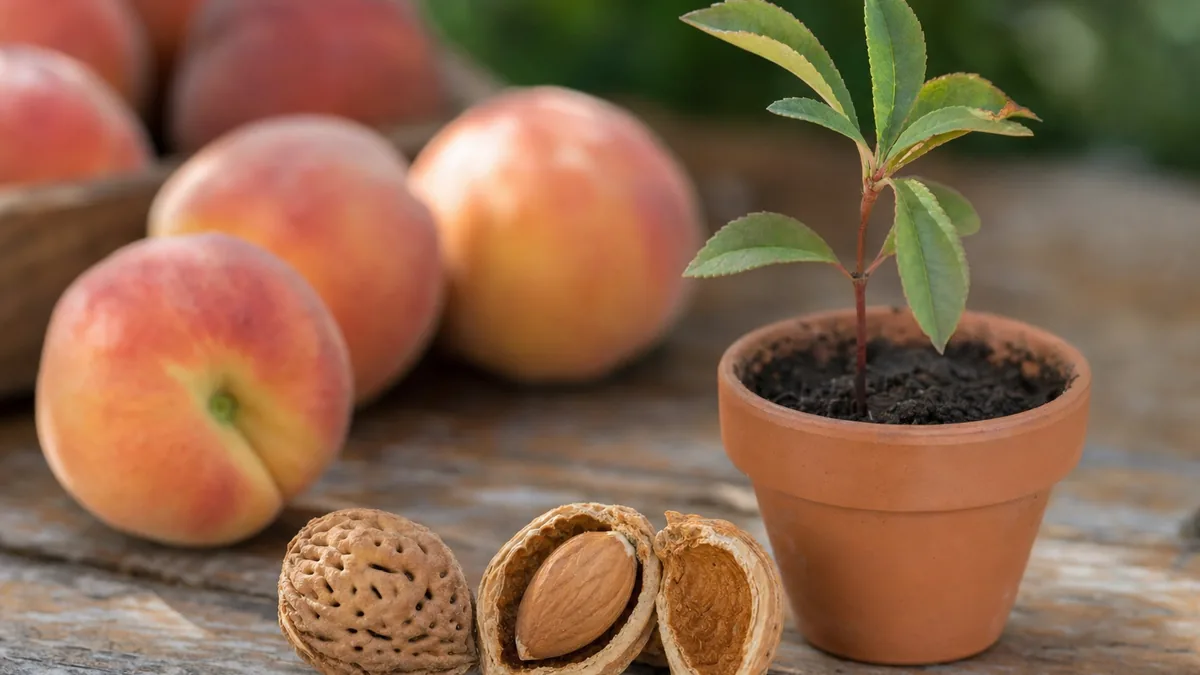
Extension sources treat this as a worthwhile project and a gamble. Iowa State says peaches do not reproduce true from seed, and Clemson’s Ask Extension answer says starting peach trees from seed is not recommended if you want the same variety. If you want to see what an apple tree needs by comparison, our guide to how long an apple tree takes to grow covers the same seed against grafted trade-off.
Growing a Peach Pit at a Glance
| Step | What the sources say | Source |
|---|---|---|
| Cold period (stratification) | About 90 to 130 days at roughly 32 to 50°F | Georgia, Penn State, Oklahoma State, Iowa State |
| Planting depth | 1.5 to 2 inches | University of Georgia, Iowa State |
| Sprouting in the refrigerator | Often 6 to 8 weeks per one university blog, shorter than the figures above | UC ANR |
| Time to first fruit | 3 to 4 years | UC ANR, Virginia Tech |
| Spacing for a full-size tree | 15 to 20 feet or more, depending on the source | Iowa State, NC State, Virginia Tech |
| Same fruit as the parent? | Not reliably | Iowa State, Penn State, UC ANR |
Will a Peach Pit Grow the Same Peach?
Probably not. Penn State Extension says seedlings from fruit trees are hybrids, and that their fruit and foliage “may not look or taste the same as the parent.” The University of Georgia says deciduous fruit plants do not come true to seed, which is why peaches are normally budded or grafted onto seedling rootstock. Iowa State adds that trees grown from pits often bear smaller, lower-quality fruit and may not be reliably winter hardy. A University of California blog on the same project puts it more cheerfully: will the peaches taste like the one you ate? “Maybe yes, maybe no.”
That does not make it a waste of time. Peach pits are exactly what nurseries use to make rootstock, and a seedling can still become a handsome tree that blooms in spring. Expect a new, unnamed variety. If you need a known variety on a known schedule, buy a grafted tree. Our guide to planting mangoes from seeds walks through the same seed against grafted decision for a tropical fruit.
One more option sits in between. Penn State says peach seedlings are budded to a chosen variety in late July or early August, and Georgia says well-grown seedlings are big enough to bud by late May or June after seeding. Those publications are written for nursery growers, so treat budding a home seedling as a project for later, once you have a healthy tree to work with.
How to Prepare Peach Pits for Planting
Start with a pit from a ripe peach. Scrub off the flesh and rinse it, because leftover fruit invites mold during the long cold period ahead. Then decide how to handle the hard shell.
The sources differ here. The UC ANR blog removes the seed from the pit and says to do it without damaging the seed’s brown coating, then chills the seed in a damp paper towel inside a sealed bag. Georgia and Penn State do not describe cracking the pit at all. They treat the whole pit as the seed and chill it in a damp mix. Oklahoma State notes that peach seed can be partly dormant at ripening, with as much as 50 percent of the seed dormant, which is a good reason to start several pits instead of one.
A practical read of this: if you leave the shell on, plan for the longer end of the chilling range. If you open it, work slowly and do not nick the kernel. We found no extension page that gives a tool or technique for cracking peach pits, so we cannot offer a sourced method.
Iowa State’s tree seed guide mentions filing or sanding hard seed coats, but it lists that for other species, and it gives only a chilling time for peach. A quick soak is better supported. The University of Georgia says to soak peach seed in water for 24 hours before mixing it into the chilling medium.
How to Germinate a Peach Pit: The Cold Period
This is the step most online guides rush past. Peach seed needs weeks of cold, moist conditions before it will sprout, a process called cold stratification. Sources agree on the idea and differ on the number of days.
- University of Georgia: 90 to 130 days at 35 to 50°F, in a mix of one-third peat moss and two-thirds sand by volume, kept “moist, not wet.”
- Penn State Extension: a table lists peach at 120 to 130 days, with 45°F as the best temperature and 33 to 50°F as the effective range.
- Oklahoma State University: approximately 100 days at 32 to 45°F.
- Iowa State University Extension: 98 to 105 days at 33 to 41°F.
Read together, plan on about 90 to 130 days in a refrigerator-cold range of roughly 33 to 45°F. A kitchen refrigerator sits in that band. Clemson’s Ask Extension answer, which quotes Texas A&M, describes a simple version: seeds in moist paper towels, sealed in a zip-lock bag, refrigerated from January to April. That window is about 90 days, which fits inside the Georgia range.
Check the bag every couple of weeks. The medium should stay damp, not wet, and any pit that smells sour or grows mold should go in the compost. Georgia says sprouted seed should be planted promptly, and that sprouts are brittle, so handle them gently. If you cannot plant right away, Georgia says to hold the seed at 32 to 33°F until you can.
Can you grow a peach pit in water?
Many websites suspend a pit over a glass of water. None of the extension and university sources we reviewed describe that method for peach. They chill the seed in a damp medium, such as peat and sand or paper towels, or leave it outdoors through winter. Water alone does not supply the cold period, so we do not recommend it.
Let winter do the work
If your winters are cold, you can skip the refrigerator. Penn State says to sow seed in a fall plot in a furrow no deeper than one or two times the longest dimension of the seed, and to cover it with hardware cloth to keep chipmunks and squirrels out. Oklahoma State says commercial nurseries often plant peach pits in the fall, and they usually germinate well the following spring because fall planting provides the right conditioning. Clemson’s Ask Extension answer offers a pot version, planting seeds in loose potting soil in early winter and keeping the pot watered through dry spells. If you would rather plant a bare-root peach tree than start from a pit, can you plant trees in the winter covers the dormant planting window.
How to Plant a Peach Pit, Step by Step
Once the cold period is done and the seed has cracked or sprouted, follow this order.
- Pick the timing. Penn State’s refrigerator method plants the seed in early April in a prepared bed. Georgia plants sprouted seed in spring or in mid-October for fall seeding. Our guide to soil temperature for planting helps you judge when the ground is workable.
- Handle the sprout gently. Georgia warns that sprouts are brittle, so lift the seed with its medium rather than pulling on the root.
- Set the depth. Georgia says peach should be seeded about 1.5 inches deep, and Iowa State says seeds of plums and peaches should go 2 inches deep. Use 1.5 to 2 inches.
- Keep the soil moist, not wet. Penn State says to keep the soil moist but not wet, and not to add fertilizer at this stage.
- Protect the spot. Cover an outdoor planting with hardware cloth if squirrels or chipmunks live nearby, as Penn State advises.
- Be patient. The UC ANR blog says seeds usually sprout in 6 to 8 weeks in the refrigerator, which is shorter than the 90 to 130 days other sources give for the full cold period, so check the bag early. It then moves sprouted seeds to tall pots before planting outdoors in spring.
Growing a Peach Seedling in a Pot
A pot is the safest first home for a young seedling. The UC ANR blog moves sprouted seeds to tall pots, which suits the deep taproot of a young tree. Choose a container that is deeper than it is wide, with drainage holes. Our plant pot sizes chart shows how nursery pot sizes translate to volume, which helps when you pot the seedling up.
We found no extension source that gives a long-term recipe for keeping a peach seedling indoors, and peaches are temperate trees that expect winter cold. Clemson says peaches need full or nearly full sun, and the Utah State guide says to choose a site with at least 8 hours of full sun. A sunny outdoor spot is the better bet through the growing season, with the pot sheltered when hard freezes arrive. Penn State advises against fertilizing a newly planted seedbed, so hold off on feeding until the seedling has a few leaves and is growing.
A peach grown in a pot will not stay small forever. Virginia Tech Extension says dwarf peach trees are not recommended because they may not survive more than five years due to disease and incompatibility problems, and it recommends planting a standard tree. Plan to move a healthy seedling into the ground once it outgrows its container.
How Long Does It Take to Grow a Peach Tree?
The timeline depends on the source and on how the tree started.
- UC ANR blog (pit-grown): “In just three to four short years your miracle tree should be bearing fruit.”
- Virginia Tech Extension (nursery tree): peach trees bear in 3 to 4 years, with a life expectancy of 15 to 20 years.
- University of Illinois Extension (nursery tree): peaches should start bearing during their third year in the orchard, and be in heavy production after 5 years.
- UC IPM: training takes the first 2 to 3 years after planting, and it advises against letting fruit develop in the first two or three years.
The sources roughly agree on 3 to 4 years, but a seedling must also spend time as a sprout and a young tree before it is “planted in the orchard,” so count from sprouting, not from the day you ate the peach. Expect the first crop to be small. Weather matters too. Iowa State says that in southern Iowa a good peach crop in 2 or 3 out of every five years is realistic, and in northern Iowa about one harvest every 5 years. Iowa State also says trees are short-lived there, often dying within 10 to 12 years.
For comparison with a pomegranate, which can fruit sooner from cuttings, see how to plant pomegranate. And if you inherit an older peach tree and wonder how old it is, our guide to telling the age of a tree explains the methods.
Hardiness Zones and Chill Hours
The University of Minnesota’s tree guide lists peach for USDA zones 5 to 9. Iowa State warns that even cultivars hardy to zone 5 may see damage or poor yields depending on the weather. Utah State says most peach cultivars are hardy to -10°F, with a few hardy to -20°F. A seedling from a pit is an unknown, so Iowa State’s note that pit-grown trees may not be reliably winter hardy matters most in the colder zones. Our explainer on USDA hardiness zones covers what a zone number does and does not tell you, and our growing zones pages list zones by location.
Zones are only half of the answer, because peaches also need winter chill. Utah State defines chill hours as the hours between 32 and 45°F needed to break dormancy, with its table running from 500 hours for Suncrest to 1,050 for Contender. NC State says peach trees may need as little as 200 hours to as much as 1,000 or more. The University of Georgia groups cultivars as low (under 600 hours), moderate (600 to 750), high (750 to 900) and very high (over 900). A seedling’s requirement depends on its unknown parents, so a pit from a store peach is a wildcard in a warm climate. Our frost temperature guide explains the bloom time risk covered below.
Spring frost at bloom
Peaches bloom early, so cold snaps hit the flowers. Iowa State says that at full bloom 10 percent damage occurs at 26°F and 90 percent at 21°F, and that temperatures below 25°F after petal fall can severely reduce the crop. Utah State says peaches are particularly prone to crop loss due to late spring freezes, and that a spot on the south or west side of a building can bloom earlier and raise the risk. Check your frost dates before you commit a spot to a tree.
Where to Plant and How Far Apart
Choose full sun and well-drained soil. Clemson says peaches are extremely sensitive to poorly drained soils and want a soil pH near 6.5, and that lime is usually needed in South Carolina soils, based on a soil test. Utah State asks for a pH below 8.0 and well-drained soil. Clemson says to avoid poor air circulation, and the University of Maryland asks for excellent air circulation and drainage. Utah State adds that bench areas often have a lower freeze risk than valley floors.
Spacing guidance varies by rootstock and by source, so here is the range.
- Iowa State: about 15 feet for standard trees and about 10 feet for dwarfs.
- Utah State: 12 to 16 feet, depending on rootstock and training system.
- NC State and University of Georgia: a minimum of 18 to 20 feet.
- Virginia Tech: at least 20 feet.
- University of Maryland: 20 feet by 25 feet for stone fruit, depending on cultivar and rootstock.
A tree grown from a pit is on its own roots at standard size, so use the wider end of that range. The University of Minnesota lists mature peach height and width at 12 to 15 feet. Virginia Tech describes peaches as self-fruitful, so one tree can set fruit. See our plant spacing pages for crop-by-crop figures.
Peach Tree Problems to Expect
Peaches are among the more demanding backyard fruit trees, and a pit-grown tree has no built-in disease resistance. These are the issues extension sources raise most often.
- Brown rot: Clemson calls it the most damaging peach disease. The University of Georgia says that without fungicides it is very hard to manage in Georgia, and that in most years 100 percent of ripening fruit can be lost on unsprayed trees. Clemson says home growers can use protective fruit bags.
- Peach leaf curl: Iowa State says the fungus overwinters on buds or twigs and infects leaves once a year in spring, and that timing is key. A fungicide is most effective when the tree is dormant, either in fall after leaves drop or in spring before buds swell, and it says one well-timed spray can control it.
- Insects: Clemson and Georgia name plum curculio as a key fruit pest, and Georgia also lists peachtree borers, Oriental fruit moth, scale and mites. Utah State says to protect the bottom 12 to 18 inches of the trunk from greater peachtree borer.
- Short tree life: NC State warns of peach tree short life, which can kill a tree after only four or five years of growth, and advises planting only on Lovell or Halford rootstocks in North Carolina. A pit-grown tree has an unknown root system, so this is a risk to accept.
- Pruning: Clemson says peaches are usually trained to an open-center, vase shape, and that annual pruning and fruit thinning are needed for quality fruit. Iowa State says to thin fruit to about 6 to 8 inches apart on the branch.
Free book · 23 pages, PDF
How to Grow a Peach Tree From a Pit FAQ
Can you grow a peach tree from a store-bought peach pit?
Yes, a pit can sprout and grow, but the tree will not reliably match the fruit. Iowa State says peaches do not reproduce true from seed, and Penn State says seedling fruit may not look or taste like the parent. A store peach also tells you nothing about the chill hours or winter hardiness of the tree.
How do you germinate a peach pit?
Chill it in a damp medium. The University of Georgia says 90 to 130 days at 35 to 50°F in a mix of peat moss and sand, Penn State lists 120 to 130 days, and Oklahoma State says approximately 100 days at 32 to 45°F. Keep the medium moist but not wet.
How deep do you plant a peach pit?
About 1.5 to 2 inches. The University of Georgia says peach should be seeded about 1.5 inches deep, and Iowa State says seeds of plums and peaches should be planted 2 inches deep. Penn State says to keep the soil moist but not wet and to skip fertilizer at first.
How long does it take a peach tree to grow from a pit?
A UC ANR blog says a pit-grown tree should bear in three to four years, and Virginia Tech gives 3 to 4 years for a peach tree in general. The University of Illinois says peaches should start bearing in their third year in the orchard and be in heavy production after 5 years.
Can you grow a peach pit in water?
We did not find an extension source that describes it. The sources chill the seed in a damp medium such as sand and peat or moist paper towels. Clemson's Ask Extension answer, quoting Texas A&M, uses moist paper towels in a sealed bag in the refrigerator from January to April.
Can you grow a peach pit indoors?
Only for the early stage. The UC ANR blog moves sprouted seeds into tall pots, but peach is a temperate tree. Utah State says to choose a site with at least 8 hours of full sun, and Virginia Tech does not recommend dwarf peach trees, so plan to plant a seedling outdoors.
What zones can you grow a peach tree in?
The University of Minnesota lists peach for USDA zones 5 to 9. Iowa State cautions that even cultivars hardy to zone 5 can suffer damage or low yields in some years, and that pit-grown trees may not be reliably winter hardy, so colder sites carry more risk.
Sources & further reading
Seed chilling, depth and propagation details come from University of Georgia Extension’s Propagating Deciduous Fruit Plants Common to Georgia, Penn State Extension’s Growing Fruit Plants from Seed, Oklahoma State University Extension’s Propagation of Fruit and Nuts by Seed, Iowa State University Extension’s Germination of Tree Seed, the UC ANR blog post Dreams of a Perfect Peach and Ask Extension’s Sprouting peach seeds. Growing, hardiness, spacing and disease details come from Iowa State’s Growing Peaches in Iowa, Iowa State’s Peach Leaf Curl, Utah State University Extension’s How to Grow Peaches in Your Garden, Clemson HGIC’s Peaches & Nectarines, University of Georgia’s Home Garden Peaches, NC State Extension Gardener Handbook’s Tree Fruit and Nuts, Virginia Tech’s Tree Fruit in the Home Garden, University of Illinois Extension’s Peaches, University of Maryland Extension’s Growing Stone Fruits in a Home Garden, UC IPM’s Cultural Tips for Growing Peach and Nectarine and University of Minnesota’s Peach profile. For how we source the facts on this site, see our methodology page.
Free book · 23 pages, PDF
The Tree Care Cheat Sheet
Sent