Part of our Plant Problem Diagnosis series
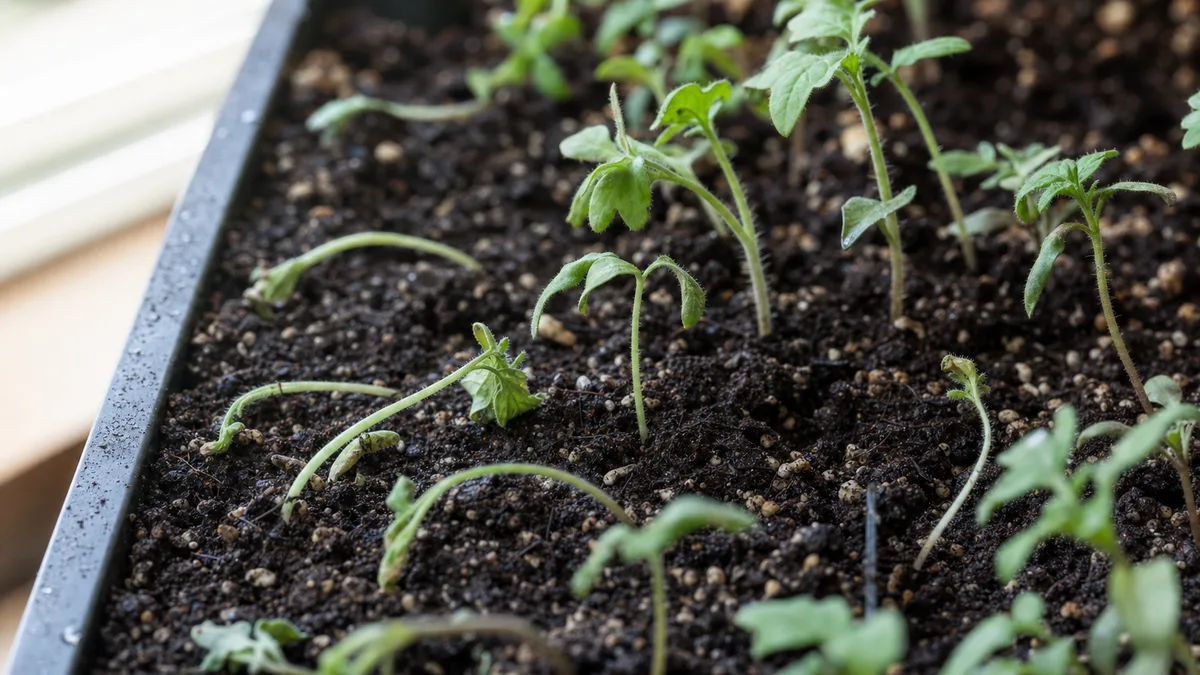
Seedlings that sprout fine and then fold over at the soil line, or seeds that never come up at all, are usually victims of damping off: a group of soil-dwelling organisms that rot seeds and young stems when the mix is cool, wet and not clean. Infected seedlings rarely survive, so the real work is prevention. Sterile mix, clean trays, light watering, good light and warmth, and a little airflow do almost all of it.
Quick Answer: Is This Damping Off?
Two questions sort it out before you start changing your routine.
What Damping Off Is
Damping off is a disease of seeds and very young seedlings. The University of Minnesota Extension says infected seedlings rarely survive to become vigorous plants, and that whole trays are often lost. Plants with mature leaves and well-developed roots resist it far better, which makes the window between sowing and the first set of true leaves the dangerous one. Texas A&M AgriLife Extension puts the reason plainly: the organisms attack young, soft tissue when it is growing slowly.
The word covers several different organisms and two timing patterns. Understanding both explains why the same handful of habits protects against it.
Pre-Emergence vs. Post-Emergence Damping Off
Pre-emergence damping off happens underground. The University of California IPM program describes seeds that rot before germinating, turning soft, mushy and dark brown. Texas A&M says this can look like poor germination, and a closer look may turn up tiny rotted seedlings on the soil surface. The University of Kentucky notes that dead seed can leave circular bare patches in a flat. If cells never come up, dig up a few seeds before blaming the packet.
Post-emergence damping off is the version most people recognize. Texas A&M says symptoms show soon after germination, starting at the base of the seedling: the stem looks water-soaked, then becomes a constricted, darkened area at the soil line. The top often stays green for a while, but the seedling falls over, frequently with rotted roots. UMass Extension adds that in a flat the problem often spreads in a roughly circular patch, and Penn State says white, cottony growth or tan-brown strands may show on infected seedlings in moist conditions.
Some seedlings survive. UMass Extension and the University of Kentucky describe “wirestem”: a dark, shriveled, wiry constriction at the stem base. These plants are stunted, so treat a wirestemmed seedling as a weak start rather than a rescue.
The Pathogens Behind Damping Off
No single organism is to blame. Penn State Extension names Rhizoctonia, Fusarium, Pythium and Phytophthora, and says they may act alone or together. The University of Kentucky and Penn State separate them into two groups: Rhizoctonia and Fusarium are true fungi, while Pythium and Phytophthora are water molds, fungus-like organisms that need free water. The University of Minnesota Extension agrees on Pythium. Not every extension page draws that line, and some just say “fungi or fungus-like organisms.”
The practical points are shared. The University of California IPM program says these organisms are present in nearly all soils and survive on dead plant matter. Penn State lists the routes in: infected seed and transplants, contaminated soil, irrigation water, tools, pots and hands. UMass Extension adds that purchased soilless mix is unlikely to carry them, but they can arrive on soiled tools, hands, hose ends or splashing water. That is why sanitation sits at the center of every prevention list.
Conditions That Favor Damping Off
Anything that keeps the mix wet or slows the seedling down helps the disease.
- Cool, wet mix. The University of Minnesota Extension says the pathogens thrive in cool, wet conditions, and Penn State lists soil below 68°F before germination as a risk.
- Overwatering and poor drainage. Penn State says the disease is most severe with excessive soil moisture and high humidity.
- Crowding and poor airflow. The University of California IPM program lists dense seedlings with poor air movement.
- Contaminated mix, trays and tools. Garden soil, old mix, dirty pots and unwashed tools carry the organisms in.
- Deep sowing. The University of Arizona says deep planting slows emergence and encourages disease.
- Low light and slow growth. The University of Minnesota Extension lists low light, overwatering, excess salts and cool soil, since each slows growth.
The cool-and-wet story is not universal. The University of Arizona says damping off occurs in both cool and warm soils: Rhizoctonia is most often a problem in cool, moist soil, while the common desert Pythium is most active in wet, warm soil. Penn State also lists soil above 77°F after emergence as a risk. The constant is wet soil, not one temperature.
Damping Off vs. Other Seedling Problems
Look at the stem at the soil line first.
- Cutworms. The University of Maryland Extension says older cutworm larvae cut young plants off at or below the soil surface. The stem is severed, not soft and pinched.
- Leggy seedlings. The University of Minnesota Extension says legginess comes from low light, as plants stretch toward a light source, and that stretched seedlings collapse more easily and are more prone to damping off.
- Underwatering, heat or fertilizer. UMass Extension says non-fungal seedling death from drought, heat, hot water from sun-baked hoses, over-fertilization or chemical injury usually shows leaf symptoms first, and the stem at the soil line is usually firm and healthy with the roots unaffected. Over-fertilization typically leaves roots desiccated and shriveled. Our guide to why a plant is wilting covers thirst versus overwatering.
- Root rot in older seedlings. A seedling or transplant that wilts while the mix stays wet, with brown, mushy roots, is more likely root rot than damping off at the stem.
- High salts. The University of Minnesota Extension notes some potting mixes carry salt levels high enough to inhibit germination, so a whole tray of one mix failing may be salts, not rot.
- Old seed. The University of California IPM program recommends fresh, high-quality seed for rapid emergence.
Extension plant clinics can confirm a cause; Penn State, for example, says Pennsylvania residents can send samples to its Plant Disease Clinic. For leaf symptoms, see our yellow-leaves guide.
Prevention in 8 Steps
Together these steps cover what the disease needs: organisms in the mix and conditions that favor them.
Start with sterile seed-starting mix, not garden soil. The University of Minnesota Extension says to use new potting mix and not to reuse mix or use garden soil or compost. Penn State says most commercial soilless mixes are free of damping-off fungi. If you pasteurize your own, numbers differ: Penn State says about 180°F for 30 minutes, while the UC Master Gardeners of Placer County say 140°F for at least 30 minutes. A bagged mix avoids the guesswork.
Clean trays, pots and tools. Wash off old mix, then disinfect. Sources agree on roughly a 10 percent bleach solution but not on contact time. The University of Wisconsin-Madison Extension says 1 part disinfecting bleach to 9 parts water for 30 minutes, then a thorough rinse. Minnesota and the University of California IPM program also say 10 percent for 30 minutes, and a Utah State University Extension fact sheet says one hour. The University of Maryland Extension says 1 part bleach to 10 parts water for 1 to 2 minutes. By our arithmetic, 1 part in 9 parts of water is 1 in 10 total (10 percent), and 1 part in 10 is about 9 percent (1 divided by 11), so the recipes are close and the time is what differs.
Use containers with drainage holes. Texas A&M says not to overwater and to make sure the container drains. Keep flats off dirt floors and wet ground, as UMass Extension and Texas A&M advise.
Water lightly and keep the surface drier. The University of Wisconsin-Madison Extension says to keep seedlings a bit on the dry side, since the pathogens are more active in wet soil, and the University of Maryland Extension says to let the top of the mix dry slightly before watering. Method varies. The University of Minnesota Extension says bottom watering keeps foliage dry, which helps prevent disease, and the UC Master Gardeners suggest pouring out standing water after 15 minutes. South Dakota State University Extension recommends gentle misting or top watering instead. The shared rule is never to leave seedlings standing in water. Minnesota also notes that tiny seedlings take up little water, so daily watering is often more than they need.
Add airflow. South Dakota State University Extension suggests a small fan on low, and the University of Minnesota Extension says a fan for ventilation helps. Extension sources give no fan speed or schedule, so keep it gentle.
Sow at the right depth and density. The University of California IPM program and the University of Missouri Extension both give a rule of about twice the seed’s width. By our arithmetic, a seed 1/8 inch across goes about 1/4 inch deep. Fine seeds that need light, such as lettuce (see growing lettuce from seed), are the exception; Missouri says to leave them uncovered. A Utah State University Extension fact sheet says to sow thinly in trays without individual cells, and Penn State advises against overseeding.
Keep the mix warm enough to germinate quickly. The University of Minnesota Extension says a heating pad can warm soil to 70 to 75°F indoors, and Penn State gives the same range for bottom heat. The University of California IPM program gives 65 to 70°F for most seeds, and the University of Maryland Extension gives 65 to 75°F. Minnesota’s seed-starting guide adds that mix can run as much as 5°F cooler than the room. Check the crop: peppers want more warmth than the general range, as our guides to growing tomatoes from seed and growing peppers from seed show. Minnesota also says 68 to 77°F water is better than cold, and that 50°F water slows growth and raises infection risk.
Give real light and fresh seed. The University of Minnesota Extension says seedlings need 12 to 16 hours of light from a fluorescent or grow light, and that window light alone is not enough; Maryland says 14 to 16 hours. Our comparison of LED vs. fluorescent grow lights covers the choice. Use fresh seed, as the University of California IPM program advises. Minnesota says to hold fertilizer until several true leaves form, then use quarter-strength. Maryland also warns against pre-soaking bean or corn seed, which can make it more vulnerable to soil pathogens, so check our bean seed guide first.
What to Do When Damping Off Hits
Once a stem has collapsed, the seedling is not coming back. The University of Minnesota Extension says infected seedlings rarely survive, and Texas A&M says plants showing symptoms are generally expected to die. What you can do is stop the spread.
- Remove sick seedlings now. Texas A&M says to remove and destroy them immediately. A Utah State University Extension fact sheet says to take them out along with their soil and watch the neighbors closely.
- Think about the whole flat. UMass Extension and UConn Extension say to discard the entire flat, because healthy-looking seedlings may sit in contaminated mix and can develop root rot or stem canker weeks later. In a small home tray, a reasonable compromise is moving untouched seedlings you want to keep into fresh mix and clean containers, accepting that some may still fail.
- Stop overwatering. Let the surface dry slightly and empty any water under the tray.
- Improve air and light. Thin crowded cells, add a gentle fan, and check the light is close enough and on long enough.
- Restart cleanly. Resow in fresh sterile mix and disinfected containers, with fresh seed if the packet is old.
Can You Reuse the Mix and Trays?
Mix: no. The University of Minnesota Extension says not to reuse potting mix or use garden soil or compost for seed starting, and the University of California IPM program notes that immature compost holds water and can support the pathogens. After an outbreak, treat old mix as contaminated.
Trays and pots: yes, after cleaning. Wash off every trace of mix, disinfect with one of the bleach recipes above, rinse and let them dry. The exception is small cells: UConn Extension says not to reuse plug trays that held diseased plants, because organic matter is hard to remove from tiny cells and disinfectant cannot reach it. Outdoors, the University of Kentucky advises rotating beds every 3 years where the disease has occurred and sowing after the soil warms.
Home Remedies and Fungicides: What Extension Says
The proven tools are sanitation, sterile mix, and moisture, temperature and light control. Below, remedies are sorted by what extension actually says. Anything extension does not support is labeled unproven, with no dosage on purpose.
Cinnamon, chamomile tea, hydrogen peroxide
We found no extension damping-off fact sheet that recommends cinnamon or chamomile tea. The University of Minnesota Extension’s prevention page does not mention chamomile, cinnamon or peroxide. One newsletter from the UC Master Gardeners of Placer County lists peroxide, chamomile and cinnamon, crediting chamomile to Minnesota and cinnamon to Illinois, but it reports no test results and we could not trace either claim to a published extension finding. Treat all three as unproven.
Peroxide needs one clarification. The University of Kentucky says some hydrogen dioxide products are labeled for seed treatment, and UMass Extension lists such products among greenhouse options. Those are commercial products with their own labels, not the kitchen bottle, and neither source gives a household recipe.
Vinegar, baking soda and compost tea
None of the extension damping-off sources we read mentions vinegar or baking soda, so both are unproven here. Compost tea is also unsupported, and the sources lean the other way on compost: Minnesota says not to use compost in seed starting, and the University of California IPM program warns that immature compost can feed the pathogens.
Biologicals, treated seed and fungicides
The University of Kentucky says biological products containing Bacillus, Streptomyces or Trichoderma can be applied to media before seeding. UMass Extension is clear about the limit: the biologicals it lists act as preventives and will not cure diseased plants. Seed treatment is the best-supported chemical step: a Utah State University Extension fact sheet and the University of Kentucky say it can reduce damping off, and Texas A&M says many purchased seeds are already treated, suggesting a check for red or blue coloring.
Sprays and drenches are a last resort. Penn State says to use fungicides when warranted, follow the label, and identify the organism first since effectiveness varies. UConn Extension warns that young seedlings are prone to chemical injury. The University of Kentucky says most conventional drench fungicides are restricted to commercial producers, though some general-use products may be used as seedling drenches at home. The extension sources we read give no home-garden rates, so we give none and name no brands. Your county extension office can tell you what is labeled where you live.
Damping Off Quick Reference Table
Match what you see to the likely cause and the next move. Sources for each row are in the sections above.
| What you see | Likely cause | What to do |
|---|---|---|
| Seeds never come up; dug-up seeds are soft, mushy and dark | Pre-emergence rot | Resow in fresh sterile mix; keep mix warm and not wet |
| Seeds never come up; dug-up seeds are firm and intact | Cold mix, old seed or high salts | Check mix temperature; try fresh seed; check mix salts |
| Stem water-soaked, dark and pinched at the soil line, then toppled | Post-emergence damping off | Remove seedlings and surrounding mix; discard the flat; restart clean |
| Stem cleanly cut through at ground level | Cutworms | Look for larvae in the mix near the cut stems |
| Stem firm at the soil line; leaves wilted or scorched first | Drought, heat or fertilizer injury | Check moisture, water temperature and fertilizer; roots will look shriveled, not rotten |
| Tall, pale, floppy seedlings with a firm base | Low light (stretching) | Move the light closer and lengthen the day |
| Dark, wiry, shriveled stem base on a seedling that survived | Wirestem (survived infection) | Expect a weak plant; resow if the stand is thin |
| Cinnamon, chamomile, vinegar, baking soda or compost tea | Unproven by extension | Skip; put effort into clean mix, trays and watering |
Free book · 23 pages, PDF
Damping Off FAQ
Can seedlings recover from damping off?
Seedlings with a collapsed, water-soaked stem cannot be saved. The University of Minnesota Extension says infected seedlings rarely survive, and Texas A&M AgriLife Extension says to remove and destroy them immediately. Seedlings that survive an infection can develop wirestem, a stunted plant with a dark, wiry stem base, according to UMass Extension and the University of Kentucky.
Is damping off caused by overwatering?
Overwatering is the most common trigger, but not the only one. Penn State Extension says the disease is most severe with excessive moisture and high humidity. The organisms are also already in many soils, and contaminated mix, dirty trays, cool soil, low light and deep sowing all raise the risk. Watering alone will not cause it in clean, sterile mix, but wet mix gives the organisms their opening.
Can I reuse seed-starting mix after seedlings died?
No. The University of Minnesota Extension says not to reuse potting mix, and UMass Extension says to discard the whole flat after an outbreak, since healthy-looking seedlings may sit in contaminated mix. Trays and pots can be reused after scrubbing, disinfecting and rinsing, but the University of Connecticut says not to reuse plug trays that held diseased plants.
Does cinnamon or chamomile tea stop damping off?
Extension sources do not support either. We found no university damping-off fact sheet that recommends cinnamon or chamomile tea, and one Master Gardener newsletter that mentions them reports no test results. Treat both as unproven and rely on sterile mix, clean trays, restrained watering, warmth and light, which extension sources do support.
What bleach solution should I use to clean seed trays?
Extension sources agree on roughly a 10 percent solution. The University of Wisconsin-Madison Extension says 1 part disinfecting bleach to 9 parts water for 30 minutes, then rinse well, and the University of Minnesota Extension also says 10 percent for 30 minutes. The University of Maryland Extension gives 1 part bleach to 10 parts water for 1 to 2 minutes, so contact time is where they differ. Scrub off old mix first.
Will damping off spread to older plants in my garden?
Mostly it is a seedling disease. The University of Minnesota Extension says plants with mature leaves and well-developed roots resist it better, and the University of California IPM program says established plants are much less susceptible. The same organisms can still cause root rot or crown rot in older plants under some conditions, and soil that held an outbreak may carry them, so rotate beds as the University of Kentucky advises.
Sources & further reading
The pathogen groups and the water-mold distinction draw on Penn State Extension’s guide to safeguarding seedlings, University of Minnesota Extension’s page on preventing seedling damping off (the 10 percent bleach soak, heating pad range, water temperature, light hours and not reusing mix) and the University of Kentucky’s damping-off fact sheet. Symptoms and the pre- versus post-emergence split come from Texas A&M AgriLife Extension’s Plant Disease Diagnostic Lab, the University of California IPM program and UMass Extension’s fact sheet.
Further detail came from Penn State Extension’s damping off page, University of Wisconsin-Madison Extension’s seed-starting tips, UConn Extension’s IPM page, University of Arizona Cooperative Extension’s AZ1029, a Utah State University Extension damping-off fact sheet, University of Maryland Extension on seedlings that fall over, its guide to starting vegetable seeds indoors, University of Minnesota Extension on troubleshooting seedlings, its tips for healthy seedlings, its guide to starting seeds indoors, University of Missouri Extension’s guide to starting plants indoors and South Dakota State University Extension’s seed-starting basics. The remedies newsletter is from the UC Master Gardeners of Placer County. For more on our sourcing approach, see our methodology page.
Free book · 23 pages, PDF
The Plant Problem Diagnosis Quick Reference
Sent